
 = Partner Site
The Hero and the Crown Reading Level: A Complete Guide
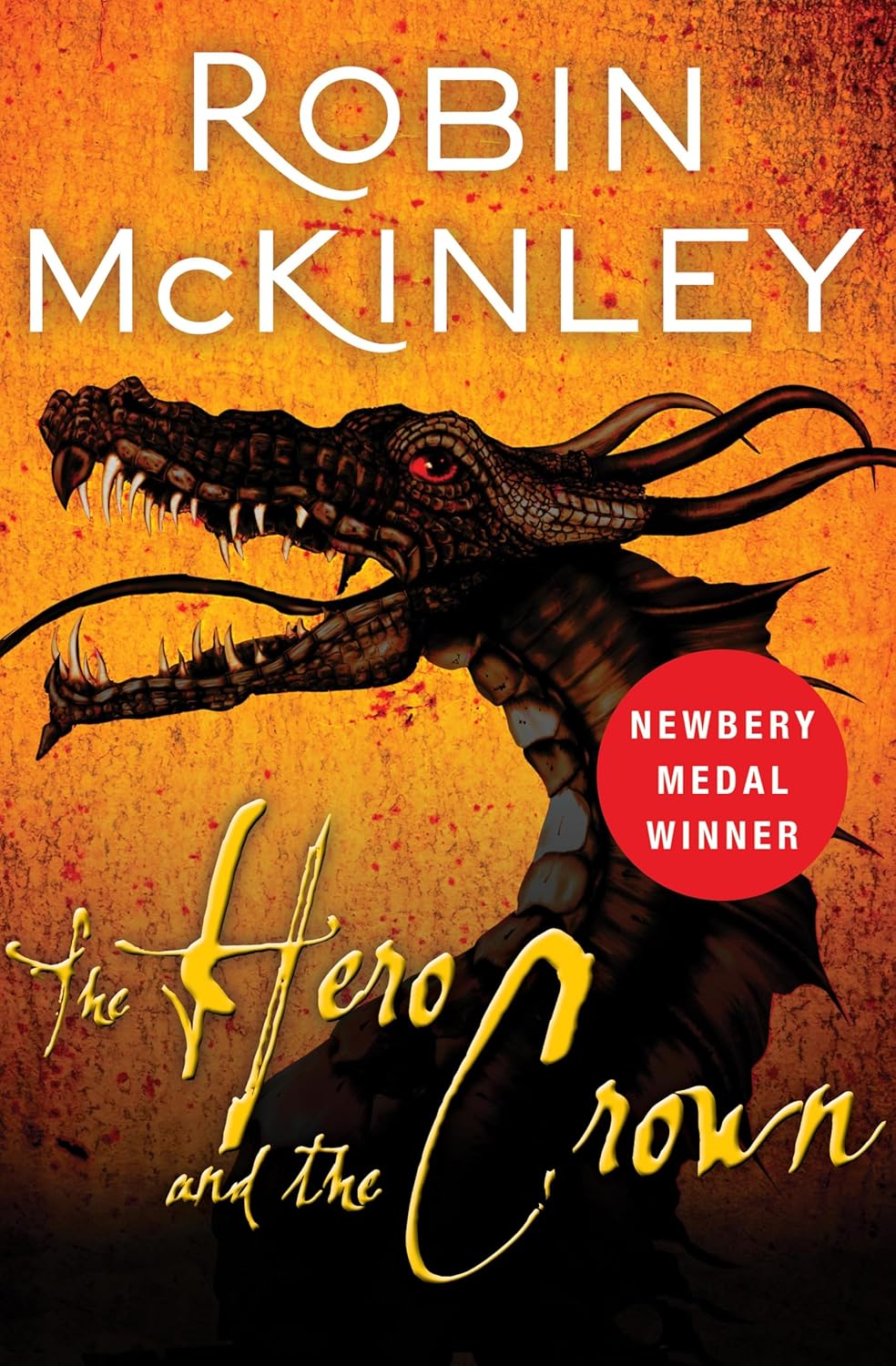
The Hero and the Crown by Robin McKinley is a Newbery Medal novel about Aerin, the king’s daughter in the fantasy kingdom of Damar, who is considered an outsider in her own court and who sets out — without permission, without blessing, and largely without help — to become the hero her country needs. First published in 1984, it is a prequel to McKinley’s earlier novel The Blue Sword and one of the foundational texts of feminist fantasy fiction: a book about a girl who earns her legend through hard work, repeated failure, and the particular stubbornness of someone who has nothing to lose by trying. This complete guide covers The Hero and the Crown‘s reading level, recommended age, content considerations, characters, themes, and books similar to The Hero and the Crown, designed for parents, teachers, and students.
For Parents
The Hero and the Crown is a rich, demanding fantasy novel with a heroine whose journey is defined by patience, failure, and earned competence rather than chosen destiny or special powers. It is slower and more interior than contemporary fantasy fiction, and rewards readers willing to inhabit its world carefully. Best for readers ages 11–15, it is particularly valuable for young readers — especially girls — who are drawn to fantasy but tired of protagonists who succeed because they are special rather than because they work.
For Teachers
A Newbery Medal winner well suited to grades 6–9, The Hero and the Crown is an excellent text for teaching the fantasy genre, the hero’s journey as subverted by a female protagonist, and McKinley’s distinctive narrative technique — a dreamlike, reflective structure that circles back on itself in ways that reward close reading. Pairs naturally with The Blue Sword as a companion novel, and with Le Guin’s A Wizard of Earthsea for a unit on literary fantasy that takes its world-building seriously.
The Hero and the Crown at a Glance
Find on Amazon →| Author | Robin McKinley |
| Published | 1984 |
| Grade Level | 6–9 (our assessment) |
| Recommended Age | 11–15 |
| Flesch-Kincaid Grade | ~6.8 |
| Word Count | ~90,000 |
| Pages | ~246 (Greenwillow paperback) |
| Chapters | 22 |
| Genre | Fantasy |
| Setting | Damar, a secondary world fantasy kingdom |
| Awards | Newbery Medal (1985) |
For official Lexile and AR levels, visit Lexile.com or AR BookFinder. ReadingVine provides independent editorial assessments.
What Reading Level Is The Hero and the Crown?
By our editorial assessment, The Hero and the Crown reads at a grade 6–9 level. The Flesch-Kincaid formula places it at approximately grade 6.8 — accessible to a confident sixth-grade reader at the sentence level, though the novel’s narrative structure and emotional interiority make it more rewarding for readers in the 7th–9th grade range. McKinley writes in a dense, immersive prose style that builds Damar’s world through accumulation of detail rather than explicit exposition, and readers who are accustomed to contemporary fantasy’s faster pacing may need time to settle into her rhythm.
The novel’s structure is notably nonlinear — McKinley circles back, layers in backstory, and trusts the reader to hold threads across long passages — and this is the primary challenge for younger readers. The story rewards patience and rereading in the way that the best literary fantasy does, and readers who engage with it carefully will find a world that feels genuinely inhabited rather than constructed for plot purposes. It is a more demanding read than its page count suggests, and a more rewarding one.
Parents and teachers should note that The Hero and the Crown is a prequel to McKinley’s earlier novel The Blue Sword — published two years before — though it is set long before those events and reads as a complete standalone. Many readers encounter The Hero and the Crown first; either order works. For official Lexile and Accelerated Reader scores, visit Lexile.com or AR BookFinder. ReadingVine’s assessments are independent editorial judgments.
What Age Is The Hero and the Crown Appropriate For?
We recommend The Hero and the Crown for readers ages 11–15. The novel contains no sexual content beyond a restrained romantic subplot, no profanity, and violence that is present but handled without graphic detail. Its challenges are those of any serious fantasy novel: battle, injury, the death of characters the reader has come to care about, and a protagonist who spends significant portions of the story in genuine danger and genuine pain.
The novel contains battle sequences and dragon-fighting scenes in which Aerin is seriously injured — including one extended sequence in which she recovers from severe burns over a long period. Characters die, including ones the reader will be attached to. The novel’s second half introduces a mage named Luthe and a romantic element that is handled with restraint but involves an age dynamic — Luthe is significantly older than Aerin — that some parents and teachers find worth discussing. There is also a climactic confrontation with a demonic villain that is genuinely frightening in its stakes, though not graphically violent. None of this content is inappropriate for the recommended age range; parents of readers at the lower end (11–12) who are sensitive to injury or death in fiction should be aware of these elements.
For readers ages 11 and up, The Hero and the Crown is an exceptionally well-crafted fantasy novel whose darkness is entirely purposeful. Aerin’s injuries and her long recoveries are central to McKinley’s argument about what heroism actually costs; the deaths matter because the relationships that precede them have been genuinely built. This is not a book that uses peril decoratively.
What Is The Hero and the Crown About?
Aerin is the only child of the king of Damar, but she is not a welcome figure at court. Her mother was a witchwoman from the North who died shortly after Aerin’s birth, and the whisper that follows Aerin through the palace is that her mother ensorcelled the king into marriage, that Aerin herself has no Gift — the magical inheritance that marks Damar’s ruling bloodline — and that she has no business claiming any future in a kingdom that is not truly hers. She has grown up on the margins of a world that is technically her inheritance, finding companionship in her father’s lame warhorse Talat and in the old chronicles she reads alone in the library, and told since childhood that she is not quite enough.
The novel’s first half follows Aerin as she pieces together, from an old and dangerous recipe in one of those chronicles, an ointment called kenet that renders the skin resistant to fire — and then teaches herself, through months of painstaking and repeatedly painful practice, to fight dragons. Not the great dragons, the kelar-bearing ones that only the full heroes of Damar can face, but the smaller fire-breathing nuisances that plague outlying villages and are beneath a proper hero’s notice. Aerin is not a proper hero. She goes anyway, alone, and she is not good at it at first, and she keeps going. This methodical, unheroic self-education is the moral center of the novel and what distinguishes it from most fantasy of its era.
The second half escalates sharply: Aerin’s hard-won competence is tested against Maur, the last of the great dragons, in a battle that nearly kills her and sets in motion the novel’s larger conflict with Agsded, the evil mage who is the source of the darkness threatening Damar — and who has a connection to Aerin’s own history that she does not yet understand. Her recovery, her journey to the mage Luthe in the mountains, and her final confrontation with Agsded form a story that is mythic in scale and deeply personal in texture, concerned throughout with questions of identity, inheritance, and what it means to claim a destiny that no one else has prepared for you.
The Hero and the Crown Characters
Is The Hero and the Crown Banned?
The Hero and the Crown has not been banned or formally challenged in American schools or libraries and does not appear on any lists of frequently challenged books. It is widely considered a distinguished and important work of fantasy literature and is commonly shelved and assigned without controversy. Its fantasy elements — magic, a demonic villain, Aerin’s use of an ointment brewed from a forbidden recipe — have not generated the kind of organized objection that some fantasy novels with more explicitly occult associations have faced.
The Hero and the Crown Themes and Lessons
The novel’s central argument is about the relationship between competence and heroism — specifically, that real heroism is not a matter of destiny or special gifts but of the willingness to do the work, absorb the failures, and keep going. Aerin does not have the Gift. She does not have the court’s approval. She does not have a mentor who believes in her or a prophecy that designates her. What she has is the particular freedom of someone who has already been written off: nothing to protect, nothing to lose, and the stubbornness to use that freedom to become something no one expected.
McKinley is also, in The Hero and the Crown, writing a direct response to the fantasy tradition of her era — a tradition largely built around male protagonists whose heroic status is conferred by birth, sword, or prophecy. Aerin’s heroism is earned in the most unglamorous way possible: alone, in a practice ring, setting herself on fire repeatedly until the kenet holds. Her dragon-fighting begins not with the great dragons of legend but with the small, pest-control variety that the real heroes consider beneath notice. McKinley is making a point about where competence actually comes from, and it is a point that lands as hard in the current moment as it did in 1984.
The novel’s treatment of belonging is equally careful. Aerin spends the entire first half of the book living in a world that considers her illegitimate, and she does not resolve this by proving the court wrong or winning their acceptance — she resolves it by finding, through her own work, an identity that does not depend on their recognition. What she becomes is not what Damar expected of its hero. It is something older and stranger and entirely her own.
Discussion questions for classrooms and families: Why does McKinley spend so much time on Aerin’s unglamorous practice and her early failures — what is she arguing about heroism? How is Aerin’s heroism different from the heroism of Damar’s other heroes? What does the crown represent, and why does Aerin give it up at the end? How does Aerin’s relationship with Talat prepare her for everything else she faces? What does the novel suggest about the relationship between belonging and identity — can you belong somewhere that does not fully accept you?
How Many Pages and Chapters in The Hero and the Crown?
The standard Greenwillow paperback edition of The Hero and the Crown is approximately 246 pages across 22 chapters. At roughly 90,000 words, it is a substantial novel for its age range — longer than it appears on the shelf — and the density of McKinley’s world-building means it reads at a slower pace than its word count might suggest. Readers in the recommended age range should expect two to three weeks of steady reading at 30–40 minutes per session.
The novel divides naturally into two movements: the first, which covers Aerin’s self-education and her battle with Maur (roughly the first two-thirds), and the second, which follows her recovery with Luthe and her confrontation with Agsded. The first movement is slower and more interior; the second moves with considerably more urgency. For classroom use, a three-to-four week unit allows time to read carefully enough to track McKinley’s layered structure and to discuss the ways the novel’s first half prepares the reader for everything in the second.
Books Similar to The Hero and the Crown
About Robin McKinley
Robin McKinley was born in 1952 in Warren, Ohio, and grew up in various locations due to her father’s naval career, a peripatetic childhood she has cited as formative in her development as a reader and writer. She studied at Dickinson College and later at Bowdoin College, and published her first novel, Beauty: A Retelling of the Story of Beauty and the Beast, in 1978. It established immediately the qualities that would define her career: precise, immersive prose, a deep respect for the fantasy genre as a vehicle for serious ideas, and a consistent interest in female protagonists whose competence is earned rather than granted.
The Blue Sword was published in 1982 and was a Newbery Honor book. The Hero and the Crown, its prequel, won the Newbery Medal in 1985 — an unusual achievement for a fantasy novel in that era, and a recognition that McKinley’s work operated at a level of literary craft that transcended genre. Her subsequent novels include The Outlaws of Sherwood, a retelling of Robin Hood; Rose Daughter, a second retelling of Beauty and the Beast; and Sunshine, a vampire novel for adults. She has spoken extensively about her conviction that fantasy is not an escape from reality but an oblique angle on it — that the secondary world is valuable precisely because its distance from the familiar allows readers to see things they might otherwise overlook. She lives in England.
The Hero and the Crown: Frequently Asked Questions
What reading level is The Hero and the Crown?
The Hero and the Crown has a Flesch-Kincaid grade level of approximately 6.8. Our editorial assessment places it at grades 6–9 (ages 11–15). The prose is dense and immersive and more demanding than its sentence-level score suggests — the nonlinear structure and world-building style reward patient, experienced readers. For official Lexile and AR scores, visit Lexile.com or AR BookFinder.
What grade is The Hero and the Crown appropriate for?
We recommend grades 6–9 as the primary range, most commonly assigned in 7th and 8th grade. Strong 6th-grade readers who are comfortable with demanding fantasy can engage with it successfully; the novel’s interiority and structural complexity are better suited to readers 12 and up.
How many pages are in The Hero and the Crown?
The standard Greenwillow paperback is approximately 246 pages across 22 chapters. Word count is roughly 90,000 words. The density of McKinley’s world-building means it reads at a slower pace than its page count suggests; readers in the target range should expect two to three weeks of steady reading.
What is The Hero and the Crown about?
Aerin, a king’s daughter considered an outsider in her own court, teaches herself through years of patient and often painful work to fight dragons — and eventually faces the ancient evil threatening the kingdom no one expected her to save. It is a fantasy novel about earned heroism: a girl who becomes a legend not because she was chosen but because she refused to accept that she wasn’t.
Do I need to read The Blue Sword before The Hero and the Crown?
No. The Hero and the Crown is set long before the events of The Blue Sword and is fully self-contained. Many readers encounter it first and read The Blue Sword afterward. Either order works — reading The Blue Sword first gives some additional pleasure in recognizing the legend Aerin has become; reading The Hero and the Crown first lets you experience Aerin’s story without that foreknowledge.
Why did The Hero and the Crown win the Newbery Medal?
It won the Newbery Medal in 1985 for the quality of its writing — specifically for the originality and depth of McKinley’s world-building, the craft of her prose, the psychological complexity of Aerin as a protagonist, and the seriousness with which the novel engages its themes of identity, heroism, and belonging. It was a significant recognition for a fantasy novel at a time when the genre was not typically considered Newbery territory.
Is The Hero and the Crown a feminist novel?
Yes, in the most practical sense — it is a novel about a girl who is told she does not belong in the world of heroes and who becomes one anyway, through work rather than birthright. McKinley has said she was writing in conscious response to a fantasy tradition that confined female characters to supporting roles, and the novel’s insistence that heroism is earned rather than granted is a direct argument against the assumptions of that tradition. It is one of the foundational texts of feminist fantasy fiction.
Is The Hero and the Crown part of a series?
It is a companion novel to The Blue Sword — the two books share the world of Damar, with The Hero and the Crown set centuries before The Blue Sword‘s events. Both are standalones. McKinley has not written additional Damar novels, and the two books together constitute the complete Damar companion set.