
 = Partner Site
Simile Examples
A simile is a figure of speech that compares two unlike things using the words “like” or “as.” Similes make writing more vivid by creating clear mental images: “Her eyes sparkled like diamonds” or “He ran as fast as the wind.” These 50+ simile examples help students recognize and create this essential literary device across grade levels.
For Teachers
Simile examples are organized by grade band for easy differentiation. Use these for direct instruction, anchor charts, mentor sentences, or assessment. Each example includes context notes to support teaching.
For Parents
Start with the simpler examples in the K-2 section and work up to your child’s level. Point out similes when you encounter them in books, songs, and everyday conversation to build recognition skills.
Practice Similes with Worksheets
Ready for hands-on practice? Our simile worksheets help students identify and create their own similes.
What Is a Simile?
A simile is a figure of speech that compares two different things using “like” or “as.” Similes help readers visualize and understand by connecting something unfamiliar to something familiar. When we say “The baby’s skin was as soft as silk,” we help readers feel the softness by comparing it to something they know.
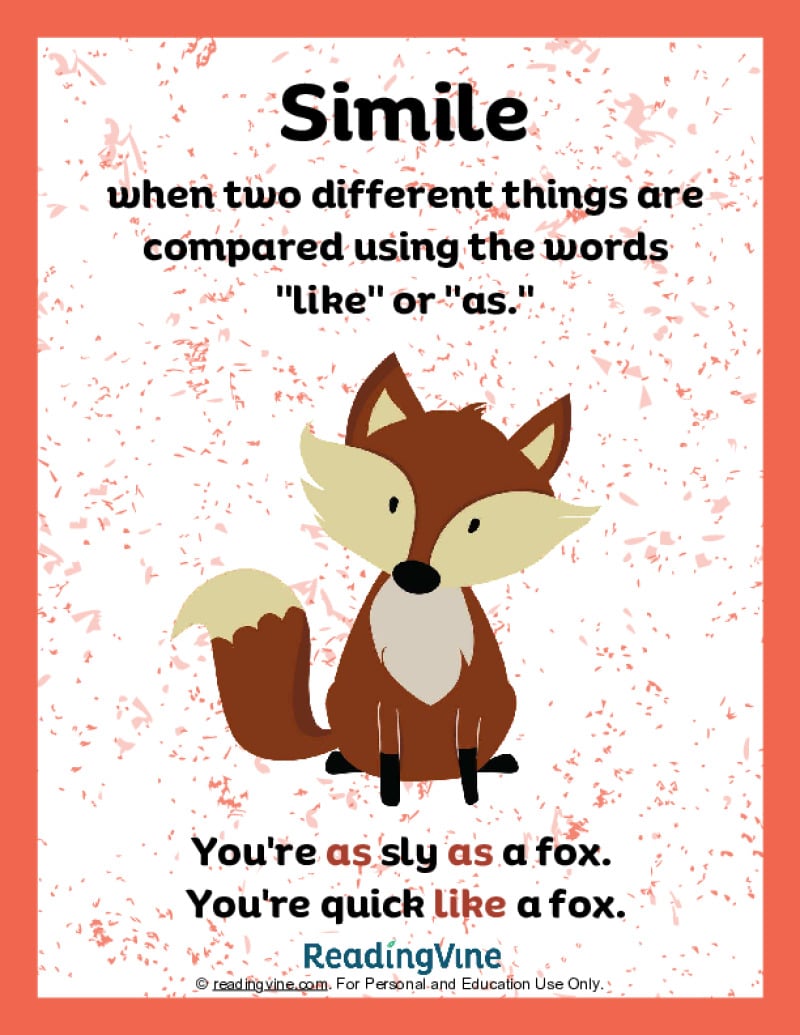
Simile Anchor Chart
Use this printable anchor chart to help students understand and identify similes.
What’s included:
- Simile definition
- Signal words (like, as)
- Visual examples
Simile vs. Metaphor: What’s the Difference?
The snow is like a white blanket.
Uses “like” or “as”The snow is a white blanket.
Direct comparison (is)Simile Example Categories
Jump to any section, or scroll through all 50+ simile examples below.
Grades K-2
Simple, concrete similes
12 examplesGrades 3-5
Expanded comparisons & emotions
15 examplesGrades 6-8
Literary & complex similes
15 examples“Like” vs. “As” Similes
Both forms with examples
10 examplesIs This a Simile?
Test your understanding
8 questionsCommon Mistakes
What’s NOT a simile
5 examplesSimile Examples for Grades K-2
These simple simile examples use familiar objects and animals young students can easily picture. Perfect for introducing “like” and “as” comparisons.
She is as busy as a bee.
Compares someone working hard to a bee that never stops moving.
He eats like a pig.
Describes messy or greedy eating habits.
The puppy is as cute as a button.
Describes something small and adorable.
Her hair is like silk.
Describes smooth, soft, shiny hair.
He runs like the wind.
Describes someone who runs very fast.
The puddle was as slippery as soap.
Describes a surface that’s hard to walk on without slipping.
She sings like a bird.
Describes a beautiful, melodic singing voice.
The blanket is as soft as a cloud.
Describes something very soft and fluffy.
He is as slow as a turtle.
Describes someone or something moving very slowly.
Her smile is like sunshine.
Describes a bright, warm, cheerful smile.
The baby sleeps like a log.
Describes sleeping deeply without moving.
He is as strong as an ox.
Describes someone with great physical strength.
Simile Examples for Grades 3-5
These simile examples introduce more sophisticated comparisons involving emotions, actions, and abstract ideas. Students at this level can explore how similes create vivid imagery.
The stars twinkled like diamonds in the sky.
Creates a visual image of sparkling brightness.
Her voice was as sweet as honey.
Describes a pleasant, smooth-sounding voice.
The classroom was like a zoo.
Describes a noisy, chaotic environment.
He stood as still as a statue.
Describes complete motionlessness.
The news spread like wildfire.
Describes information traveling quickly from person to person.
She felt as light as a feather.
Describes feeling weightless, free, or happy.
The old car ran like a dream.
Describes something working smoothly and perfectly.
His hands were as cold as ice.
Emphasizes extreme coldness of touch.
The thunder roared like a lion.
Describes a loud, powerful, frightening sound.
She was as brave as a lion.
Describes great courage and fearlessness.
Time passed like molasses.
Describes time moving very slowly.
The dancer moved like water.
Describes graceful, fluid, flowing movement.
Her eyes sparkled like stars.
Describes bright, lively, expressive eyes.
The test was as easy as pie.
Describes something very simple to do.
He fought like a tiger.
Describes fighting fiercely and with determination.
Simile Examples for Grades 6-8
These simile examples include literary references and more nuanced comparisons. Middle school students can analyze how authors use similes to create mood and meaning.
Her thoughts scattered like leaves in a strong wind.
Describes racing, disorganized thinking that’s hard to control.
My love is like a red, red rose.
Robert Burns’ famous simile comparing love to a beautiful flower.
His apology sounded like a script he didn’t believe.
Describes insincere, rehearsed-sounding words.
Her words cut like a knife.
Describes hurtful speech that causes emotional pain.
The silence was like a heavy blanket over the room.
Describes oppressive, uncomfortable quiet.
His conscience gnawed at him like a hungry rat.
Describes persistent, uncomfortable guilt.
The memories flooded back like a tidal wave.
Describes overwhelming, sudden recollection.
She guarded her secret like a dragon guards its treasure.
Describes fierce protection of something valuable.
The city streets were like veins carrying life through the urban body.
Extended simile comparing a city to a living organism.
Her mood changed like the weather in spring.
Describes unpredictable, rapidly shifting emotions.
He clung to hope like a shipwrecked sailor to driftwood.
Describes desperate, survival-driven optimism.
The truth hit her like a freight train.
Describes a sudden, shocking realization.
His explanation was as clear as mud.
Ironic simile meaning the explanation was confusing.
The abandoned house stood like a skeleton against the sky.
Creates a haunting, eerie visual image.
Ideas spread through the crowd like ripples on a pond.
Describes how thoughts or movements travel outward gradually.
“Like” vs. “As” Similes
Both “like” and “as” create similes, but they’re used differently. Here are examples of each form to help students recognize both patterns.
Similes Using “Like”
“Like” is followed by a noun or noun phrase.
“She sings like an angel.”
“He eats like a horse.”
“The car runs like a dream.”
“The hallway buzzed like a beehive.”
“The kids played like puppies.”
Similes Using “As…As”
“As…as” uses the pattern: as + adjective + as + noun.
“As quiet as a mouse.”
“As tall as a tree.”
“As bright as the sun.”
“As stubborn as a mule.”
“As pretty as a picture.”
Is This a Simile?
Test your understanding! Can you tell which sentences are similes and which are not?
“The lake was like a mirror.”
Uses “like” to compare the lake to a mirror (still, reflective).
“Time is money.”
No “like” or “as”—this is a metaphor.
“He was as brave as a lion.”
Uses “as…as” to compare bravery to a lion.
“The wind whispered through the trees.”
Gives human action to wind—this is personification.
“She swims like a fish.”
Uses “like” to compare swimming ability to a fish.
“I like chocolate ice cream.”
“Like” here means enjoyment, not comparison—this is literal.
“The homework took as long as forever.”
Uses “as…as” to exaggerate duration.
“I waited for a million years.”
Exaggerates without comparison—this is hyperbole.
Common Simile Mistakes
Students often confuse similes with other figures of speech or misidentify them. Here are the most common mix-ups and how to avoid them.
1 Confusing Similes with Metaphors
“Her heart is gold.”
“Her heart is like gold.”
Remember: Similes MUST use “like” or “as.” If the comparison uses “is” or “was” directly, it’s a metaphor.
2 Thinking Every “Like” Makes a Simile
“I like pizza.” / “It looks like rain.”
“The cheese stretched like rubber.”
Remember: “Like” must be used to COMPARE two different things. “I like pizza” shows preference; “looks like rain” is a prediction.
3 Confusing Similes with Literal Comparisons
“My sister looks like my mom.”
“My sister acts like a queen.”
Remember: Similes compare two UNLIKE things. Comparing family members or similar objects isn’t figurative—it’s literal.
4 Missing the “As…As” Pattern
“She is quiet as a mouse.” (informal)
“She is as quiet as a mouse.”
Remember: The full pattern is “as [adjective] as [noun].” While informal speech drops the first “as,” formal writing should include both.
5 Overusing Clichéd Similes
“Busy as a bee,” “light as a feather,” “cold as ice”
“Busy as a chef on Thanksgiving,” “light as a soap bubble”
Remember: Clichéd similes aren’t wrong, but original similes make writing more interesting and memorable.
Tips for Teaching Similes
Before diving into examples, make sure students understand that similes ALWAYS use “like” or “as.” Create anchor charts highlighting these signal words so students can spot similes quickly.
Similes are easier for students to identify because of the signal words. Once they master similes, introduce metaphors by showing how to remove “like” or “as” to make the comparison more direct.
“Quick as a Cricket” by Audrey Wood is perfect for primary grades. For older students, try poetry by Langston Hughes or excerpts from “The Outsiders” which contains vivid similes throughout.
Have students describe things using each sense: “The cookie tasted like…” “The music sounded like…” “The fabric felt like…” This builds simile-writing skills while reinforcing descriptive writing.
When students write “fast as lightning” or “quiet as a mouse,” challenge them: “What else is fast? What else is quiet?” Push for original comparisons that show creative thinking.
Create a sorting activity with sentences that use “like” and “as.” Include similes, literal comparisons (“She looks like her sister”), and preferences (“I like apples”). Students must identify which are true similes.
Simile Examples: Frequently Asked Questions
What is a simile in simple terms?
A simile is a comparison between two different things using the words “like” or “as.” When we say “Her smile is like sunshine,” we’re comparing a smile to sunshine to show it’s bright and warm. Similes help readers picture what we’re describing by connecting it to something familiar.
What is the difference between a simile and a metaphor?
Both similes and metaphors compare two unlike things, but they do it differently. A simile uses “like” or “as”: “He runs like the wind.” A metaphor says one thing is another: “He is the wind.” Similes are easier for students to identify because of the signal words.
What grade level should students learn about similes?
Students typically encounter similes in 1st or 2nd grade as part of early figurative language instruction. Common Core State Standards introduce similes and metaphors together in standard RL.3.4 for 3rd grade. By 4th grade, students should identify similes in text and explain their meaning.
What are some easy simile examples for beginners?
Easy simile examples use familiar animals and objects: “as busy as a bee,” “as slow as a turtle,” “runs like the wind,” “sleeps like a log,” “as cold as ice,” and “eats like a pig.” These classic similes help young students understand the concept before creating original comparisons.
How do I help students write their own similes?
Start with a formula: “[Subject] is like [comparison]” or “[Subject] is as [adjective] as [comparison].” Have students brainstorm qualities first (fast, loud, soft, scary), then think of things with those qualities. For “loud,” they might write “as loud as a jet engine” or “loud like thunder.”
Why do similes use “like” and “as”?
The words “like” and “as” signal that a comparison is being made between two different things. They tell the reader “I’m not saying these things are the same—I’m saying they share a quality.” Without these signal words, the comparison becomes a metaphor, which states the two things are the same.