
 = Partner Site
Metaphor Examples
A metaphor is a figure of speech that directly compares two unlike things by saying one thing is another. Unlike similes, which use “like” or “as,” metaphors make the comparison implicit: “Time is money” or “The world is a stage.” These 50+ metaphor examples help students recognize and create this powerful literary device across grade levels.
For Teachers
Metaphor examples are organized by grade band for easy differentiation. Use these for direct instruction, anchor charts, mentor sentences, or assessment. Each example includes context notes to support teaching.
For Parents
Start with the simpler examples in the K-2 section and work up to your child’s level. Point out metaphors when you encounter them in books, songs, and everyday conversation to build recognition skills.
Practice Metaphors with Worksheets
Ready for hands-on practice? Our metaphor worksheets help students identify and create their own metaphors.
What Is a Metaphor?
A metaphor is a figure of speech that describes something by saying it is something else. Metaphors create vivid comparisons without using “like” or “as.” When we say “Her voice is music,” we don’t mean her voice literally makes musical sounds—we mean it’s pleasant and melodic.
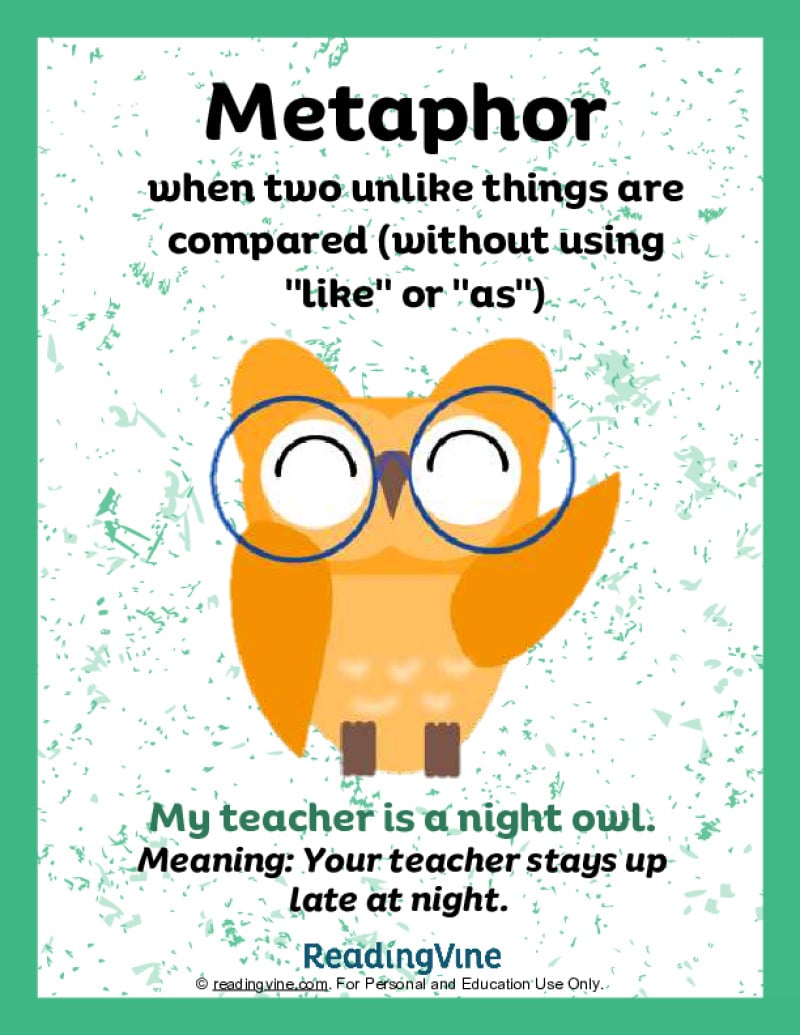
Metaphor Anchor Chart
Use this printable anchor chart to help students understand and create metaphors.
What’s included:
- Metaphor definition
- Simile vs. metaphor comparison
- Visual examples
Metaphor vs. Simile: What’s the Difference?
The snow is like a white blanket.
Uses “like” or “as”Metaphor Example Categories
Jump to any section, or scroll through all 50+ metaphor examples below.
Grades K-2
Simple, concrete metaphors
12 examplesGrades 3-5
Expanded comparisons & context
15 examplesGrades 6-8
Literary & abstract metaphors
15 examplesTypes of Metaphors
Implied, extended, dead & more
5 typesIs This a Metaphor?
Test your understanding
8 questionsCommon Mistakes
What’s NOT a metaphor
5 examplesMetaphor Examples for Grades K-2
These simple metaphor examples use familiar objects and concepts young students can easily visualize. Perfect for introducing the concept that one thing can “be” another.
The sun is a golden ball in the sky.
Compares the sun’s round, glowing shape to a ball.
My mom is an angel.
Describes someone kind and caring as a heavenly being.
The snow is a white blanket on the ground.
Shows how snow covers everything like a blanket covers a bed.
My brother is a monkey.
Describes someone who climbs, jumps, and acts silly.
The stars are diamonds in the sky.
Compares the sparkle of stars to sparkling gems.
Her smile is sunshine.
Shows how a smile can brighten your day like the sun.
The classroom was a zoo today.
Describes a noisy, chaotic room full of activity.
My dog is a fluffy cloud.
Describes a soft, puffy, white dog.
The moon is a nightlight.
Shows how the moon provides soft light in the dark.
My teacher is a superhero.
Describes someone who helps, protects, and does amazing things.
The baby is a little bear when he wakes up.
Describes a grumpy, growly baby in the morning.
His room is a pigsty.
Describes a very messy, dirty room.
Metaphor Examples for Grades 3-5
These metaphor examples introduce more sophisticated comparisons and emotions. Students at this level can explore how metaphors create meaning beyond literal description.
Life is a roller coaster.
Compares life’s ups and downs to the thrilling, unpredictable ride.
The world is a stage.
Suggests that people play roles and perform in daily life.
Time is money.
Shows that time is valuable and shouldn’t be wasted.
Her heart is gold.
Describes someone who is kind, generous, and valuable.
The test was a breeze.
Describes something that was easy and effortless.
He has a heart of stone.
Describes someone who shows no emotion or compassion.
She was drowning in homework.
Shows being overwhelmed with too much work to do.
His words were daggers.
Describes hurtful words that cause emotional pain.
The news was a punch to the gut.
Describes information that was shocking and upsetting.
My memory is a steel trap.
Describes someone who remembers everything.
The detective’s mind is a computer.
Shows quick thinking and processing of information.
Her voice is velvet.
Describes a smooth, soft, pleasant-sounding voice.
The road was a ribbon stretching across the desert.
Creates a visual image of a long, narrow, winding road.
Books are windows to other worlds.
Shows how reading lets us see and experience new things.
Laughter is the best medicine.
Suggests that being happy can help you feel better.
Metaphor Examples for Grades 6-8
These metaphor examples include literary references and abstract concepts. Middle school students can analyze how authors use metaphors to convey complex emotions and themes.
Hope is the thing with feathers that perches in the soul.
Emily Dickinson’s famous metaphor comparing hope to a bird that never stops singing.
Conscience is a man’s compass.
Suggests that our sense of right and wrong guides our decisions.
Jealousy is a green-eyed monster.
Shakespeare’s metaphor showing jealousy as a destructive creature.
The mind is an ocean of possibilities.
Conveys the vast, deep, unexplored potential of human thought.
Her tears were a river flowing down her cheeks.
Emphasizes intense, continuous crying through exaggeration.
America is a melting pot.
Describes how diverse cultures blend together in one nation.
Knowledge is a treasure.
Shows that learning is valuable and worth seeking.
The fog was a thick curtain hiding the city.
Creates an image of fog completely obscuring the view.
Failure is the stepping stone to success.
Suggests that mistakes help us reach our goals.
The assignment was a mountain I had to climb.
Describes a difficult task requiring sustained effort.
Chaos is a friend of mine.
Personifies disorder as something familiar and comfortable.
Her laughter was music to my ears.
Describes a pleasant, melodic-sounding laugh.
The economy is a house of cards.
Describes something fragile that could easily collapse.
Life is a journey with many paths to choose.
Compares living to traveling with decisions along the way.
His anger was a volcano waiting to erupt.
Shows intense, building emotion ready to explode.
Types of Metaphors
Metaphors come in several forms. Understanding these types helps students recognize metaphors in literature and use them more effectively in their own writing.
Standard Metaphor
Directly states that one thing is another.
“The classroom was a circus.”
Implied Metaphor
Suggests a comparison without stating it directly.
“She barked orders at her team.” (Implies she is like a dog)
Extended Metaphor
A metaphor that continues through several sentences, a paragraph, or an entire work.
“Life is a journey. Sometimes the road is smooth, sometimes rocky. We meet fellow travelers along the way.”
Dead Metaphor
A metaphor used so often it has lost its figurative impact and feels literal.
“Foot of the bed,” “head of the class,” “falling in love”
Mixed Metaphor
Combines two unrelated metaphors, often creating confusing or humorous results. Usually a mistake to avoid.
“We’ll burn that bridge when we come to it.”
Is This a Metaphor?
Test your understanding! Can you tell which sentences are metaphors and which are not?
“Time is a thief.”
Directly says time IS a thief (compares without like/as).
“She runs like the wind.”
Uses “like” to compare—this is a simile.
“The world is your oyster.”
Directly says the world IS an oyster (full of opportunities).
“The thunder growled angrily.”
Gives human qualities to thunder—this is personification.
“He’s a night owl.”
Directly says he IS an owl (stays up late).
“I’ve told you a million times.”
Exaggerates quantity—this is hyperbole.
“Her eyes were stars.”
Directly says eyes WERE stars (bright and sparkling).
“The cat is sleeping on the couch.”
This is a literal statement—no comparison is being made.
Common Metaphor Mistakes
Students often confuse metaphors with other figures of speech. Here are the most common mix-ups and how to avoid them.
1 Confusing Metaphors with Similes
“He eats like a pig.”
“He is a pig when he eats.”
Remember: Similes use “like” or “as.” Metaphors say one thing IS another.
2 Confusing Metaphors with Personification
“The wind whispered through the trees.”
“The wind is a whispering ghost.”
Remember: Personification gives human actions to non-human things. Metaphors compare two different things directly.
3 Taking Metaphors Literally
“He has a heart of gold” means his heart is made of gold metal.
“He has a heart of gold” means he is kind and generous.
Remember: Metaphors are figurative, not literal. Look for the deeper meaning.
4 Creating Mixed Metaphors
“We need to hit the ground running and sail through this project.”
“We need to hit the ground running and sprint to the finish line.”
Remember: Stick with one comparison. Don’t mix running with sailing!
5 Overusing Clichéd Metaphors
“Life is a journey,” “Time flies,” “Love is blind”
“Life is a choose-your-own-adventure book”
Remember: While clichés aren’t wrong, original metaphors are more powerful and engaging.
Tips for Teaching Metaphors
Teach students the basic metaphor structure: “[Something] is [something else].” Have them practice filling in the blanks before creating their own metaphors from scratch.
Many students learn similes before metaphors. Show how “The snow is like a blanket” becomes “The snow is a blanket.” Removing “like” or “as” transforms a simile into a metaphor.
Point out metaphors in read-alouds and shared reading. Picture books like “Quick as a Cricket” and novels like “Bridge to Terabithia” contain accessible examples for class discussion.
Metaphors shine when describing feelings. Ask students: “What does anger feel like? Is it a fire? A storm? A volcano?” This helps them see how metaphors make abstract ideas concrete.
Metaphors are everywhere! Challenge students to find them in songs, advertisements, sports commentary, and everyday speech. “Dead” metaphors like “surfing the web” are great starting points.
Keep a running collection of metaphors students find or create. Categorize by type (emotions, nature, people) or by source (books, songs, original). Refer back during writing instruction.
Metaphor Examples: Frequently Asked Questions
What is a metaphor in simple terms?
A metaphor is a figure of speech that says one thing is another thing, even though it’s not literally true. When we say “Time is money,” we don’t mean time is actual currency—we mean time is valuable and shouldn’t be wasted. Metaphors help us understand abstract ideas by comparing them to concrete, familiar things.
What is the difference between a metaphor and a simile?
The key difference is how the comparison is made. A simile uses “like” or “as” to compare: “Her smile is like sunshine.” A metaphor says one thing is another: “Her smile is sunshine.” Both compare unlike things, but metaphors make the comparison more direct and powerful by removing the signal words.
What grade level should students learn about metaphors?
Students typically encounter metaphors in 2nd or 3rd grade as part of figurative language instruction. The Common Core State Standards introduce figurative language (including metaphors) in standard RL.4.4 for 4th grade, but simpler metaphor examples can be introduced earlier. By middle school, students should analyze how metaphors contribute to meaning in literary texts.
What are some common metaphor examples for kids?
Simple metaphor examples for kids include: “The snow is a white blanket,” “My brother is a monkey,” “The stars are diamonds in the sky,” “Her smile is sunshine,” and “The classroom was a zoo.” These examples compare familiar things and help young students grasp how metaphors work before moving to more abstract comparisons.
How do I help students write their own metaphors?
Start with a formula: “[Thing 1] is [Thing 2].” Have students brainstorm what qualities they want to describe (soft, loud, fast, scary), then think of objects with those same qualities. For example, to describe a loud voice, they might write “Her voice is a foghorn.” Encourage them to be specific and avoid overused comparisons.
What is an extended metaphor?
An extended metaphor is a metaphor that continues throughout several sentences, a paragraph, or even an entire piece of writing. For example, if a poem compares life to a journey, it might continue with roads, crossroads, fellow travelers, and destinations. Extended metaphors are common in poetry and speeches—Martin Luther King Jr.’s “I Have a Dream” speech uses extended metaphors throughout.