
 = Partner Site
Author’s Purpose
Author’s purpose is the reason why a writer creates a text. Every article, story, advertisement, and textbook exists because an author wanted to achieve something—whether that’s changing your mind, teaching you something new, or simply making you laugh. Understanding author’s purpose helps students become critical readers who can ask, “Why did the author write this?” These 50+ author’s purpose examples help students master the PIE framework across grade levels.
For Teachers
Start with the PIE acronym and obvious examples (ads = persuade, textbooks = inform, jokes = entertain) before introducing texts with blended or subtle purposes. Use the examples below for whole-class sorting activities or independent practice.
For Parents
Point out author’s purpose in everyday life: “Why did they make this commercial? What do they want us to do?” Cereal boxes, movie trailers, and birthday cards all have purposes your child can identify with a little prompting.
What Is Author’s Purpose?
Author’s purpose is the main reason an author writes a text. Authors write to persuade (convince readers to think or do something), to inform (teach readers facts or explain how something works), or to entertain (amuse readers or engage them in a story). Many texts combine purposes, but identifying the primary purpose helps readers understand why the author made specific choices about content, tone, and structure.
Author’s Purpose Anchor Charts
Use these printable anchor charts to help students identify why authors write. Choose the version that fits your grade level.
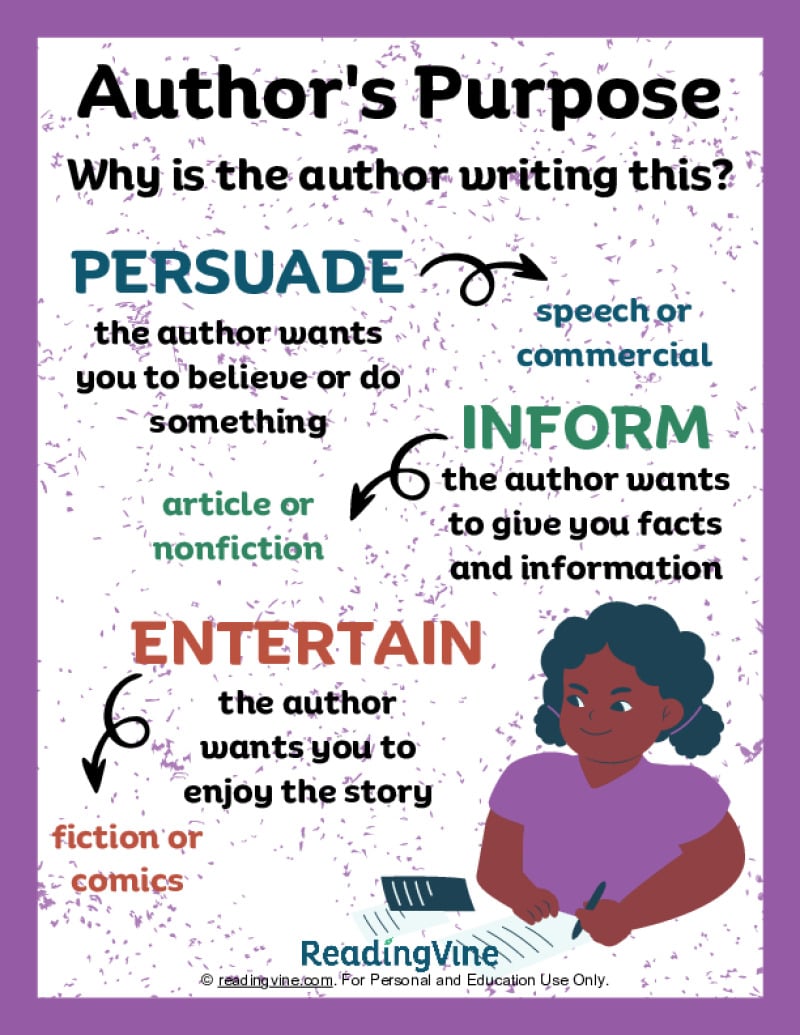

The PIE Framework: Three Types of Author’s Purpose
Convince readers to believe, think, feel, or do something.
Ads, speeches, reviews, editorials, campaign postersTeach readers facts, explain concepts, or show how to do something.
Textbooks, news articles, recipes, encyclopedias, directionsAmuse readers, tell a story, or engage their emotions and imagination.
Novels, jokes, poems, comics, fairy tales, moviesRemember: PIE covers the three main purposes, but many texts blend purposes. A funny cookbook entertains AND informs. A documentary about pollution informs AND persuades. Look for the primary purpose—what the author wanted MOST.
Signal Words for Author’s Purpose
should, must, best, worst, opinion, believe, reasons, call to action, you need to
facts, explains, steps, definitions, dates, according to, research shows, how to
characters, plot, once upon a time, humor, dialogue, suspense, imagine, suddenly
Author’s Purpose Examples by Category
Jump to any section, or scroll through all 50+ author’s purpose examples below.
Grades K-2
Simple, everyday texts
12 examplesGrades 3-5
Varied text types
15 examplesGrades 6-8
Complex & subtle purposes
15 examplesBy Purpose Type
Persuade, Inform, Entertain
3 categoriesWhat’s the Purpose?
Test your understanding
10 questionsCommon Mistakes
Errors to avoid
5 mistakesAuthor’s Purpose Examples for Grades K-2
Simple, familiar texts that young learners encounter every day. These examples use clear, obvious purposes.
A recipe for making a peanut butter sandwich
Inform — Teaches readers the steps to make something.
A fairy tale about a princess who rescues a dragon
Entertain — Tells an imaginative story for readers to enjoy.
A TV commercial for a new toy
Persuade — Tries to make kids want to buy the toy.
A book about how caterpillars become butterflies
Inform — Teaches facts about the butterfly life cycle.
A silly poem about a dog who wears a hat
Entertain — Written to make readers laugh and smile.
A poster saying “Vote for Emma for Class President!”
Persuade — Wants readers to vote for Emma.
A weather report showing tomorrow’s forecast
Inform — Gives facts about the weather.
A cartoon about animals going on a camping trip
Entertain — Tells a fun story with funny characters.
A sign in the cafeteria: “Try our new fruit cups!”
Persuade — Encourages students to choose the fruit cups.
Directions for how to play a board game
Inform — Explains the rules so readers can play.
A joke book full of knock-knock jokes
Entertain — Written to make readers laugh.
A flyer from the dentist saying “Brush twice a day to keep your teeth healthy!”
Persuade — Wants readers to brush more often.
Author’s Purpose Examples for Grades 3-5
More varied text types including some with blended purposes. Students at this level can explain WHY they identified each purpose.
A newspaper article about a local fire
Inform — Reports facts about what happened without taking sides.
A biography of Abraham Lincoln
Inform — Teaches readers about a real person’s life.
A mystery novel about kids solving a crime
Entertain — Engages readers with suspense and a plot to follow.
An editorial saying schools should have longer recess
Persuade — Tries to convince readers to agree with an opinion.
A how-to article about building a birdhouse
Inform — Gives step-by-step instructions.
A Greek myth about how the seasons began
Entertain — Tells a dramatic story with gods and adventure.
A travel brochure for a theme park
Persuade — Wants readers to visit and spend money there.
A science textbook chapter about the solar system
Inform — Teaches facts about planets and space.
A fantasy story about a wizard’s quest
Entertain — Takes readers on an imaginative adventure.
A movie review recommending a new film
Persuade — Wants readers to go see (or skip) the movie.
An encyclopedia entry about dolphins
Inform — Presents facts without opinion or story.
A humorous essay about the author’s messy room
Entertain — Uses humor to amuse readers.
A letter to the editor about saving the park
Persuade — Argues for a specific action or viewpoint.
A historical fiction novel set during the Revolutionary War
Entertain — Tells a story (even though it includes real history).
A pamphlet about recycling at school
Persuade — Encourages readers to recycle more.
Author’s Purpose Examples for Grades 6-8
Complex texts with subtle, blended, or layered purposes. Middle schoolers can analyze how authors combine purposes strategically.
A satirical article mocking celebrity culture
Entertain + Persuade — Uses humor to criticize and change opinions.
A political speech about climate change
Persuade — Aims to convince voters to support certain policies.
A documentary about ocean pollution
Inform + Persuade — Presents facts but wants viewers to take action.
A memoir about growing up in a different country
Entertain + Inform — Shares a personal story while teaching about another culture.
An infomercial for a kitchen gadget
Persuade — Disguised as information but designed to sell a product.
An allegory like Animal Farm that uses animals to represent political ideas
Entertain + Persuade — Tells a story with a deeper political message.
An investigative journalism piece exposing corruption
Inform + Persuade — Reports facts but hopes to spark change.
A public service announcement about texting and driving
Persuade — Tries to change dangerous behavior.
A dystopian novel like The Giver
Entertain + Persuade — Engages readers while warning about society.
A scientific journal article about a new discovery
Inform — Shares research findings with other scientists.
A campaign ad attacking an opponent
Persuade — Wants viewers to vote against someone.
A parody video mocking a popular song
Entertain — Created for humor and amusement.
A blog post titled “10 Reasons to Adopt, Not Shop”
Persuade — Uses a list format but the goal is to change behavior.
A true crime podcast about an unsolved mystery
Entertain + Inform — Presents facts but hooks listeners with suspense.
A company’s “About Us” page on their website
Persuade — Seems informational but aims to build trust and attract customers.
Author’s Purpose Examples by Type
Examples organized by the three main purposes: Persuade, Inform, and Entertain.
Persuade Examples
These texts try to convince readers to think, believe, feel, or do something.
Advertisements and commercials
Want you to buy a product or service.
Political speeches and campaign materials
Want you to vote for a candidate or support a cause.
Editorials and opinion columns
Want you to agree with the writer’s viewpoint.
Reviews (books, movies, restaurants)
Want you to see, read, eat, or avoid something.
Fundraising letters and donation requests
Want you to give money to a cause.
Public service announcements (PSAs)
Want you to change a behavior for safety or health.
Inform Examples
These texts teach facts, explain concepts, or show how to do something.
Textbooks and educational materials
Teach subject matter like science, history, or math.
News articles (straight reporting)
Report what happened without opinion.
Encyclopedias and reference books
Provide factual information on topics.
How-to guides, recipes, and instructions
Explain steps to complete a task.
Biographies and autobiographies
Share facts about a person’s life.
Documentaries (informational)
Present facts about real events or topics.
Entertain Examples
These texts amuse readers, tell stories, or engage emotions and imagination.
Novels, short stories, and fiction
Tell imaginative stories for readers to enjoy.
Jokes, comics, and humor writing
Make readers laugh.
Poetry and song lyrics
Create emotional or aesthetic experiences.
Fairy tales, myths, and legends
Share traditional stories passed down through time.
Movies, TV shows, and plays
Engage audiences with drama, comedy, or adventure.
Personal narratives and memoirs
Share life experiences in an engaging way.
What’s the Author’s Purpose?
Test your understanding with these examples. Some are straightforward; others are tricky!
“A Wikipedia article about the history of pizza”
Presents facts about pizza’s origins without trying to sell pizza or tell a story.
“A mystery novel where a detective solves a murder”
Engages readers with suspense, characters, and plot—the goal is enjoyment.
“A commercial showing a happy family eating at a restaurant”
Even though it tells a mini-story, the goal is to make you visit the restaurant.
“A blog post: ’10 Facts About Why Cats Are Better Than Dogs'”
Persuade — The list format seems informational, but the author wants to convince you cats are better.
“A recipe card explaining how to make spaghetti”
Teaches readers the steps to cook a dish—the primary goal is instruction.
“A news article titled ‘New Study Shows Exercise Prevents Disease'”
Inform — Reports research findings. If it said “You MUST exercise more!” it would be persuade.
“A sign at the zoo: ‘Adopt an Animal Today!'”
Wants visitors to take action and donate money.
“A documentary about fast food and health problems”
Inform + Persuade — Presents facts but clearly wants viewers to eat less fast food.
“A comic strip about a lazy cat who hates Mondays”
Created to make readers laugh and enjoy the characters.
“A company’s FAQ page answering customer questions”
Inform + Persuade — Provides information but also builds trust to encourage purchases.
Common Author’s Purpose Mistakes
These are the errors students make most often when identifying author’s purpose.
1 Confusing Topic with Purpose
“The author’s purpose is dinosaurs.”
“The author’s purpose is to inform readers about dinosaurs.”
Remember: Topic is WHAT the text is about. Purpose is WHY the author wrote it. Purpose always includes a verb: to persuade, to inform, to entertain.
2 Thinking Entertaining Texts Can’t Persuade
“This commercial is funny, so the purpose is to entertain.”
“This commercial uses humor to persuade me to buy the product.”
Remember: Entertainment can be a strategy, not the purpose. Advertisers use humor, stories, and emotions as tools to persuade.
3 Assuming All Nonfiction Is “Inform”
“It’s nonfiction, so the purpose must be to inform.”
“This editorial is nonfiction, but the purpose is to persuade readers to agree with the author’s opinion.”
Remember: Editorials, reviews, speeches, and opinion pieces are nonfiction but aim to persuade, not just inform.
4 Focusing on Reader’s Experience Instead of Author’s Goal
“I learned a lot from this novel, so the purpose is to inform.”
“The author wrote this novel to entertain, even though I happened to learn something.”
Remember: Purpose is about the author’s GOAL, not your experience. You might enjoy a textbook or learn from a story, but that doesn’t change the author’s intent.
5 Missing Subtle Persuasion
“It doesn’t say ‘buy this,’ so it’s not persuasion.”
“This article wants me to think differently about climate change—that’s persuasion.”
Remember: Persuasion isn’t always “buy this product.” It can be “believe this idea,” “feel this emotion,” or “support this cause.” Look for the author’s underlying goal.
Tips for Teaching Author’s Purpose
Introduce Persuade, Inform, and Entertain as the three main purposes before analyzing any texts. The acronym gives students a framework to return to. Use an anchor chart as a visual reference.
Cereal boxes, movie trailers, text messages, birthday cards, menus—students encounter author’s purpose constantly. Starting with familiar texts builds confidence before tackling complex passages.
Train students to ask this question with every text. What does the author want me to think? Feel? Do? Buy? Learn? Believe? This shifts focus from content to intent.
Real texts often combine purposes. A documentary informs AND persuades. A funny cookbook entertains AND informs. Help students identify the PRIMARY purpose while acknowledging secondary ones.
Give students a stack of text samples (or descriptions) and have them sort into PIE categories. Require them to explain their reasoning—the discussion matters more than getting it “right.”
Start with clear examples (ads = persuade, encyclopedias = inform, jokes = entertain) before introducing trickier texts like editorials disguised as news or documentaries with agendas.
Author’s Purpose: Frequently Asked Questions
What is author’s purpose in simple terms?
Author’s purpose is the reason WHY an author writes something. Every text exists because the author wanted to achieve a goal—maybe to teach you something (inform), convince you of something (persuade), or give you an enjoyable experience (entertain). When you read, asking “Why did the author write this?” helps you understand the text better.
What does PIE stand for in author’s purpose?
PIE stands for Persuade, Inform, and Entertain—the three main reasons authors write. Persuade means to convince readers to think, feel, or do something. Inform means to teach facts or explain how something works. Entertain means to amuse readers or engage them in a story. The PIE acronym helps students remember these three purposes.
What grade level should students learn about author’s purpose?
Students typically begin learning author’s purpose in 1st or 2nd grade with simple texts and the PIE framework. By 3rd-5th grade, students identify purpose in various genres and explain their reasoning. In middle school, students analyze texts with blended or subtle purposes, like propaganda or satire. Common Core addresses author’s purpose throughout the Reading Informational Text standards, especially where point of view, argument, and intent are analyzed.
How do I identify the author’s purpose in a text?
Ask yourself: “What does the author want me to think, feel, or do after reading this?” Look for clues: Does the text present facts without opinion? (Inform) Does it try to convince you of something or call you to action? (Persuade) Does it tell a story or try to amuse you? (Entertain) Also consider the text type—ads usually persuade, textbooks usually inform, and novels usually entertain.
Can a text have more than one author’s purpose?
Yes! Many texts have multiple purposes. A documentary might inform viewers about a topic while also persuading them to care about an issue. A funny cookbook entertains readers while informing them how to cook. When texts have multiple purposes, try to identify the primary purpose—what the author wanted MOST—while acknowledging secondary purposes.
What is the difference between author’s purpose and main idea?
Author’s purpose is WHY the author wrote the text (to persuade, inform, or entertain). Main idea is WHAT the text is mostly about—the central message or most important point. For example, an article’s main idea might be “Recycling helps the environment,” while the author’s purpose is to persuade readers to recycle more. Purpose is about the author’s goal; main idea is about the content.
