
 = Partner Site
Point of View
Point of view is the perspective from which a story is told—it determines whose eyes readers see through and whose thoughts they can access. Whether a narrator uses “I,” “you,” or “he/she/they” completely changes how readers experience a story. These 50+ point of view examples help students identify and understand first person, second person, third person limited, and third person omniscient perspectives across grade levels.
For Teachers
Start with first and third person—these are most common in student reading. Teach students to look for pronoun clues first, then dig deeper into whose thoughts the reader can access. The distinction between third person limited and omniscient is where most students struggle.
For Parents
While reading together, pause and ask: “Who is telling this story? How do you know?” Help your child notice whether the narrator says “I” (first person) or uses character names and “he/she/they” (third person). This builds reading comprehension that transfers to all genres.
What Is Point of View?
Point of view (POV) is the perspective from which a story is narrated. It determines who is telling the story, what pronouns are used, and how much the reader knows about characters’ thoughts and feelings. Point of view shapes the entire reading experience—a story told by the main character feels very different from the same story told by an outside narrator. Understanding point of view helps readers analyze author’s craft and helps writers make intentional choices about perspective.
Point of View Anchor Charts
Use these printable anchor charts to help students identify narrative point of view. Choose the version that fits your grade level.
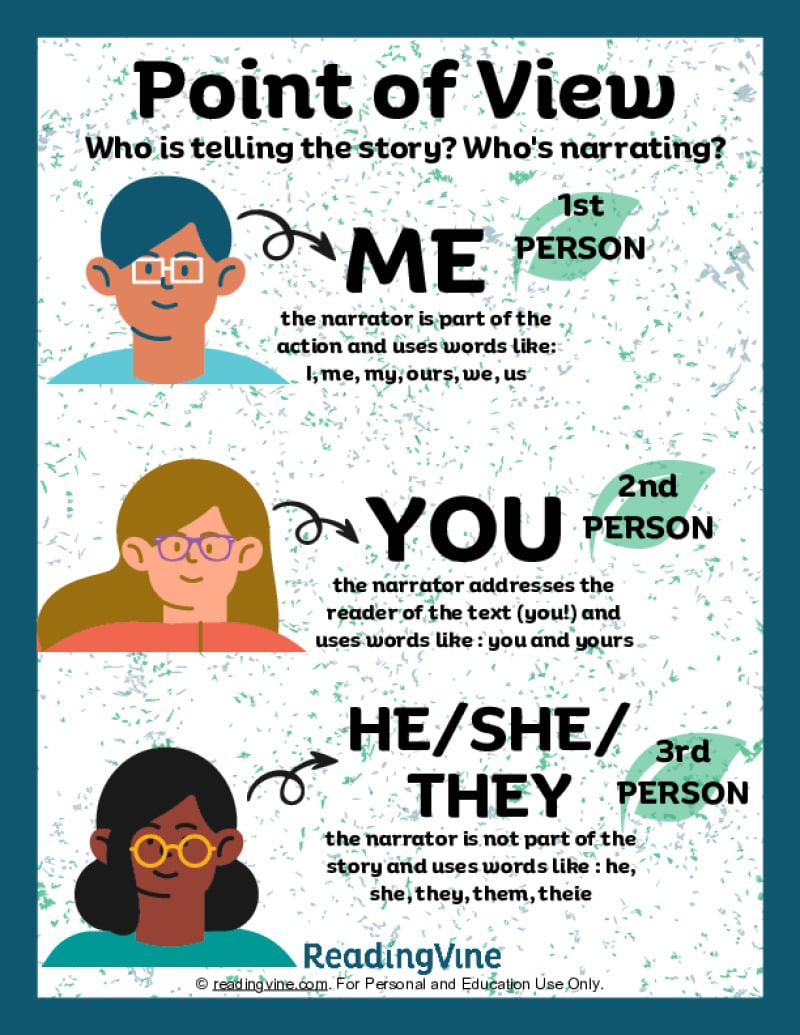
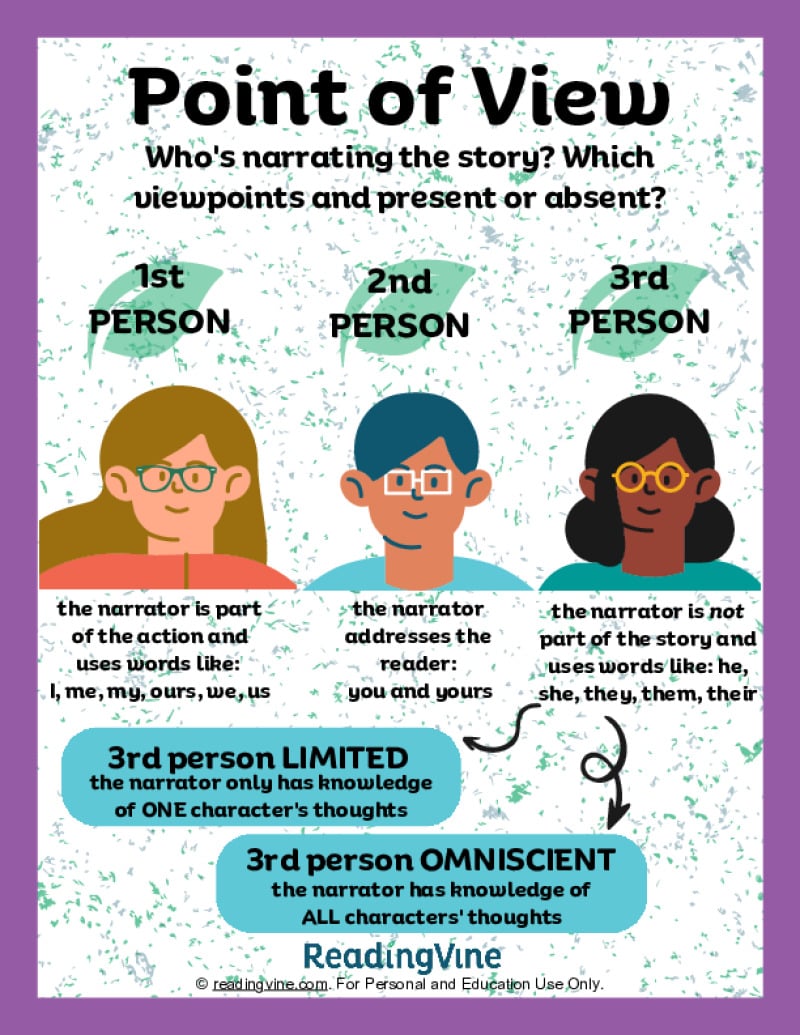
The Four Types of Point of View
The narrator is a character in the story, using “I” and “me.”
“I walked into the room and saw my best friend waiting for me.”The narrator speaks directly to “you,” making the reader the character.
“You walk into the room and see your best friend waiting.”An outside narrator follows ONE character, using “he/she/they.”
“She walked into the room. She felt nervous about seeing her friend.”An all-knowing narrator reveals MULTIPLE characters’ thoughts.
“She walked in nervously. Her friend felt relieved to finally see her.”Key question: Whose thoughts can the reader access? First person = narrator only. Third limited = one character. Third omniscient = multiple characters. Second person = “you” (the reader).
How to Identify Point of View
Look for: I, me, my, we, our, mine. The narrator is IN the story as a character.
Look for: you, your, yours. The reader becomes the main character.
Look for: he, she, they, character names. Only ONE character’s thoughts are revealed.
Look for: he, she, they, character names. MULTIPLE characters’ thoughts are revealed.
Point of View Examples by Category
Jump to any section, or scroll through all 50+ point of view examples below.
Grades K-2
Simple first & third person
12 examplesGrades 3-5
All four POV types
15 examplesGrades 6-8
Complex narratives
15 examplesBy POV Type
1st, 2nd, 3rd limited, 3rd omniscient
4 typesWhat POV Is This?
Test your understanding
10 questionsCommon Mistakes
Errors to avoid
5 mistakesPoint of View Examples for Grades K-2
Simple examples focusing on first person (“I”) and third person (“he/she/they”). These examples help young readers identify who is telling the story.
“I love my new puppy. My puppy likes to play with me.”
First Person: The narrator uses “I,” “my,” and “me”—they’re telling their own story.
“She put on her red boots. She splashed in every puddle.”
Third Person: The narrator uses “she” and “her”—someone else is telling the story.
“I went to the park today. I played on the swings with my friend.”
First Person: The narrator is telling about their own day at the park.
“The bear was hungry. He looked for berries in the forest.”
Third Person: The narrator tells us about the bear using “he.”
“We made cookies with Grandma. I got to lick the spoon!”
First Person: The narrator uses “we” and “I”—they were part of the story.
“Max the dog wagged his tail. He was happy to see his family.”
Third Person: The narrator uses “his” and “he” to tell about Max.
“I lost my tooth at school today. The tooth fairy will come tonight!”
First Person: The narrator is sharing their own exciting news.
“The children played in the snow. They built a big snowman together.”
Third Person: The narrator uses “they” to tell about the children.
“My cat is fluffy and soft. I like to pet her every day.”
First Person: The narrator is telling us about their own cat.
“Lily found a pretty shell. She put it in her pocket to keep.”
Third Person: Someone else is telling us about what Lily did.
“I can ride my bike without training wheels now. I practiced every day.”
First Person: The narrator is proud and telling their own story.
“The bunny hopped across the yard. It stopped to nibble some clover.”
Third Person: The narrator watches and tells us about the bunny.
Point of View Examples for Grades 3-5
Examples covering all four point of view types. Students at this level learn to distinguish between third person limited and third person omniscient.
“I couldn’t believe my eyes when I opened the box. Inside was the exact skateboard I had been dreaming about for months.”
First Person: The narrator shares their own thoughts and feelings using “I.”
“Maya stared at the math problem. She wondered if she would ever understand fractions.”
Third Person Limited: We only know Maya’s thoughts—the narrator follows her perspective.
“You step onto the creaky porch. Your heart beats faster as you reach for the door.”
Second Person: The narrator speaks directly to “you,” putting the reader in the story.
“Jake thought his joke was hilarious. His sister Emma thought it was the worst joke she’d ever heard.”
Third Person Omniscient: The narrator knows what BOTH Jake and Emma are thinking.
“I knew something was wrong the moment I walked into class. Everyone was staring at me, but I had no idea why.”
First Person: We only know what the narrator knows—we’re as confused as they are.
“The detective examined the footprints carefully. He suspected the thief had escaped through the back door.”
Third Person Limited: We follow the detective’s perspective and suspicions only.
“You open the treasure map and trace the dotted line with your finger. The X marks a spot in your own backyard.”
Second Person: Common in choose-your-own-adventure stories where YOU are the hero.
“Mom worried the storm would ruin the picnic. The kids, however, secretly hoped for thunder so they could stay inside and play video games.”
Third Person Omniscient: The narrator reveals thoughts of both Mom and the kids.
“We had been planning the surprise party for weeks. I was in charge of keeping Dad distracted while everyone hid.”
First Person: The narrator uses both “we” and “I”—they’re part of the group.
“Sarah watched her brother open his gift. She had no idea what he was thinking as he stared at the box.”
Third Person Limited: We follow Sarah—she doesn’t know her brother’s thoughts, and neither do we.
“I heard a noise in the attic. My hands trembled as I climbed the stairs, one creaky step at a time.”
First Person: We experience the narrator’s fear directly through their words.
“The teacher knew Marcus had cheated. Marcus believed he had gotten away with it. Both were about to be surprised.”
Third Person Omniscient: The all-knowing narrator sees into both characters’ minds.
“You hear footsteps behind you. Do you turn around or keep walking?”
Second Person: The reader must decide—this POV makes stories interactive.
“Carlos couldn’t stop smiling. He replayed the winning goal in his mind over and over.”
Third Person Limited: We’re inside Carlos’s head, experiencing his joy.
“I promised myself I would never tell anyone the secret. But keeping it was harder than I ever imagined.”
First Person: The narrator’s internal struggle is front and center.
Point of View Examples for Grades 6-8
Complex examples exploring unreliable narrators, shifting perspectives, and the impact of POV on story meaning. Students analyze how authors use point of view intentionally.
“I didn’t mean to start the fire. At least, that’s what I kept telling myself as I watched the flames spread.”
First Person (Unreliable): Can we trust this narrator? Their self-doubt makes us question their story.
“Elena convinced herself that leaving was the right choice. Across town, her mother sat by the window, certain her daughter would return.”
Third Person Omniscient: We see both characters’ perspectives, creating dramatic tension.
“You know you shouldn’t open the letter. But your curiosity has always been stronger than your judgment.”
Second Person: This POV creates intimacy and implicates the reader in the character’s choices.
“Jordan watched the new student cross the cafeteria. Something about her seemed familiar, though Jordan couldn’t place why.”
Third Person Limited: We share Jordan’s confusion—we can’t know more than Jordan knows.
“I was the best player on the team. Everyone knew it, even if they were too jealous to admit it.”
First Person (Unreliable): The narrator’s arrogance suggests their perspective may be biased.
“The diplomat smiled warmly, though his mind raced with suspicion. The ambassador returned the smile, hiding her own doubts behind practiced composure.”
Third Person Omniscient: Access to both minds reveals the tension beneath their polite surface.
“I remember that summer differently than my sister does. She says I started the argument. I know it was her.”
First Person: The narrator acknowledges conflicting perspectives, adding complexity to their account.
“Marcus heard laughter from the other room. He assumed they were laughing at him, though he had no way of knowing for certain.”
Third Person Limited: Marcus’s assumption may be wrong—we only know his interpretation.
“You tell yourself it doesn’t matter what they think. But you check your phone again anyway, hoping for a notification.”
Second Person: Creates an uncomfortable recognition—readers see themselves in the character.
“The grandmother remembered a different version of the family history. The grandson had heard another story entirely. Both versions contained truth; neither was complete.”
Third Person Omniscient: The all-knowing narrator comments on the nature of memory and truth.
“I should probably mention that I wasn’t entirely sober when this happened. But I swear I remember it exactly as it occurred.”
First Person (Unreliable): The narrator undermines their own credibility while insisting on accuracy.
“Aisha scanned the crowded room for an exit. Her instincts screamed that something was wrong, even if she couldn’t identify what.”
Third Person Limited: We experience Aisha’s intuition and uncertainty directly.
“You have two choices. You can confront your fear, or you can let it define you. There is no third option.”
Second Person: Directly challenges the reader, creating urgency and personal stakes.
“The detective prided himself on reading people. The suspect prided herself on being unreadable. One of them would be proven wrong.”
Third Person Omniscient: The narrator sets up conflict by showing both characters’ confidence.
“I was twelve when I discovered the truth about my family. Looking back now, I realize how much I misunderstood at the time.”
First Person (Reflective): The older narrator looks back, acknowledging their younger self’s limited understanding.
Point of View Examples by Type
Examples organized by the four main point of view types: first person, second person, third person limited, and third person omniscient.
First Person Point of View Examples
In first person, the narrator is a character in the story who uses “I,” “me,” “my,” “we,” and “our.” Readers experience events through this character’s eyes and only know what this character knows.
“I never expected to find the diary hidden under the floorboards. But once I started reading, I couldn’t stop.”
The narrator discovers something and shares their personal reaction.
“My grandmother always said I worried too much. Maybe she was right, but I couldn’t help it.”
The narrator reflects on advice while revealing their personality.
“We all knew the rules, but I was the only one brave—or foolish—enough to break them.”
First person can use “we” when the narrator is part of a group.
Second Person Point of View Examples
In second person, the narrator addresses “you” directly, making the reader the main character. This POV is common in choose-your-own-adventure stories, instructions, and some literary fiction.
“You wake up in a room you don’t recognize. Your head throbs, and you can’t remember how you got here.”
The reader becomes the character, experiencing confusion directly.
“You see the finish line ahead. Your legs burn, but you push harder. You can do this.”
Second person creates immediacy and draws readers into the action.
“If you choose to open the door, turn to page 47. If you choose to run away, turn to page 23.”
Classic choose-your-own-adventure format puts decisions in the reader’s hands.
Third Person Limited Point of View Examples
In third person limited, an outside narrator follows ONE character closely, using “he,” “she,” or “they.” Readers only know what this one character thinks, feels, and perceives.
“Mia felt her stomach drop when she saw the grade on her paper. She wondered how she would tell her parents.”
We’re inside Mia’s head—we know her feelings and worries.
“He noticed the stranger watching him from across the street. He pretended not to see, but his heart raced.”
We follow “he” closely, sharing his observations and physical reactions.
“She couldn’t understand why her best friend was acting so distant. Had she done something wrong?“
The character’s confusion becomes the reader’s confusion—we don’t know either.
Third Person Omniscient Point of View Examples
In third person omniscient, an all-knowing narrator can access ANY character’s thoughts and feelings. The narrator may also share information that no character knows.
“Tom thought he was being sneaky. His mother, however, had known about his plan since breakfast.”
The narrator reveals both characters’ knowledge, creating dramatic irony.
“The king believed his kingdom was safe. Miles away, an army was already marching toward his borders—a threat no one in the castle could have imagined.”
The omniscient narrator knows things no character in the story knows.
“Both sisters wanted to apologize first. Both were too proud to make the first move. And so the silence stretched on.”
Access to both minds shows how similar they are, despite the conflict.
What Point of View Is This?
Test your understanding! Identify the point of view in each example, then check the answer.
“I knew I should have studied harder for the test.”
The pronoun “I” tells us the narrator is a character telling their own story.
“She watched the sunset, wondering if he was watching it too.”
Uses “she” but only reveals HER thoughts—we don’t know what “he” is actually doing.
“She thought he was ignoring her. He thought she was avoiding him. Both were wrong.”
The narrator reveals BOTH characters’ thoughts and tells us they’re both mistaken.
“You feel the cold water hit your face. You gasp and sit up in bed.”
The pronoun “you” makes the reader the main character experiencing the story.
“We decided to explore the abandoned house, even though my brother said it was a bad idea.”
“We” and “my” show the narrator is part of the story—first person can use “we.”
“Marcus didn’t understand why everyone was laughing. He felt his face turn red.”
We only know Marcus’s confusion and embarrassment—not what others are thinking.
“The dog waited eagerly by the door, not knowing his owner would never return. Miles away, she was starting a new life.”
The narrator knows things no single character knows and shows us multiple perspectives.
“To make the perfect pancake, you first heat the pan. Then you pour the batter slowly.”
Instructions and how-to writing often use second person “you.”
“Looking back, I realize how naive I was. But at the time, I believed every word he said.”
A reflective first-person narrator looks back on their past self.
“The letter sat unopened on her desk. Part of her wanted to read it; part of her was afraid.”
We’re deep inside “her” internal conflict—third person limited can feel very intimate.
Common Point of View Mistakes
Students often confuse point of view types or mix them up in their own writing. Here are the most common errors.
1 Confusing Third Person Limited with Third Person Omniscient
“It’s third person omniscient because it uses ‘he’ and ‘she.'”
“I need to check how MANY characters’ thoughts are revealed, not just the pronouns.”
Remember: Third person limited and omniscient BOTH use “he/she/they.” The difference is whether we see into ONE mind (limited) or MULTIPLE minds (omniscient).
2 Shifting Point of View Mid-Story (POV Slip)
“I walked into the room. She noticed that I looked tired.” (Switches from first to third)
“I walked into the room. She looked at me like I was exhausted.” (Stays in first person)
Remember: In first person, the narrator can only describe what others DO, not what they THINK (unless told directly). Watch for accidental perspective shifts.
3 Thinking “We” Is Not First Person
“‘We went to the store’ is third person because it’s about a group.”
“‘We’ is first person plural—the narrator is part of the group they’re describing.”
Remember: First person includes “I,” “me,” “my,” AND “we,” “us,” “our.” If the narrator is IN the story, it’s first person.
4 Confusing the Narrator with the Author
“The story is in first person because the author is telling us about herself.”
“The story is in first person because the NARRATOR uses ‘I.’ The narrator isn’t always the author.”
Remember: The narrator tells the story; the author writes it. A male author can write a female first-person narrator. They’re not the same person.
5 Missing Second Person Entirely
“There are only two types: first person and third person.”
“Second person uses ‘you’ and appears in choose-your-own-adventure books, instructions, and some literary fiction.”
Remember: Second person is less common but still important. Anytime “you” is the main character, it’s second person POV.
Tips for Teaching Point of View
Teach students to identify “I/me” (first), “you” (second), and “he/she/they” (third) first. Once they can spot pronouns, introduce the limited vs. omniscient distinction.
Ask: “Whose thoughts can we read?” If it’s one character = limited. If it’s multiple characters = omniscient. This is the key distinction students struggle with most.
Have students rewrite a short paragraph from first person to third person (and vice versa). This hands-on practice reveals how POV changes the reader’s experience.
Push beyond identification to analysis: “Why did the author use first person here? What would change if this were third person omniscient?” This builds critical thinking.
Once students understand first person, challenge them: “Can we always trust what the narrator tells us?” This opens rich discussions about bias and perspective.
Display the four types with pronouns, definitions, and examples from books students know. Reference it during read-alouds and independent reading discussions.
Point of View: Frequently Asked Questions
What is point of view in simple terms?
Point of view is who is telling a story and how they’re telling it. If the narrator says “I” and is a character in the story, that’s first person. If the narrator talks about characters using “he,” “she,” or “they” and isn’t in the story, that’s third person. Point of view determines what readers can know about characters’ thoughts and feelings.
What is the difference between third person limited and third person omniscient point of view?
Both use “he/she/they” pronouns, but they differ in how many characters’ thoughts readers can access. Third person limited follows ONE character—readers only know what that character thinks and perceives. Third person omniscient is “all-knowing”—the narrator can reveal ANY character’s thoughts and may even share information no character knows.
What grade level should students learn about point of view?
Students begin identifying first and third person in grades 1-2. By grades 3-5, students distinguish between first, second, and third person and are introduced to limited vs. omniscient. In grades 6-8, students analyze how POV affects meaning and explore concepts like unreliable narrators. Common Core standard RL.6 addresses point of view across grade levels.
What is second person point of view?
Second person point of view uses “you” as the main character, making the reader part of the story. It’s common in choose-your-own-adventure books (“You open the door and see…”), instructions (“First, you preheat the oven…”), and some literary fiction. Second person creates immediacy and directly involves the reader in the narrative.
How do I help students identify point of view?
Teach a two-step process: (1) Find the pronouns—”I/me” = first person, “you” = second person, “he/she/they” = third person. (2) For third person, ask “Whose thoughts can I read?” If only one character’s thoughts = limited; if multiple characters’ thoughts = omniscient. Practice with short passages before analyzing longer texts.
Why is point of view important in reading and writing?
Point of view shapes the entire reading experience. First person creates intimacy but limits what readers know. Third person omniscient provides a broader view but may feel less personal. Understanding POV helps readers analyze author’s craft—why did the author choose this perspective? It also helps writers make intentional choices about how to tell their own stories effectively.