
 = Partner Site
Cause and Effect
Cause and effect is a relationship where one event (the cause) makes another event (the effect) happen. Understanding cause and effect helps readers comprehend why things happen in texts and in the real world. This skill is essential for reading comprehension, scientific thinking, and analyzing historical events. These 50+ cause and effect examples help students identify causes, effects, and the signal words that connect them across grade levels.
For Teachers
Start with simple, single cause-and-effect relationships before introducing chains and multiple causes/effects. Teach signal words explicitly—they’re the key to identifying cause and effect in text. Use graphic organizers to help students visualize the relationships.
For Parents
Help your child spot cause and effect in everyday life: “Why did that happen? What happened because of it?” While reading together, pause to ask “What caused that?” and “What happened as a result?” This builds critical thinking skills that transfer to all subjects.
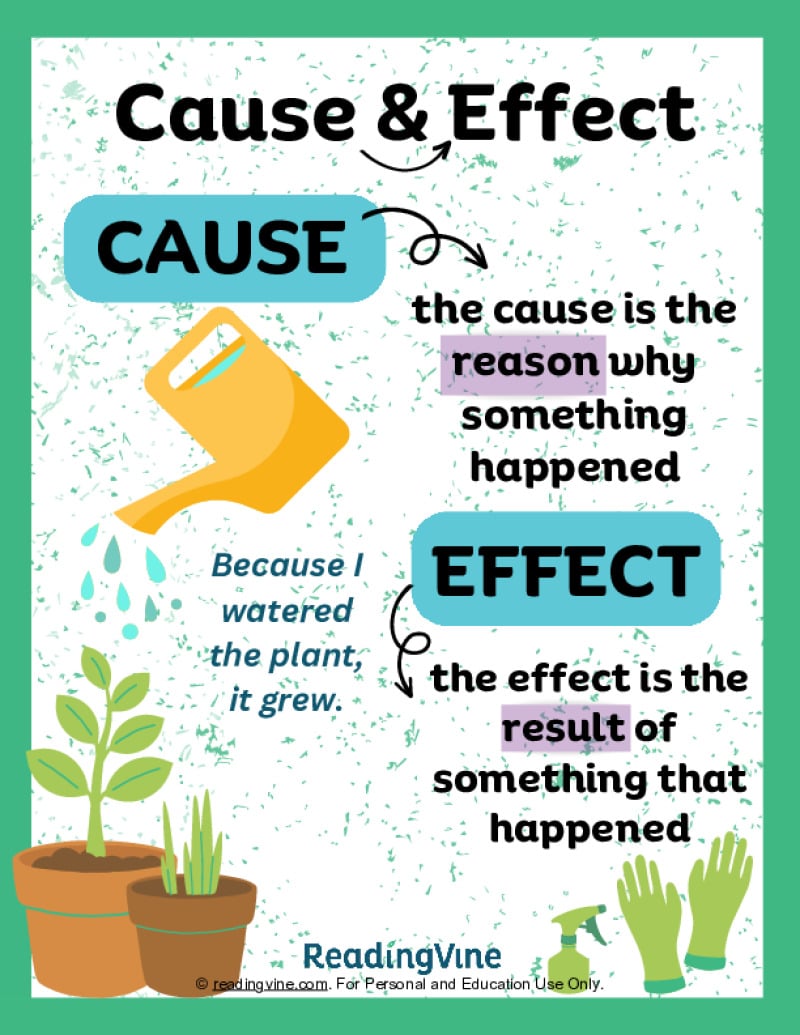
Cause and Effect Anchor Chart
Use this printable anchor chart to help students understand cause and effect relationships.
What’s included:
- Cause and effect definitions
- Signal words list
- Visual examples
What Is Cause and Effect?
Cause and effect is a relationship between events where one event (the cause) makes another event (the effect) happen. The cause is WHY something happens; the effect is WHAT happens as a result. Authors use signal words like “because,” “therefore,” and “as a result” to show cause-and-effect relationships. Understanding cause and effect is essential for reading comprehension, scientific reasoning, and understanding how events in history connect.
Cause vs. Effect
The reason WHY something happens. Comes first (but may appear second in a sentence).
Ask: “Why did this happen?”WHAT happens as a result. The outcome or consequence of the cause.
Ask: “What happened because of this?”Because it rained all day (cause), the soccer game was canceled (effect).
The rain CAUSED the cancellation. The cancellation is the EFFECT of the rain.Remember: The cause doesn’t always come first in the sentence. “The game was canceled because it rained” puts the effect first, then the cause. Look for signal words to identify which is which.
Cause and Effect Signal Words
because, since, due to, as a result of, caused by, the reason for, on account of, bring about
so, therefore, as a result, consequently, thus, hence, leads to, results in, causes, effects
if…then, when…then, unless, provided that, in order to
this led to, this caused, which resulted in, for this reason, that’s why
Cause and Effect Examples by Category
Jump to any section, or scroll through all 50+ cause and effect examples below.
Grades K-2
Simple relationships
12 examplesGrades 3-5
Chains & multiple effects
15 examplesGrades 6-8
Complex relationships
15 examplesBy Relationship Type
Single, multiple, chains
4 typesIdentify Cause & Effect
Test your understanding
10 questionsCommon Mistakes
Errors to avoid
5 mistakesCause and Effect Examples for Grades K-2
Simple, single cause-and-effect relationships that young readers can easily identify. Signal words are highlighted to help students see the connection between cause and effect.
“Because it was raining, we stayed inside.”
Cause: It was raining. Effect: We stayed inside. Signal word: because.
“The boy forgot his lunch, so he was hungry at school.”
Cause: Forgot his lunch. Effect: Was hungry. Signal word: so.
“Since the sun was bright, I wore my sunglasses.”
Cause: The sun was bright. Effect: Wore sunglasses. Signal word: since.
“The dog barked loudly. As a result, the baby woke up.”
Cause: Dog barked. Effect: Baby woke up. Signal words: as a result.
“If you don’t water plants, then they will die.”
Cause: Not watering plants. Effect: Plants die. Signal words: if…then.
“The ice cream melted because it was left in the sun.”
Cause: Left in the sun. Effect: Ice cream melted. Signal word: because.
“She studied hard for the test, so she got a good grade.”
Cause: Studied hard. Effect: Got a good grade. Signal word: so.
“The wind blew hard. This caused the leaves to fall from the trees.”
Cause: Wind blew hard. Effect: Leaves fell. Signal words: this caused.
“Because the alarm clock didn’t ring, Mom overslept.”
Cause: Alarm didn’t ring. Effect: Mom overslept. Signal word: because.
“The kitten knocked over the glass, so water spilled everywhere.”
Cause: Kitten knocked over glass. Effect: Water spilled. Signal word: so.
“Due to the snowstorm, school was closed.”
Cause: Snowstorm. Effect: School was closed. Signal words: due to.
“He ate too much candy, so his stomach hurt.”
Cause: Ate too much candy. Effect: Stomach hurt. Signal word: so.
Cause and Effect Examples for Grades 3-5
More complex relationships including cause-and-effect chains, multiple causes, and multiple effects. Students analyze how events connect and influence each other.
“Because the river flooded, many homes were damaged. As a result, families had to move to shelters.”
Chain: Flood → damaged homes → families in shelters. One effect becomes the cause of the next.
“The invention of the printing press had many effects. Books became cheaper, more people learned to read, and new ideas spread faster.”
One cause, multiple effects: Printing press caused three different outcomes.
“The team won the championship due to their hard work, excellent coaching, and teamwork.”
Multiple causes, one effect: Three factors combined to cause the win.
“Since the colonists were taxed without representation, they grew angry. This led to protests, which eventually resulted in the American Revolution.”
Chain: Taxation → anger → protests → Revolution. Events build on each other.
“Deforestation causes animals to lose their homes. Consequently, many species become endangered or extinct.”
Cause: Deforestation. Effects: Habitat loss → endangered species. Signal words: causes, consequently.
“The experiment failed because the scientist didn’t follow the procedure correctly and the equipment was broken.”
Multiple causes, one effect: Two problems caused the failure.
“When water freezes, it expands. This is why pipes can burst during cold weather.”
Cause: Water freezing/expanding. Effect: Pipes burst. Signal words: when, this is why.
“The drought had several effects on the farm. Crops died, the well dried up, and the farmer had to sell his animals.”
One cause, multiple effects: Drought caused three different problems.
“Because bees pollinate flowers, plants can make seeds. Without bees, many plants could not reproduce.”
Cause: Bee pollination. Effect: Plants make seeds. Also shows what happens without the cause.
“Rosa Parks refused to give up her bus seat. As a result, she was arrested. This sparked the Montgomery Bus Boycott, which helped end bus segregation.”
Chain: Refusal → arrest → boycott → end of segregation. Each event causes the next.
“The city built a new park, resulting in more families visiting downtown, increased business for local shops, and cleaner air from the new trees.”
One cause, multiple effects: The park caused several positive changes.
“Due to poor diet, lack of exercise, and not enough sleep, the student had trouble focusing in class.”
Multiple causes, one effect: Three factors caused the concentration problem.
“The earthquake damaged the power lines. Therefore, thousands of homes lost electricity. This meant food in refrigerators spoiled.”
Chain: Earthquake → damaged lines → lost power → spoiled food.
“Since the library started a summer reading program, more children read during vacation and test scores improved in the fall.”
One cause, multiple effects: Reading program caused more reading AND better scores.
“The volcano erupted, causing ash to fill the sky. As a result, flights were canceled and the sun was blocked for days.”
Chain with multiple effects: Eruption → ash → canceled flights AND blocked sun.
Cause and Effect Examples for Grades 6-8
Complex cause-and-effect relationships including implied connections, long-term effects, and analysis of how historical, scientific, and social events influence each other.
“The Industrial Revolution transformed society through interconnected causes and effects. As factories emerged, rural populations migrated to cities. This urbanization led to overcrowding, which in turn caused public health crises and eventually prompted new sanitation laws.”
Complex chain: Factories → migration → overcrowding → health crises → new laws. Effects become causes of further effects.
“Because social media algorithms prioritize engaging content, users often see posts that confirm their existing beliefs. This creates ‘filter bubbles’ which contribute to political polarization.”
Chain: Algorithms → confirmation bias → filter bubbles → polarization. Shows modern cause/effect.
“Climate change results from multiple factors: burning fossil fuels, deforestation, and industrial agriculture all release greenhouse gases. The combined effect is rising global temperatures.”
Multiple causes, one effect: Three human activities combine to cause warming.
“The stock market crash of 1929 had cascading effects. When banks failed, people lost their savings. Since consumers had no money to spend, businesses closed. Consequently, unemployment soared, deepening the Great Depression.”
Cascading chain: Crash → bank failures → lost savings → business closures → unemployment → Depression.
“Antibiotic overuse has led to drug-resistant bacteria. Because these ‘superbugs’ don’t respond to standard treatments, infections that were once easily cured can now be deadly.”
Cause: Antibiotic overuse. Effects: Resistant bacteria → untreatable infections → potential deaths.
“The invention of the smartphone caused profound social changes. Communication became instant, information became accessible anywhere, and entire industries were disrupted—all because of a device that fits in your pocket.”
One cause, multiple far-reaching effects: Shows how one invention transformed society.
“Due to the assassination of Archduke Franz Ferdinand, a complex web of alliances was triggered. This resulted in nations declaring war on each other, ultimately causing World War I to engulf Europe.”
Chain: Assassination → alliance activations → declarations of war → global conflict.
“Ocean acidification occurs because oceans absorb excess carbon dioxide. As a result, the water’s pH drops, which causes coral bleaching and threatens shellfish that need calcium carbonate to build shells.”
Scientific chain: CO₂ absorption → pH drop → coral bleaching + shellfish threat.
“The lack of representation in government, unfair taxation, and restrictions on trade all contributed to colonial resentment. These factors combined to make the American Revolution inevitable.”
Multiple causes, one effect: Several grievances together caused the Revolution.
“When species lose their natural habitats, they often come into closer contact with humans. This proximity increases the risk of diseases jumping from animals to people, as demonstrated by several recent outbreaks.”
Cause: Habitat loss. Effects: Closer contact → disease transmission → outbreaks.
“The Civil Rights Movement succeeded because of multiple factors: courageous leaders, strategic nonviolent protests, media coverage of violence against protesters, and shifting public opinion. No single cause was sufficient alone.”
Multiple causes, one effect: Various factors combined for success.
“Automation in manufacturing has resulted in both job losses and new opportunities. While some workers lost positions to robots, this same technology has created demand for technicians, programmers, and engineers.”
One cause, contrasting effects: Automation caused both negative and positive outcomes.
“Because plastics take centuries to decompose, waste accumulates in ecosystems. Consequently, microplastics enter the food chain, eventually affecting human health in ways scientists are still discovering.”
Long-term chain: Non-decomposition → accumulation → food chain → human health.
“The development of the internet made possible global communication, e-commerce, and remote work. However, it also led to new problems: cybercrime, misinformation, and privacy concerns.”
One cause, multiple mixed effects: Internet caused both benefits and challenges.
“Rising temperatures cause ice sheets to melt. This melting leads to rising sea levels, which threatens coastal cities. The displacement of populations could result in migration crises and political instability.”
Extended chain: Temperature → melting → sea rise → coastal threats → displacement → instability.
Cause and Effect Examples by Relationship Type
Different patterns of cause and effect relationships: single, multiple causes, multiple effects, and chains.
Single Cause → Single Effect
The simplest pattern: one event causes one result. This is where students should start.
“The cat knocked the vase off the table, so it shattered on the floor.”
Cause: Cat knocked vase. Effect: Vase shattered. One cause, one effect.
“Because the battery died, the flashlight stopped working.”
Cause: Battery died. Effect: Flashlight stopped. Direct, simple relationship.
Single Cause → Multiple Effects
One event causes several different results. Common in science and history.
“The hurricane caused widespread damage: homes were destroyed, power was lost for weeks, and thousands of people were displaced.”
One cause (hurricane), three effects: Destroyed homes, lost power, displaced people.
“Regular exercise leads to improved cardiovascular health, better mood, increased energy, and stronger muscles.”
One cause (exercise), four effects: Heart health, mood, energy, muscle strength.
Multiple Causes → Single Effect
Several factors combine to produce one result. Common in complex situations.
“The student earned an A on the project due to careful research, excellent writing, creative presentation, and meeting the deadline.”
Four causes, one effect: Research + writing + creativity + timeliness = A grade.
“The extinction of dinosaurs resulted from an asteroid impact, volcanic activity, and climate change working together.”
Multiple causes, one effect: Several factors combined to cause extinction.
Cause and Effect Chains
One effect becomes the cause of the next event, creating a chain reaction. Also called “domino effect.”
“The alarm didn’t go off → I overslept → I missed the bus → I was late for school → I missed the test.”
Chain of 5 links: Each effect becomes the cause of the next problem.
“Because it didn’t rain, the crops failed. This caused food shortages, which led to rising prices, resulting in widespread hunger.”
Chain: No rain → crop failure → shortages → high prices → hunger.
“A single spark ignited dry brush → the fire spread to trees → smoke filled the valley → residents had to evacuate → homes were lost.”
Chain: Small cause (spark) leads to progressively larger effects.
What’s the Cause? What’s the Effect?
Test your understanding! Identify the cause and effect in each example.
“Because the road was icy, several cars slid into the ditch.”
Cause: The road was icy. Effect: Cars slid into the ditch. Signal word “because” introduces the cause.
“The team practiced every day after school. As a result, they won the championship.”
Cause: Daily practice. Effect: Won championship. “As a result” signals the effect.
“The store closed early due to the power outage.”
Cause: Power outage. Effect: Store closed early. “Due to” introduces the cause (even though effect comes first in the sentence).
“When you mix baking soda and vinegar, the mixture fizzes and bubbles.”
Cause: Mixing baking soda and vinegar. Effect: Fizzing and bubbling. “When” signals the cause condition.
“The student forgot to save her work. Therefore, she lost the entire essay when the computer crashed.”
Cause: Forgot to save. Effect: Lost the essay. “Therefore” signals the effect.
“Heavy rains caused the river to flood, which damaged homes and washed out bridges.”
Cause: Heavy rains. Effects: Flood → damaged homes AND washed out bridges. One cause, multiple effects.
“The cookies burned because the oven was too hot and the timer didn’t go off.”
Causes: Oven too hot AND timer didn’t go off. Effect: Cookies burned. Multiple causes, one effect.
“Since she stayed up late watching movies, Maria was exhausted the next day.”
Cause: Stayed up late. Effect: Was exhausted. “Since” introduces the cause.
“If plants don’t get enough sunlight, they will not be able to make food through photosynthesis.”
Cause: Not enough sunlight. Effect: Can’t make food. “If…will” shows conditional cause and effect.
“The invention of vaccines led to the eradication of smallpox and the prevention of countless deaths.”
Cause: Invention of vaccines. Effects: Smallpox eradicated AND deaths prevented. “Led to” signals the effects.
Common Cause and Effect Mistakes
Students often make these errors when identifying cause and effect. Here’s how to avoid them.
1 Confusing Sequence with Cause and Effect
“I ate breakfast. Then I went to school.” = cause and effect
This is SEQUENCE (time order), not cause/effect. Eating breakfast didn’t CAUSE going to school.
Remember: Just because B happens after A doesn’t mean A caused B. Ask: “Did A MAKE B happen?” If not, it’s sequence, not cause and effect.
2 Reversing Cause and Effect
“The sidewalk was wet because I slipped.” (Wet sidewalk caused the slip, not the other way around.)
“I slipped because the sidewalk was wet.” (Wet sidewalk = cause; slipping = effect.)
Remember: The cause happens first and MAKES the effect happen. Ask: “Which event made the other one happen?” That’s the cause.
3 Thinking the Cause Always Comes First in the Sentence
“The first thing mentioned is always the cause.”
“The game was canceled because it rained.” Effect (cancellation) comes first; cause (rain) comes second.
Remember: Authors often put the effect first. Use signal words to identify which is which, not word order. “Because” and “since” introduce causes; “so” and “therefore” introduce effects.
4 Missing Implied Cause and Effect
“There’s no cause and effect because I don’t see signal words.”
“He studied for six hours. He aced the test.” = cause and effect, even without “so” or “because.”
Remember: Not all cause-and-effect relationships use signal words. Sometimes you have to infer the connection. Ask yourself: “Did one event lead to the other?”
5 Assuming Correlation Is Causation
“Ice cream sales increase in summer. Crime also increases in summer. So ice cream causes crime.”
Both are caused by a third factor (hot weather). Ice cream doesn’t cause crime—they just happen at the same time.
Remember: Two things happening together doesn’t mean one caused the other. Look for a direct, logical connection. Ask: “Does this REALLY make that happen, or do they just occur together?”
Tips for Teaching Cause and Effect
Create a reference chart with cause signal words (because, since, due to) and effect signal words (so, therefore, as a result). Students can use it during reading.
Train students to ask: “Why did this happen?” (finds cause) and “What happened because of this?” (finds effect). These questions work for any cause-and-effect relationship.
This is the #1 confusion. Just because B follows A doesn’t mean A caused B. Use examples like “I brushed my teeth, then I went to bed” (sequence) vs. “Because I was tired, I went to bed” (cause/effect).
Cause-and-effect charts, chain diagrams, and fishbone diagrams help students visualize relationships. Match the organizer to the type: simple arrows for single cause/effect, branching diagrams for multiple effects.
Cause and effect is everywhere: science experiments, historical events, story plots, current events. Help students see the pattern across contexts to deepen understanding.
Start with single cause → single effect. Then introduce multiple effects, multiple causes, and finally cause-and-effect chains. Build complexity gradually.
Cause and Effect: Frequently Asked Questions
What is cause and effect in simple terms?
Cause and effect is a relationship between events where one event (the cause) makes another event (the effect) happen. The cause is WHY something happens. The effect is WHAT happens as a result. For example: “The glass broke because it fell off the table.” The fall is the cause; the breaking is the effect.
What are signal words for cause and effect?
Cause signal words include: because, since, due to, as a result of, caused by, the reason for. Effect signal words include: so, therefore, as a result, consequently, thus, leads to, results in. Conditional words like “if…then” also show cause and effect relationships.
What is the difference between cause and effect and sequence?
Sequence is simply the order events happen in—first, then, next, finally. Cause and effect means one event MAKES another happen. Just because B happens after A doesn’t mean A caused B. “I ate breakfast, then went to school” is sequence. “Because I was hungry, I ate breakfast” is cause and effect.
Can one cause have multiple effects?
Yes! One cause can lead to many effects. For example, a hurricane (one cause) can destroy homes, knock out power, flood streets, and displace families (multiple effects). Similarly, multiple causes can lead to one effect—a student might fail a test due to not studying, being tired, AND feeling sick.
What grade level should students learn about cause and effect?
Students begin identifying simple cause-and-effect relationships in kindergarten and 1st grade. By grades 3-5, students analyze more complex relationships including chains and multiple causes/effects. In grades 6-8, students evaluate cause and effect in history, science, and complex texts. This skill appears in Common Core Reading standards across all grade levels.
What is a cause and effect chain?
A cause and effect chain (also called a domino effect) is when one effect becomes the cause of the next event. For example: Rain → flooding → road closures → people late for work → missed meetings. Each effect triggers the next cause, creating a chain reaction. Understanding chains helps students see how small events can have big consequences.