
 = Partner Site
Figurative Language
Figurative language uses words and phrases in creative, non-literal ways to create vivid images, evoke emotions, and add depth to writing. Instead of saying “she’s happy,” figurative language lets us say “she’s on cloud nine” or “her smile lit up the room.” Writers use these literary devices to paint pictures with words, make comparisons that spark understanding, and engage readers on a deeper level.
For Teachers
Start with concrete, familiar devices like simile and personification before moving to more nuanced concepts like symbolism and irony. Use the examples pages below for direct instruction, mentor text analysis, and student writing practice.
For Parents
Figurative language is everywhere—in books, songs, ads, and everyday speech. Help your child recognize these creative expressions by pointing them out and asking “What two things are being compared?” or “What picture does that create in your mind?”
Figurative Language Worksheets
Printable worksheets to practice similes, metaphors, personification, idioms, and other literary devices.
What Is Figurative Language?
Figurative language is any language that uses words in non-literal ways to create meaning, evoke emotion, or paint vivid pictures. It includes devices like simile, metaphor, personification, hyperbole, idioms, and more. Figurative language makes writing more interesting and helps readers connect with ideas on a deeper level than plain, literal statements allow.
Figurative vs. Literal Language
Time flies when you’re having fun.
Time doesn’t actually fly—this expresses how quickly it seems to passKey distinction: Literal language means exactly what it says. Figurative language uses creative comparisons, exaggerations, and expressions to convey meaning.
Types of Figurative Language
Click any type below to see 50+ examples organized by grade level, or scroll down for a quick overview of each.
Comparisons & Descriptions
Devices that compare things or create vivid mental images for readers.
Simile
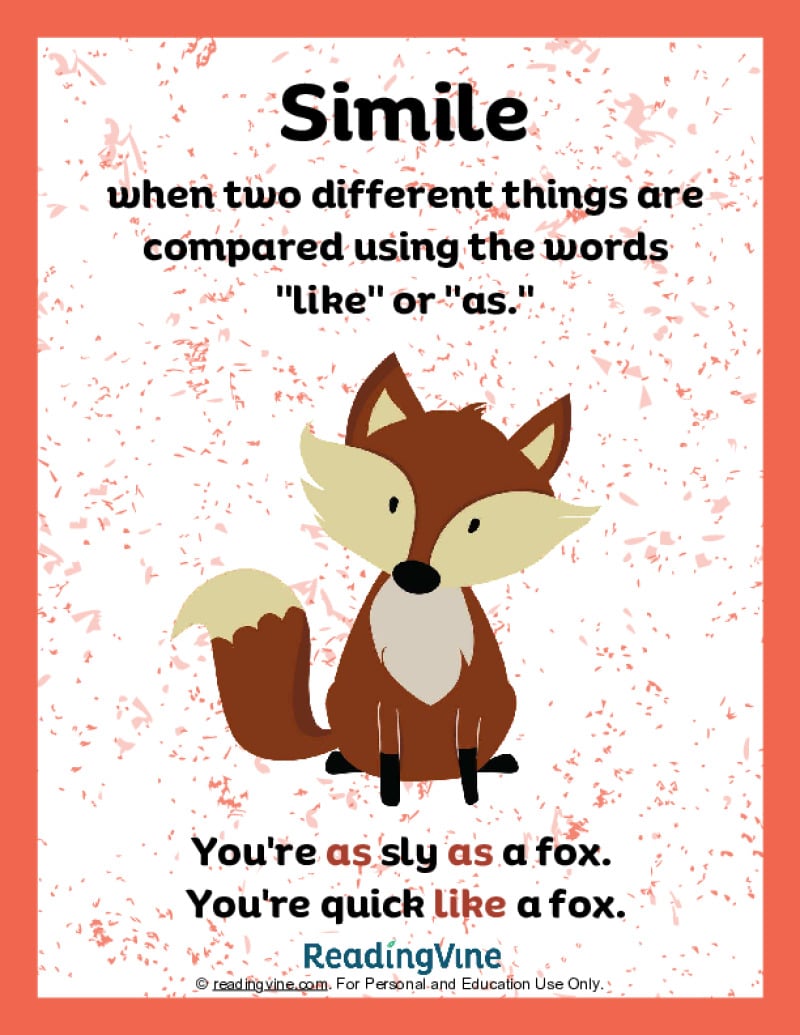
Comparisons using “like” or “as” to create vivid descriptions.
50+ examplesMetaphor
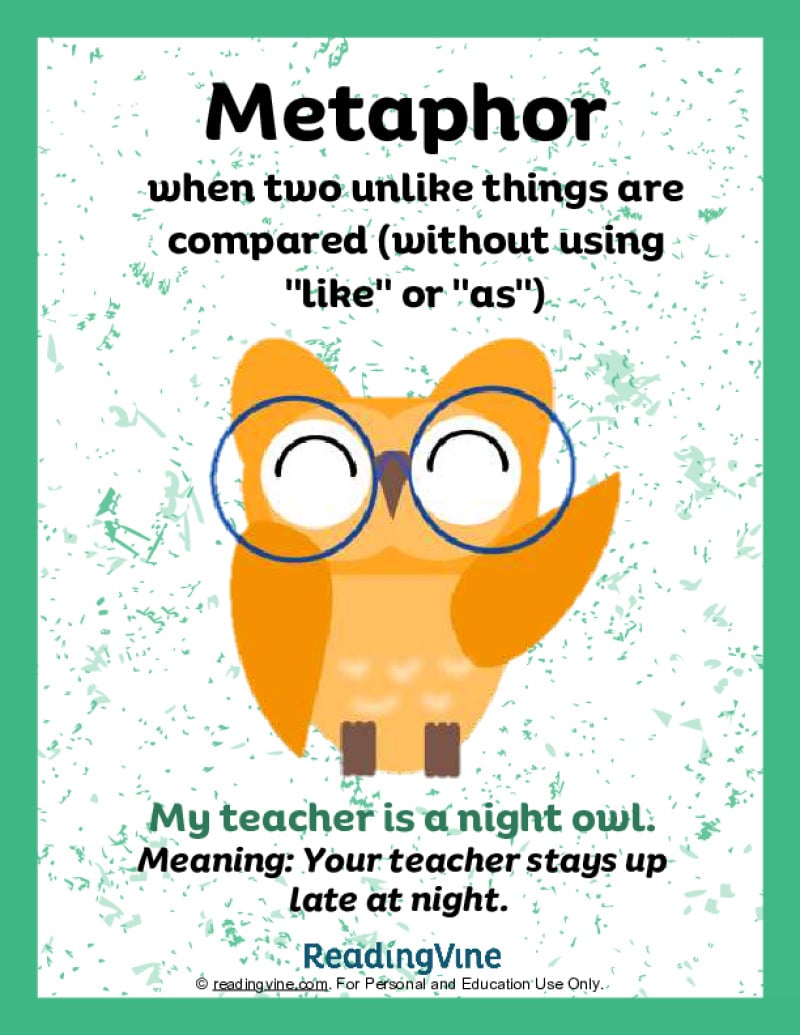
Direct comparisons that say one thing IS another.
50+ examplesPersonification
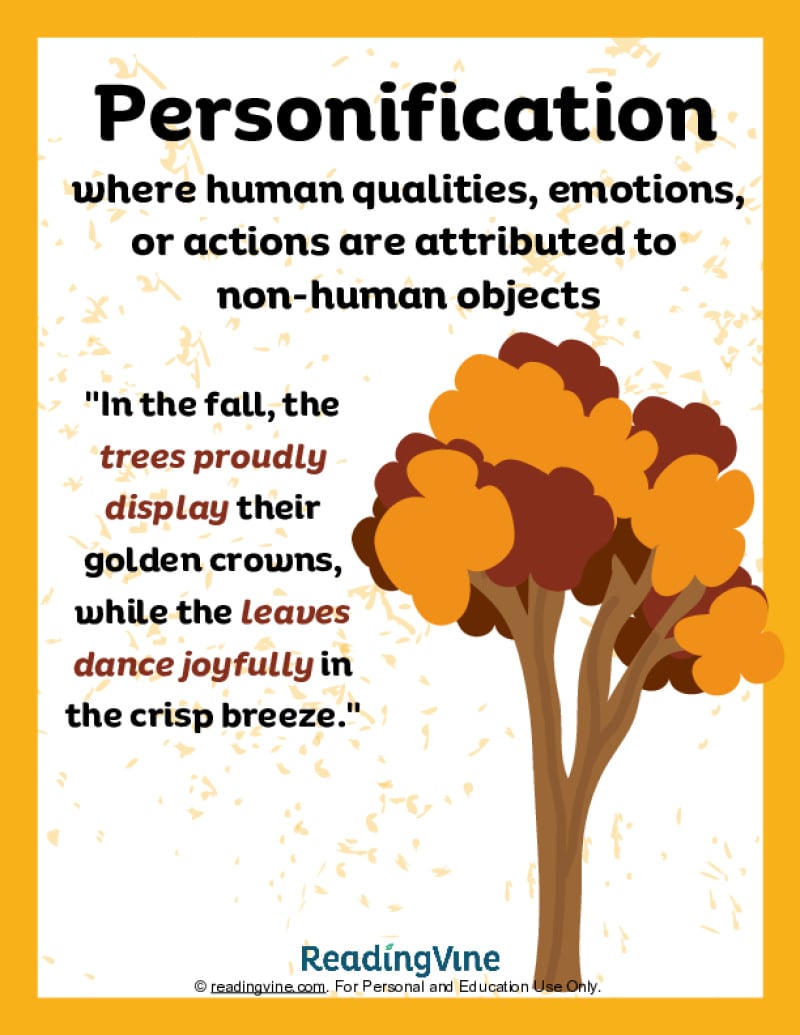
Giving human qualities to animals, objects, or ideas.
50+ examplesHyperbole
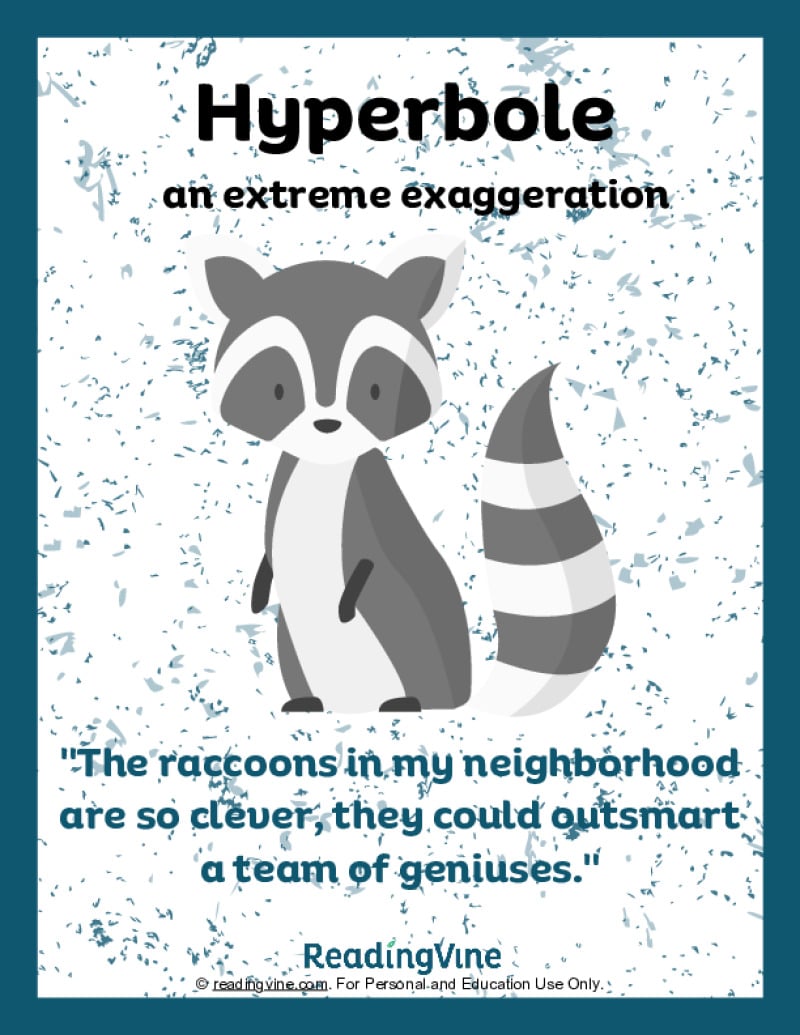
Extreme exaggeration used for emphasis or humor.
50+ examplesImagery
Descriptive language that appeals to the five senses.
50+ examplesOxymoron
Combining contradictory terms for effect.
50+ examplesSound Devices
Literary techniques that create rhythm, music, and memorable sounds in writing.
Alliteration
Repetition of consonant sounds at the beginning of words.
50+ examplesOnomatopoeia
Words that imitate the sounds they describe.
50+ examplesMeaning & Interpretation
Devices that convey deeper meanings, hidden messages, or unexpected twists.
Idiom
Phrases with figurative meanings different from literal words.
50+ examplesSymbolism
Objects, colors, or elements that represent deeper meanings.
50+ examplesIrony
When words or situations convey the opposite of expectations.
50+ examplesEuphemism
Mild expressions used in place of harsh or blunt ones.
50+ examplesDouble Entendre
Words or phrases with two interpretations.
50+ examplesNarrative & Rhetorical Techniques
Devices that shape storytelling, build suspense, or create persuasive effects.
Foreshadowing
Hints or clues about events that will happen later.
50+ examplesFlashback
Scenes that interrupt the present to show past events.
50+ examplesRhetorical Devices
Techniques used to persuade or create an effect.
50+ examplesRhetorical Questions
Questions asked for effect, not to get an answer.
50+ examplesTone & Atmosphere
How authors create emotional effects and convey attitudes toward their subjects.
Tone
The author’s attitude toward the subject or audience.
50+ examplesMood
The emotional atmosphere a text creates for readers.
50+ examplesFigurative Language Examples by Type
Quick examples at each grade level. Click the link below each section for 50+ more examples.
Simile
A simile compares two different things using the words “like” or “as.” Similes help readers understand something by comparing it to something familiar.
Her eyes sparkled like stars.
Compares eyes to stars using “like.”
The snow was as white as cotton.
Compares snow to cotton using “as.”
His words cut like a knife.
Compares hurtful words to a knife using “like.”
Metaphor
A metaphor directly states that one thing IS another thing, without using “like” or “as.” Metaphors create strong images by equating two different things.
The classroom was a zoo.
Says the classroom IS a zoo (chaotic).
Life is a roller coaster.
Says life IS a roller coaster (full of ups and downs).
Time is a thief that steals our youth.
Says time IS a thief (takes things from us).
Personification
Personification gives human qualities, actions, or emotions to animals, objects, or ideas. It helps readers connect with non-human things.
The sun smiled down on us.
Gives the sun the human ability to smile.
The wind whispered through the trees.
Gives wind the human ability to whisper.
Fear crept up behind her.
Gives fear the human ability to sneak.
Hyperbole
Hyperbole (hy-PER-buh-lee) is extreme exaggeration not meant to be taken literally. It adds emphasis, humor, or emotion to writing.
I’m so hungry I could eat a horse.
Exaggerates hunger—no one could really eat a horse.
I’ve told you a million times!
Exaggerates frequency for emphasis.
Her heart shattered into a million pieces.
Exaggerates emotional pain—hearts don’t literally shatter.
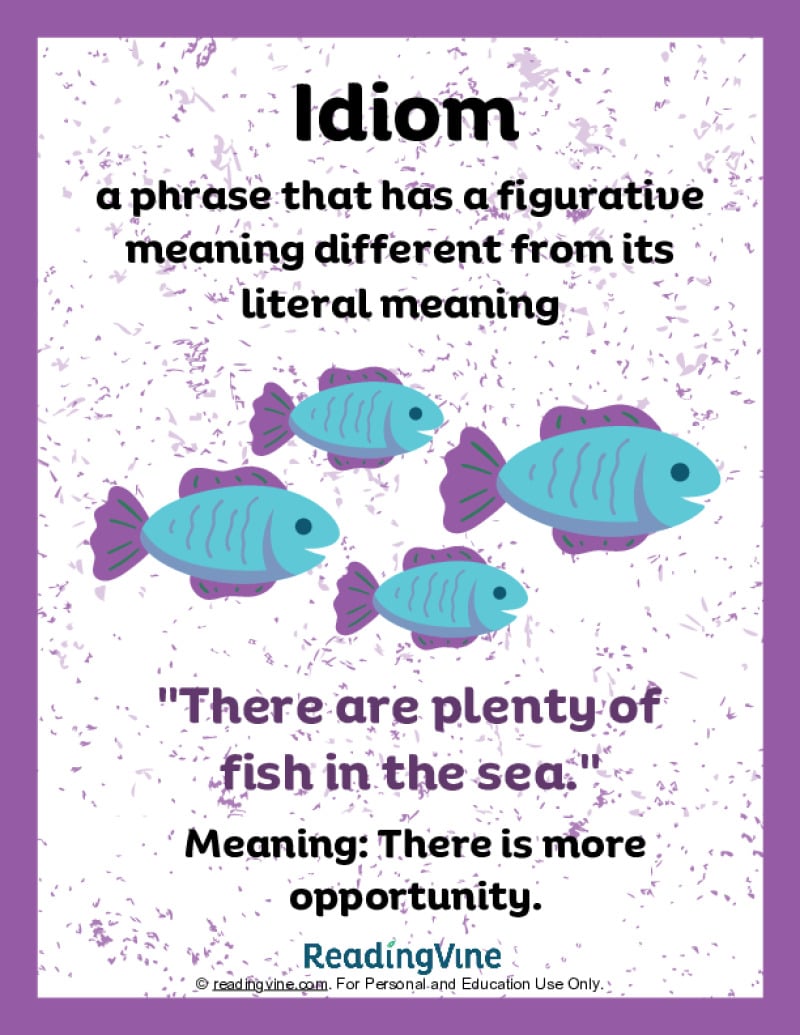
Idiom
An idiom is a phrase whose meaning cannot be understood from the literal definition of its words. Idioms must be learned as complete expressions.
It’s raining cats and dogs.
Means it’s raining heavily—not actual animals.
Let the cat out of the bag.
Means to reveal a secret.
The elephant in the room.
An obvious problem no one wants to discuss.
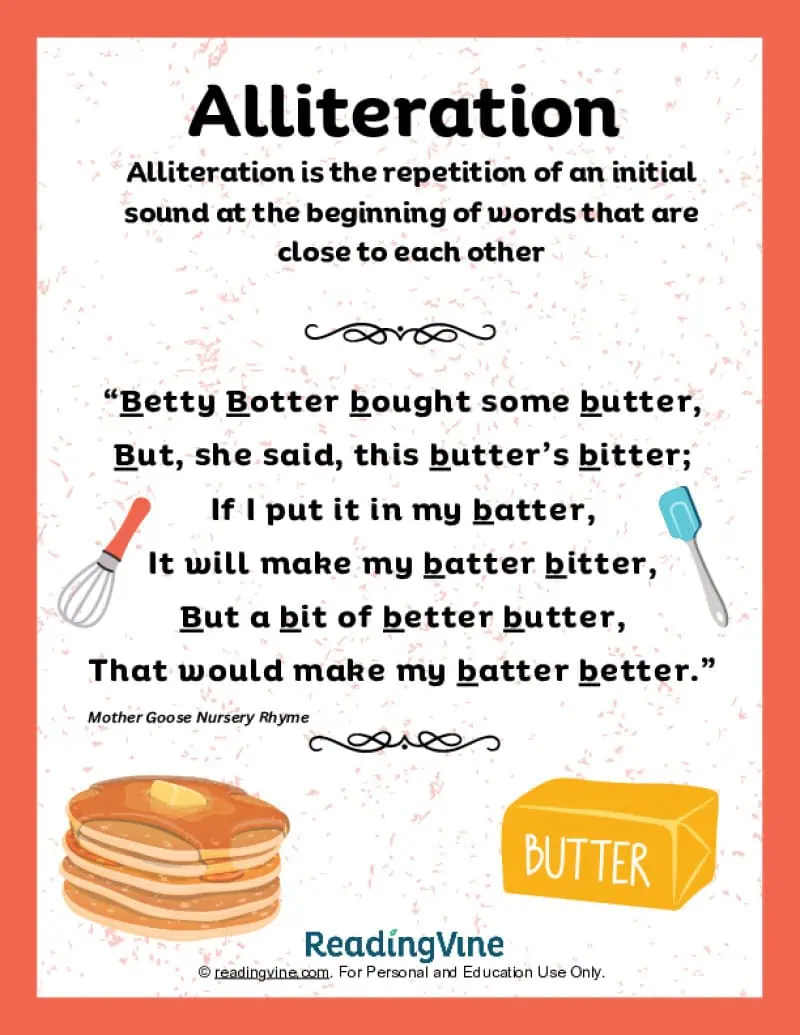
Alliteration
Alliteration is the repetition of the same consonant sound at the beginning of nearby words. It creates rhythm and makes phrases memorable.
Peter Piper picked a peck of pickled peppers.
Repeats the “p” sound throughout.
The wild wind whipped through the willows.
Repeats the “w” sound to mimic wind.
Doubting, dreaming dreams no mortal ever dared to dream before.
Poe’s “d” sounds create a haunting rhythm.
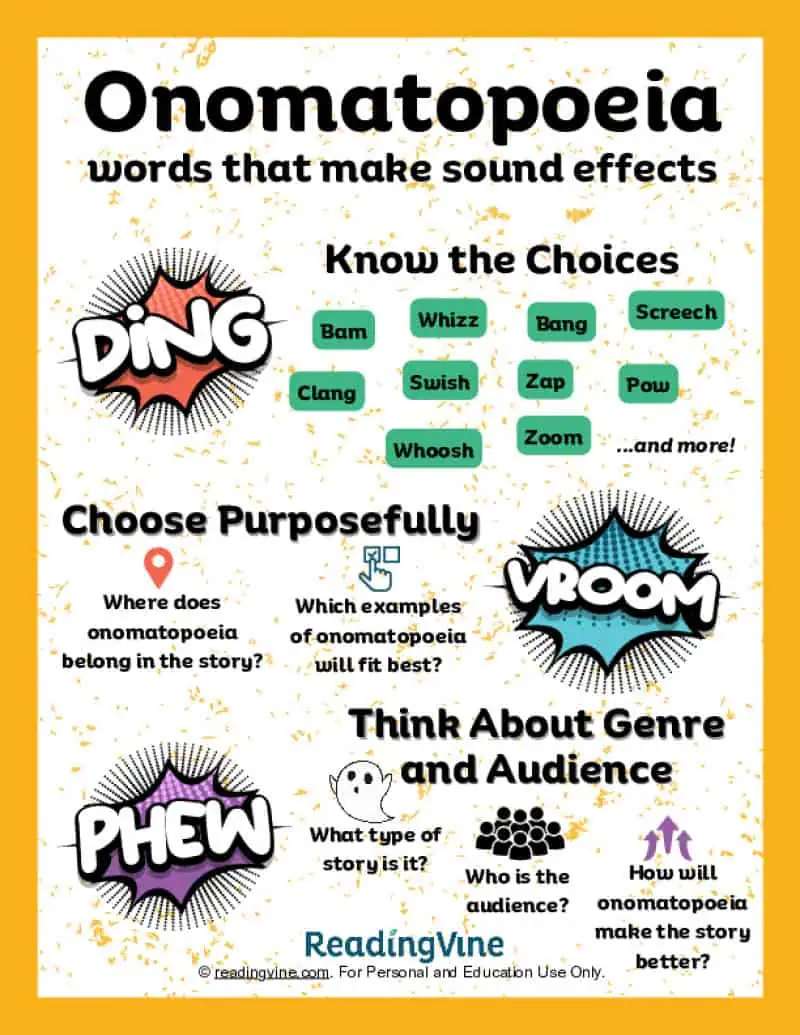
Onomatopoeia
Onomatopoeia (on-uh-mat-uh-PEE-uh) is a word that sounds like the noise it describes. These words help readers “hear” the action.
The bee buzzed around the flower.
“Buzz” sounds like the noise a bee makes.
The bacon sizzled in the pan.
“Sizzle” sounds like food frying.
Thunder boomed overhead as the storm arrived.
“Boom” sounds like a deep, resonant noise.
Imagery
Imagery is descriptive language that appeals to the five senses—sight, sound, smell, taste, and touch. It helps readers experience a scene.
The cookie was warm, soft, and gooey.
Appeals to touch (warm, soft) and taste.
Cinnamon and nutmeg perfumed the air as the pie baked.
Appeals to smell with specific scents.
Neon signs buzzed and flickered, painting the wet pavement in pink and blue.
Appeals to sight and sound together.
Symbolism
Symbolism is when an object, color, person, or event represents something beyond its literal meaning. Symbols add deeper layers to stories.
A heart shape symbolizes love.
Hearts represent love and caring.
A butterfly symbolizes transformation.
Represents change and growth.
A cage symbolizes restriction or oppression.
Represents lack of freedom, being trapped.
Figurative Language Quick Reference
Use this table to quickly compare the different types of figurative language.
| Type | What It Does | Key Signal | Example |
|---|---|---|---|
| Simile | Compares two things | Uses “like” or “as” | Brave as a lion |
| Metaphor | Says one thing IS another | No “like” or “as” | Time is money |
| Personification | Gives human traits to non-humans | Human actions/feelings | The wind whispered |
| Hyperbole | Extreme exaggeration | Impossible statements | I could eat a horse |
| Idiom | Fixed phrase with figurative meaning | Doesn’t make literal sense | Break a leg! |
| Alliteration | Repeats beginning sounds | Same consonant sounds | Peter Piper picked |
| Onomatopoeia | Words that sound like meaning | Sound words | Buzz, splash, bang |
| Imagery | Appeals to the five senses | Sensory details | The warm, gooey chocolate |
| Symbolism | Objects represent ideas | Deeper meaning | A dove = peace |
| Irony | Opposite of what’s expected | Contrast/surprise | Fire station burns down |
| Oxymoron | Contradictory terms together | Opposite words paired | Deafening silence |
How Figurative Language Devices Connect
Simile = comparison using “like” or “as” (her smile is like sunshine). Metaphor = direct comparison without “like/as” (her smile is sunshine).
Tone = author’s attitude (how the writer feels). Mood = reader’s feeling (how the text makes YOU feel).
Hyperbole = extreme exaggeration (I’ve told you a million times). Idiom = phrase with figurative meaning (break a leg).
Foreshadowing = hints about future events. Flashback = scenes showing past events.
Figurative Language by Grade Level
Focus on: Simple similes, basic personification, onomatopoeia, alliteration, rhyming, beginning idioms
Focus on: Metaphors, hyperbole, idioms, imagery, basic symbolism, simile vs. metaphor, tone
Focus on: Irony types, extended metaphors, symbolism analysis, foreshadowing, mood vs. tone, rhetorical devices
Figurative Language Worksheets
Free printable worksheets to practice essential figurative language skills.
Figurative Language Anchor Charts
Free printable anchor charts to support figurative language instruction. Click any chart to download the PDF.

Tips for Teaching Figurative Language
Kids use figurative language naturally—”I’m starving!” (hyperbole), “It’s raining cats and dogs” (idiom). Point out that they’re already experts, then build from familiar examples to new concepts.
Don’t overwhelm students with all types at once. Spend focused time on similes before metaphors, then personification. Once each is solid, compare and contrast them together.
This simple question works for similes, metaphors, and personification. It helps students break down the comparison and understand the author’s purpose.
Writing original similes, metaphors, and personification deepens understanding far more than just identifying examples. Start with sentence frames if needed.
Find rich examples in picture books, poems, and chapter books. Read passages aloud, identify the figurative language together, and discuss why the author chose it.
Rewrite figurative language as literal statements: “Time flies” becomes “Time seems to pass quickly.” Discuss what’s lost—the vivid image, the emotional impact.
Create an anchor chart or bulletin board with examples of each type. As students find figurative language in their reading, add to the collection to celebrate discoveries.
Students need both skills: identifying figurative language in texts AND creating their own. Balance activities—find the simile, then write a simile.
Figurative Language: Frequently Asked Questions
What is figurative language?
Figurative language is any language that uses words in non-literal ways to create meaning, evoke emotion, or paint vivid pictures. Instead of saying exactly what you mean, figurative language uses comparisons, exaggerations, and creative expressions. “I’m drowning in homework” doesn’t mean you’re literally underwater—it means you have too much homework. Figurative language makes writing more vivid, interesting, and emotionally powerful.
What are the main types of figurative language?
The main types include: Simile (compares using “like” or “as”), Metaphor (says one thing IS another), Personification (gives human traits to non-humans), Hyperbole (extreme exaggeration), Idiom (phrases with figurative meanings), Alliteration (repeated beginning sounds), Onomatopoeia (words that sound like their meaning), Imagery (appeals to senses), Symbolism (objects representing ideas), and Irony (opposite of what’s expected).
What’s the difference between simile and metaphor?
Both compare two things, but they work differently. A simile uses “like” or “as”: “Her smile is like sunshine.” A metaphor says one thing IS another without “like” or “as”: “Her smile is sunshine.” Metaphors create a stronger, more direct comparison, while similes are more explicit about making a comparison.
What’s the difference between tone and mood?
Tone is the author’s attitude toward the subject—how the writer feels (sarcastic, hopeful, angry). Mood is the emotional atmosphere the text creates for readers—how it makes YOU feel (suspenseful, peaceful, anxious). An author’s tone creates the mood, but they’re not always the same.
What grade level should students learn figurative language?
Students begin learning figurative language in 2nd-3rd grade with simple similes, basic personification, and common idioms. Common Core State Standards address figurative language starting in 4th grade (RL.4.4), with increasing complexity through middle school. By 6th-8th grade, students should analyze how figurative language contributes to meaning and tone in complex texts.
Why is figurative language important in writing?
Figurative language makes writing more engaging, vivid, and memorable. It helps readers visualize scenes (imagery), feel emotions (hyperbole), understand abstract ideas (metaphor), and connect with characters. Compare “She was sad” to “Her heart was a stone sinking in her chest.” Figurative language shows rather than tells, creating deeper reader engagement.
How can I help my child recognize figurative language?
Start by pointing out figurative language in everyday life: songs, commercials, picture books. Ask questions like “Is that literally true?” and “What picture does that create?” Practice with common idioms and similes your child already uses. Make it a game to spot figurative language during reading time together.
How do I help students identify figurative language in texts?
Teach students to ask: “Does this mean exactly what it says?” If not, it’s figurative. Provide specific signals to look for: “like” or “as” (simile), human actions given to non-humans (personification), extreme exaggerations (hyperbole), phrases that don’t make literal sense (idioms). Practice with short passages, highlighting and labeling each type found.