
 = Partner Site
Idiom Examples
An idiom is a phrase or expression that means something different from the literal meaning of the words. When someone says “it’s raining cats and dogs,” they don’t mean animals are falling from the sky—they mean it’s raining heavily. Idioms add color and personality to language, but they can be tricky to learn because you can’t figure out their meaning just by knowing the individual words. These 50+ idiom examples help students understand and use these common expressions across grade levels.
For Teachers
Idiom examples are organized by grade band and category for easy differentiation. Use these for vocabulary instruction, reading comprehension, or to help English language learners understand figurative expressions.
For Parents
When you use idioms at home, explain what they really mean! Kids often take expressions literally at first. Make a game of finding idioms in books, movies, and everyday conversation.
Practice Idioms with Worksheets
Ready for hands-on practice? Our idiom worksheets help students match idioms to their meanings and use them in context.
What Is an Idiom?
An idiom is a common phrase whose meaning cannot be understood from the literal definition of its words. “Break a leg” doesn’t mean to injure yourself—it means “good luck.” Idioms are learned as whole phrases because their meaning is figurative, not literal. Every language has idioms, and they often reflect cultural history and traditions.
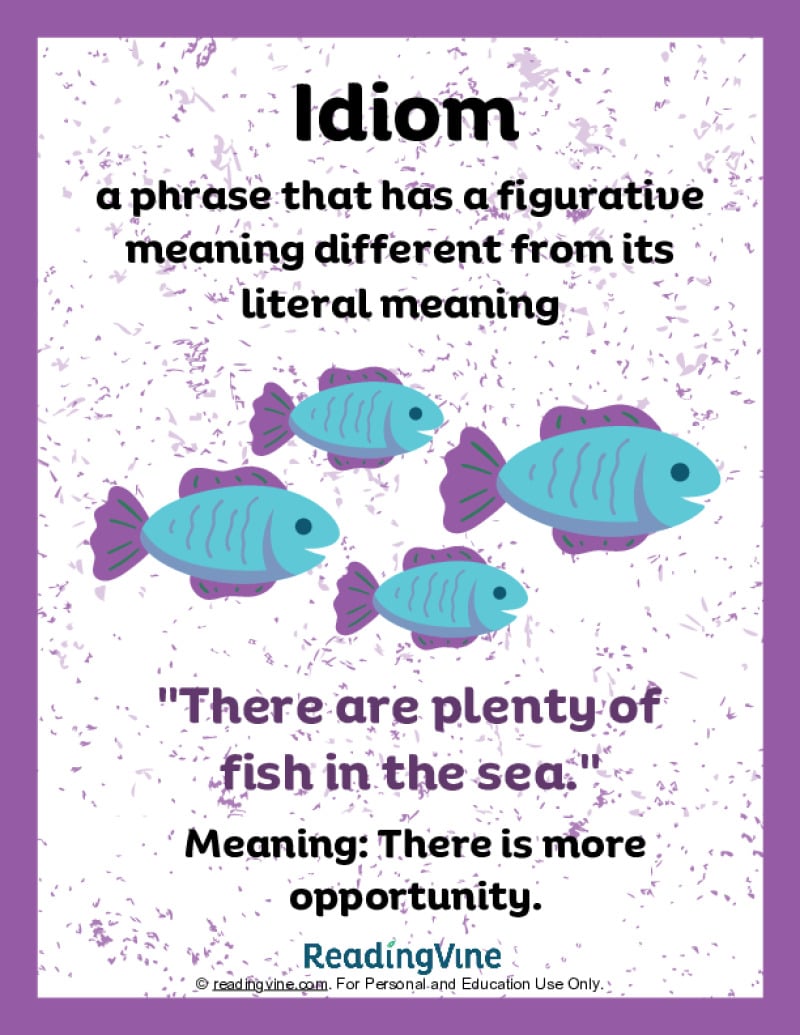
Idiom Anchor Chart
Use this printable anchor chart to help students understand common idioms and their meanings.
What’s included:
- Idiom definition
- Common idiom examples
- Literal vs. figurative meanings
Idiom vs. Literal Meaning
“Let the cat out of the bag”
Means: To reveal a secretKey distinction: Idioms must be learned as complete phrases. You can’t figure out their meaning by defining each word separately.
Idiom Example Categories
Jump to any section, or scroll through all 50+ idiom examples below.
Grades K-2
Simple, common expressions
12 examplesGrades 3-5
Everyday idioms in context
15 examplesGrades 6-8
Advanced & nuanced idioms
15 examplesBy Category
Animals, body parts, food & more
5 categoriesIs This an Idiom?
Test your understanding
8 questionsCommon Mistakes
What’s NOT an idiom
5 examplesIdiom Examples for Grades K-2
These simple idioms are ones young students often hear at home or school. Explaining these common expressions helps children understand that words don’t always mean exactly what they say.
It’s raining cats and dogs.
Meaning: It’s raining very heavily.
Break a leg!
Meaning: Good luck! (often said before a performance)
Piece of cake.
Meaning: Something is very easy to do.
Hold your horses.
Meaning: Wait; slow down; be patient.
When pigs fly.
Meaning: That will never happen.
Under the weather.
Meaning: Feeling sick or unwell.
Cat got your tongue?
Meaning: Why aren’t you speaking?
Hit the hay.
Meaning: Go to bed; go to sleep.
A piece of my mind.
Meaning: To tell someone you’re upset with them.
Keep your eyes peeled.
Meaning: Watch carefully; pay close attention.
Butterflies in my stomach.
Meaning: Feeling nervous or excited.
Zip your lip.
Meaning: Be quiet; stop talking.
Idiom Examples for Grades 3-5
These idioms appear frequently in books, conversations, and media. Students at this level can learn to recognize idioms in context and understand their figurative meanings.
Let the cat out of the bag.
Meaning: To accidentally reveal a secret.
Bite off more than you can chew.
Meaning: To take on more than you can handle.
Cost an arm and a leg.
Meaning: Very expensive.
The ball is in your court.
Meaning: It’s your turn to make a decision or take action.
Spill the beans.
Meaning: To reveal secret information.
Bite the bullet.
Meaning: To face a difficult situation bravely.
Hit the nail on the head.
Meaning: To be exactly right about something.
A blessing in disguise.
Meaning: Something good that seemed bad at first.
Kill two birds with one stone.
Meaning: To accomplish two things with one action.
Once in a blue moon.
Meaning: Very rarely; almost never.
The apple doesn’t fall far from the tree.
Meaning: Children are similar to their parents.
Don’t cry over spilled milk.
Meaning: Don’t worry about things that have already happened.
Get out of hand.
Meaning: To become out of control.
On thin ice.
Meaning: In a risky or dangerous situation.
Put all your eggs in one basket.
Meaning: To risk everything on one plan or idea.
Idiom Examples for Grades 6-8
These idioms include more nuanced expressions that appear in literature, professional settings, and mature conversations. Middle school students can analyze how idioms add color to language.
Burning the midnight oil.
Meaning: Working late into the night.
A penny for your thoughts.
Meaning: What are you thinking about?
Burning bridges.
Meaning: Destroying relationships or opportunities permanently.
The elephant in the room.
Meaning: An obvious problem no one wants to discuss.
Throw in the towel.
Meaning: To give up; to quit.
Read between the lines.
Meaning: To understand the hidden or implied meaning.
Jump on the bandwagon.
Meaning: To follow a popular trend or activity.
Play devil’s advocate.
Meaning: To argue the opposite side for the sake of debate.
Back to the drawing board.
Meaning: To start over after a failure.
The best of both worlds.
Meaning: A situation with all the advantages of two different things.
Barking up the wrong tree.
Meaning: Pursuing the wrong course of action or making a false assumption.
Cut to the chase.
Meaning: Get to the point; skip the unimportant details.
A taste of your own medicine.
Meaning: To experience the same treatment you gave others.
The tip of the iceberg.
Meaning: A small, visible part of a much larger problem.
Miss the boat.
Meaning: To miss an opportunity.
Idioms by Category
Many idioms relate to common topics like animals, body parts, and food. Here are examples grouped by theme.
Animal Idioms
Idioms featuring animals and their behaviors.
Let sleeping dogs lie – Don’t stir up trouble
Hold your horses – Be patient
The early bird catches the worm – Success comes to those who prepare
A fish out of water – Uncomfortable in a situation
Body Part Idioms
Idioms using parts of the human body.
Keep an eye on – Watch carefully
Lend a hand – Help someone
Get cold feet – Become nervous and hesitate
Put your foot in your mouth – Say something embarrassing
Food Idioms
Idioms involving food and eating.
Spill the beans – Reveal a secret
Piece of cake – Something easy
Bring home the bacon – Earn money for the family
In a nutshell – Briefly summarized
Weather Idioms
Idioms using weather and natural elements.
Under the weather – Feeling sick
Rain on someone’s parade – Spoil someone’s plans
A storm in a teacup – A big fuss over something small
Every cloud has a silver lining – Good comes from bad
Color Idioms
Idioms featuring colors and their associations.
Green with envy – Very jealous
Feeling blue – Feeling sad
In the red – Owing money; in debt
Black sheep – The odd one out in a group
Is This an Idiom?
Test your understanding! Does the phrase have a figurative meaning different from its literal words?
“It’s raining cats and dogs outside.”
Means heavy rain—not literal animals falling from the sky.
“Her smile was like sunshine.”
This is a simile—comparing two things using “like.”
“He really let the cat out of the bag.”
Means he revealed a secret—nothing to do with actual cats.
“I’m so hungry I could eat a horse.”
This is hyperbole—an exaggeration for effect.
“She’s feeling under the weather today.”
Means feeling sick—weather has nothing to do with it.
“Time is money.”
This is a metaphor—saying time equals money directly.
“Don’t put all your eggs in one basket.”
Means don’t risk everything on one plan—not about actual eggs.
“The wind howled through the trees.”
This is personification—giving wind a human action.
Common Idiom Mistakes
Students sometimes confuse idioms with other figurative language or misuse them in writing. Here are common mix-ups.
1 Confusing Idioms with Similes and Metaphors
“He’s as busy as a bee.”
“He has a bee in his bonnet.” (He’s obsessed with something.)
Remember: Similes and metaphors compare things. Idioms are fixed phrases whose meaning can’t be determined from the individual words.
2 Taking Idioms Literally
“Break a leg” means to injure yourself.
“Break a leg” means “good luck.”
Remember: Idioms have figurative meanings that must be learned. This is especially challenging for English language learners and young children.
3 Mixing Up Similar Idioms
“It’s not rocket surgery.” (Mixing two idioms)
“It’s not rocket science” OR “It’s not brain surgery.” (Both mean it’s not difficult.)
Remember: Idioms are fixed phrases. Changing the words, even slightly, can make them confusing or incorrect.
4 Using Idioms in Formal Writing
“The experiment was a piece of cake.”
“The experiment was straightforward and simple to complete.”
Remember: Idioms are conversational. In formal essays and academic writing, use precise language instead of idioms.
5 Thinking Idioms Translate Across Languages
“It’s raining cats and dogs” translated word-for-word into another language.
Other languages have different idioms for heavy rain (e.g., “raining chair legs” in Greek).
Remember: Idioms are culturally specific. Each language has its own unique expressions that often don’t translate directly.
Tips for Teaching Idioms
Have students draw the literal meaning of an idiom (“raining cats and dogs” with animals falling from clouds), then discuss what it really means. This visual contrast makes the concept memorable and fun.
Instead of memorizing definitions, teach idioms through stories and scenarios. “When Jake finally told his mom about the broken vase, he had to face the music.” Context makes meaning stick.
Idioms are especially challenging for ELL students because they can’t be translated word-for-word. Create an “idiom wall” that grows throughout the year, with pictures and meanings for reference.
Many idioms have fascinating histories. “Break a leg” may come from theater superstition; “spill the beans” might relate to ancient voting. Exploring origins helps students remember meanings and builds cultural knowledge.
Teach animal idioms together, then body part idioms, then weather idioms. Grouping by category helps students see patterns and remember related expressions more easily.
Idioms are great in conversation and creative writing but should be avoided in formal academic writing. Teach students to recognize audience and purpose when deciding whether to use idioms.
Idiom Examples: Frequently Asked Questions
What is an idiom in simple terms?
An idiom is a phrase that means something different from what the words literally say. “Kick the bucket” doesn’t mean to actually kick a bucket—it means to pass away. You can’t figure out an idiom’s meaning by looking up each word; you have to learn the phrase as a whole. Idioms make language more colorful and expressive.
What is the difference between an idiom and a metaphor?
A metaphor directly compares two things by saying one IS another: “Time is money.” An idiom is a fixed phrase with a figurative meaning that must be learned: “Kill two birds with one stone” (accomplish two things at once). Metaphors make comparisons; idioms are expressions whose meaning can’t be guessed from the words.
Why are idioms difficult for English language learners?
Idioms are challenging because they can’t be translated word-for-word. If you translate “it’s raining cats and dogs” literally into another language, it won’t make sense. Every language has its own idioms, and they often don’t match up. Learners must memorize idioms as complete phrases with their figurative meanings.
What grade level should students learn about idioms?
Students can begin learning common idioms in 2nd-3rd grade. Common Core State Standards address idioms under Language standards (L.4.5b) starting in 4th grade, where students learn to recognize and explain the meaning of common idioms. By middle school, students should interpret idioms in context and understand their role in language.
What are the most common idioms in English?
Some of the most common English idioms include: “break a leg” (good luck), “piece of cake” (easy), “under the weather” (sick), “hit the nail on the head” (exactly right), “let the cat out of the bag” (reveal a secret), “once in a blue moon” (rarely), and “cost an arm and a leg” (very expensive). These appear frequently in everyday conversation.
Should I use idioms in formal writing?
Generally, no. Idioms are conversational and informal, so they’re usually not appropriate for academic essays, research papers, or professional reports. However, they can add voice and personality to creative writing, dialogue, personal narratives, and informal communication. Always consider your audience and purpose when deciding whether to use idioms.