
 = Partner Site
Personification Examples
Personification is a figure of speech that gives human qualities to animals, objects, or ideas. When we say “The wind whispered through the trees” or “The sun smiled down on us,” we’re using personification to make our writing more vivid and engaging. These 50+ personification examples help students recognize and create this powerful literary device across grade levels.
For Teachers
Personification examples are organized by grade band for easy differentiation. Use these for direct instruction, anchor charts, mentor sentences, or assessment. Each example includes context notes to support teaching.
For Parents
Start with the simpler examples in the K-2 section and work up to your child’s level. Point out personification in picture books, poems, and songs to help your child recognize when objects “come alive” in writing.
Practice Personification with Worksheets
Ready for hands-on practice? Our personification worksheets help students identify and create their own examples of personification.
What Is Personification?
Personification is a figure of speech that gives human characteristics to something that is not human. This includes animals, objects, ideas, and forces of nature. When we write “The flowers danced in the breeze,” the flowers aren’t literally dancing—we’re giving them a human action to create a vivid image.
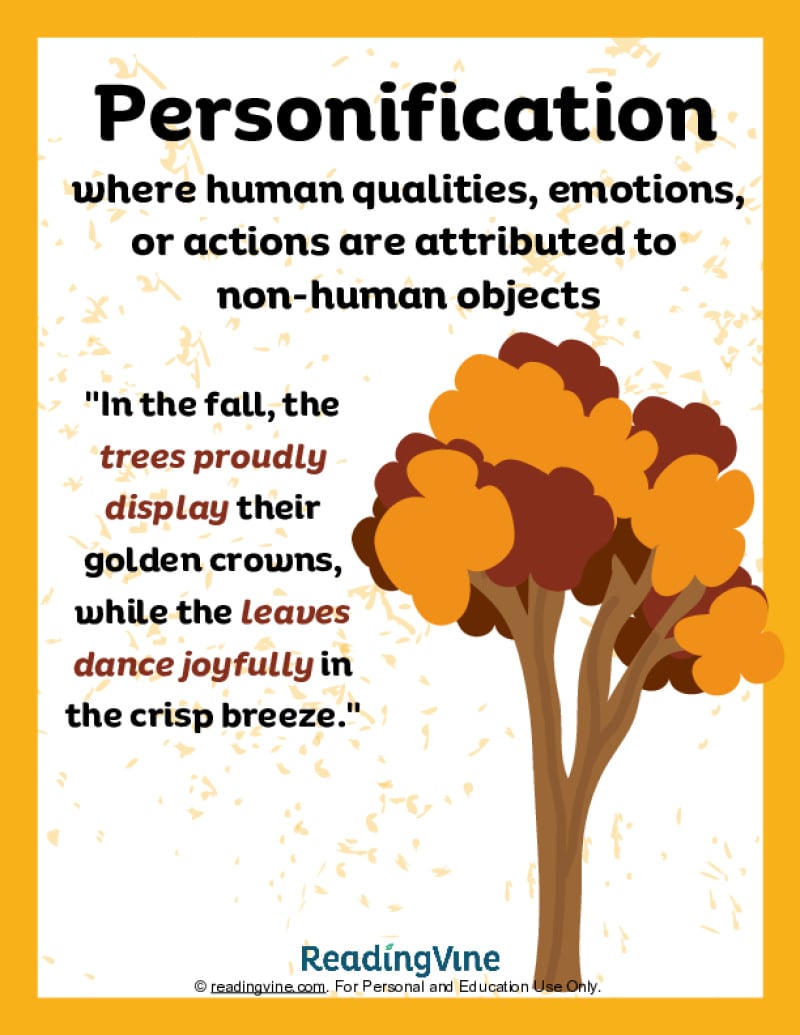
Personification Anchor Chart
Use this printable anchor chart to help students understand and identify personification.
What’s included:
- Personification definition
- Human traits and actions
- Visual examples
Personification vs. Metaphor: What’s the Difference?
The wind whispered secrets.
Gives human action (whispering) to windKey distinction: Metaphors compare two things; personification humanizes non-human things. They can overlap—”Time is a thief” is both.
Personification Example Categories
Jump to any section, or scroll through all 50+ personification examples below.
Grades K-2
Simple, concrete examples
12 examplesGrades 3-5
Expanded actions & emotions
15 examplesGrades 6-8
Literary & abstract examples
15 examplesBy Category
Nature, objects, emotions & more
Organized by typeIs This Personification?
Test your understanding
8 questionsCommon Mistakes
What’s NOT personification
5 examplesPersonification Examples for Grades K-2
These simple personification examples use familiar objects and nature that young students can easily picture. Perfect for introducing how writers make things “come alive.”
The sun smiled down on us.
Gives the sun a human facial expression to show warmth and happiness.
The flowers danced in the wind.
Gives flowers the human action of dancing to show movement.
The stars winked at me.
Gives stars a playful human gesture to describe twinkling.
The wind whispered through the trees.
Gives wind the human ability to whisper, showing a soft sound.
My teddy bear hugged me back.
Gives a stuffed toy the human action of hugging.
The leaves waved goodbye.
Gives leaves a human farewell gesture as they blow in the wind.
The thunder grumbled in the sky.
Gives thunder a grumpy human sound to describe its rumble.
The cookies called my name.
Gives cookies the human ability to speak, showing temptation.
The moon watched over us at night.
Gives the moon the human action of watching protectively.
My alarm clock yelled at me to wake up.
Gives the alarm clock a human voice to describe its loud sound.
The car coughed and sputtered.
Gives the car human sounds to show it’s not working well.
The rain tapped on the window.
Gives rain the human action of tapping, like knocking politely.
Personification Examples for Grades 3-5
These personification examples explore more complex human emotions and actions. Students at this level can analyze how personification creates mood and meaning in writing.
The ancient oak tree groaned in the storm.
Gives the tree a human sound of strain or discomfort.
Fear crept up behind her.
Gives fear the human ability to sneak and move like a person.
The old house moaned and creaked.
Gives the house human sounds to create a spooky atmosphere.
The fire hungrily devoured the forest.
Gives fire the human quality of hunger and the action of eating greedily.
Time waits for no one.
Gives time the human ability to wait (or refuse to wait).
The camera loves her.
Gives the camera the human emotion of love, meaning she photographs well.
Lightning danced across the sky.
Gives lightning the human action of dancing to show erratic movement.
The waves kissed the shore.
Gives waves the gentle human action of kissing.
My computer decided to crash during my presentation.
Gives the computer human decision-making ability.
The road stretched lazily into the distance.
Gives the road the human quality of being lazy.
Opportunity knocked on my door.
Gives the abstract idea of opportunity a human action.
The shadows crept across the floor.
Gives shadows the human action of creeping to create suspense.
The city never sleeps.
Gives a city the human need for sleep (which it doesn’t take).
The wind howled through the night.
Gives wind the human (or animal) sound of howling.
My stomach growled with hunger.
Gives the stomach an animal-like growl to express hunger.
Personification Examples for Grades 6-8
These personification examples include more sophisticated language and abstract concepts. Middle school students can analyze how personification creates tone, mood, and deeper meaning in literature.
Justice is blind.
Gives justice the human quality of blindness, meaning it treats everyone equally.
Death knocked at his door.
Gives death the human action of arriving like a visitor.
Silence crept into the room.
Gives silence the human action of sneaking or moving quietly.
Jealousy reared its ugly head.
Gives jealousy a physical presence like a creature emerging.
The memory haunted her for years.
Gives a memory the supernatural human action of haunting.
Grief wrapped its arms around him.
Gives grief the human action of embracing, showing its overwhelming presence.
The economy stumbled through the recession.
Gives the economy the human action of struggling to walk.
History repeated itself.
Gives history the human ability to perform the same actions again.
The news raced through town.
Gives news the human action of running quickly.
War devours everything in its path.
Gives war the violent human action of eating destructively.
Her conscience whispered warnings she couldn’t ignore.
Gives conscience a human voice that speaks quietly but persistently.
The truth refused to stay hidden.
Gives truth the human ability to refuse and make decisions.
The blank page mocked his writer’s block.
Gives a page the human action of teasing or ridiculing.
Pride goes before a fall.
Gives pride the human ability to walk ahead of consequences.
The mountains stood as silent witnesses to centuries of change.
Gives mountains the human role of watching events unfold.
Personification by Category
Personification can apply to nature, objects, abstract ideas, and more. Here are examples organized by what is being personified.
Nature Personification
Weather, plants, celestial bodies, and natural forces given human qualities.
“The sun peeked through the clouds.”
“The river sang as it flowed.”
“The storm raged all night.”
“The flowers bowed their heads.”
Object Personification
Everyday items and machines given human characteristics.
“The phone screamed for attention.”
“The stairs groaned under his weight.”
“The refrigerator hummed contentedly.”
“The door refused to open.”
Abstract Idea Personification
Emotions, concepts, and ideas given human form or action.
“Love conquered all obstacles.”
“Doubt crept into her mind.”
“Hope springs eternal.”
“Anger clouded his judgment.”
Time Personification
Time given human abilities to act, move, or make decisions.
“Time flies when you’re having fun.”
“The years crept by slowly.”
“Time heals all wounds.”
“Monday dragged its feet.”
Is This Personification?
Test your understanding! Can you tell which sentences use personification and which do not?
“The wind howled through the valley.”
Gives wind the human/animal action of howling.
“The wind blew strongly.”
“Blew” is what wind literally does—no human quality given.
“The city that never sleeps.”
Gives a city the human need for sleep.
“Her eyes were like diamonds.”
Uses “like” to compare—this is a simile.
“The alarm clock screamed at 6 a.m.”
Gives the clock the human action of screaming.
“Time is money.”
Says time IS something else—this is a metaphor.
“Fear gripped his heart.”
Gives fear the human action of grabbing or holding.
“The dog barked loudly.”
Dogs actually bark—this is literal, not figurative.
Common Personification Mistakes
Students often confuse personification with other figures of speech. Here are the most common mix-ups and how to avoid them.
1 Confusing Personification with Metaphor
“The moon is a silver coin.”
“The moon watched over the sleeping town.”
Remember: Metaphor says one thing IS another. Personification gives human ACTIONS or QUALITIES to non-human things.
2 Confusing Personification with Simile
“The car roared like a lion.”
“The car complained as it climbed the hill.”
Remember: Similes use “like” or “as” to compare. Personification directly gives human traits without comparison words.
3 Thinking Animal Actions Are Always Personification
“The dog wagged its tail happily.”
“The dog smiled at his owner.”
Remember: Animals do wag tails—that’s literal. But dogs don’t actually smile (that’s a human expression), so that’s personification.
4 Missing Subtle Personification
“The economy is struggling.”
The economy can’t literally struggle—that’s a human action.
Remember: Common expressions like “time flies” or “the market crashed” are personification even though we use them every day.
5 Confusing Literal Actions with Figurative Ones
“The water flowed downhill.”
“The water danced over the rocks.”
Remember: Ask yourself: “Can this thing actually do this action?” Water flows (literal), but water doesn’t dance (figurative/personification).
Tips for Teaching Personification
Help students remember that personification gives “person” qualities to non-person things. Break down the word: person + ification = making something into a person.
Teach students to ask: “Can this thing really do this action?” The sun can’t actually smile, wind can’t whisper, and time can’t fly. If the answer is no, it’s likely personification.
“The Giving Tree” by Shel Silverstein is full of personification. For poetry, try Carl Sandburg’s “Fog” or Emily Dickinson’s nature poems. These provide rich examples for discussion.
Weather and emotions are natural fits for personification. Have students describe a storm as if it were angry, or sunshine as if it were friendly. This builds understanding through practice.
Teach all three together so students see the differences. Simile uses “like/as,” metaphor says something IS something else, and personification gives human qualities. Create a comparison chart.
Point out common phrases students already use: “My phone died,” “The car won’t start,” “Time flies.” They’ve been using personification without knowing it! This builds confidence.
Personification Examples: Frequently Asked Questions
What is personification in simple terms?
Personification is when you give human qualities to something that isn’t human. This includes animals, objects, ideas, and nature. When we say “The sun smiled” or “The wind whispered,” we’re using personification because the sun can’t really smile and wind can’t really whisper—those are human actions.
What is the difference between personification and metaphor?
A metaphor says one thing IS another thing: “Time is money.” Personification gives human actions or qualities to non-human things: “Time flies.” In metaphor, you’re comparing two different things. In personification, you’re making something act like a person. Sometimes they overlap—”Time is a thief” is both a metaphor AND personification because it compares time to a thief while giving time the human ability to steal.
What grade level should students learn about personification?
Students typically encounter personification in 2nd or 3rd grade as part of figurative language instruction. Common Core State Standards include personification under standard RL.4.4 for 4th grade, where students interpret figurative language. By middle school, students should analyze how personification contributes to meaning and tone in literary texts.
What are easy personification examples for beginners?
Easy personification examples use familiar objects and nature: “The sun smiled,” “The flowers danced,” “The wind whispered,” “The stars winked,” “My alarm clock yelled at me,” and “The cookies called my name.” These examples give simple human actions to things children encounter every day.
How do I help students write their own personification?
Start with a two-step process: (1) Choose a non-human thing (the sun, a tree, fear), and (2) Give it a human action or emotion (smiled, danced, crept). Use sentence starters like “The [object] [human action]…” For example: “The stairs ___” could become “The stairs groaned under my feet.” Brainstorm human actions first, then apply them to objects.
Why do authors use personification in writing?
Authors use personification to make writing more vivid and engaging. It helps readers connect emotionally with non-human things, creates stronger imagery, and can set mood or tone. “The angry storm attacked the coast” is more powerful than “The storm was strong.” Personification makes descriptions come alive and helps readers visualize and feel what’s happening.