
 = Partner Site
Hyperbole Examples
Hyperbole is an extreme exaggeration used for emphasis or effect—not meant to be taken literally. When someone says “I’m so hungry I could eat a horse” or “I’ve told you a million times,” they’re using hyperbole to make a point. These 50+ hyperbole examples help students recognize and create this expressive literary device across grade levels.
For Teachers
Hyperbole examples are organized by grade band for easy differentiation. Use these for direct instruction, creative writing, humor analysis, or figurative language units. Each example includes context notes to support teaching.
For Parents
Start with the familiar examples in the K-2 section—your child probably already uses hyperbole without knowing it! Point out exaggerations in books, movies, and everyday conversation to build recognition skills.
Practice Hyperbole with Worksheets
Ready for hands-on practice? Our hyperbole worksheets help students identify and create their own examples of hyperbole.
What Is Hyperbole?
Hyperbole (pronounced hy-PER-buh-lee) is an obvious, intentional exaggeration not meant to be taken literally. When we say “This bag weighs a ton,” we don’t mean it literally weighs 2,000 pounds—we mean it’s very heavy. Hyperbole adds emphasis, humor, and emotion to language by stretching the truth to make a point.
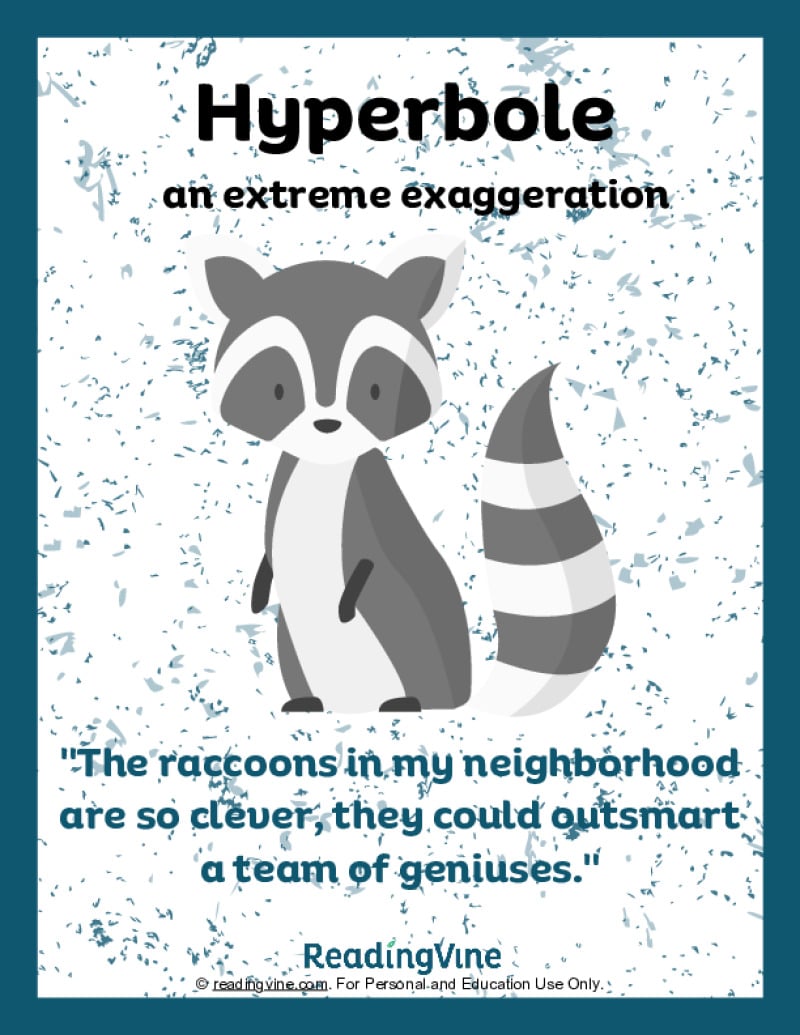
Hyperbole Anchor Chart
Use this printable anchor chart to help students understand and identify hyperbole.
What’s included:
- Hyperbole definition
- Exaggeration examples
- Visual examples
Hyperbole vs. Literal Statement
I’m so tired I could sleep for a year.
Exaggerates to emphasize exhaustionKey distinction: Hyperbole is never meant to be believed literally. It’s an obvious “stretch” that everyone understands is exaggerated for effect.
Hyperbole Example Categories
Jump to any section, or scroll through all 50+ hyperbole examples below.
Grades K-2
Simple, fun exaggerations
12 examplesGrades 3-5
Everyday & emotional hyperbole
15 examplesGrades 6-8
Literary & sophisticated examples
15 examplesBy Emotion
Hunger, tiredness, anger & more
Organized by feelingIs This Hyperbole?
Test your understanding
8 questionsCommon Mistakes
What’s NOT hyperbole
5 examplesHyperbole Examples for Grades K-2
These simple hyperbole examples use familiar situations young students experience every day. Kids often use hyperbole naturally—these examples help them recognize and name it.
I’m so hungry I could eat a horse.
Exaggerates hunger—no one could really eat a whole horse!
My backpack weighs a ton.
Exaggerates weight—a ton is 2,000 pounds!
I’ve told you a million times!
Exaggerates how many times something was said.
It’s so cold outside, I’m freezing to death.
Exaggerates feeling cold—not literally dying!
I’m so tired I could sleep for a year.
Exaggerates tiredness—no one sleeps for a whole year.
This is taking forever!
Exaggerates how long something is taking.
My feet are killing me.
Exaggerates foot pain—feet can’t actually kill you.
I have a mountain of homework.
Exaggerates the amount of homework.
She’s the nicest person in the whole wide world.
Exaggerates how nice someone is—out of billions of people!
I almost died laughing.
Exaggerates how funny something was.
It’s hotter than the sun out there!
Exaggerates temperature—the sun is millions of degrees!
I waited in line for ages.
Exaggerates waiting time—ages means thousands of years!
Hyperbole Examples for Grades 3-5
These hyperbole examples explore more varied emotions and situations. Students at this level can analyze how writers use exaggeration to create humor and emphasis.
I’m so embarrassed I could just die.
Exaggerates embarrassment to show extreme discomfort.
That joke is so old, dinosaurs laughed at it.
Exaggerates how outdated a joke is—dinosaurs lived millions of years ago!
I could eat this pizza every day for the rest of my life.
Exaggerates love of food—you’d get tired of it eventually!
Her smile was a mile wide.
Exaggerates the size of a smile—a mile is 5,280 feet!
I have a thousand things to do today.
Exaggerates the number of tasks—probably more like ten or twenty.
He’s older than dirt.
Exaggerates age—dirt has been around for billions of years!
I nearly jumped out of my skin when you scared me.
Exaggerates the startle response—skin stays on!
That movie was so boring, it lasted an eternity.
Exaggerates how long something felt—eternity means forever.
My parents are going to flip out when they see this mess.
Exaggerates expected reaction—not literally flipping!
I’ve seen that movie a billion times.
Exaggerates viewing frequency—a billion would take thousands of years!
His brain is the size of a pea.
Exaggerates to suggest someone isn’t thinking clearly.
I’m so bored I could scream.
Exaggerates boredom to show extreme restlessness.
This suitcase weighs more than an elephant.
Exaggerates weight—elephants weigh 10,000+ pounds!
She runs faster than the speed of light.
Exaggerates speed—nothing moves faster than light!
I’m drowning in paperwork.
Exaggerates the amount of work—not literally underwater.
Hyperbole Examples for Grades 6-8
These hyperbole examples include literary references and more sophisticated exaggerations. Middle school students can analyze how writers use hyperbole to create tone, humor, and emotional impact.
I had to walk fifteen miles uphill both ways to get to school.
Classic humorous exaggeration about hardship—impossible to go uphill both ways!
The shot heard ’round the world.
Historical hyperbole about the start of the American Revolution—sound doesn’t travel that far.
I have told you this a thousand million times.
Emphasizes frustration through impossible repetition.
The whole world was watching that moment.
Exaggerates viewership—not literally every person on Earth.
His voice was so loud it shook the walls.
Exaggerates volume—human voices rarely cause structural vibrations.
She cried an ocean of tears.
Exaggerates crying to convey overwhelming grief.
I would walk five hundred miles to see you.
Exaggerates devotion and willingness to make effort.
If I have to read one more page, my brain will melt.
Exaggerates mental exhaustion—brains don’t actually melt.
Her heart shattered into a million pieces.
Exaggerates emotional pain—hearts don’t literally break.
I would sell my soul for a slice of that cake.
Exaggerates desire—not a literal offer!
The line for tickets stretched to infinity.
Exaggerates length—infinity has no end.
I must have apologized a hundred times already.
Exaggerates frequency to emphasize sincerity of apology.
The news spread across the globe in seconds.
Exaggerates speed of information—even today, not quite instant everywhere.
I’ve been waiting here since the dawn of time.
Exaggerates duration—the dawn of time was billions of years ago.
This opportunity comes once in a lifetime—no, once in a millennium.
Stacked hyperbole emphasizes extreme rarity.
Hyperbole by Emotion
We often use hyperbole to express strong feelings. Here are examples organized by the emotion or situation being exaggerated.
Hunger & Thirst
Exaggerating how hungry or thirsty you feel.
“I could eat a horse.”
“I’m starving to death.”
“I’m so thirsty I could drink the ocean.”
“I haven’t eaten in forever.”
Tiredness
Exaggerating exhaustion and need for rest.
“I could sleep for a week.”
“I’m dead tired.”
“I’m running on empty.”
“I haven’t slept in days.”
Frustration & Anger
Exaggerating annoyance and strong negative emotions.
“I’ve told you a million times!”
“My head is going to explode.”
“I’m so mad I could scream.”
“This is driving me insane.”
Happiness & Love
Exaggerating joy, excitement, and affection.
“I’m on top of the world!”
“I love you to the moon and back.”
“This is the best day of my entire life.”
“I’m bursting with joy.”
Is This Hyperbole?
Test your understanding! Can you tell which sentences use hyperbole and which do not?
“I’m so hungry I could eat a whale.”
Obviously exaggerated—no one could eat a whale.
“I’m very hungry.”
This is a simple statement of fact—no exaggeration.
“This bag weighs a ton.”
Exaggerates weight—bags don’t actually weigh 2,000 pounds.
“She runs like the wind.”
Uses “like” to compare—this is a simile, not hyperbole.
“I’ve asked you a thousand times to clean your room.”
Exaggerates frequency—probably asked a dozen times, not a thousand.
“The thunder roared angrily.”
Gives thunder human qualities—this is personification.
“My heart stopped when I saw the grade.”
Exaggerates physical reaction—heart didn’t literally stop.
“Time is money.”
Says time IS something else—this is a metaphor.
Common Hyperbole Mistakes
Students often confuse hyperbole with other figures of speech or miss the exaggeration entirely. Here are the most common mix-ups.
1 Confusing Hyperbole with Metaphor
“Her eyes are diamonds.”
“Her eyes are bigger than dinner plates.”
Remember: Metaphors compare one thing to another. Hyperbole exaggerates size, amount, degree, or intensity beyond what’s possible.
2 Confusing Hyperbole with Simile
“He runs like the wind.”
“He runs faster than the speed of light.”
Remember: Similes use “like” or “as” to compare. Hyperbole makes something impossibly extreme. They CAN overlap—”fast as lightning” is both!
3 Missing “Dead” Hyperbole We Use Every Day
“I’m starving.” / “I’m dying of boredom.” / “That’s hilarious.”
You’re not literally starving, dying, or finding it extremely laughable.
Remember: Many everyday expressions are hyperbole we don’t notice anymore. Being “starving” just means hungry. Being “dead tired” means very tired.
4 Thinking Hyperbole Must Be Funny
“Hyperbole is only used for humor.”
“She cried an ocean of tears” is hyperbole expressing serious grief.
Remember: Hyperbole can express ANY strong emotion—sadness, love, anger, fear—not just humor. It’s about emphasis, not comedy.
5 Confusing Hyperbole with Lies
“I finished all my homework” (when you didn’t).
“I have a million pages of homework tonight.”
Remember: Hyperbole is OBVIOUSLY not true—everyone knows it’s exaggerated. Lies are meant to be believed. If someone could mistake it for truth, it’s not hyperbole.
Tips for Teaching Hyperbole
Kids use hyperbole naturally: “I’m starving!” “That took forever!” “You’re the worst!” Point out that they’re already experts at exaggeration—now they’re just learning the name for it.
Many students mispronounce “hyperbole” as “hyper-bowl.” Teach the correct pronunciation early: hy-PER-buh-lee (four syllables). It comes from Greek and rhymes with “hyperbole.”
Have students rewrite hyperbole as literal statements: “I’m so hungry I could eat a horse” becomes “I’m very hungry.” Then discuss what’s lost—the humor, emphasis, and emotion.
Advertisements are full of hyperbole: “The best burger in the universe!” Have students find examples in commercials, movie trailers, and social media. Discuss why advertisers exaggerate.
Help students understand that hyperbole is OBVIOUS exaggeration—everyone knows it’s not literally true. If someone could believe it, it’s not hyperbole. “I have a million dollars” (lie) vs. “I have a million things to do” (hyperbole).
Give students an emotion and have them create hyperbole: “How hungry are you?” “So hungry I could eat everything in the cafeteria!” This makes hyperbole personal and memorable.
Hyperbole Examples: Frequently Asked Questions
What is hyperbole in simple terms?
Hyperbole is an extreme exaggeration that isn’t meant to be taken literally. When someone says “I’m so tired I could sleep for a year,” they don’t actually mean 365 days—they mean they’re very tired. Hyperbole stretches the truth to make a point, add humor, or express strong emotion.
How do you pronounce hyperbole?
Hyperbole is pronounced hy-PER-buh-lee (four syllables). It does NOT rhyme with “Super Bowl.” The word comes from Greek, meaning “excess” or “to throw beyond.” A common mistake is saying “hyper-bowl,” but the correct pronunciation ends with the same sound as “family” or “melody.”
What is the difference between hyperbole and a lie?
The key difference is intent and obviousness. Hyperbole is OBVIOUSLY exaggerated—everyone knows “I’ve told you a million times” isn’t literally true. A lie is meant to deceive and be believed. If someone could reasonably think your statement is true, it’s not hyperbole. Hyperbole is a figure of speech; lying is dishonesty.
What grade level should students learn about hyperbole?
Students typically learn about hyperbole in 3rd or 4th grade as part of figurative language instruction. Common Core State Standards include hyperbole under RL.4.4, where students interpret figurative language. However, younger students can be introduced to the concept since they naturally use hyperbole in everyday speech.
What are common hyperbole examples kids use every day?
Kids use hyperbole constantly without realizing it: “I’m starving!” “This is taking forever!” “I’ve told you a million times!” “My backpack weighs a ton!” “I almost died laughing!” “She’s the best person ever!” These everyday exaggerations are perfect starting points for teaching hyperbole.
Why do authors use hyperbole in writing?
Authors use hyperbole to create emphasis, express strong emotions, add humor, and make descriptions more vivid and memorable. “The line stretched to infinity” is more impactful than “The line was very long.” Hyperbole helps readers feel the intensity of a situation rather than just understand it intellectually.
