
 = Partner Site
Onomatopoeia Examples
Onomatopoeia is a word that imitates the sound it describes. Words like “buzz,” “splash,” “bang,” and “whisper” sound like what they mean. From comic book sound effects to poetry, onomatopoeia brings writing to life by letting readers “hear” the action. These 50+ onomatopoeia examples help students recognize and use this fun literary device across grade levels.
For Teachers
Onomatopoeia examples are organized by grade band and sound category for easy differentiation. Use these for phonics connections, poetry units, descriptive writing, or sensory language instruction.
For Parents
Kids love onomatopoeia! Start with animal sounds and comic book words your child already knows. Point out sound words in picture books, songs, and everyday life to build recognition skills.
Practice Onomatopoeia with Worksheets
Ready for hands-on practice? Our onomatopoeia worksheets help students identify and create their own examples of onomatopoeia.
What Is Onomatopoeia?
Onomatopoeia (pronounced on-uh-mat-uh-PEE-uh) is a word that sounds like the noise it describes. When you say “buzz,” it sounds like a bee. When you say “splash,” it sounds like water. These sound words help readers hear the action in their minds, making writing more vivid and engaging.
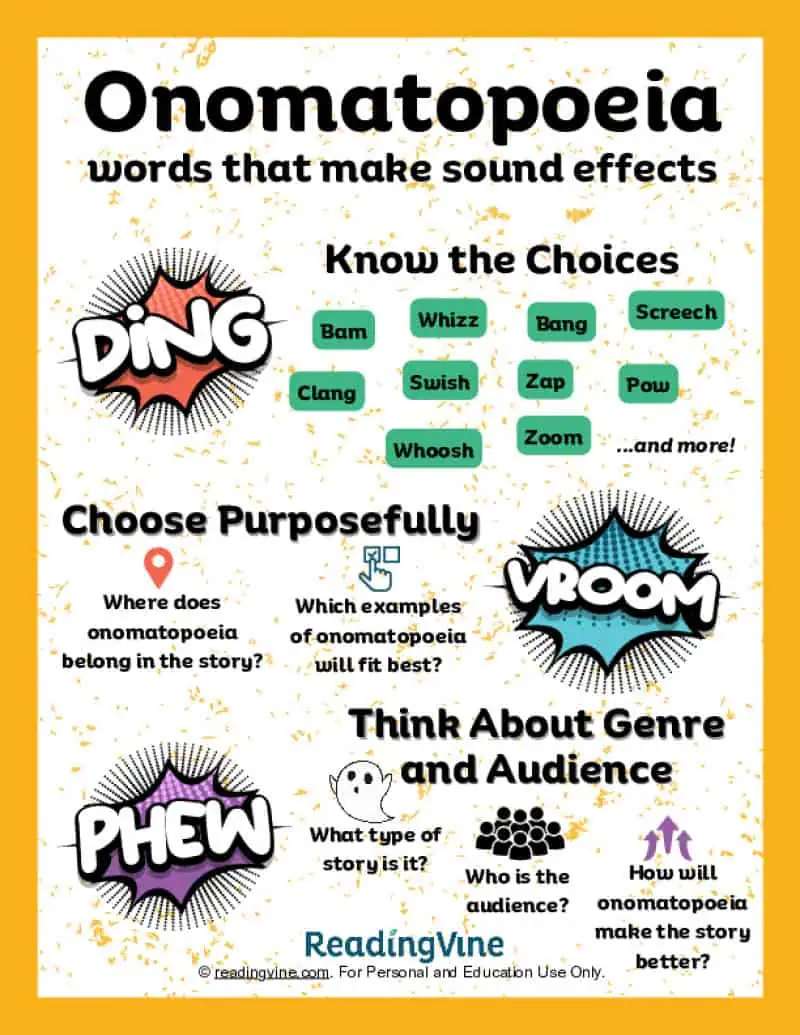
Onomatopoeia Anchor Chart
Use this printable anchor chart to help students understand and identify onomatopoeia.
What’s included:
- Onomatopoeia definition
- Sound word categories
- Visual examples
Onomatopoeia vs. Regular Words
The door creaked open slowly.
“Creaked” sounds like the noise a door makesKey distinction: Onomatopoeia words imitate actual sounds. Regular words describe actions without mimicking how they sound.
Onomatopoeia Example Categories
Jump to any section, or scroll through all 50+ onomatopoeia examples below.
Grades K-2
Animal sounds & simple words
12 examplesGrades 3-5
Action words in sentences
15 examplesGrades 6-8
Literary & sophisticated uses
15 examplesBy Sound Type
Water, impact, animal & more
Organized by categoryIs This Onomatopoeia?
Test your understanding
8 questionsCommon Mistakes
What’s NOT onomatopoeia
5 examplesOnomatopoeia Examples for Grades K-2
These simple onomatopoeia examples include animal sounds and everyday noises young students already know. Perfect for connecting sound words to phonics and early reading.
The bee buzzed around the flower.
“Buzz” sounds like the humming noise a bee makes.
The dog barked at the mailman.
“Bark” imitates the sharp sound a dog makes.
The cat meowed for her dinner.
“Meow” sounds like a cat’s cry.
The water splashed in the tub.
“Splash” sounds like water hitting a surface.
The balloon popped loudly.
“Pop” sounds like a small, sudden burst.
The duck quacked at the pond.
“Quack” imitates the sound a duck makes.
The snake hissed at us.
“Hiss” sounds like air escaping through a narrow space.
The clock went tick-tock all night.
“Tick-tock” imitates the sound of a clock’s hands moving.
The pig oinked in the mud.
“Oink” sounds like a pig’s snorting noise.
The door slammed shut.
“Slam” sounds like something closing hard and fast.
The cow mooed in the barn.
“Moo” imitates a cow’s long, low sound.
The bird chirped in the tree.
“Chirp” sounds like a bird’s short, high call.
Onomatopoeia Examples for Grades 3-5
These onomatopoeia examples show sound words in action within sentences. Students at this level can analyze how onomatopoeia creates vivid imagery and engages readers.
The thunder rumbled across the valley.
“Rumble” sounds like a deep, rolling noise.
The bacon sizzled in the pan.
“Sizzle” imitates the sound of food frying in hot oil.
She crunched on her apple at lunch.
“Crunch” sounds like something crisp being bitten.
The floorboards creaked under his feet.
“Creak” imitates the squeaky sound of old wood.
The coins clinked together in his pocket.
“Clink” sounds like metal objects tapping each other.
The old car engine sputtered and coughed.
“Sputter” and “cough” imitate an engine struggling to run.
Rain pattered against the window.
“Patter” sounds like light, quick tapping.
The glass shattered on the floor.
“Shatter” imitates something breaking into many pieces.
The fire crackled in the fireplace.
“Crackle” sounds like small, sharp popping noises.
The bees hummed around the hive.
“Hum” imitates a low, steady buzzing sound.
He gulped down his water quickly.
“Gulp” sounds like swallowing a large amount at once.
The leaves rustled in the breeze.
“Rustle” imitates the soft, swishing sound of leaves moving.
The horse clip-clopped down the street.
“Clip-clop” sounds like hooves hitting pavement.
The children giggled at the joke.
“Giggle” imitates light, bubbly laughter.
The whip cracked through the air.
“Crack” sounds like a sharp, sudden snap.
Onomatopoeia Examples for Grades 6-8
These onomatopoeia examples show more sophisticated uses in descriptive writing and literature. Middle school students can analyze how sound words contribute to mood, tone, and imagery.
The murmur of voices filled the crowded hall.
“Murmur” imitates soft, indistinct speech from many people.
Waves crashed against the rocky cliffs.
“Crash” sounds like a loud, violent collision.
The wind howled through the abandoned house.
“Howl” imitates a long, mournful sound—creating an eerie mood.
Her heels clicked on the marble floor.
“Click” sounds like a short, sharp tap of hard materials.
The old gate squeaked as it swung open.
“Squeak” imitates a high-pitched, friction-caused sound.
Thunder boomed overhead as the storm arrived.
“Boom” sounds like a deep, resonant explosion of noise.
The audience gasped when the magician revealed the trick.
“Gasp” imitates a sudden, sharp intake of breath.
Blood throbbed in his ears as he waited.
“Throb” sounds like a pulsing, rhythmic beat.
The arrow whizzed past her head.
“Whiz” imitates something moving quickly through air.
His stomach growled during the quiet test.
“Growl” sounds like a low, rumbling noise.
The silk dress swished as she walked.
“Swish” imitates the soft, brushing sound of fabric.
Champagne fizzed in the crystal glasses.
“Fizz” sounds like tiny bubbles popping rapidly.
The branch snapped under his weight.
“Snap” imitates a quick, clean breaking sound.
Static crackled through the old radio.
“Crackle” imitates irregular, popping electrical sounds.
The crowd roared when the team scored.
“Roar” sounds like a loud, sustained noise from many voices.
Onomatopoeia by Sound Type
Onomatopoeia words can be grouped by the type of sound they describe. Here are common categories with examples.
Water Sounds
Words that imitate liquid and water noises.
Splash – water hitting a surface
Drip – single drops falling
Gurgle – water flowing unevenly
Slosh – liquid moving in a container
Plop – something dropping into water
Impact Sounds
Words that imitate things hitting or colliding.
Bang – loud, sudden impact
Thud – heavy, dull impact
Crash – violent collision
Smack – sharp slapping sound
Thump – heavy, muffled hit
Animal Sounds
Words that imitate noises animals make.
Woof – dog barking
Meow – cat crying
Moo – cow calling
Ribbit – frog croaking
Chirp – bird singing
Human Sounds
Words that imitate noises people make.
Whisper – soft, quiet speech
Giggle – light laughter
Gasp – sudden breath intake
Mumble – unclear speech
Hiccup – involuntary sound
Is This Onomatopoeia?
Test your understanding! Does the word sound like what it describes?
“The bees buzzed around the garden.”
“Buzz” sounds like the humming noise bees make.
“The bees flew around the garden.”
“Flew” describes the action but doesn’t sound like anything.
“The fire crackled in the fireplace.”
“Crackle” sounds like the popping of burning wood.
“The fire burned in the fireplace.”
“Burned” describes what fire does but doesn’t imitate a sound.
“She whispered the secret.”
“Whisper” sounds soft and airy—like quiet speech.
“The wind was cold.”
“Cold” describes temperature, not a sound.
“Lightning cracked across the sky.”
“Crack” sounds like a sharp, sudden noise.
“The cat is soft and fluffy.”
“Soft” and “fluffy” describe texture, not sound.
Common Onomatopoeia Mistakes
Students sometimes confuse onomatopoeia with other descriptive words or miss what makes a word a “sound word.”
1 Confusing Action Words with Sound Words
“Run,” “jump,” “walk,” “throw”
“Stomp,” “thud,” “swoosh,” “whack”
Remember: Action verbs describe what something does. Onomatopoeia words sound like the noise made. “Walk” is an action; “stomp” sounds like heavy footsteps.
2 Thinking All Descriptive Words Are Onomatopoeia
“Loud,” “quiet,” “soft,” “harsh”
“Boom,” “whisper,” “murmur,” “screech”
Remember: Words like “loud” DESCRIBE sounds but don’t IMITATE them. “Boom” actually sounds like an explosion.
3 Missing “Hidden” Onomatopoeia
“Whisper,” “murmur,” “giggle,” “sigh”
Say them aloud—they sound like what they describe!
Remember: Not all onomatopoeia is as obvious as “bang” or “crash.” Softer words like “whisper” and “murmur” also imitate sounds when you say them.
4 Confusing Onomatopoeia with Alliteration
“Sally sells seashells” – repeats the “s” sound
“The seashells clattered in the bucket” – “clattered” sounds like the noise
Remember: Alliteration repeats beginning sounds for rhythm. Onomatopoeia imitates real-world sounds. They’re different devices!
5 Mispronouncing “Onomatopoeia”
“On-oh-mah-toh-PEE-ah” or “Onna-motta-PEE-a”
on-uh-mat-uh-PEE-uh (6 syllables)
Remember: Break it down: ON-uh-MAT-uh-PEE-uh. The word comes from Greek meaning “name-making”—creating names that sound like what they describe.
Tips for Teaching Onomatopoeia
Onomatopoeia is a big word! Break it down: on-uh-mat-uh-PEE-uh. Practice saying it together until students are comfortable. Ironically, “onomatopoeia” itself is NOT an onomatopoeia—it doesn’t sound like what it means!
Kids already know animal onomatopoeia: woof, meow, moo, oink, quack. Start here to build understanding, then expand to other categories like water sounds (splash, drip) and impact sounds (bang, crash).
Comics are treasure troves of onomatopoeia: POW! WHAM! KABOOM! SPLASH! Have students find and collect examples. Discuss why comic artists use these visual sound effects.
Onomatopoeia only makes sense when you HEAR it. Have students say “buzz,” “splash,” “crunch,” and “whisper” aloud. Can they hear how the words sound like what they describe? This makes the concept click.
Walk around the school or playground listening for sounds. Students write onomatopoeia for what they hear: doors slamming, feet shuffling, birds chirping, pencils scratching. Real-world connections make it memorable.
Show students how onomatopoeia improves writing. Compare: “The door closed” vs. “The door slammed.” Which sentence lets you HEAR the action? Onomatopoeia makes writing come alive.
Onomatopoeia Examples: Frequently Asked Questions
What is onomatopoeia in simple terms?
Onomatopoeia is a word that sounds like the noise it describes. When you say “buzz,” it sounds like a bee. When you say “splash,” it sounds like water. These words let readers “hear” the action. Think of comic book words like “POW!” and “WHAM!”—they sound like what’s happening.
How do you pronounce onomatopoeia?
Onomatopoeia is pronounced on-uh-mat-uh-PEE-uh (six syllables). Break it down: ON-uh-MAT-uh-PEE-uh. The word comes from Greek and means “name-making”—as in, making names (words) that sound like what they describe. Interestingly, “onomatopoeia” itself is NOT an onomatopoeia!
What grade level should students learn about onomatopoeia?
Students can learn onomatopoeia as early as kindergarten through animal sounds and simple words like “buzz” and “pop.” It connects naturally to phonics instruction. Common Core State Standards include onomatopoeia under craft and structure standards (RL.4.4) by 4th grade, where students analyze how word choice contributes to meaning.
What are easy onomatopoeia examples for kids?
Easy onomatopoeia examples include animal sounds (woof, meow, moo, quack, chirp), water sounds (splash, drip, plop), and everyday noises (bang, pop, buzz, click, slam). These familiar words help young students understand the concept before moving to more subtle examples like “whisper” or “murmur.”
What is the difference between onomatopoeia and alliteration?
Onomatopoeia words sound like real noises: “The bee buzzed” (buzz sounds like a bee). Alliteration repeats beginning sounds for rhythm: “The big brown bear” (all start with “b”). They’re different devices. Alliteration is about repeated sounds; onomatopoeia is about imitating real-world sounds.
Why do authors use onomatopoeia in writing?
Authors use onomatopoeia to create vivid imagery and engage readers’ senses. Instead of just describing what happens, onomatopoeia lets readers “hear” the action. “The glass shattered on the floor” is more powerful than “The glass broke.” Sound words make scenes come alive and pull readers into the story.
