
 = Partner Site
Descriptive Adjectives Worksheets
Descriptive adjectives are the workhorses of the adjective family—words like “tall,” “blue,” “delicious,” and “ancient” that add detail to nouns. These worksheets cover identification, sentence expansion, and vocabulary building as students move from basic descriptors to more precise word choices.
Since descriptive adjectives are typically the first type students learn, this collection spans multiple grade levels—from simple identification in early grades to synonym work and “showing not telling” revision in upper elementary. Browse below for targeted practice.
Descriptive Adjectives

Circle the Descriptive Adjectives Reading Activity
Read the paragraph about an adventurous explorer named Cameron and circle or underline each descriptive adjective throughout the passage.

Describe a Character with Descriptive Adjectives Worksheet
Roll the dice to determine descriptive adjectives, then use the selected words to create and illustrate an original character.

Descriptive Adjectives Paragraph Search Reading Worksheet
In this ballerina passage, read about dancer Maria's performance and highlight or underline the descriptive adjectives describing her movements.

Highlight the Descriptive Adjectives Worksheet
Read through ten sentences about various subjects, then highlight the descriptive adjectives found in each sentence.
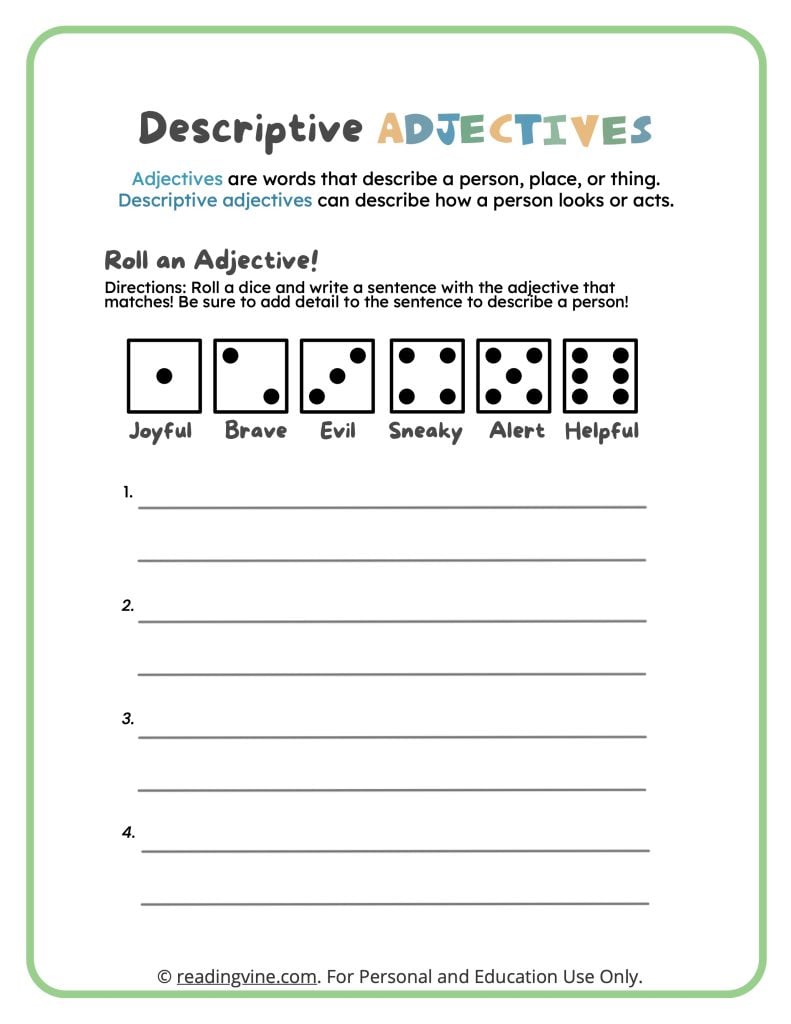
Roll a Descriptive Adjective! Printable Writing Activity
Roll the dice to select a descriptive adjective, then write an original sentence incorporating the word matching the number rolled.

Underline the Descriptive Adjectives Paragraph Search Worksheet
Read through a descriptive paragraph about a clown named Seemy, then underline or highlight all descriptive adjectives in the text.
Grade-Level Progression: Descriptive adjectives appear as early as kindergarten and 1st grade with basic identification (“Find the word that describes the noun”). By grades 2-3, students practice adding adjectives to expand sentences. In grades 4-5, the focus shifts to word choice—replacing vague adjectives (“nice,” “good,” “bad”) with precise ones (“generous,” “exceptional,” “disappointing”).
The Vocabulary Connection: Descriptive adjective work is vocabulary instruction in disguise. Building lists of size words, feeling words, texture words, and sensory words gives students concrete tools for better writing. Thesaurus skills fit naturally here.
Revision Application: Teach students to audit their drafts: circle every adjective, then ask “Is this the most specific word?” Replacing “The big house” with “The sprawling Victorian house” shows how precise adjectives do more work than generic ones.
