
 = Partner Site
Making Inferences
Making inferences means using clues from the text plus what you already know to figure out something the author doesn’t say directly. Good readers constantly make inferences—about character feelings, why events happen, what words mean, and what the author wants us to understand. Inferencing is “reading between the lines,” and it’s one of the most important comprehension skills students can develop.
For Teachers
Make the inference process visible by teaching the equation: Text Clues + Background Knowledge = Inference. Model your thinking aloud, showing students exactly which clues you used and what prior knowledge you applied. Start with character feelings—they’re the most concrete entry point.
For Parents
While reading together, pause and ask: “How do you think the character feels? What makes you think that?” This simple routine builds inference skills naturally. Help your child connect clues in the story to things they already know from real life.
Inference Worksheets
Practice making inferences with our printable reading passages and worksheets for grades K-8.
What Is an Inference?
An inference is a conclusion you reach based on evidence and reasoning. When you make an inference while reading, you combine clues from the text with your own background knowledge to understand something the author doesn’t state directly. Authors don’t tell us everything—they expect readers to “read between the lines” and figure things out. Making inferences is essential for deep comprehension.
The Inference Equation
What the author tells you
What you already know
What you figure out
Example: The text says “Maria wiped her eyes and sniffled.” (clue) + You know people do this when crying (background knowledge) = Maria is sad or upset (inference).
Inference Anchor Chart
Use this printable anchor chart to help students remember the inference process.
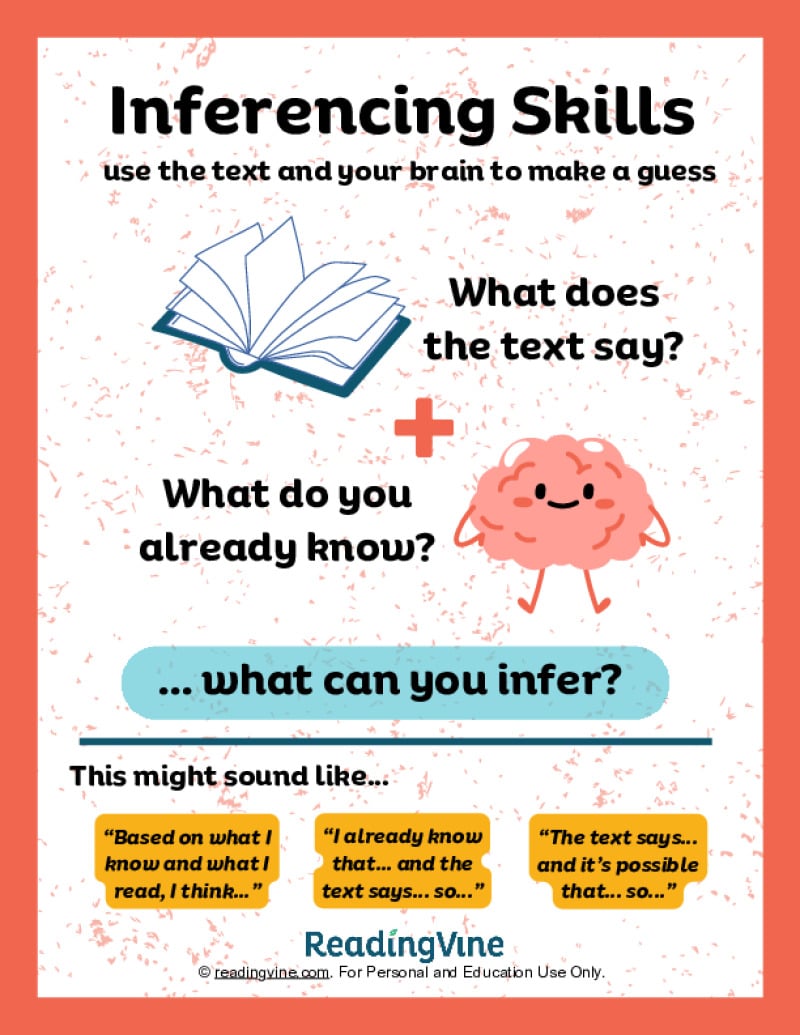
What’s included:
- The inference equation
- Key questions to ask
- Student-friendly examples
Inference vs. Similar Skills
A conclusion about what IS happening or HAS happened, based on clues and reasoning.
“The character is nervous.” (based on clues)A guess about what WILL happen next, based on clues and patterns.
“The character will probably fail the test.”Something directly STATED in the text. No reasoning required.
“The text says the character is sweating.”A random thought with NO evidence from the text.
“Maybe the character likes pizza.”Key difference: Inferences are always supported by text evidence. If you can’t point to clues that support your thinking, it’s a guess, not an inference.
Inference Examples by Category
Jump to any section, or scroll through all examples below.
Grades K-2
Simple inferences
10 examplesGrades 3-5
Deeper inferences
12 examplesGrades 6-8
Complex inferences
12 examplesBy Inference Type
Feelings, traits, cause & more
12 examplesWhat Can You Infer?
Test your skills
10 questionsCommon Mistakes
Errors to avoid
5 mistakesInference Examples for Grades K-2
Simple inferences about character feelings and everyday situations. Each example shows the text, the clues, and the inference.
“Sam looked at his melted ice cream cone on the hot sidewalk. His lip began to tremble.”
Clues: Melted ice cream, lip trembling. Background knowledge: People’s lips tremble when they’re about to cry.
Inference: Sam is sad about losing his ice cream.
“Emma ran to the window when she heard the truck’s music. She grabbed her piggy bank.”
Clues: Truck with music, grabbed piggy bank. Background knowledge: Ice cream trucks play music.
Inference: Emma wants to buy ice cream from the ice cream truck.
“The dog’s tail wagged back and forth. He jumped up and licked Dad’s face.”
Clues: Wagging tail, jumping, licking. Background knowledge: Dogs wag their tails when happy.
Inference: The dog is happy to see Dad.
“Lily yawned three times during the movie. Her eyes kept closing.”
Clues: Yawning, eyes closing. Background knowledge: People yawn and their eyes close when tired.
Inference: Lily is tired or sleepy.
“Ben put on his boots, hat, and mittens. He grabbed his sled.”
Clues: Boots, hat, mittens, sled. Background knowledge: You need winter clothes and a sled for snow.
Inference: Ben is going outside to play in the snow.
“Mom smiled and clapped when Maya showed her the paper with a big star on top.”
Clues: Smiling, clapping, paper with star. Background knowledge: Teachers put stars on good work.
Inference: Maya did well on her schoolwork and Mom is proud.
“The cat hid under the bed. Outside, the sky flashed bright and a loud boom shook the house.”
Clues: Cat hiding, sky flashing, loud boom. Background knowledge: Thunder and lightning scare some animals.
Inference: There’s a thunderstorm and the cat is scared.
“Jake kept looking at the clock. He tapped his foot and sighed loudly.”
Clues: Looking at clock, tapping foot, sighing. Background knowledge: People do these things when impatient.
Inference: Jake is impatient and wants something to happen soon.
“Anna blew out the candles on the cake while everyone sang to her.”
Clues: Candles on cake, people singing. Background knowledge: We blow out candles and sing “Happy Birthday.”
Inference: It’s Anna’s birthday party.
“The baby rubbed her eyes and started to cry. Mom picked her up and rocked her gently.”
Clues: Rubbing eyes, crying, being rocked. Background knowledge: Babies rub eyes when tired; rocking helps them sleep.
Inference: The baby is tired and Mom is helping her fall asleep.
Inference Examples for Grades 3-5
More complex inferences about character motivations, relationships, settings, and unstated causes. Students must combine multiple clues.
“Marcus stuffed his report card deep into his backpack before walking into the house. He went straight to his room without saying hello.”
Clues: Hiding report card, avoiding family. Background knowledge: People hide things they’re ashamed of.
Inference: Marcus got bad grades and doesn’t want his parents to see.
“Every day after school, Mrs. Chen sat on the porch and waved to the children walking by. She always had a plate of cookies ready.”
Clues: Daily routine, waving, cookies for children. Background knowledge: Lonely people seek connection; kind people share food.
Inference: Mrs. Chen is friendly and enjoys the company of the neighborhood children.
“When Tyler’s name was called to receive the award, his teammates lifted him onto their shoulders. They had all signed a card that said ‘Thanks for being our captain.'”
Clues: Lifted on shoulders, thank-you card, called him captain. Background knowledge: Teams celebrate leaders they respect.
Inference: Tyler was a good captain and his teammates respect and appreciate him.
“The old house had broken windows and a sagging roof. Weeds grew through cracks in the walkway, and the mailbox overflowed with yellowed newspapers.”
Clues: Broken windows, sagging roof, overgrown weeds, old newspapers. Background knowledge: Empty houses fall into disrepair.
Inference: No one has lived in this house for a long time.
“Grandpa’s hands shook as he held the faded photograph. He traced the face in the picture with his finger and whispered a name.”
Clues: Shaking hands, faded photo, tracing the face, whispering. Background knowledge: Old photos often show loved ones; people treat meaningful things gently.
Inference: The photograph shows someone Grandpa loved, possibly someone who has passed away.
“At lunch, Sophie sat alone at the end of a table. When other students walked by, she looked down at her food and didn’t make eye contact.”
Clues: Sitting alone, avoiding eye contact, looking down. Background knowledge: People avoid eye contact when shy or uncomfortable.
Inference: Sophie is shy, lonely, or doesn’t feel like she fits in.
“Whenever Mom mentioned getting a dog, Dad suddenly needed to mow the lawn or fix something in the garage.”
Clues: Dad leaves when dogs are mentioned, always finds other tasks. Background knowledge: People avoid topics they don’t want to discuss.
Inference: Dad doesn’t want to get a dog and is avoiding the conversation.
“The science fair judges spent twice as long at Kenji’s table as anyone else’s. They asked him many questions and took notes on their clipboards.”
Clues: Extra time at table, many questions, note-taking. Background knowledge: Judges spend more time on impressive entries.
Inference: Kenji’s project is impressive and may win a prize.
“After the argument, Mia found a note slipped under her door. It said ‘I’m sorry’ in her brother’s messy handwriting, with a chocolate bar taped to it.”
Clues: Apology note, brother’s handwriting, gift of chocolate. Background knowledge: People give gifts when apologizing.
Inference: Mia’s brother feels bad about the argument and wants to make up.
“Every book on Daniel’s shelf was about space—planets, astronauts, rockets. His ceiling was covered with glow-in-the-dark stars, and a telescope sat by his window.”
Clues: Space books, star decorations, telescope. Background knowledge: People collect things related to their interests.
Inference: Daniel is very interested in space and astronomy.
“The coach put her arm around Amy after the missed goal. ‘Everyone makes mistakes,’ she said. ‘What matters is what you do next.'”
Clues: Arm around Amy, comforting words after mistake. Background knowledge: Good coaches support players through failure.
Inference: The coach is kind and supportive, and wants Amy to keep trying.
“The lights flickered and went out. Outside, tree branches scraped against the windows and rain pounded on the roof.”
Clues: Lights out, branches scraping, rain pounding. Background knowledge: Storms can knock out power.
Inference: A bad storm has caused a power outage.
Inference Examples for Grades 6-8
Complex inferences about themes, unreliable narrators, social dynamics, and layered meanings. Students analyze subtle clues and conflicting information.
“‘I’m fine,’ Jordan said, smiling. But her hands trembled as she gripped her coffee cup, and she hadn’t touched her food in twenty minutes.”
Clues: Says “fine” but trembling hands, not eating, forced smile. Background knowledge: Body language often reveals true feelings; people hide emotions.
Inference: Jordan is not fine—she’s anxious or upset about something but doesn’t want to show it.
“The CEO announced record profits while laying off 500 workers. In her office, a photo showed her shaking hands with the governor at a charity gala.”
Clues: Record profits but layoffs, charity photo as display. Background knowledge: Some people prioritize appearance over genuine care.
Inference: The CEO appears to care more about image and profits than about her employees.
“My brother says he’s the best basketball player in the school. Of course, he also says he would have won the spelling bee if the words weren’t ‘unfair,’ and that the teacher ‘has it out for him’ when he fails tests.”
Clues: Claims of excellence, blames others for failures, pattern of excuses. Background knowledge: People who always blame others may lack self-awareness.
Inference: The brother is probably not as talented as he claims; the narrator seems skeptical of him.
“In the photo from ten years ago, the whole family stood close together, arms around each other, laughing. In this year’s photo, everyone stood apart, no one touching, with tight smiles.”
Clues: Physical closeness then vs. distance now, genuine laughter vs. forced smiles. Background knowledge: Body language in photos reveals relationships.
Inference: The family has grown apart or is experiencing tension in their relationships.
“Elena always volunteered to help the new students—showing them around, sitting with them at lunch, introducing them to others. She still remembered her first week at the school.”
Clues: Helps new students, remembers own first week. Background knowledge: People who struggled often help others avoid the same pain.
Inference: Elena probably had a difficult time when she was new and wants to make it easier for others.
“The candidate promised to fight for working families. The reporter noted that his campaign was funded almost entirely by large corporations.”
Clues: Promise to help workers, funding from corporations. Background knowledge: Donors often expect favors; actions and funding can contradict words.
Inference: There may be a conflict between what the candidate says and who he actually serves.
“‘This is the best day of my life,’ she said flatly, staring at the acceptance letter. She set it down without smiling and walked slowly to her room.”
Clues: Words say “best day” but flat tone, no smile, slow walk. Background knowledge: Tone and body language reveal true feelings.
Inference: She’s not actually happy about the acceptance—perhaps she doesn’t want to go, or something else is wrong.
“Marcus always talked about his father’s important business trips. But when the school called home, his mother said Marcus’s father hadn’t lived with them for three years.”
Clues: Marcus’s stories vs. mother’s statement, “business trips” as explanation. Background knowledge: Children sometimes create stories to hide painful truths.
Inference: Marcus’s parents are separated or divorced, and Marcus has been covering up his father’s absence.
“The narrator described himself as everyone’s best friend, the life of every party, beloved by all. Yet every scene showed him standing alone while others talked in groups.”
Clues: Self-description vs. what scenes show, always alone in groups. Background knowledge: Unreliable narrators’ words don’t match reality.
Inference: The narrator is unreliable—he’s actually isolated and perhaps lonely, despite his claims.
“Grandma kept every letter, every drawing, every photo her grandchildren had ever sent her. She had labeled each one with the date and the child’s name in her careful handwriting.”
Clues: Kept everything, careful labeling, organization. Background knowledge: People preserve what they treasure.
Inference: Grandma deeply treasures her relationship with her grandchildren; these items are precious to her.
“The town had three churches but no library. It had a new sports stadium but the school had outdated textbooks. The mayor drove a luxury car.”
Clues: Contrasts between what the town has vs. lacks, mayor’s car. Background knowledge: Budget priorities reveal values.
Inference: The town’s leadership may have misplaced priorities, valuing appearance or sports over education.
“After her speech about kindness and acceptance, Brittany walked past the new student eating alone without a glance. Her friends giggled as they followed.”
Clues: Speech about kindness vs. ignoring lonely student, friends giggling. Background knowledge: Actions reveal character more than words.
Inference: Brittany is hypocritical—she talks about kindness but doesn’t practice it.
Inference Examples by Type
Different kinds of inferences readers make. Each type requires looking for different clues.
Character Feelings
Inferring how a character feels based on actions, words, and body language.
“Rosa paced back and forth outside the principal’s office. She kept checking her phone and biting her nails.”
Inference: Rosa is nervous or anxious about something (maybe she’s in trouble or waiting for important news).
“When his team lost, James shook hands with every opponent and congratulated them on their win.”
Inference: James is a good sport who handles disappointment with grace.
“After reading the letter, Mom sat down slowly, pressed her hand to her heart, and said ‘Oh my.'”
Inference: Mom received surprising or emotional news—possibly good or bad.
Character Traits
Inferring what kind of person a character is based on patterns of behavior.
“Every morning, Mr. Garcia arrived at school an hour early to tutor struggling students for free.”
Inference: Mr. Garcia is dedicated, generous, and cares about his students’ success.
“Whenever someone else got praised, Kevin would roll his eyes and mutter about how he could have done it better.”
Inference: Kevin is jealous and has difficulty being happy for others’ success.
“Ava triple-checked her homework, organized her binder by color, and always arrived five minutes early to class.”
Inference: Ava is organized, responsible, and takes her schoolwork seriously.
Cause or Motivation
Inferring WHY something happened or why a character acts a certain way.
“The city built a new fence around the old swimming hole after three rescues in one summer.”
Inference: The fence was built because the swimming hole was dangerous and the city wanted to prevent more accidents.
“Marcus started walking home a different way after the older boys began waiting on his usual route.”
Inference: Marcus is avoiding the older boys, possibly because they bully or threaten him.
“Even though she was exhausted, Mom stayed up until midnight finishing the costume for the school play.”
Inference: Mom loves her child and wants them to have a great costume, even at personal cost.
Setting or Mood
Inferring where or when a scene takes place, or the atmosphere the author creates.
“Flickering candles cast dancing shadows on the stone walls. Somewhere in the darkness, water dripped steadily.”
Inference: The setting is somewhere old, dark, and possibly underground—like a cave, dungeon, or castle. The mood is eerie or mysterious.
“Horns honked, sirens wailed, and thousands of people rushed past without making eye contact. Steam rose from grates in the sidewalk.”
Inference: The setting is a large, busy city. The mood is hectic and impersonal.
“The house smelled of cinnamon and fresh bread. Laughter echoed from the kitchen, and a fire crackled in the hearth.”
Inference: The mood is warm, welcoming, and happy. This is likely a loving home, possibly during a holiday gathering.
What Can You Infer?
Read each passage and make an inference. Check your thinking against the answer.
“The referee blew the whistle, and the crowd erupted. Players from one team jumped on each other while the other team walked off slowly with their heads down.”
Inference: The game just ended. The celebrating team won; the team walking away lost.
“The woman checked her watch for the fifth time, then stared at the door. She tapped her foot and sighed loudly.”
Inference: She’s waiting for someone who is late, and she’s growing impatient or frustrated.
“Alex quickly closed the browser window when his mother walked into the room. He smiled and said he was ‘just doing homework.'”
Inference: Alex wasn’t actually doing homework—he was looking at something he didn’t want his mother to see.
“The dog cowered under the table, whimpering. Outside, the sky lit up bright white, followed by a loud crack.”
Inference: There’s a thunderstorm, and the dog is scared of the lightning and thunder.
“Every picture in the house showed the same two people—at their wedding, at the beach, at graduations. But now only one coffee cup sat by the window each morning.”
Inference: The couple in the photos is no longer together—one person may have died or left.
“The shelves were empty except for a few dented cans. A sign on the door read ‘Everything Must Go.'”
Inference: The store is going out of business and having a closing sale.
“The student raised her hand before the teacher finished asking the question. She bounced slightly in her seat, practically bursting to answer.”
Inference: The student is eager and confident—she already knows the answer and is excited to share it.
“After dinner, Tom’s plate was clean, but his little sister’s plate still held all her vegetables arranged in a smiley face.”
Inference: Tom ate his dinner including vegetables, but his sister didn’t eat hers—she just played with them.
“The candidate smiled for the cameras and shook hands with workers at the factory. As soon as the reporters left, she checked her phone and walked quickly to her car.”
Inference: The visit was a photo opportunity for publicity, not genuine interest in the workers.
“Mom came home with a small wrapped box hidden behind her back. She told everyone to stay out of her room until tomorrow.”
Inference: Mom bought a surprise gift for someone—possibly for a birthday or holiday tomorrow.
Common Inference Mistakes
Watch out for these frequent errors when making inferences.
1 Confusing Inference with Prediction
“I think the character will fail the test.” (What WILL happen)
“The character is nervous about the test.” (What IS happening, based on clues)
Remember: Inference = what’s happening now or has happened. Prediction = what will happen in the future.
2 Making Unsupported Guesses
“The character probably likes pizza.” (Where does this come from?)
“The character is hungry.” (Based on clues: stomach growling, looking at food)
Remember: Every inference must be supported by text evidence. If you can’t point to clues, it’s a guess.
3 Restating What’s Directly Stated
Text: “Sara was sad.” Student: “Sara is sad.” (That’s just repeating!)
Text: “Sara wiped her eyes and sniffled.” Student: “Sara is sad.” (Figured out from clues!)
Remember: Inferences are about what’s NOT directly stated. If the text says it explicitly, you’re summarizing, not inferring.
4 Over-Inferring (Reading Too Much Into It)
Text: “He frowned.” Student: “He’s plotting revenge against his enemies.”
Text: “He frowned.” Student: “He’s unhappy or confused about something.”
Remember: Stick close to what the clues actually support. Don’t create elaborate theories from small details.
5 Ignoring Clues That Contradict Your Inference
Text: “She said she was fine, but tears ran down her face.” Student: “She’s fine because she said so.”
“She’s NOT fine—she says she is, but her tears show she’s actually upset.”
Remember: Use ALL the clues, including ones that contradict what characters say. Actions often reveal more than words.
Tips for Teaching Inference
Text Clues + Background Knowledge = Inference. Make students identify BOTH parts for every inference they make.
Use images to practice inferencing first—students can see clues directly. Then transfer the skill to written text.
Show students your inference process: “I notice… I already know that… So I can infer…” Make the invisible visible.
Emotions are the most concrete entry point. Students connect easily to facial expressions, body language, and actions.
When students make an inference, require them to cite evidence. This separates supported inferences from random guesses.
Post the inference equation where students can see it. Having a visual reminder helps them internalize the process.
Making Inferences: Frequently Asked Questions
What is an inference?
An inference is a conclusion you draw based on evidence and reasoning. When reading, you combine clues from the text with your background knowledge to understand something the author doesn’t state directly. Inferences go beyond what’s written—they’re what you figure out by “reading between the lines.”
What is the difference between an inference and a prediction?
An inference is a conclusion about what IS happening or HAS happened, based on current clues. A prediction is a guess about what WILL happen in the future. Both use text evidence, but inferences are about the present or past, while predictions are about what comes next.
What is the difference between an inference and an observation?
An observation is something directly stated in the text—you can point to it. An inference is something you figure out that ISN’T directly stated. For example, “The sky was gray” is an observation. “It might rain soon” is an inference based on that observation.
How do I know if my inference is correct?
A good inference is supported by text evidence. Ask yourself: “What clues support this?” and “Does this fit with what I already know?” If you can point to specific details AND the inference makes logical sense, you’re on the right track. Multiple valid inferences are sometimes possible.
What grade level should students learn to make inferences?
Students begin making simple inferences in kindergarten and 1st grade, starting with character feelings. By grades 3-5, students make inferences about motivations, relationships, and themes. In grades 6-8, students analyze complex texts including unreliable narrators and subtle social dynamics.
Why is making inferences important?
Authors don’t tell readers everything—they expect us to figure things out. Making inferences is essential for deep comprehension: understanding characters, themes, and meaning. It’s also a critical thinking skill used beyond reading—we make inferences constantly in daily life based on evidence around us.