
 = Partner Site
Text Structure
Text structure is the way an author organizes information in a text. Recognizing text structure helps readers understand how ideas connect, anticipate what’s coming next, and remember information better. The five main text structures—description, sequence, cause and effect, compare and contrast, and problem and solution—each have unique signal words and patterns. These 50+ text structure examples help students identify and analyze how authors organize their writing across grade levels.
For Teachers
Teach signal words explicitly—they’re the key to identifying text structure. Start with description and sequence (most concrete), then move to cause/effect, compare/contrast, and problem/solution. Use the examples below for modeling, and have students hunt for signal words in their own reading.
For Parents
When reading nonfiction with your child, ask: “How did the author organize this?” Look for clue words like “first,” “because,” “however,” or “the problem was.” Understanding text structure helps kids comprehend textbooks, articles, and informational books more effectively.
Text Structure Worksheets
Our printable text structure worksheets help students identify the five text structures and their signal words.
What Is Text Structure?
Text structure is the way an author organizes information and ideas in a text. Different purposes call for different structures: describing a topic, explaining steps in order, showing causes and effects, comparing two things, or presenting a problem and solution. Authors use signal words to help readers recognize the structure. Understanding text structure improves reading comprehension because readers can predict what’s coming, see how ideas connect, and organize information in their memory.
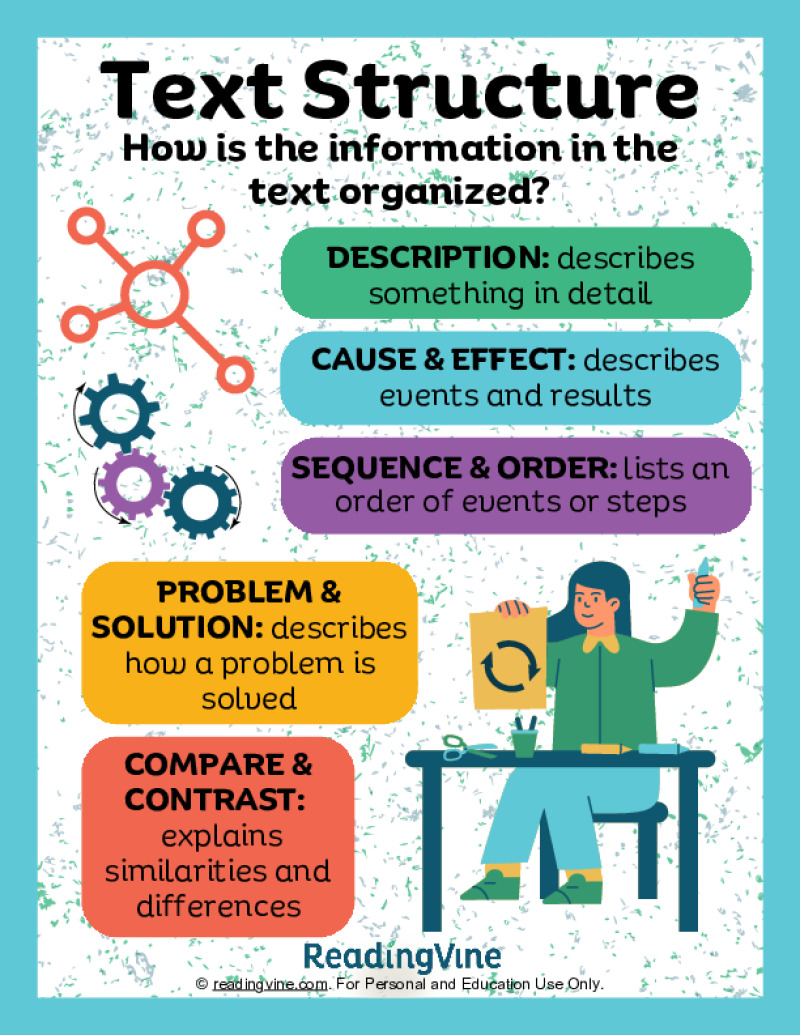
Text Structure Anchor Chart
Use this printable anchor chart to help students identify the five main nonfiction text structures.
What’s included:
- Five text structure types
- Signal words for each
- Visual organization
The Five Types of Text Structure
Describes a topic by listing characteristics, features, or examples.
Signal words: for example, characteristics, such as, including, to illustratePresents information in order—steps, events, or stages.
Signal words: first, next, then, finally, after, before, steps, datesShows how one event (cause) leads to another (effect).
Signal words: because, as a result, therefore, consequently, since, soShows similarities and/or differences between two or more things.
Signal words: similarly, however, both, unlike, on the other hand, whereasPresents a problem and explains one or more solutions.
Signal words: the problem is, the solution, solved by, as a result, one answer isRemember: A single text may use more than one structure. Look for signal words to identify the primary structure, and notice how sections may shift between structures.
How to Identify Text Structure
Scan for clue words like “because,” “first,” “however,” “the problem was.” These point directly to the structure.
Describing? Explaining steps? Showing causes? Comparing? Solving a problem? The author’s purpose reveals the structure.
How is information grouped? By time? By similarities/differences? By cause/effect? By problem/solution?
What structure fits MOST of the text? Individual paragraphs may differ, but one structure usually dominates.
Text Structure Examples by Category
Jump to any section, or scroll through all 50+ text structure examples below.
Grades K-2
Simple structures
12 examplesGrades 3-5
All five structures
15 examplesGrades 6-8
Complex passages
15 examplesBy Structure Type
All five text structures
5 typesWhat Structure Is This?
Test your understanding
10 questionsCommon Mistakes
Errors to avoid
5 mistakesText Structure Examples for Grades K-2
Simple examples focusing on description and sequence—the two easiest structures for young readers to recognize. Signal words are highlighted to help students see the patterns.
“Dogs make great pets. They are loyal and friendly. Dogs come in many sizes, from tiny Chihuahuas to giant Great Danes. Some dogs have long fur, while others have short fur.”
Description: Describes dogs by listing their characteristics and features.
“First, get your toothbrush and toothpaste. Next, put a small amount of toothpaste on the brush. Then, brush your teeth in circles. Finally, rinse your mouth with water.”
Sequence: Steps for brushing teeth in order. Signal words: first, next, then, finally.
“Apples are a popular fruit. They can be red, green, or yellow. Apples taste sweet or sour. You can eat them raw, baked in pies, or made into applesauce.”
Description: Describes apples by explaining their colors, taste, and uses.
“A caterpillar changes into a butterfly. First, it hatches from an egg. Then, it eats leaves and grows bigger. Next, it makes a chrysalis. Finally, a butterfly comes out!”
Sequence: The stages of a butterfly’s life cycle in order.
“The sun did not come out today. Because of the clouds, we couldn’t have our picnic. So we played games inside instead.”
Cause and Effect: Clouds (cause) led to canceling the picnic (effect). Signal words: because, so.
“Elephants are the largest land animals. They have big ears and long trunks. Their trunks help them drink water and grab food. Elephants live in groups called herds.”
Description: Describes elephants by listing their features and behaviors.
“To make a peanut butter sandwich, start by getting two slices of bread. Then, spread peanut butter on one slice. After that, put the slices together. Now you can eat!”
Sequence: Steps for making a sandwich. Signal words: to make, start by, then, after that.
“Cats and dogs are both popular pets. However, cats are usually quieter. Dogs need to go on walks, but cats do not.”
Compare and Contrast: Shows similarities and differences between cats and dogs. Signal words: both, however, but.
“It rained for three days. As a result, the river got very high. The water flooded the park because there was too much rain.”
Cause and Effect: Rain (cause) led to flooding (effect). Signal words: as a result, because.
“Penguins are interesting birds. They have black and white feathers. Unlike most birds, penguins cannot fly. They are excellent swimmers.”
Description: Describes penguins by listing their characteristics.
“The problem was that the plants were dying. They needed water. To solve this, the farmer built a sprinkler system. Now the plants get water every day.”
Problem and Solution: Dying plants (problem) solved by sprinklers (solution). Signal words: the problem was, to solve this.
“In the morning, the farmer feeds the chickens. At noon, she collects the eggs. In the evening, she closes the coop to keep the chickens safe.”
Sequence: The farmer’s daily routine in time order. Signal words: in the morning, at noon, in the evening.
Text Structure Examples for Grades 3-5
Longer passages demonstrating all five text structures. Students at this level identify signal words and analyze how structure supports the author’s purpose.
“The Amazon rainforest is home to incredible biodiversity. For example, it contains over 400 billion trees from 16,000 different species. The rainforest also includes millions of insects, thousands of bird species, and countless mammals, reptiles, and amphibians.”
Description: Describes the Amazon’s biodiversity with examples. Signal words: for example, also includes.
“The American Revolution unfolded over many years. First, in 1765, Britain passed the Stamp Act. Then, in 1773, colonists dumped tea into Boston Harbor. By 1775, fighting had begun at Lexington and Concord. Finally, in 1783, the war ended with American independence.”
Sequence/Chronological: Events of the Revolution in time order. Signal words: first, then, by, finally, dates.
“Deforestation has serious consequences. Because trees absorb carbon dioxide, cutting them down leads to more greenhouse gases in the atmosphere. As a result, global temperatures rise. This causes ice caps to melt and sea levels to increase.”
Cause and Effect: Chain of effects from deforestation. Signal words: because, leads to, as a result, this causes.
“Frogs and toads are similar in many ways. Both are amphibians that start life as tadpoles. However, there are key differences. Frogs have smooth, moist skin, while toads have dry, bumpy skin. Frogs live near water, whereas toads prefer drier habitats.”
Compare and Contrast: Similarities and differences between frogs and toads. Signal words: similar, both, however, while, whereas.
“Many schools faced a problem: students were bringing unhealthy lunches. To address this issue, some schools started nutrition education programs. As a solution, they also added more healthy options to the cafeteria. The result was that students began making better food choices.”
Problem and Solution: Unhealthy lunches (problem) solved by education and options (solutions). Signal words: a problem, to address this issue, as a solution, the result.
“The Grand Canyon is one of Earth’s most spectacular natural wonders. Its colorful rock layers reveal millions of years of geological history. The canyon stretches 277 miles long, up to 18 miles wide, and over a mile deep. It is home to diverse plants and animals adapted to its unique environment.”
Description: Describes the Grand Canyon’s features and characteristics.
“Making a volcano for the science fair requires several steps. Begin by building a cone shape from clay or papier-mâché. Next, place a small container inside the top. Then, add baking soda to the container. When you’re ready, pour in vinegar and watch it erupt!”
Sequence: Steps for making a volcano model. Signal words: steps, begin by, next, then, when you’re ready.
“Due to the invention of the printing press, books became much cheaper to produce. Consequently, more people learned to read. This led to the spread of new ideas across Europe. Because information traveled faster, scientific discoveries increased.”
Cause and Effect: Effects of the printing press. Signal words: due to, consequently, this led to, because.
“Renewable and nonrenewable energy sources differ in important ways. Renewable sources like solar and wind power can be replenished naturally. In contrast, nonrenewable sources such as coal and oil take millions of years to form. Unlike fossil fuels, renewable energy produces little pollution.”
Compare and Contrast: Differences between energy types. Signal words: differ, like, in contrast, such as, unlike.
“Coral reefs around the world face a serious problem: rising ocean temperatures are causing coral bleaching. Scientists are working on solutions, including growing heat-resistant coral in labs. Another approach is creating protected marine areas where reefs can recover without human interference.”
Problem and Solution: Coral bleaching (problem) with multiple solutions. Signal words: a serious problem, solutions, another approach.
“Ancient Egypt was characterized by remarkable achievements. The Egyptians developed one of the first writing systems, called hieroglyphics. They also built massive pyramids that still stand today. Their knowledge of medicine, mathematics, and astronomy was advanced for its time.”
Description: Describes Ancient Egyptian achievements. Signal words: was characterized by, developed, also built, their knowledge of.
“The water cycle is a continuous process. First, the sun heats water in oceans and lakes, causing evaporation. Then, water vapor rises and cools, forming clouds through condensation. Eventually, precipitation falls as rain or snow. Finally, water flows back to the oceans through rivers.”
Sequence: Stages of the water cycle in order. Signal words: first, then, eventually, finally.
“Since plastic takes hundreds of years to decompose, it accumulates in landfills and oceans. As a result, wildlife often mistakes plastic for food. This leads to injury and death for millions of animals each year. Therefore, reducing plastic use is critical for protecting ecosystems.”
Cause and Effect: Effects of plastic pollution. Signal words: since, as a result, this leads to, therefore.
“The challenge of feeding a growing population requires creative solutions. One answer is vertical farming, which grows crops in stacked layers indoors. This solves the problem of limited farmland by using less space. It also addresses water scarcity by recycling water within the system.”
Problem and Solution: Feeding population (problem) solved by vertical farming. Signal words: the challenge, one answer, this solves, it also addresses.
“City life and country life offer different experiences. Cities have more restaurants, museums, and entertainment options. On the other hand, rural areas provide more space and access to nature. Both have advantages, and the best choice depends on personal preferences.”
Compare and Contrast: Differences between city and country living. Signal words: different, on the other hand, both.
Text Structure Examples for Grades 6-8
Complex passages that may combine multiple structures. Students analyze how authors choose and transition between structures to achieve their purpose.
“The Industrial Revolution transformed society through a series of interconnected causes and effects. As factories emerged, rural populations migrated to cities for work. This urbanization led to overcrowding, which in turn caused public health crises. Consequently, governments were forced to develop new sanitation systems and labor laws.”
Cause and Effect (chain): Multiple linked causes and effects. Signal words: as, led to, in turn caused, consequently.
“Democracy and authoritarianism represent fundamentally opposing systems of government. In democracies, citizens elect leaders and enjoy protected rights. Conversely, authoritarian regimes concentrate power in one leader or party, while limiting individual freedoms. However, the line between these systems is not always clear—some governments blend elements of both.”
Compare and Contrast: Contrasts government systems with nuance. Signal words: opposing, in democracies, conversely, while, however.
“Antibiotic resistance has emerged as one of the most pressing health challenges of our time. The problem stems from overuse of antibiotics in medicine and agriculture. Several strategies offer potential solutions: developing new antibiotics, improving diagnostic tools to prevent unnecessary prescriptions, and educating patients about proper antibiotic use.”
Problem and Solution: Antibiotic resistance (problem) with multiple solutions. Signal words: pressing challenge, the problem stems from, strategies offer potential solutions.
“The scientific method follows a systematic sequence. Scientists begin by observing phenomena and asking questions. Next, they formulate hypotheses to explain their observations. Subsequently, they design experiments to test these hypotheses. Following data collection, they analyze results and draw conclusions. Finally, they share findings for peer review.”
Sequence: Steps of the scientific method. Signal words: begin by, next, subsequently, following, finally.
“Black holes are among the most mysterious objects in the universe. They form when massive stars collapse at the end of their life cycle. A black hole’s gravitational pull is so strong that nothing—not even light—can escape once it crosses the event horizon. Despite their name, black holes can be detected through their effects on nearby matter.”
Description: Describes black holes’ characteristics and formation. Includes some cause/effect (formation) within descriptive structure.
“Because social media algorithms prioritize engaging content, users often see posts that confirm their existing beliefs. This creates ‘filter bubbles’ where people rarely encounter opposing viewpoints. As a consequence, political polarization increases, making it harder for citizens to find common ground on important issues.”
Cause and Effect: Chain showing how algorithms lead to polarization. Signal words: because, this creates, as a consequence, making it.
“The civil rights movement progressed through distinct phases. During the 1950s, activists focused on legal challenges to segregation. By the early 1960s, sit-ins and freedom rides brought direct action to the forefront. The period from 1963-1965 saw landmark legislation, including the Civil Rights Act and Voting Rights Act. After 1965, the movement increasingly addressed economic inequality.”
Sequence/Chronological: Phases of the civil rights movement. Signal words: during, by, the period from, after, dates.
“Traditional and online education each have distinct advantages. Traditional classrooms offer face-to-face interaction and structured schedules. Online learning, by contrast, provides flexibility and accessibility. While traditional education benefits from immediate feedback, online platforms can offer personalized pacing. Neither approach is universally superior; the best choice depends on individual learning styles.”
Compare and Contrast: Balanced comparison of education methods. Signal words: distinct, offer, by contrast, while, neither.
“Ocean acidification presents a mounting threat to marine ecosystems. The underlying problem is that oceans absorb excess carbon dioxide from the atmosphere, lowering the water’s pH. To combat this, scientists propose reducing carbon emissions and exploring ocean alkalinity enhancement. Some researchers are also developing coral species that can tolerate more acidic conditions.”
Problem and Solution: Acidification (problem) with multiple approaches (solutions). Signal words: mounting threat, underlying problem, to combat this, also developing.
“The human brain is characterized by remarkable complexity. It contains approximately 86 billion neurons, each connected to thousands of others. Different regions specialize in distinct functions: the frontal lobe handles reasoning, while the occipital lobe processes vision. Despite decades of research, much about the brain remains unknown.”
Description: Describes brain structure and function. Signal words: is characterized by, contains, different regions specialize in.
“Gene editing technology like CRISPR has evolved rapidly. First developed in 2012, it initially allowed basic genetic modifications. Within just a few years, researchers refined the technique for greater precision. By 2020, CRISPR had been used to treat genetic diseases in human trials. Looking ahead, scientists anticipate even broader applications in medicine and agriculture.”
Sequence/Chronological: Development of CRISPR over time. Signal words: first developed, within, by, looking ahead, dates.
“When temperatures rise, ice sheets melt at accelerated rates. This melting causes sea levels to rise, threatening coastal communities. Rising seas, in turn, lead to increased flooding, erosion, and saltwater intrusion into freshwater supplies. These effects ultimately result in displacement of populations and economic disruption.”
Cause and Effect (chain): Climate change effects cascade through multiple stages. Signal words: when, causes, in turn lead to, result in.
“Capitalism and socialism represent different approaches to economic organization. Capitalist systems emphasize private ownership and market competition. Socialist systems, in contrast, favor collective ownership and government planning. Most modern economies, however, blend elements of both—pure examples of either system are rare in practice.”
Compare and Contrast: Economic systems compared with nuance. Signal words: different approaches, emphasize, in contrast, however.
“Student mental health has emerged as a critical issue in schools nationwide. The challenge involves increasing rates of anxiety and depression among young people. Schools are responding with expanded counseling services and mental health education. Some districts have also implemented later start times and reduced homework policies to address student stress.”
Problem and Solution: Student mental health (problem) with institutional responses (solutions). Signal words: critical issue, the challenge, responding with, also implemented.
“Artificial intelligence encompasses a range of technologies that simulate human intelligence. These include machine learning systems that improve through experience, natural language processing that enables computers to understand human speech, and computer vision that allows machines to interpret images. AI applications now extend to healthcare, transportation, and countless other fields.”
Description: Describes AI and its components. Signal words: encompasses, these include, applications extend to.
Text Structure Examples by Type
Examples organized by each of the five text structures, with signal words highlighted.
Description Text Structure Examples
Description structure describes a topic by listing its characteristics, features, or examples. Signal words: for example, such as, including, characteristics, is/are, consists of, to illustrate.
“The Sahara Desert is the world’s largest hot desert. It spans 3.6 million square miles across North Africa. The landscape includes sand dunes, rocky plateaus, and gravel plains. Temperatures can reach 136°F during the day but drop below freezing at night.”
Describes the Sahara’s size, location, and features.
“Octopuses are known for their remarkable intelligence. For instance, they can solve puzzles, open jars, and use tools. They also have three hearts, blue blood, and the ability to change color instantly.”
Describes octopus characteristics using examples.
Sequence / Chronological Text Structure Examples
Sequence structure presents information in order—steps, events, stages, or time periods. Signal words: first, next, then, finally, after, before, during, later, steps, dates, beginning, following.
“To conduct a successful experiment, begin with a clear hypothesis. Then, gather your materials and set up controlled conditions. Next, collect data carefully. After completing trials, analyze your results. Finally, draw conclusions based on evidence.”
Steps for conducting an experiment in order.
“In 1969, Apollo 11 launched toward the moon. Four days later, the lunar module landed on the surface. Neil Armstrong then became the first human to walk on the moon. Shortly after, Buzz Aldrin joined him. They returned to Earth on July 24.”
Events of the moon landing in chronological order.
Cause and Effect Text Structure Examples
Cause and effect structure shows how one event (cause) leads to another (effect). Signal words: because, since, therefore, as a result, consequently, due to, leads to, so, if…then, this caused.
“Because honeybee populations are declining, crop pollination is threatened. This decline is due to pesticide use, habitat loss, and disease. As a result, farmers face reduced yields. Consequently, food prices may rise if the trend continues.”
Causes of bee decline and their effects on agriculture.
“When the stock market crashed in 1929, banks began to fail. Since people lost their savings, consumer spending dropped dramatically. This led to business closures and massive unemployment, resulting in the Great Depression.”
Chain of cause and effect during the Great Depression.
Compare and Contrast Text Structure Examples
Compare and contrast structure shows similarities and/or differences between two or more things. Signal words: similarly, however, both, unlike, on the other hand, whereas, in contrast, different, same, also, but, while.
“Alligators and crocodiles are both large reptiles, but they have key differences. Alligators have U-shaped snouts, while crocodiles have V-shaped ones. Similarly, both live in water, however, crocodiles can tolerate saltwater, unlike alligators.”
Compares similarities and contrasts differences.
“The North and South had different economies before the Civil War. The North was characterized by industry and manufacturing. In contrast, the South relied heavily on agriculture and slavery. These differences contributed to growing tensions between the regions.”
Contrasts Northern and Southern economies.
Problem and Solution Text Structure Examples
Problem and solution structure presents a problem and explains one or more solutions. Signal words: the problem is, the issue, challenge, solved by, one solution, as a result, the answer, to address this, resolved.
“Traffic congestion is a growing problem in cities worldwide. One solution is expanding public transportation. Another approach involves congestion pricing, which charges drivers to enter busy areas. Cities like London have successfully addressed this issue with such policies.”
Traffic problem with multiple solutions.
“The challenge of space debris threatens satellites and astronauts. To tackle this problem, scientists are developing nets to capture debris and lasers to push objects into Earth’s atmosphere. These solutions could help protect vital space infrastructure.”
Space debris problem with proposed solutions.
What Text Structure Is This?
Test your understanding! Identify the text structure in each passage, then check the answer.
“Venus is often called Earth’s twin because of its similar size. It has a thick atmosphere of carbon dioxide. The surface is covered with volcanoes and mountains.”
Lists Venus’s characteristics and features—no time order, cause/effect, comparison, or problem/solution.
“First, preheat the oven to 350°F. Then, mix the dry ingredients. Next, add eggs and butter. Finally, pour the batter into a pan and bake for 30 minutes.”
Steps in order with signal words: first, then, next, finally.
“Because the soil lacked nutrients, the crops failed. As a result, the farmer switched to organic fertilizers. Consequently, the next harvest was much better.”
Shows causes and effects with signal words: because, as a result, consequently.
“Both butterflies and moths belong to the same insect order. However, butterflies are active during the day, while moths are nocturnal. Unlike butterflies, moths usually have feathery antennae.”
Shows similarities and differences with signal words: both, however, while, unlike.
“Plastic pollution is choking our oceans. To address this crisis, many cities have banned single-use plastics. Companies are also developing biodegradable alternatives.”
Presents a problem (pollution) and solutions (bans, alternatives).
“World War I began in 1914 after the assassination of Archduke Franz Ferdinand. By 1917, the United States entered the war. The conflict finally ended in 1918.”
Events in chronological order with dates: 1914, 1917, 1918.
“When water freezes, it expands. This expansion can cause pipes to burst. Therefore, homeowners should insulate pipes before winter.”
Shows cause (freezing/expansion) leading to effect (burst pipes) with signal words: when, this causes, therefore.
“The blue whale is the largest animal ever known to exist. These massive creatures can reach 100 feet in length and weigh up to 200 tons. Their hearts alone are the size of a small car.”
Describes characteristics of blue whales—size, weight, heart size.
“Many students struggle with test anxiety. One effective strategy is practicing deep breathing exercises. Another helpful approach is breaking study sessions into smaller chunks.”
Problem (test anxiety) with solutions (breathing, chunked study).
“Electric cars and gas cars both provide personal transportation. Electric cars, however, produce zero tailpipe emissions. On the other hand, gas cars currently offer greater range and faster refueling.”
Compares two types of cars with signal words: both, however, on the other hand.
Common Text Structure Mistakes
Students often confuse similar text structures or misidentify them. Here are the most common errors.
1 Confusing Sequence with Cause and Effect
“It has dates and ‘then,’ so it must be cause and effect.”
“Sequence = time order. Cause/effect = one thing MAKING another happen. Just because B comes after A doesn’t mean A caused B.”
Remember: In sequence, events happen in order. In cause and effect, one event CAUSES another. “First I woke up, then I ate breakfast” is sequence. “Because I was hungry, I ate breakfast” is cause/effect.
2 Confusing Description with Compare and Contrast
“It describes two animals, so it’s compare and contrast.”
“Compare/contrast actively shows similarities AND/OR differences. Just describing two things separately is description.”
Remember: Compare/contrast requires the author to explicitly connect two things—showing how they’re similar or different. Look for signal words like “both,” “however,” “unlike,” “similarly.”
3 Missing Combined Structures
“There can only be ONE text structure in a passage.”
“Many texts use multiple structures. Look for the PRIMARY structure, but recognize that paragraphs may shift between structures.”
Remember: A problem-solution article might use cause/effect to explain WHY the problem exists, then description to explain the solution. Identify the overall structure while recognizing secondary structures.
4 Over-relying on Signal Words
“It says ‘because,’ so it MUST be cause and effect.”
“Signal words are clues, but I need to look at the OVERALL organization. What is the author’s main purpose?”
Remember: Signal words help, but context matters more. A problem-solution text might include “because” when explaining the cause of the problem. Look at the big picture: What is the author MAINLY doing?
5 Confusing Text Structure with Genre
“It’s a biography, so the text structure is biography.”
“Biography is a GENRE. A biography typically uses CHRONOLOGICAL/SEQUENCE text structure because it tells a life story in order.”
Remember: Genre is the category of writing (biography, article, essay). Text structure is HOW the information is organized (description, sequence, cause/effect, compare/contrast, problem/solution).
Tips for Teaching Text Structure
Create a reference chart listing signal words for each structure. Have students use it during reading until they internalize the patterns.
These are the most concrete and easiest to identify. Build confidence before moving to cause/effect, compare/contrast, and problem/solution.
Train students to think about author’s purpose: Describing? Explaining steps? Showing cause/effect? Comparing? Solving a problem? Purpose reveals structure.
Sequence = timeline. Compare/contrast = Venn diagram. Cause/effect = arrows. Problem/solution = T-chart. The organizer reinforces the structure.
Science texts often use cause/effect and description. History uses sequence and cause/effect. Apply text structure across subjects to deepen understanding.
Writing in a specific structure builds deeper understanding than just identifying it. Assign paragraphs using each of the five structures on the same topic.
Text Structure: Frequently Asked Questions
What is text structure in simple terms?
Text structure is how an author organizes information in a text. Just like a house has a structure (foundation, walls, roof), a text has a structure that holds ideas together. The five main text structures are description, sequence, cause and effect, compare and contrast, and problem and solution. Recognizing text structure helps readers understand and remember information better.
What are the five types of text structure?
The five main text structures are: Description (lists characteristics), Sequence/Chronological (presents events in order), Cause and Effect (shows how one thing leads to another), Compare and Contrast (shows similarities and differences), and Problem and Solution (presents a problem and explains how to solve it). Each structure has unique signal words that help readers identify it.
What are signal words for text structure?
Signal words are clue words that point to specific text structures. Description: for example, such as, including. Sequence: first, then, next, finally, dates. Cause and Effect: because, therefore, as a result, due to. Compare and Contrast: similarly, however, both, unlike, whereas. Problem and Solution: the problem is, one solution, to address this.
What grade level should students learn about text structure?
Students begin recognizing basic structures like description and sequence in grades 1-2. By grades 3-5, students learn all five structures and use signal words to identify them. In grades 6-8, students analyze how authors use and combine structures for specific purposes. Common Core Reading Informational Text standard RI.5 addresses text structure across grade levels.
Why is text structure important for reading comprehension?
Understanding text structure helps readers in three key ways: (1) Predicting—knowing the structure helps readers anticipate what’s coming next, (2) Connecting—readers see how ideas relate to each other, and (3) Remembering—organized information is easier to recall. Research shows that explicitly teaching text structure significantly improves reading comprehension.
Can a text have more than one text structure?
Yes! Many texts combine multiple structures. For example, an article about climate change might use cause and effect to explain why temperatures are rising, description to explain the effects, and problem and solution to suggest responses. When analyzing text structure, identify the PRIMARY structure that organizes the whole text, while recognizing that individual sections may use different structures.