
 = Partner Site
Theme Examples
Theme is the underlying message, lesson, or central idea that a story conveys. It’s not what happens in the story (that’s the plot), but what the story means—the bigger truth about life, human nature, or society that the author wants readers to understand. Themes like “friendship conquers all” or “honesty is the best policy” give stories deeper meaning. These 50+ theme examples help students identify and analyze themes across grade levels.
For Teachers
Theme examples are organized by grade band and category for easy differentiation. Use these for literary analysis, reading comprehension, or to help students identify themes in their own reading and writing.
For Parents
After reading a book or watching a movie together, ask your child: “What lesson did the characters learn?” or “What was this story really about?” This builds the skill of finding deeper meaning in stories.
What Is Theme?
Theme is the central message, lesson, or insight about life that an author conveys through a story. It answers the question: “What is this story really about?” Theme is not the plot (what happens) or the subject (what the story is about on the surface). It’s the deeper meaning—a universal truth that applies beyond the story itself. A story can have multiple themes.
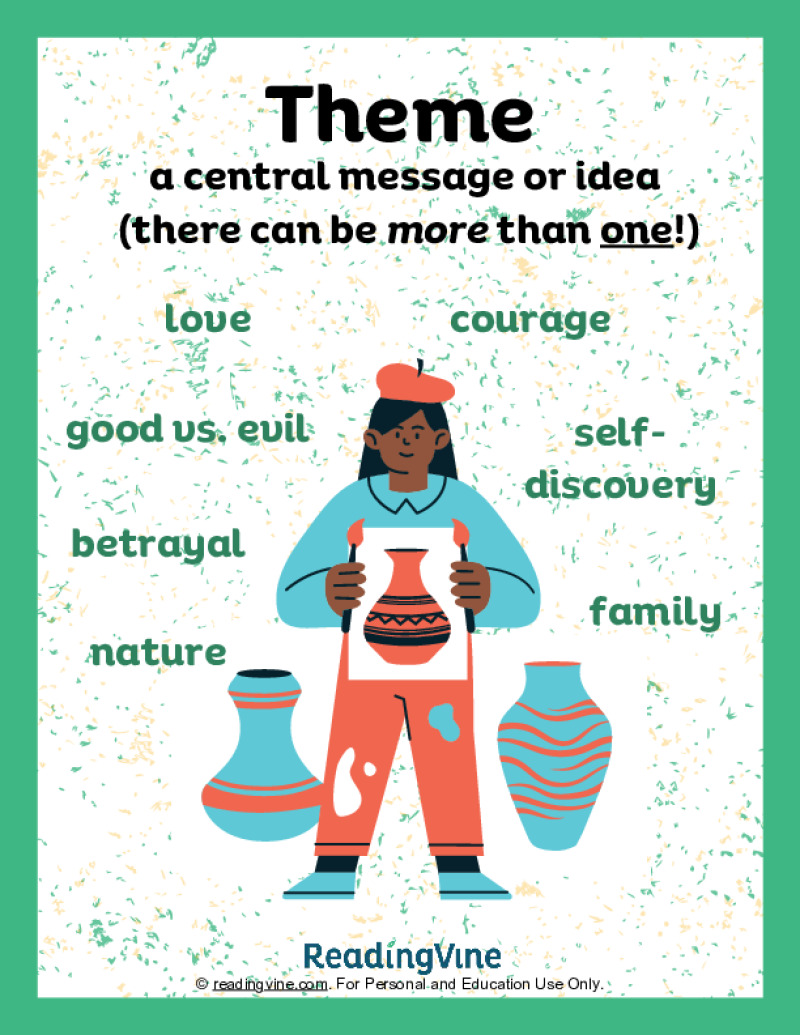
Theme Anchor Chart
Use this printable anchor chart to help students understand theme and distinguish it from topic.
What’s included:
- Theme vs. topic explanation
- Common themes list
- How to identify theme
Theme vs. Topic vs. Plot
True friends stand by you even when times are hard.
The lesson or insight about lifeKey distinction: Topic is a single word (friendship, courage, love). Theme is a complete statement about that topic—what the author believes or wants readers to understand about it.
Theme Example Categories
Jump to any section, or scroll through all 50+ theme examples below.
Grades K-2
Simple lessons & morals
12 examplesGrades 3-5
Character growth themes
15 examplesGrades 6-8
Complex & nuanced themes
15 examplesBy Category
Identity, relationships, society & more
5 categoriesIs This a Theme?
Test your understanding
8 questionsCommon Mistakes
What’s NOT a theme
5 examplesTheme Examples for Grades K-2
These simple themes appear in picture books and early readers. Young students can understand these as “lessons” the characters learn or messages the author wants to share.
Be kind to others.
Stories show that treating people well makes everyone happier.
It’s okay to be different.
Characters learn that being unique is something to celebrate.
Friends help each other.
True friends support one another in good times and bad.
Honesty is the best policy.
Telling the truth, even when it’s hard, is always the right choice.
Don’t give up when things get hard.
Perseverance and trying again leads to success.
Sharing makes everyone happy.
When we share, we all benefit and feel good.
Family loves you no matter what.
Family members support each other unconditionally.
Believe in yourself.
Self-confidence helps you achieve your goals.
Being brave means doing things even when you’re scared.
Courage isn’t the absence of fear—it’s acting despite fear.
Everyone has something special to offer.
Each person has unique talents and value.
Good things come to those who wait.
Patience is rewarded; rushing leads to problems.
Treat others the way you want to be treated.
The Golden Rule—kindness creates kindness.
Theme Examples for Grades 3-5
These themes involve more complex ideas about character growth, relationships, and personal choices. Students at this level can analyze how characters learn and change throughout a story.
True friendship requires sacrifice and loyalty.
Real friends sometimes give things up for each other.
Appearances can be deceiving.
People and situations aren’t always what they seem at first.
Standing up for what’s right takes courage.
Doing the right thing isn’t always easy or popular.
People can change and grow.
Characters learn from mistakes and become better people.
Working together accomplishes more than working alone.
Teamwork and cooperation lead to greater success.
Actions have consequences.
Choices—good or bad—lead to outcomes we must face.
Home is where you feel loved and accepted.
Home is about belonging, not just a physical place.
Knowledge and education open doors.
Learning gives us power and opportunities.
Small acts of kindness can make a big difference.
Little things we do for others can have huge impacts.
Greed leads to unhappiness.
Wanting too much often causes us to lose what we have.
Nature should be respected and protected.
We have a responsibility to care for our environment.
Facing your fears helps you overcome them.
Running from fears makes them stronger; confronting them makes us stronger.
Everyone deserves a second chance.
People can redeem themselves after making mistakes.
True wealth is measured by love, not money.
Relationships matter more than material possessions.
We should help those less fortunate than ourselves.
Compassion and generosity strengthen communities.
Theme Examples for Grades 6-8
These themes explore more complex, nuanced ideas about identity, society, morality, and the human condition. Middle school students can analyze how authors develop themes through plot, character, and literary devices.
The search for identity is a lifelong journey.
Discovering who we are takes time and involves struggle.
Society often pressures individuals to conform.
External forces push us to fit in, sometimes at the cost of our true selves.
Power can corrupt even good people.
Authority and influence can change a person’s values and actions.
The truth is often more complex than it first appears.
Reality has many layers; simple explanations rarely tell the whole story.
Prejudice blinds us to the humanity of others.
Judging people by their group prevents us from seeing them as individuals.
Growing up means accepting responsibility for your choices.
Maturity involves owning our decisions and their consequences.
Hope can survive even in the darkest circumstances.
The human spirit can endure tremendous hardship and still find light.
Silence in the face of injustice is a form of complicity.
Failing to speak up against wrong makes us part of the problem.
The past shapes who we are, but doesn’t have to define us.
Our history influences us, but we can choose our future.
Freedom requires sacrifice and vigilance.
Liberty must be earned and protected; it’s never guaranteed.
Love can inspire both great sacrifice and terrible destruction.
Love is a powerful force that can lead to heroism or tragedy.
The desire for revenge often harms the one seeking it most.
Vengeance consumes the person who pursues it.
Isolation and loneliness can change a person.
Human connection is essential; without it, we suffer.
War affects everyone, not just those who fight.
Conflict ripples outward, touching families, communities, and generations.
Sometimes the greatest battles are fought within ourselves.
Internal conflict—between duty and desire, fear and courage—shapes who we become.
Common Themes by Category
Many themes fall into common categories that appear across literature. Here are examples grouped by topic.
Identity & Self-Discovery
Themes about finding out who you are.
• It’s okay to be different
• The search for identity is a lifelong journey
• Believe in yourself
• We must accept ourselves before others can accept us
Relationships & Love
Themes about connections with others.
• True friendship requires sacrifice
• Family loves you no matter what
• Love can inspire great sacrifice
• Isolation and loneliness change a person
Good vs. Evil
Themes about morality and choices.
• Standing up for what’s right takes courage
• Power can corrupt even good people
• Actions have consequences
• Sometimes the line between good and evil is blurry
Perseverance & Courage
Themes about overcoming obstacles.
• Don’t give up when things get hard
• Facing your fears helps you overcome them
• Hope can survive in the darkest circumstances
• Being brave means acting despite fear
Society & Justice
Themes about the world and fairness.
• Prejudice blinds us to the humanity of others
• Silence in the face of injustice is complicity
• Society pressures individuals to conform
• Freedom requires sacrifice and vigilance
Is This a Theme?
Test your understanding! Is it a theme, a topic, or something else?
“True friends stand by you even when times are hard.”
Complete statement about life/friendship that applies beyond the story.
“Friendship”
This is a topic—just one word. What ABOUT friendship?
“People can change and grow from their mistakes.”
A message about human nature that extends beyond any single story.
“A boy goes on a journey and learns to be brave.”
This is plot summary—what happens, not the message.
“Greed leads to unhappiness.”
A statement about life that the story demonstrates.
“Courage, love, family”
These are topics—words without a message. Turn them into statements.
“The truth is often more complex than it first appears.”
A universal insight about truth and perception.
“The main character is brave.”
This is characterization—describing a character, not a life lesson.
Common Theme Mistakes
Students often confuse theme with other story elements. Here are the most common mix-ups.
1 Confusing Theme with Topic
“Friendship” or “Courage” or “Love”
“True friendship means standing by someone even when it’s difficult.”
Remember: Topic is one word. Theme is a complete sentence that makes a statement about that topic. Ask: “What does this story say ABOUT [topic]?”
2 Confusing Theme with Plot
“The girl saves her village from the dragon.”
“One person’s courage can make a difference for many.”
Remember: Plot is WHAT happens. Theme is WHAT IT MEANS. The plot shows the theme through events, but they’re not the same thing.
3 Making Theme Too Specific
“Harry should be nice to Dobby.”
“Kindness to those society overlooks reveals true character.”
Remember: Themes should be universal—applicable to life beyond the specific story. Remove character names and specific plot details.
4 Stating Theme as a Command
“Be brave!” or “Don’t lie!”
“Being brave means acting despite your fears.” or “Honesty, though difficult, builds trust.”
Remember: Themes are observations about life, not instructions. Turn commands into statements about why that quality matters.
5 Thinking Every Story Has One Theme
“THE theme of this book is…”
“One theme in this book is… Another theme is…”
Remember: Complex stories often have multiple themes. Look for several messages the author might be conveying through different characters or plot lines.
Tips for Teaching Theme
This is the most common confusion. Practice the formula: Topic is one word (friendship). Theme is a sentence about that topic (True friends stick together through hard times). Post this distinction visibly in your classroom.
After summarizing plot, ask students: “So what? What’s the bigger message?” or “What did the main character learn that we can learn too?” These questions push students from plot to theme.
Practice with fairy tales, fables, and movies students already know. What’s the theme of “The Three Little Pigs”? (Hard work and planning pay off.) Familiar content lets students focus on the skill, not comprehension.
If a student’s theme includes character names or specific plot details, it’s too narrow. Practice removing specifics: “Harry learns to trust his friends” becomes “Trusting others helps us overcome challenges we can’t face alone.”
Themes should be supported by what happens in the story. Ask students to find specific scenes, dialogue, or character changes that prove their theme. This prevents wild guessing and builds analytical skills.
Complex stories have multiple themes, and different readers may emphasize different messages. As long as students can support their theme with evidence, multiple interpretations can be correct. This builds critical thinking.
Theme Examples: Frequently Asked Questions
What is theme in simple terms?
Theme is the message, lesson, or main idea that a story teaches us about life. It’s not what happens in the story (that’s the plot), but what the story MEANS. Think of it as the author’s message to readers—something true about life, people, or the world that the story shows us through its characters and events.
What is the difference between theme and topic?
Topic is a single word or phrase that tells what the story is about: friendship, courage, love, growing up. Theme is a complete sentence that makes a statement about that topic: “True friendship means standing by someone even when it’s difficult.” Topic is the subject; theme is the message about that subject.
What is the difference between theme and moral?
A moral is a direct lesson, often stated explicitly at the end of a fable: “Slow and steady wins the race.” A theme is usually implied rather than stated directly, and it’s more nuanced than a simple lesson. Themes explore complex ideas about life; morals give clear rules to follow. All morals are themes, but not all themes are morals.
How do I find the theme of a story?
Look for clues: What does the main character learn? How do they change? What consequences do characters face for their choices? What idea comes up repeatedly? Ask yourself: “What is the author trying to say about life or human nature?” Then state your answer as a complete sentence without using character names or plot details.
Can a story have more than one theme?
Yes! Most complex stories have multiple themes. A novel might explore themes about friendship, growing up, AND the importance of honesty all at once. Different readers may focus on different themes based on their own experiences and what resonates with them. When analyzing literature, look for several messages the author conveys.
What grade level should students learn about theme?
Students begin learning about theme in 2nd-3rd grade with simple “lessons” from stories. Common Core State Standards address theme explicitly starting in 4th grade (RL.4.2), where students determine theme and summarize text. By middle school, students analyze how theme develops through character, setting, and plot, and compare themes across texts.
