
 = Partner Site
Compound Adjectives Worksheets
Compound adjectives combine two or more words to describe a noun—”well-known author,” “fast-paced story,” “sugar-free snack.” These worksheets help students recognize compound adjectives, understand hyphenation rules, and use them to add precision to their writing.
Hyphenation is the tricky part: compound adjectives before a noun typically need a hyphen (“a well-known author”), but the same words after a linking verb often don’t (“the author is well known”). Browse below for identification, hyphenation, and sentence-writing practice.
Printable Compound Adjective Worksheets

Compound Adjectives Matching Game Activity
Match word pairs from two columns to create proper compound adjectives like long-lasting, self-confident, and short-term.

Compound Adjectives Writing Activity
Rewrite sentences to include compound adjectives for enhanced description, then draw pictures illustrating each revised sentence.

Drawing and Writing Compound Adjectives Worksheet
Write a descriptive sentence using a compound adjective provided, then illustrate the sentence with an accompanying drawing.

Fix the Compound Adjectives Worksheet
Add hyphens to word pairs to create proper compound adjectives, transforming phrases like well known into well-known.

Rewrite the Sentences with Compound Adjectives
Rewrite given sentences to include compound adjectives, transforming simple descriptions into more sophisticated descriptive phrases.
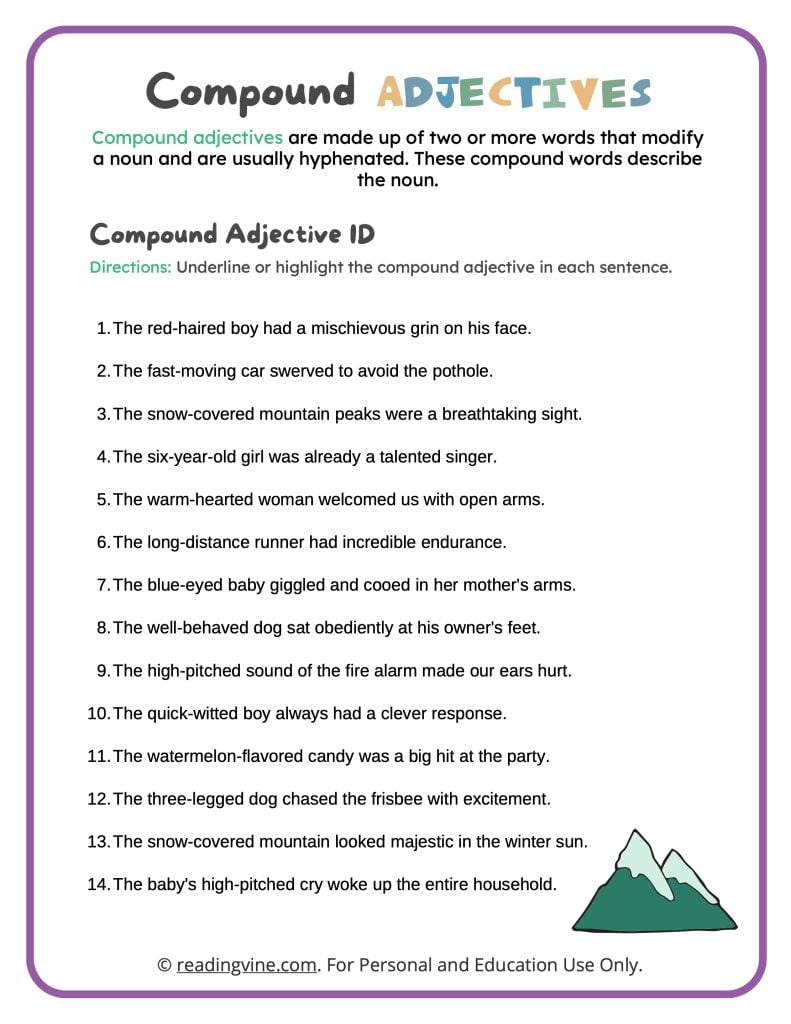
Underline the Compound Adjectives Activity
Identify compound adjectives in sentences by reading through each one and underlining or highlighting hyphenated descriptive words.

iSpy with Compound Adjectives Worksheet
Practice identifying compound adjectives with this fun iSpy activity, reading sentences and finding hyphenated descriptive words throughout.
Grade-Level Placement: Compound adjectives typically appear in grades 4-5, after students understand basic adjective function and have some familiarity with hyphens. The concept pairs well with compound word instruction and hyphenation rules.
Common Formations: Help students recognize patterns: adjective + participle (“old-fashioned,” “good-looking”), noun + participle (“time-consuming,” “heart-breaking”), and adverb + adjective (“well-known,” “brightly-lit”). Knowing these patterns helps students both identify and create compound adjectives.
The Hyphen Question: Students struggle most with when to hyphenate. The general rule: hyphenate before the noun (“a part-time job”) but not after (“the job is part time”). However, some compounds are always hyphenated regardless of position. Worksheets focusing on before/after placement build this editing skill without overwhelming students with exceptions.