
 = Partner Site
Story Elements
Story elements are the building blocks of every narrative. Whether it’s a picture book or a complex novel, every story contains characters, a setting, a plot, conflict, and theme. Understanding these elements helps readers analyze literature, make predictions, and understand how authors craft meaningful stories. Learning story elements also helps students become better writers by giving them a framework for their own narratives.
For Teachers
Start with the basics—characters, setting, and plot—before introducing conflict types and theme. Use familiar stories (fairy tales, movies) to teach elements before applying them to new texts. Graphic organizers help students track elements as they read.
For Parents
After reading together, ask simple questions: “Who was in the story? Where did it happen? What was the problem?” These questions naturally cover characters, setting, and conflict. Discussing favorite books and movies builds story element awareness.
What Are Story Elements?
Story elements are the essential components that make up a narrative. Every story—whether a fairy tale, novel, movie, or personal narrative—contains these building blocks. The five main story elements are characters (who), setting (where and when), plot (what happens), conflict (the problem), and theme (the message or lesson). Understanding these elements helps readers comprehend, analyze, and discuss any story.
The 5 Main Story Elements
Who is in the story?
Where and when?
What happens?
What’s the problem?
What’s the message?
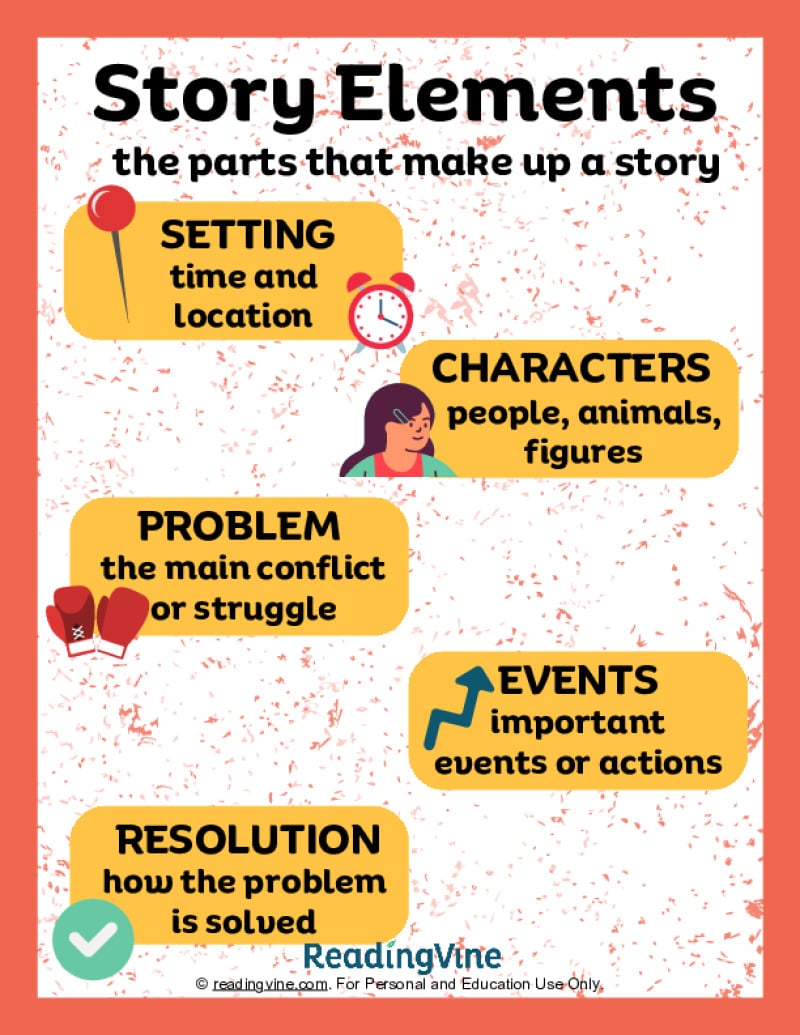
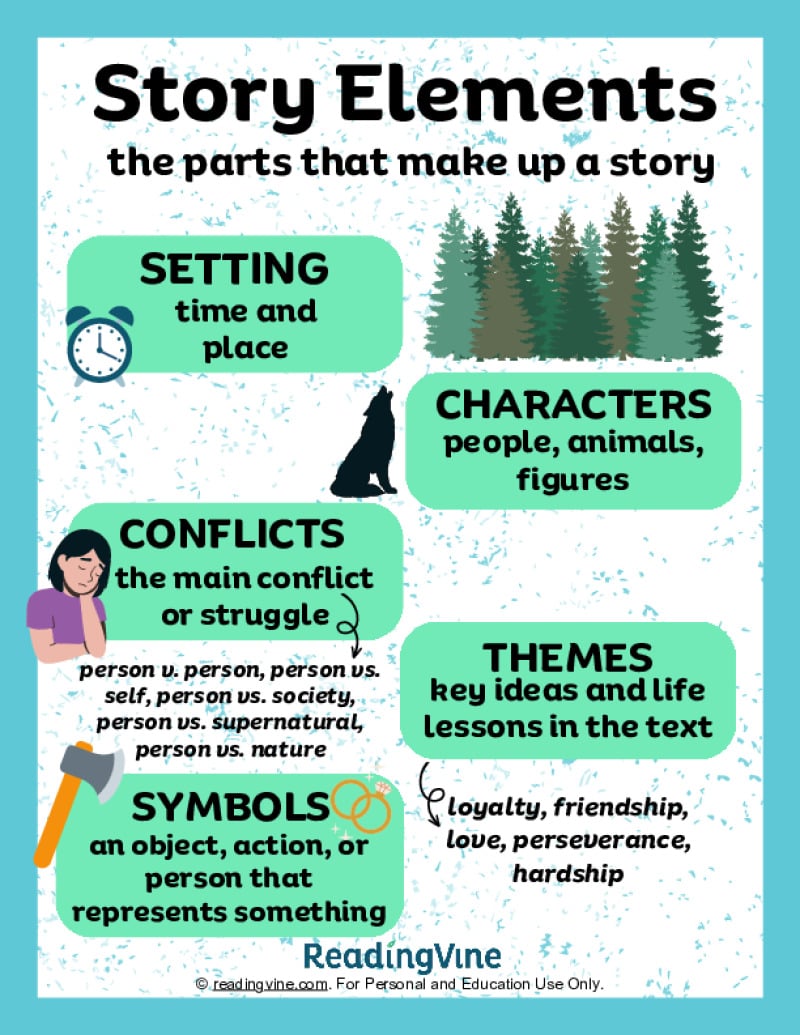
Story Elements Anchor Charts
Use these printable anchor charts to help students remember the story elements. Choose the version that fits your grade level.
Story Elements Explained
Jump to any section, or scroll through all elements and examples below.
Characters
Who is in the story
4 examplesSetting
Where and when
4 examplesPlot
What happens
5 examplesConflict
The problem
5 typesTheme
The message
4 examplesBy Grade Level
K-2, 3-5, 6-8
24 examplesCharacters
Characters are the people, animals, or beings in a story. The protagonist is the main character; the antagonist opposes them. Characters can be flat (simple) or round (complex), and static (unchanging) or dynamic (changing).
Types of Characters
The main character—the one the story is mostly about. We usually root for them.
The character (or force) that opposes the protagonist. Creates the conflict.
Cinderella: The protagonist is Cinderella, a kind girl who dreams of a better life. The antagonists are her cruel stepmother and stepsisters who mistreat her.
Cinderella is a dynamic character—she transforms from servant to princess. The stepmother is static—she remains cruel throughout.
Harry Potter: Harry is the protagonist—a young wizard discovering his identity. Voldemort is the antagonist—an evil wizard who wants to destroy Harry and rule the wizarding world.
Harry is a round, dynamic character who grows throughout the series. Supporting characters like Ron and Hermione help the protagonist.
The Three Little Pigs: The three pigs are the protagonists. The Big Bad Wolf is the antagonist who threatens them.
The third pig (who builds with bricks) could be seen as the main protagonist since his choices save everyone.
The Hunger Games: Katniss is the protagonist who volunteers to save her sister. The antagonist is more complex—it includes President Snow and the oppressive Capitol system.
Sometimes the antagonist isn’t a single person but a system, society, or force.
Go deeper: See our Character Traits examples →
Setting
Setting is WHERE and WHEN a story takes place. It includes the physical location, time period, weather, and social environment. Setting can create mood, affect the plot, and influence characters’ choices.
Components of Setting
Physical location—a city, forest, school, planet, etc.
When—past, present, future, specific era, time of day, season.
The mood created—dark, cheerful, tense, magical.
Charlotte’s Web: The setting is a farm in rural America, with the barn as the central location. The time is the present day (mid-20th century when written).
The farm setting is essential—it explains why Wilbur might be slaughtered and allows for animal characters who live together.
The Lion, the Witch and the Wardrobe: The story has two settings—wartime England and the magical land of Narnia, which is trapped in eternal winter.
The contrast between settings is important. The children escape the real-world danger of WWII into a fantasy world with its own dangers.
Number the Stars: Set in Copenhagen, Denmark during World War II (1943). The Nazi occupation creates constant tension and danger.
The historical setting drives the entire plot. The story couldn’t happen in a different time or place.
The Giver: Set in a seemingly perfect future community where everything is controlled—no color, no emotions, no choices.
The dystopian setting IS the conflict. The community’s rules create the problem Jonas must face.
Plot
Plot is the sequence of events in a story—what happens from beginning to end. Most plots follow a structure: exposition (introduction), rising action (building tension), climax (turning point), falling action, and resolution.
Plot Structure (Freytag’s Pyramid)
Introduction—characters, setting, situation established.
Conflict develops, tension builds, complications arise.
Turning point—the most intense or important moment.
Events after the climax—loose ends begin to tie up.
Conclusion—conflict resolved, story ends.
Goldilocks and the Three Bears:
Exposition: Goldilocks finds a house in the woods.
Rising Action: She tries the porridge, chairs, and beds.
Climax: The bears come home and find her.
Resolution: Goldilocks runs away.
Finding Nemo:
Exposition: Marlin is an overprotective father; Nemo is captured.
Rising Action: Marlin journeys across the ocean, facing sharks and jellyfish.
Climax: Nemo escapes the tank; father and son reunite.
Resolution: They return home; Marlin learns to let go.
The Outsiders:
Exposition: Ponyboy introduces the Greasers vs. Socs conflict.
Rising Action: Johnny kills a Soc; boys hide out; church fire.
Climax: Johnny dies from injuries.
Falling Action: Rumble with Socs; Dally’s death.
Resolution: Ponyboy writes the story we just read.
Little Red Riding Hood:
Exposition: Red sets off to grandmother’s house.
Rising Action: Wolf arrives first and disguises himself.
Climax: Wolf reveals himself (“the better to eat you with!”).
Resolution: Huntsman saves Red and grandmother.
Holes:
Exposition: Stanley is wrongly convicted and sent to Camp Green Lake.
Rising Action: He digs holes, befriends Zero, discovers the camp’s secrets.
Climax: Stanley and Zero find the treasure and survive on the mountain.
Resolution: Stanley’s name is cleared; the curse is broken.
Conflict
Conflict is the problem or struggle that drives the story. Without conflict, there’s no story. Conflict creates tension and gives characters something to overcome. There are several types of conflict.
Types of Conflict
Struggle between two characters—hero vs. villain, rivals, enemies.
Internal struggle—fear, guilt, making a difficult decision, overcoming flaws.
Struggle against natural forces—storms, animals, survival in the wild.
Struggle against rules, laws, expectations, or social norms.
Struggle against machines, destiny, supernatural forces, or the unknown.
Character vs. Character: In Harry Potter, Harry struggles against Voldemort. In Cinderella, Cinderella faces her stepmother.
This is the most common and easiest conflict type to identify—one person against another.
Character vs. Self: In Wonder, Auggie struggles with self-doubt about his appearance. In Diary of a Wimpy Kid, Greg battles his own laziness and poor choices.
Internal conflicts show characters making difficult decisions or overcoming their own fears and flaws.
Character vs. Nature: In Hatchet, Brian must survive alone in the Canadian wilderness. In The Perfect Storm, fishermen battle a deadly hurricane.
Nature conflicts often involve survival—characters against weather, terrain, or wild animals.
Character vs. Society: In The Hunger Games, Katniss resists an oppressive government. In To Kill a Mockingbird, Atticus fights against racist social norms.
Society conflicts involve challenging unfair rules, laws, expectations, or widespread beliefs.
Character vs. Technology/Fate: In A Wrinkle in Time, Meg battles against IT, a controlling force. In Greek mythology, heroes often struggle against fate or prophecy.
These conflicts involve forces beyond human control—destiny, supernatural powers, or technology.
Theme
Theme is the underlying message, lesson, or insight about life that the story conveys. Theme is not the topic (what the story is about) but the statement the story makes about that topic. Theme is usually implied, not stated directly.
Topic vs. Theme
Friendship, courage, family, growing up, justice
True friends stand by you in difficult times. Courage means doing what’s right even when you’re scared.
Charlotte’s Web:
Topic: Friendship
Theme: The story suggests that true friendship means making sacrifices for those you love.
The Tortoise and the Hare:
Topic: Perseverance
Theme: Slow and steady effort can defeat natural talent wasted by overconfidence.
Wonder:
Topic: Kindness, acceptance
Theme: The story explores the idea that choosing kindness can change lives, and that true beauty is found within, not in appearances.
The Outsiders:
Topic: Identity, class
Theme: Social divisions are artificial—people are more alike than different regardless of background.
Go deeper: See our Theme examples → | Main Idea vs. Theme →
Story Elements by Grade Level
See how story elements appear in texts at different grade levels, from simple fairy tales to complex novels.
Grades K-2: Simple Stories
The Very Hungry Caterpillar
Character: A caterpillar
Setting: Various places over one week
Plot: Caterpillar eats, gets sick, then becomes a butterfly
Conflict: Character vs. Self (hunger, then stomachache)
Theme: Growth and transformation are natural
The Three Billy Goats Gruff
Characters: Three goats (protagonists), troll (antagonist)
Setting: A bridge over a river
Plot: Each goat crosses; biggest defeats troll
Conflict: Character vs. Character
Theme: Cleverness and teamwork defeat bullies
Corduroy
Characters: Corduroy (teddy bear), Lisa (girl)
Setting: A department store
Plot: Bear wants a home; searches for button; girl buys him
Conflict: Character vs. Self (wanting to be perfect to be loved)
Theme: You don’t have to be perfect to be loved
The Ugly Duckling
Character: A “duckling” who is actually a swan
Setting: A farm and pond
Plot: Duckling is rejected, wanders, discovers he’s a swan
Conflict: Character vs. Society (rejection by others)
Theme: True identity reveals itself in time
Knuffle Bunny
Characters: Trixie, Daddy, Knuffle Bunny
Setting: A laundromat and neighborhood
Plot: Bunny lost at laundromat; Trixie can’t explain; they go back
Conflict: Character vs. Self (frustration at not being understood)
Theme: Communication matters; parents listen when they understand
Where the Wild Things Are
Character: Max
Setting: Max’s room → land of Wild Things → home
Plot: Max misbehaves, sails away, becomes king, returns home
Conflict: Character vs. Self (anger, loneliness)
Theme: Home and love are always waiting, even when you misbehave
The Snowy Day
Character: Peter
Setting: A city neighborhood after a snowfall
Plot: Peter explores the snow, saves a snowball, finds it melted
Conflict: Character vs. Nature (snow melts)
Theme: Simple experiences bring joy; some things can’t be kept forever
Swimmy
Characters: Swimmy (black fish), school of red fish
Setting: The ocean
Plot: Swimmy’s school eaten; he finds new friends; they scare big fish together
Conflict: Character vs. Character (big fish threat)
Theme: Working together makes us stronger
Grades 3-5: Chapter Books
Because of Winn-Dixie
Characters: Opal (lonely girl), Winn-Dixie (dog), various townspeople
Setting: Small town in Florida
Plot: Girl finds dog; dog helps her make friends and understand her past
Conflict: Character vs. Self (loneliness, missing her mother)
Theme: Friendship heals loneliness; everyone has a story
Shiloh
Characters: Marty, Shiloh (dog), Judd Travers
Setting: Rural West Virginia
Plot: Boy hides abused dog; faces moral dilemmas; earns the dog
Conflict: Character vs. Character (Judd), Character vs. Self (lying)
Theme: Doing right is complicated; sometimes you must fight for what you love
Bridge to Terabithia
Characters: Jess, Leslie
Setting: Rural Virginia; imaginary kingdom of Terabithia
Plot: Two outcasts become friends, create magical world; tragedy strikes
Conflict: Character vs. Society (not fitting in), Character vs. Self (grief)
Theme: Friendship expands our world; loss is part of life
Tuck Everlasting
Characters: Winnie, the Tuck family, the Man in the Yellow Suit
Setting: Woods near Treegap village, late 1800s
Plot: Girl discovers family who can’t die; must choose whether to join them
Conflict: Character vs. Self (choice about immortality)
Theme: Death is natural and necessary; life has value because it ends
Esperanza Rising
Characters: Esperanza, Mama, various farm workers
Setting: Mexico → California, 1930s Great Depression
Plot: Wealthy girl loses everything; learns to work and find strength
Conflict: Character vs. Society (poverty, discrimination), Character vs. Self (pride)
Theme: True wealth is family and resilience; hardship builds character
Hatchet
Characters: Brian Robeson
Setting: Canadian wilderness
Plot: Boy survives plane crash; must survive 54 days alone
Conflict: Character vs. Nature (wilderness survival), Character vs. Self (fear, divorce pain)
Theme: Self-reliance comes through facing challenges; nature is indifferent
Wonder
Characters: Auggie, Via, Jack, others (multiple POV)
Setting: Middle school in New York
Plot: Boy with facial differences attends school for first time
Conflict: Character vs. Society (prejudice), Character vs. Self (fear)
Theme: Choose kindness; everyone has struggles you can’t see
The One and Only Ivan
Characters: Ivan (gorilla), Ruby (elephant), Julia (girl)
Setting: A mall circus, then zoo
Plot: Gorilla remembers his past; works to save baby elephant
Conflict: Character vs. Society (captivity)
Theme: Promises matter; everyone deserves freedom and dignity
Grades 6-8: Complex Novels
The Giver
Characters: Jonas, The Giver, various community members
Setting: A dystopian “utopia” without color, emotion, or choice
Plot: Jonas receives memories; realizes the cost of “sameness”; escapes
Conflict: Character vs. Society (oppressive community), Character vs. Self (knowledge vs. comfort)
Theme: Freedom and pain are inseparable; a life without feeling isn’t truly living
The Outsiders
Characters: Ponyboy, Johnny, Dally, various Greasers and Socs
Setting: 1960s Oklahoma, working-class neighborhood
Plot: Gang rivalry leads to violence, death, and self-discovery
Conflict: Character vs. Society (class divisions), Character vs. Character
Theme: Class distinctions are artificial; “Stay gold”—preserve your innocence
A Wrinkle in Time
Characters: Meg, Charles Wallace, Calvin, Mrs. Whatsit/Who/Which
Setting: Earth and various planets across space and time
Plot: Children travel through space to rescue their father from evil
Conflict: Character vs. Evil (IT), Character vs. Self (Meg’s self-doubt)
Theme: Love is the most powerful force; flaws can become strengths
Roll of Thunder, Hear My Cry
Characters: Cassie Logan and her family
Setting: Mississippi, 1930s Great Depression
Plot: Black family fights to keep their land amid racism and violence
Conflict: Character vs. Society (racism, injustice)
Theme: Land represents independence and dignity; family and heritage provide strength against oppression
The Diary of Anne Frank
Characters: Anne, her family, the Van Pels, Fritz Pfeffer
Setting: Secret Annex in Amsterdam, 1942-1944
Plot: Jewish families hide from Nazis; Anne documents their lives
Conflict: Character vs. Society (Nazi persecution), Character vs. Self (growing up in confinement)
Theme: Hope persists even in darkness; “In spite of everything, people are really good at heart”
Lord of the Flies
Characters: Ralph, Jack, Piggy, Simon, others
Setting: Uninhabited island during wartime
Plot: Stranded boys attempt civilization; descend into savagery
Conflict: Character vs. Character (Ralph vs. Jack), Character vs. Self (civilization vs. savage instincts)
Theme: Civilization is fragile; evil exists within all humans
Speak
Characters: Melinda Sordino
Setting: High school, present day
Plot: Girl becomes outcast after calling police at party; slowly reveals trauma
Conflict: Character vs. Self (trauma, silence), Character vs. Society (isolation, disbelief)
Theme: Finding your voice is essential to healing; silence can be both protection and prison
The House on Mango Street
Characters: Esperanza and her community
Setting: Latino neighborhood in Chicago
Plot: Vignettes of a girl growing up, dreaming of a better house
Conflict: Character vs. Society (poverty, gender expectations), Character vs. Self (identity)
Theme: Home is both a place and an identity; you can leave but must come back for others
Identify the Story Elements
Read each short summary and identify the story elements. Check your answers below each one.
“A mouse lives in a wall of a big house. One day, a hungry cat moves in. The mouse must find a way to get food without being caught. He makes friends with the family dog, who protects him. The cat eventually gives up.”
Characters: Mouse (protagonist), cat (antagonist), dog (helper)
Setting: A house
Conflict: Character vs. Character
Theme: Friendship and allies help us overcome threats
“During a terrible drought, a village runs out of water. A young girl remembers her grandmother’s stories about a hidden spring in the mountains. Despite the danger, she climbs the mountain alone and finds the spring, saving her village.”
Characters: Young girl (protagonist)
Setting: Village and mountains during a drought
Conflict: Character vs. Nature
Theme: Courage and wisdom from elders can save us; one person can make a difference
“A robot is programmed to follow all rules. One day, it sees a child in danger but helping would mean breaking a rule. After an internal struggle, the robot decides that protecting life matters more than rules, and saves the child.”
Characters: Robot (protagonist), child
Setting: Futuristic society
Conflict: Character vs. Self (internal), Character vs. Technology/Fate (programming)
Theme: Morality sometimes requires breaking rules; true goodness means thinking for yourself
“Twin sisters both want the lead role in the school play. Their competition hurts their relationship until they realize they’ve forgotten what matters most. They decide to support each other regardless of who gets the part.”
Characters: Twin sisters
Setting: School
Conflict: Character vs. Character, Character vs. Self
Theme: Family relationships matter more than competition; rivalry can damage what we love
“In a kingdom where showing emotion is illegal, a boy accidentally laughs in public. He is sentenced to exile. In the wilderness, he discovers others who escaped, and together they plan to change their society.”
Characters: Boy (protagonist), other exiles
Setting: Dystopian kingdom and wilderness
Conflict: Character vs. Society
Theme: Emotions are essential to humanity; oppressive rules must be challenged
Common Story Elements Mistakes
Watch out for these frequent errors when identifying story elements.
1 Confusing Topic with Theme
“The theme is friendship.”
“The theme is that true friends stand by you in difficult times.”
Remember: Topic is one word (friendship); theme is a complete thought about that topic.
2 Listing Events Instead of Identifying Plot Structure
“First this happened, then this, then this, then this…”
Identifying exposition, rising action, climax, falling action, and resolution.
Remember: Plot isn’t just a list of events—it’s the structure that organizes those events around a central conflict.
3 Overlooking Internal Conflict
“There’s no conflict—no one fights anyone.”
Looking for Character vs. Self conflicts: fear, guilt, difficult decisions, inner growth.
Remember: Many stories have internal conflicts (Character vs. Self) that are just as important as external ones.
4 Only Describing Setting as Place
“The setting is a forest.”
“The setting is a dark, mysterious forest in medieval times, creating an atmosphere of danger.”
Remember: Setting includes place, time, AND atmosphere/mood. All three matter.
5 Thinking Stories Have Only One Conflict Type
“The conflict is Character vs. Character—Harry vs. Voldemort.”
“The story has multiple conflicts: Character vs. Character (Harry vs. Voldemort), Character vs. Self (Harry’s self-doubt), and Character vs. Society (the wizarding world’s problems).”
Remember: Complex stories often have multiple types of conflict working together.
Tips for Teaching Story Elements
Use fairy tales, movies, and books students already know. It’s easier to identify elements when the story is familiar.
Start with characters and setting (most concrete), then plot and conflict, and finally theme (most abstract).
Story maps, plot diagrams, and element charts help students track and organize information as they read.
Setting affects conflict (you can’t have a snowstorm survival story in the desert). Conflict reveals character. Help students see relationships.
Have students use story elements as a planning tool for their own narratives. Understanding elements improves both reading and writing.
Look at how different stories handle the same element. How do settings create mood? What conflict types appear most often?
Story Elements: Frequently Asked Questions
What are the 5 main story elements?
The five main story elements are: Characters (who is in the story), Setting (where and when it takes place), Plot (what happens), Conflict (the problem or struggle), and Theme (the underlying message or lesson). These elements work together to create a complete narrative.
What is the difference between plot and conflict?
Plot is the sequence of events—what happens from beginning to end. Conflict is the problem or struggle that drives those events. Conflict creates the plot: the character faces a problem (conflict), events unfold as they deal with it (plot), and eventually the problem is resolved (resolution).
What are the types of conflict?
The main types of conflict are: Character vs. Character (against another person), Character vs. Self (internal struggle), Character vs. Nature (against natural forces), Character vs. Society (against rules or norms), and Character vs. Technology/Fate (against machines, destiny, or supernatural forces).
How is theme different from topic?
Topic is a single word or phrase describing what the story is about (friendship, courage, family). Theme is a complete statement about that topic—the message or lesson (true friends stand by you in hard times). Think: topic is the subject; theme is what the story SAYS about that subject.
What grade should students learn story elements?
Students begin learning basic elements (character, setting, beginning/middle/end) in kindergarten. By grades 2-3, they learn problem/solution and basic plot structure. Grades 4-5 introduce conflict types and theme. Middle school adds complexity: multiple conflicts, dynamic characters, and nuanced themes.
Can a story have more than one conflict or theme?
Yes! Complex stories often have multiple conflicts working together—both external (character vs. character) and internal (character vs. self). They can also have multiple themes or layered meanings. Identifying all the conflicts and themes shows deeper understanding of a text.
