
 = Partner Site
Interjections Worksheets
Interjections are words or phrases that express strong emotion—”Wow!” “Ouch!” “Oh no!” “Hooray!” These worksheets help students identify interjections, understand how punctuation changes with intensity (comma for mild, exclamation point for strong), and use them to add voice and feeling to their writing.
Since interjections are short and expressive, they’re one of the more enjoyable parts of speech to teach. Browse below for identification activities, fill-in-the-blank practice, and creative writing prompts that put interjections to work.
Printable PDF Interjections Worksheets

Choose an Interjection Worksheet

Fill in the Blank With Interjections
Locate and underline subordinating conjunctions in varied sentences to show understanding of words introducing dependent clauses.

Fill in the Blanks Interjections Activity
Match subordinating conjunctions with appropriate sentence endings by drawing lines to create logical connections between ideas.

Find the Interjections Reading Passage
Read a soccer-themed passage and locate interjections that express excitement and emotions throughout the narrative text.

Highlight Interjections

Highlight the Interjections Printable Activity

Identify Sentences With Interjections
Determine which sentences contain interjections by checking boxes in this systematic identification exercise.

Identifying Interjections Activity
Use a checklist format to identify which sentences contain interjections expressing emotions or sudden reactions.

Interjection Identification Printable Activity
Identify sentences with interjections using a checklist approach that helps build systematic recognition of exclamatory words.

Interjections Fill in the Blanks Activity

Interjections Writing Activity
Tell a story about an exciting experience using interjections to convey emotions and reactions throughout the narrative.

Interjections in Sentences Activity
Check off sentences containing interjections in this systematic worksheet that builds recognition through repeated identification practice.

Printable Highlighting Interjections Worksheet
Locate and highlight interjections throughout a numbered list of sentences expressing various emotions and reactions.

Printable Interjections Fill in the Blank Activity

Printable Interjections Writing Prompt
Write a celebration narrative using interjections to express excitement and emotions throughout your party-themed creative story.

Printable Write Interjection Sentences Worksheet
Create fall-themed sentences using provided interjections to practice expressing emotions through proper grammar and coherent writing.

Storytelling with Interjections Activity
Create a winter-themed narrative incorporating interjections to show character emotions and build engaging storytelling with expressive language.

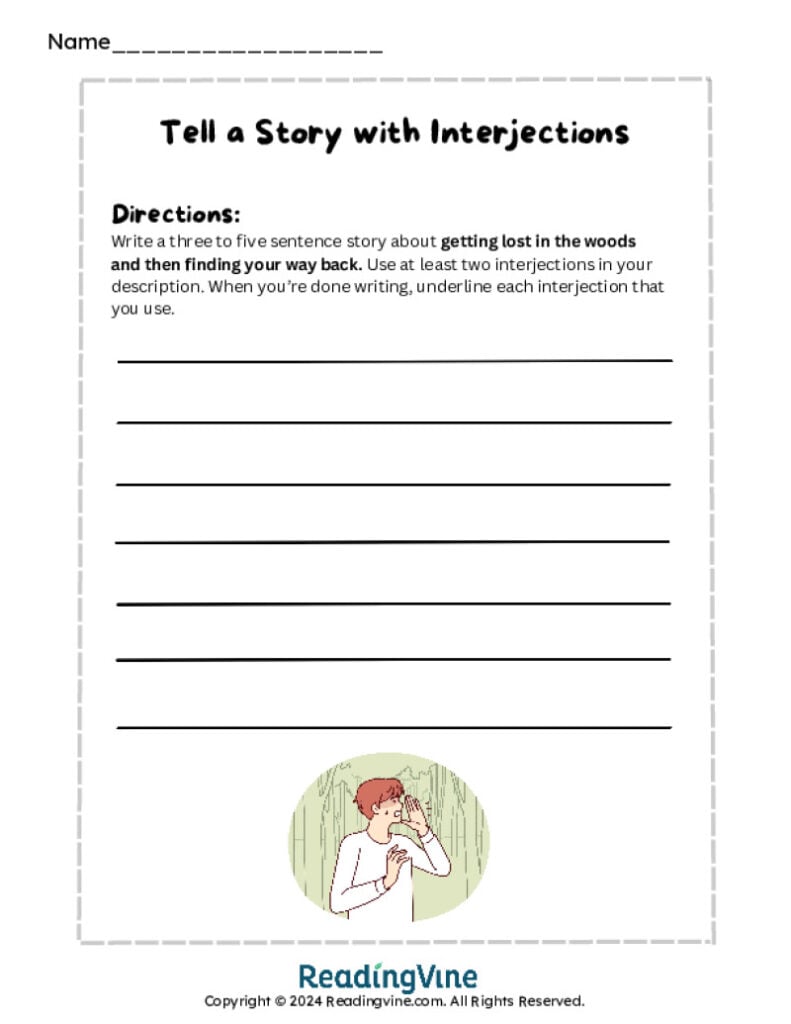
Tell a Story with Interjections
Develop a creative narrative about finding hidden treasure while incorporating interjections to express character emotions and excitement.

Write Interjection Sentences Activity
Compose original sentences about sports using interjections from the word bank to express excitement and emotional reactions.
Writing Prompt Using Interjections
Compose a narrative about a medical adventure incorporating interjections that convey character reactions and emotional responses throughout.

Writing Sentences with Interjections
Write complete sentences using winter-themed interjections to express emotions while demonstrating proper grammar and sentence structure.
Grade-Level Placement: Interjections typically appear in grades 1-3 as part of basic parts of speech instruction. Students already use interjections naturally in speech (“Ow!” “Yay!” “Uh-oh!”), so the focus is on recognition, punctuation, and deliberate use in writing.
Punctuation Matters: Teach students that interjection strength determines punctuation: mild interjections take a comma (“Well, I suppose so”), while strong ones take an exclamation point (“Wow! That’s amazing!”). This connects grammar to meaning and expression.
Writing Application: Interjections add voice to dialogue and narrative writing. When student stories feel flat, prompt them to add character reactions: “What would your character say when the door opened?” This moves interjections from identification exercises to real writing tools that show emotion rather than just telling it.