
 = Partner Site
Fly Guy Reading Level: A Complete Guide
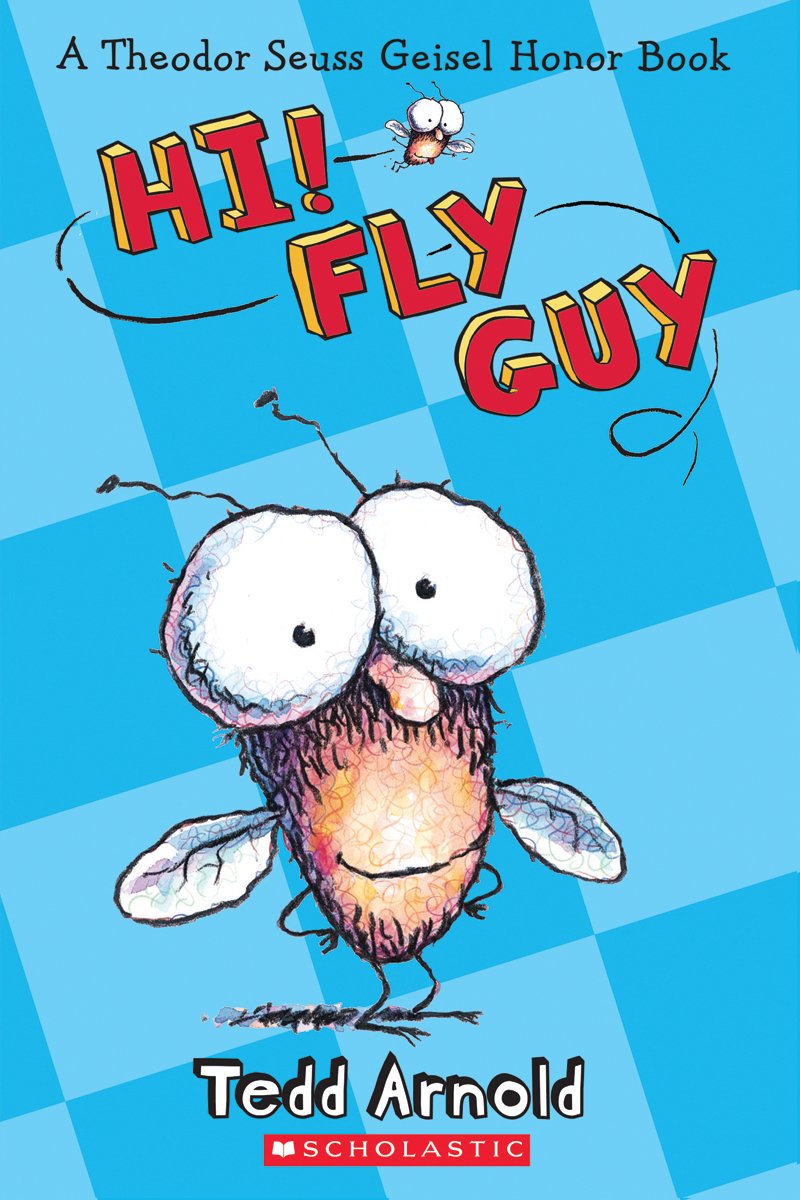
Fly Guy by Tedd Arnold is the first book in one of the most popular early reader series of the past two decades — a funny, slightly gross, completely irresistible story about a boy named Buzz who catches a fly and discovers that flies can be pets too, especially when they can say your name. This guide covers the reading level, recommended age, read-aloud vs. independent reading guidance, themes, and everything parents and teachers need to know about sharing this modern classic with young readers.
For Parents
Find out whether Fly Guy works best as a read-aloud or independent read for your child, what age range it suits, and why this funny, slightly disgusting early reader has turned more reluctant readers into enthusiastic ones than almost any other book at this level.
For Teachers
Grade-level data, read-aloud timing, key themes, and discussion questions for one of the most effective reluctant reader hooks in the K–2 library. The Fly Guy series is widely used in guided reading groups for its accessible text, short chapters, and reliable humor.
Fly Guy at a Glance
Find on Amazon →| Author & Illustrator | Tedd Arnold |
| Published | 2005 |
| Grade Level | K–2 (our assessment) |
| Recommended Age | 4–7 |
| Best For | Read-aloud ages 4–6; independent reading ages 5–7 |
| Flesch-Kincaid Grade | 1.9 |
| Word Count | ~350 |
| Pages | 30 |
| Chapters | 3 |
| Genre | Early reader / fiction |
| Setting | Buzz’s house and neighborhood |
For official Lexile and AR levels, visit Lexile.com or AR BookFinder. ReadingVine provides independent editorial assessments.
What Reading Level Is Fly Guy?
Fly Guy is a K–2 reading level by our editorial assessment, with a Flesch-Kincaid grade level of approximately 1.9 — one of the lowest on the early reader portion of the K–2 list. At only around 350 words across three very short chapters, it is the most accessible chapter book on this list, sitting at the very beginning of the I Can Read Level 2 range. The vocabulary is simple, the sentences are short, and Fly Guy’s own contributions to the dialogue — he can only say “BUZZ!” — require no decoding at all.
What makes Fly Guy work as a literacy tool despite its brevity is its structure: three chapters, a clear problem, and a resolution, all delivered with genuine comic timing. Children who read it for the first time and finish it — which many do in a single sitting — experience the specific satisfaction of completing a book with chapters, which is a milestone worth marking. The fact that it is also genuinely funny makes them want to do it again immediately, and often they do.
For parents who use specific reading level systems: we recommend checking your child’s level on Lexile.com or AR BookFinder for official scores, or asking your child’s teacher for their Guided Reading or DRA level.
Is Fly Guy a Read-Aloud or Independent Read?
Fly Guy works well as both a read-aloud for ages 4–6 and an independent read for ages 5–7, and it is particularly effective as a gateway book for children who are resistant to reading. Most adults can read the whole book aloud in about 5–8 minutes — it is short enough to read in a single sitting at any time of day, which is part of what makes it so useful for reluctant readers who find longer commitments daunting.
As a read-aloud, the book is all about comic delivery. Fly Guy says only “BUZZ!” throughout, and the humor of his contributions depends entirely on context — the same word meaning entirely different things at different moments in the story. Reading Fly Guy’s dialogue with escalating enthusiasm, or with increasing indignation, or with surprised delight depending on the situation, is one of the simpler and more rewarding read-aloud performances at this level. Arnold’s bright, slightly gross illustrations — Fly Guy’s enormous compound eyes, his enthusiasm for garbage — give the book its visual humor, and children who look at the pictures often find jokes the text doesn’t spell out.
For independent reading, Fly Guy is one of the most effective first chapter books available for children who are just making the transition from picture books to early readers. The three-chapter structure gives the reading a shape without making it feel long, the vocabulary is minimal, and the story’s momentum — Buzz wants to keep Fly Guy, his parents say no, the Amazing Pet Show resolves everything — is clear enough that children never lose the thread while decoding. Children who finish Fly Guy independently for the first time often hold the book up and say “I read the whole thing.” They are right to be proud.
There is nothing in this book that requires parental preparation. Fly Guy is slightly gross in the way that flies are slightly gross — he lands on food, he eats things children find funny and disgusting — but this is part of the book’s appeal for its target audience, not a concern for parents.
Let your child read Fly Guy’s dialogue. Every time Fly Guy speaks, the text says “BUZZ!” — which is the easiest word in the book — and letting your child take that part while you read the narration gives them the experience of reading aloud successfully from their very first page. By the third chapter, most children are trying to read more than just Fly Guy’s lines.
What Is Fly Guy About?
A boy named Buzz catches a fly and decides to keep him as a pet. He names the fly Fly Guy. His parents are skeptical — flies are not pets — but Buzz points out that Fly Guy is special: Fly Guy can say his name. (“BUZZ!”) Buzz enters Fly Guy in the Amazing Pet Show, where the judges also declare that flies are not pets. Then Fly Guy says the judge’s name. The judge changes his mind. Fly Guy wins. Buzz and Fly Guy go home together, a boy and his fly, friends for life.
That is the whole story, and it is exactly enough. Arnold does not pad it, over-explain it, or draw a lesson from it. He simply sets up a problem — can a fly be a pet? — and resolves it with a single, perfectly timed joke. The economy of the storytelling is part of what makes the book such a good early reader: every sentence is doing something, nothing is wasted, and the ending is completely satisfying.
Fly Guy Characters
Fly Guy Themes and Lessons
The central theme of Fly Guy — and of the series as a whole — is the value of an unlikely friendship. Buzz sees something in Fly Guy that no one else sees, defends that friendship against everyone’s doubts, and is vindicated. This is a simple, sturdy story shape that children respond to instinctively: the underdog validated, the skeptics proved wrong, the friendship worth fighting for. The fact that the friend in question is a fly makes it funnier and, if anything, more satisfying when the judge changes his mind.
The book is also a remarkably efficient demonstration of comic structure at the early reader level. Arnold sets up a problem, builds to a crisis, and resolves it with a single unexpected beat — Fly Guy saying the judge’s name at exactly the right moment. Children who have read or heard even a handful of stories recognize this shape intuitively, and part of the pleasure of Fly Guy is the anticipation of the payoff. This is one of the reasons the series is so useful for building reading motivation: it gives children the experience of a story working the way a story is supposed to work, which makes them want more stories.
For teachers, Fly Guy is one of the most reliable tools available for reluctant readers and struggling early readers. The combination of very short text, chapter structure, reliable gross-out humor, and a genuinely funny payoff makes it almost uniquely effective at getting resistant readers to pick up a book and finish it. The Theodor Seuss Geisel Honor it received in 2006 — an award that specifically recognizes books for beginning readers — reflects how well it does what it sets out to do.
Discussion starters for families: Why did Buzz want to keep Fly Guy even when everyone said flies aren’t pets? Was Buzz right about Fly Guy being special? Have you ever believed something about someone that no one else could see? What would you name a pet fly? What do you think Fly Guy says when he’s happy?
How Long Is Fly Guy?
Fly Guy has 30 pages across 3 short chapters, with approximately 350 words total — making it the shortest book with chapters on the K–2 list. Most adults can read the whole book aloud in about 5–8 minutes. A child reading independently at a kindergarten or early first-grade level will typically finish in about 8–12 minutes, often faster on subsequent readings.
The brevity is a feature, not a limitation. For children who are reluctant to start a chapter book, the fact that Fly Guy can be finished in a single short sitting removes the main barrier to beginning it. Many children read it twice in a row the first time they encounter it.
Books Similar to Fly Guy
If your child loves Fly Guy, these titles share its humor, its unlikely friendship, or its early reader format:
About the Author and Illustrator
Tedd Arnold is an American author and illustrator who has written and illustrated more than 50 books for children, including the Parts series (Parts, More Parts, Even More Parts) and the Fly Guy series, which has grown to more than 20 books and become one of the best-selling early reader series in the country. Fly Guy, published in 2005, received a Theodor Seuss Geisel Honor in 2006, an award that specifically recognizes distinguished books for beginning readers — a recognition that reflects how effectively the book does what it sets out to do. Arnold has said that the Fly Guy books grew out of his own children’s enthusiasm for gross things, and that he wrote them specifically for children who were not finding reading fun. His illustration style for the Fly Guy books — bright, slightly cartoonish, with Fly Guy’s enormous compound eyes rendered in loving detail — gives the series its distinctive visual identity and much of its humor. Several of the Fly Guy books have also crossed into nonfiction, with titles like Fly Guy Presents: Flies and Fly Guy Presents: Sharks introducing real science through the same characters. These nonfiction extensions make the series unusually versatile in classroom settings where teachers want to connect fiction and informational text reading for the same early readers.
Fly Guy: Frequently Asked Questions
What reading level is Fly Guy?
Fly Guy is a K–2 reading level by our editorial assessment, with a Flesch-Kincaid grade level of approximately 1.9. At around 350 words across three short chapters it is the most accessible chapter book on the K–2 list. It works best as a read-aloud for ages 4–6 and as an independent read for ages 5–7. For official Lexile and AR levels, visit Lexile.com or AR BookFinder.
What age is Fly Guy for?
Fly Guy is appropriate for ages 4–7. As a read-aloud it works well from age 4 — the humor and the very short chapters make it easy to share with younger children. As an independent read it suits children from late kindergarten through first grade. It is particularly effective for reluctant readers in this age range, who respond to its short length, gross humor, and satisfying payoff.
Can a kindergartner read Fly Guy alone?
Many kindergartners can read Fly Guy independently, particularly in the second half of the year. At around 350 words with very short sentences and a simple vocabulary, it is one of the most accessible chapter books available. The three-chapter structure gives the reading a shape, and Fly Guy’s dialogue — which consists entirely of “BUZZ!” — is the easiest word in the book. It is an excellent first chapter book for children making the transition from picture books to early readers.
How long does it take to read Fly Guy aloud?
Most adults can read Fly Guy aloud in about 5–8 minutes — making it the shortest read-aloud on the K–2 early reader list. Its brevity is one of its great virtues: it can be read at any time of day, in any setting, and children who are resistant to longer books will almost always agree to something that takes less than ten minutes.
What is Fly Guy about?
Fly Guy is about a boy named Buzz who catches a fly and decides to keep him as a pet. His parents say flies are not pets. Buzz enters Fly Guy in the Amazing Pet Show, where the judges agree: flies are not pets. Then Fly Guy says the judge’s name — “BUZZ!” — and the judge changes his mind. Fly Guy wins. Buzz and Fly Guy go home together. It is a very short, very funny story about an unlikely friendship and the satisfaction of being proved right.
Are there other books in the Fly Guy series?
Yes — Tedd Arnold has written more than 20 Fly Guy books, including Hi! Fly Guy, Shoo, Fly Guy!, There Was an Old Lady Who Swallowed Fly Guy, and a nonfiction extension series called Fly Guy Presents that uses the characters to introduce real science topics like flies, sharks, dinosaurs, and space. All titles in the series are appropriate for the same age and reading level range. The nonfiction titles in particular are widely used in classrooms to bridge fiction and informational text reading.