
 = Partner Site
The Day the Crayons Quit Reading Level: A Complete Guide
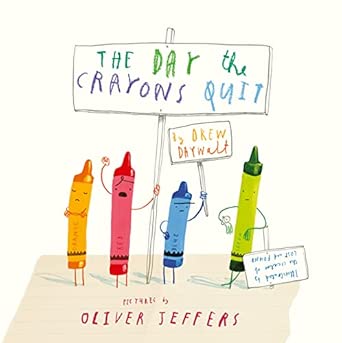
The Day the Crayons Quit by Drew Daywalt, illustrated by Oliver Jeffers, is one of the most popular picture books of the past decade — a brilliantly funny collection of complaint letters from a box of crayons, each one with its own distinct grievance and personality. This guide covers the reading level, recommended age, read-aloud vs. independent reading guidance, themes, and everything parents and teachers need to know about sharing this modern classic with young readers.
For Parents
Find out whether The Day the Crayons Quit works best as a read-aloud or independent read for your child, what age range it suits, and why its letter format and crayon voices make it one of the most engaging and re-readable picture books at this level.
For Teachers
Grade-level data, read-aloud timing, key themes, and discussion questions for a modern classroom favorite. Exceptional for lessons on voice, perspective, persuasive writing, and letter format — one of the most teachable picture books published in the last twenty years.
The Day the Crayons Quit at a Glance
Find on Amazon →| Author | Drew Daywalt |
| Illustrator | Oliver Jeffers |
| Published | 2013 |
| Grade Level | K–2 (our assessment) |
| Recommended Age | 4–8 |
| Best For | Read-aloud ages 4–8; independent reading ages 6–8 |
| Flesch-Kincaid Grade | 3.1 |
| Word Count | ~900 |
| Pages | 40 |
| Genre | Picture book / fiction |
| Setting | Duncan’s house; the letters themselves |
| Awards | Caldecott Honor (2014) |
For official Lexile and AR levels, visit Lexile.com or AR BookFinder. ReadingVine provides independent editorial assessments.
What Reading Level Is The Day the Crayons Quit?
The Day the Crayons Quit is a K–2 reading level by our editorial assessment, with a Flesch-Kincaid grade level of approximately 3.1. The text is structured as a series of letters from individual crayons to a boy named Duncan, and the vocabulary varies considerably from letter to letter — Red Crayon’s letter is relatively simple, while Pink Crayon’s more formal complaint and Beige Crayon’s existential lament push into territory that will challenge early readers. At around 900 words across twelve letters it is one of the longer picture books on this list.
The letter format is both what makes the book so funny and what gives it genuine literary range. Each crayon has a distinct voice — Red Crayon is exhausted and aggrieved, Blue Crayon is cheerful but specific, White Crayon is melancholy, Beige Crayon is philosophically wounded — and children who read it aloud naturally adjust their voice for each one. This makes it an exceptional read-aloud tool for demonstrating how voice and perspective work in writing, long before those concepts appear in a curriculum.
For parents who use specific reading level systems: we recommend checking your child’s level on Lexile.com or AR BookFinder for official scores, or asking your child’s teacher for their Guided Reading or DRA level.
Is The Day the Crayons Quit a Read-Aloud or Independent Read?
The Day the Crayons Quit works beautifully as both a read-aloud for ages 4–8 and an independent read for ages 6–8. As a read-aloud it is one of the most reliably funny picture books at this level — the crayon voices are distinct enough that a committed adult reader can give each one a different character, and children who have heard it love to read the letters alongside you, taking a crayon each. Most adults can read it aloud in about 10–14 minutes.
As a read-aloud, the episodic letter structure means the book can be read in sections without losing momentum — a useful quality for restless younger listeners. Each letter is self-contained, which means a three-year-old who loses focus after Red Crayon’s letter has still gotten a complete comedic experience. Oliver Jeffers’ illustrations are witty and warm, mixing the crayons’ handwritten letters with drawings that illustrate the grievances — Yellow Crayon’s letter, for instance, is accompanied by an illustration of the sun that Yellow clearly resents having to color entirely alone.
For independent reading, a confident first or second grader can handle most of the letters, though some — particularly Beige Crayon’s philosophical complaint about being called “wheat” or “sand” or “daddy bear” — will benefit from discussion. The letter format also makes it unusually well suited to independent reading because children can skip around or return to a favorite letter without losing the thread of the book.
There is nothing in this book that requires parental preparation. The crayons’ complaints are funny, relatable, and entirely benign.
Divide the letters between you and your child — each takes a crayon and reads its letter aloud in character. Children who are reluctant readers often find this format irresistible because the letters are short, funny, and feel like a performance rather than a reading task. By the time they’ve done Red Crayon, most children are competing to claim the next letter.
What Is The Day the Crayons Quit About?
Duncan opens his box of crayons one day and finds, instead of crayons ready to color, a stack of letters. Each crayon has written to register a complaint. Red Crayon is exhausted from being used for every important thing — stop signs, fire trucks, Santas — and wants a day off. Blue Crayon is doing fine but his paper is wearing thin from all the ocean and sky coloring. Yellow and Orange Crayon are in a bitter dispute about which of them is the real color of the sun. Black Crayon feels underappreciated — used only for outlines, never given a chance to shine. Pink Crayon has never even been unwrapped. White Crayon can’t see any of his own work. Peach Crayon is naked and embarrassed because Duncan peeled off his wrapper. Beige Crayon is tired of being boring.
Duncan reads every letter, considers the complaints carefully, and solves the problem the way only a child can — by drawing a picture that uses every single crayon for something, giving each one a moment to be exactly what it is. The book ends with Duncan receiving an A+ for creativity from his teacher, which feels entirely deserved.
The Day the Crayons Quit Characters
The Day the Crayons Quit Themes and Lessons
The central theme of The Day the Crayons Quit is voice and perspective — the idea that every point of view has its own logic, and that listening carefully to many different perspectives is the first step toward solving a problem. Duncan doesn’t dismiss the crayons’ complaints or argue with them. He reads every letter, takes each one seriously, and finds a creative solution that honors all of them. This is a model of empathetic listening that resonates with children who feel their own complaints are sometimes not taken seriously.
For teachers, the book is one of the most useful mentor texts available for persuasive writing and voice. Each crayon’s letter has a distinct argument, a distinct tone, and a distinct personality — and children who study them closely begin to understand intuitively how word choice and sentence structure create character on the page. The letter format also makes it a natural introduction to formal letter writing, with a return address, salutation, body, and closing that children can identify and imitate. Many teachers use The Day the Crayons Quit as the launching point for a writing unit in which children write their own complaint letters from the perspective of an everyday object.
The book’s resolution — Duncan drawing a picture that uses every crayon — also carries a quiet lesson about creative problem solving: the best answer to a complicated situation is often not a compromise but an invention, something that makes room for everyone without requiring anyone to give up their essential nature.
Discussion starters for families: Which crayon’s complaint did you think was most fair? Which was funniest? Have you ever felt like one of the crayons — used too much, or not enough? How did Duncan solve the problem? What would your crayon say if it wrote a letter?
How Long Is The Day the Crayons Quit?
The Day the Crayons Quit has 40 pages and approximately 900 words across twelve crayon letters. Most adults can read it aloud in about 10–14 minutes. The episodic letter structure means the book can be read in sections without losing momentum — a useful quality for younger or more restless listeners.
A child reading independently at a first- or second-grade level will typically finish in about 15–20 minutes, though children who love this book often reread individual letters — returning to a favorite crayon the way you might reread a funny passage in a chapter book.
Books Similar to The Day the Crayons Quit
If your child loves The Day the Crayons Quit, these titles share its humor, its distinct character voices, or its delight in an absurd premise fully committed to:
About the Author and Illustrator
Drew Daywalt is an American author and filmmaker who came to children’s books relatively late in his career, having spent years directing commercials and short films before writing The Day the Crayons Quit. The book, published in 2013, became an immediate phenomenon — a New York Times bestseller for more than two years and one of the best-selling picture books of the decade. Daywalt has said the idea came to him while watching his daughter color: he noticed she was very particular about which crayons she used for which things, and he began to wonder what the crayons themselves might think about their assignments. He followed it with The Day the Crayons Came Home (2015), in which the crayons write postcards from wherever they’ve been lost or forgotten, and The Crayons’ Book of Colors and The Crayons’ Book of Numbers, which extend the characters into board book format. He is also the author of The Legend of Rock Paper Scissors (2017), illustrated by Adam Rex, which brings the same comedic sensibility to a different premise.
Oliver Jeffers is a Northern Irish author and illustrator whose work spans picture books, fine art, and installation. He is the author-illustrator of several beloved picture books of his own, including How to Catch a Star, Lost and Found, and The Incredible Book Eating Boy, as well as the Here We Are series. His illustration style for The Day the Crayons Quit — loose, warm, slightly scratchy pencil and watercolor work that mimics the look of a child’s drawing while being considerably more sophisticated — is a perfect match for Daywalt’s comic premise. The illustrations extend and deepen every letter’s joke without overshadowing the text, which is exactly the right balance for a book built on the humor of the words themselves. Jeffers received a Caldecott Honor for his work on the book in 2014.
The Day the Crayons Quit: Frequently Asked Questions
What reading level is The Day the Crayons Quit?
The Day the Crayons Quit is a K–2 reading level by our editorial assessment, with a Flesch-Kincaid grade level of approximately 3.1. The text varies in complexity from letter to letter — some are simple and direct, others more sophisticated. It works best as a read-aloud for ages 4–8 and as an independent read for ages 6–8. For official Lexile and AR levels, visit Lexile.com or AR BookFinder.
What age is The Day the Crayons Quit for?
The Day the Crayons Quit is appropriate for ages 4–8 as a read-aloud — the humor lands across a wide range, and the episodic letter format means younger listeners can enjoy individual letters without needing to track the whole book. As an independent read, it suits confident first and second graders ages 6–8. It is one of the rare picture books that is genuinely as funny to adults as to children.
Can a kindergartner read The Day the Crayons Quit alone?
Most kindergartners will need support reading The Day the Crayons Quit independently — the vocabulary varies across letters, and some of the humor (Beige Crayon’s existential complaint, Pink Crayon’s formal grievance) depends on comprehension above typical kindergarten independent reading level. By mid-to-late first grade, most children can read the whole book independently. As a read-aloud, it works beautifully from age 4.
How long does it take to read The Day the Crayons Quit aloud?
Most adults can read The Day the Crayons Quit aloud in about 10–14 minutes. A participatory reading where different family members or students take different crayon letters often runs longer — and is considerably more fun. The episodic structure also makes it easy to read a few letters at a time if needed.
What is The Day the Crayons Quit about?
The Day the Crayons Quit is about a boy named Duncan who opens his crayon box and finds a stack of complaint letters from his crayons. Each crayon has a different grievance — Red is exhausted, Blue is worn out, Yellow and Orange are feuding, Pink has never been used, White can’t see his own work — and Duncan must figure out how to address all of them. His solution is to draw a picture that uses every single crayon for something, giving each one exactly what it needs. It is a funny, inventive story about listening, fairness, and creative problem solving.
Is there a sequel to The Day the Crayons Quit?
Yes — The Day the Crayons Came Home (2015), also by Drew Daywalt and illustrated by Oliver Jeffers, follows the crayons who have been lost, broken, or forgotten as they write postcards to Duncan from wherever they’ve ended up. It has the same humor and letter-based format as the original. Daywalt and Jeffers have also produced The Crayons’ Book of Colors and The Crayons’ Book of Numbers for younger readers.