
 = Partner Site
Last Stop on Market Street Reading Level: A Complete Guide
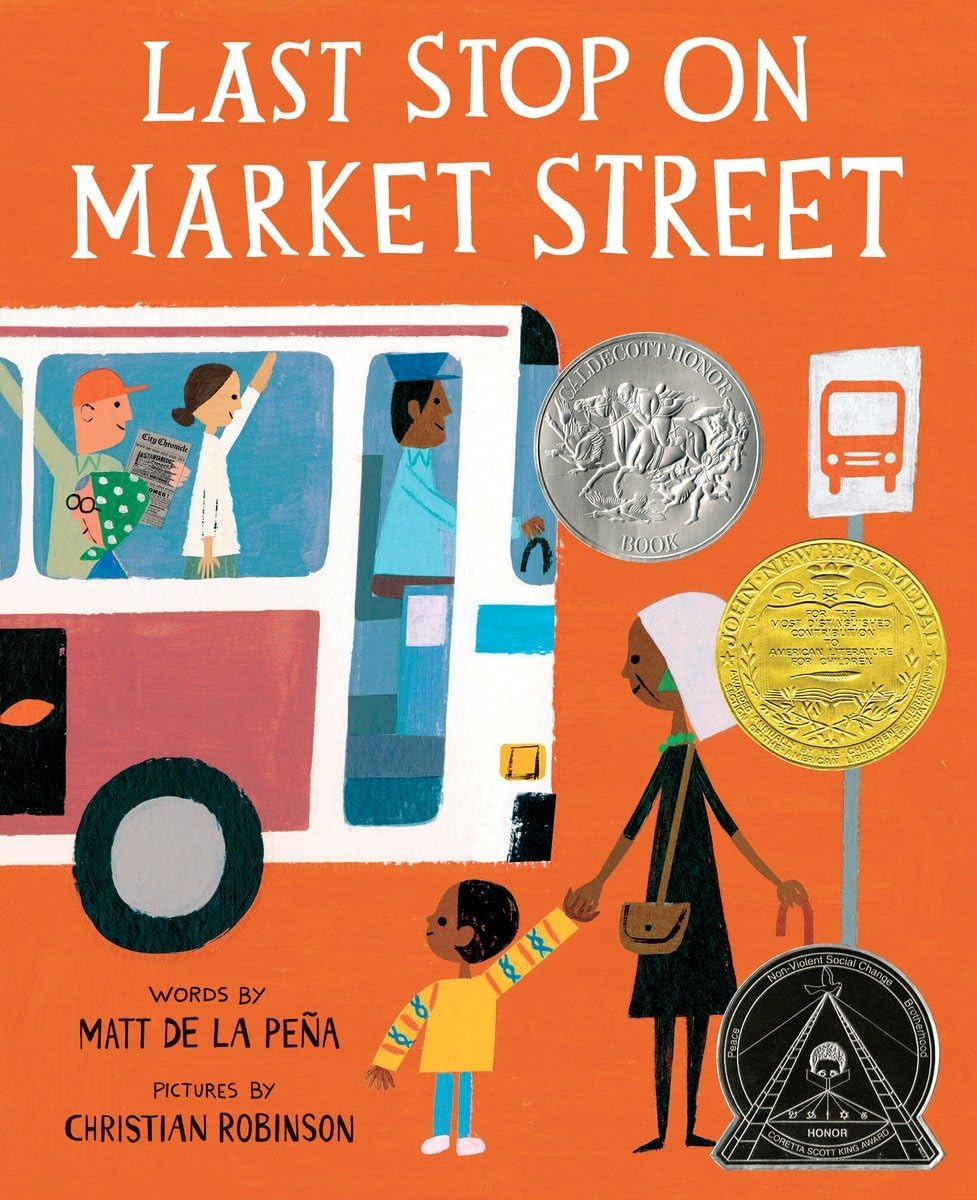
Last Stop on Market Street by Matt de la Peña, illustrated by Christian Robinson, is a Newbery Medal-winning picture book about a boy and his grandmother riding the bus across town — and the quiet lesson in gratitude and community that unfolds along the way. This guide covers the reading level, recommended age, read-aloud vs. independent reading guidance, themes, and everything parents and teachers need to know about sharing this modern classic with young readers.
For Parents
Find out whether Last Stop on Market Street works best as a read-aloud or independent read for your child, what age range it suits, and how to talk about its themes of gratitude, community, and finding beauty in ordinary things.
For Teachers
Grade-level data, read-aloud timing, key themes, and discussion questions for a Newbery Medal and Caldecott Honor winner. Strong connections to SEL units on gratitude, empathy, and community service, and to social studies conversations about neighborhoods and socioeconomic diversity.
Last Stop on Market Street at a Glance
Find on Amazon →| Author | Matt de la Peña |
| Illustrator | Christian Robinson |
| Published | 2015 |
| Grade Level | K–2 (our assessment) |
| Recommended Age | 4–8 |
| Best For | Read-aloud ages 4–8; independent reading ages 6–8 |
| Flesch-Kincaid Grade | 3.3 |
| Word Count | ~500 |
| Pages | 32 |
| Genre | Picture book / realistic fiction |
| Setting | An urban neighborhood; a city bus |
| Awards | Newbery Medal (2016); Caldecott Honor (2016); Coretta Scott King Illustrator Honor (2016) |
For official Lexile and AR levels, visit Lexile.com or AR BookFinder. ReadingVine provides independent editorial assessments.
What Reading Level Is Last Stop on Market Street?
Last Stop on Market Street is a K–2 reading level by our editorial assessment, with a Flesch-Kincaid grade level of approximately 3.3. The text is conversational and structured as a series of exchanges between CJ and his Nana — short questions from CJ, longer and more poetic responses from Nana. The vocabulary is largely accessible, but Nana’s answers have a lyrical, metaphorical quality that places this book well above a typical early reader in literary richness. Lines like “Sometimes when you’re surrounded by dirt, CJ, you’re a better witness to the jewels” carry meaning that unfolds differently for different readers at different ages.
Like Owl Moon, this is a book whose Flesch-Kincaid score significantly undersells its literary quality. The decoding demand is moderate — a confident first grader can handle the text — but the emotional and conceptual content is rich enough to sustain discussion well into second grade and beyond. It is one of the rare picture books that earns both a Newbery Medal (for literary excellence) and a Caldecott Honor (for illustration) in the same year, which tells you something about how much it is doing simultaneously.
For parents who use specific reading level systems: we recommend checking your child’s level on Lexile.com or AR BookFinder for official scores, or asking your child’s teacher for their Guided Reading or DRA level.
Is Last Stop on Market Street a Read-Aloud or Independent Read?
Last Stop on Market Street works best as a read-aloud for ages 4–8 and is a strong independent read for ages 6–8. As a read-aloud, the question-and-answer dialogue between CJ and Nana creates a natural rhythm — CJ asks why they don’t have this or that, and Nana redirects his attention toward what they do have. Reading CJ’s questions in one voice and Nana’s responses in another gives the book a warmth and intimacy that children respond to immediately. Most adults can read it aloud in about 7–10 minutes.
As a read-aloud, Christian Robinson’s illustrations are a full partner to the text. His gouache and collage compositions fill the bus with a vivid cast of characters — a man with a guitar, a woman with a jar of butterflies, a blind man with a dog — each one rendered with warmth and specificity. The illustrations show the neighborhood they’re traveling through as both impoverished and beautiful, which is exactly the tension the text is exploring. Children who look closely at the illustrations often notice things the text doesn’t say, which makes rereading genuinely rewarding.
For independent reading, a confident first or second grader can handle most of the text. Nana’s more poetic responses may need unpacking — particularly her final answer about being “a better witness to the jewels” — but the emotional arc of the story is clear enough that children who don’t fully grasp the metaphors still follow and feel the book’s essential message.
A note for parents: the book is set in a neighborhood that is clearly lower-income, and CJ’s questions — why don’t we have a car, why don’t we have an iPod — implicitly acknowledge economic difference. De la Peña handles this with complete naturalness, never making the family’s circumstances a problem to be solved or a lesson to be drawn. But it may prompt questions from children who notice the difference between CJ’s neighborhood and their own.
After the first reading, go back to Nana’s answers and read them slowly, one at a time. Ask your child: “What do you think Nana means by that?” Nana’s responses are short enough that children can hold them in mind, and rich enough that even young children often produce surprisingly perceptive interpretations. The conversation that follows is frequently the best part of sharing this book.
What Is Last Stop on Market Street About?
Every Sunday after church, CJ and his Nana ride the bus across town. CJ notices what they don’t have — a car, an iPod, friends who don’t have to take the bus — and asks his Nana why. Each time, Nana finds something beautiful in exactly what they do have: the rain on the windows, the music a man makes on his guitar, the butterflies a woman carries in a jar, the blind man whose other senses are so alive he can hear the world singing. Their last stop is a soup kitchen, where CJ and Nana volunteer. CJ looks at the neighborhood around the soup kitchen — worn, a little broken — and Nana helps him see the jewels in the dirt.
The book is quiet and wise and completely free of condescension. De la Peña never lectures. Nana never explains. She simply notices, and invites CJ to notice alongside her. By the last page, CJ is noticing on his own — he sees the beauty in the place and the people without being told to look for it. That shift, from asking why they don’t have things to seeing what they do have, is the whole arc of the book and one of the most gracefully rendered lessons in picture book literature.
Last Stop on Market Street Characters
Last Stop on Market Street Themes and Lessons
The central theme of Last Stop on Market Street is gratitude as a way of seeing — not gratitude as a moral obligation (“you should be thankful for what you have”) but gratitude as a perceptual practice, a way of training attention toward what is present rather than what is absent. Nana doesn’t tell CJ to be grateful. She shows him, again and again, that there is something worth noticing in every part of their ride — and by the end of the book, CJ has internalized that way of seeing well enough to practice it on his own. This is a more sophisticated and more honest version of the gratitude lesson than most picture books attempt.
The book is also a portrait of community service — CJ and Nana are riding to a soup kitchen, where they volunteer every Sunday. But de la Peña handles the service theme with the same restraint he brings to everything else: it isn’t announced, explained, or celebrated. It is simply what they do. The soup kitchen appears as the natural destination of the bus ride, not a lesson about helping others. Children absorb the idea that service is part of a life, not an event, without being instructed to think so.
Robinson’s illustrations add a representation dimension that the text supports but doesn’t make explicit. The bus is full of people of different races, ages, and circumstances. The neighborhood around the soup kitchen is lower-income but rendered with color and dignity. The book never labels any of this; it simply shows a world that looks like the world, which is itself a form of generosity toward young readers who rarely see their own neighborhoods in picture books.
Discussion starters for families: Why do you think CJ kept asking “why don’t we have…?” What did Nana help CJ notice on the bus? Have you ever seen something beautiful in a place that didn’t seem beautiful at first? What do you think the “jewels in the dirt” means? Is there something in your life you usually walk past without noticing?
How Long Is Last Stop on Market Street?
Last Stop on Market Street has 32 pages and approximately 500 words. Most adults can read it aloud in about 7–10 minutes, though the book’s quiet pacing and rich illustrations invite a slower reading that many families stretch to 12–15 minutes.
A child reading independently at a first- or second-grade level will typically finish in about 10–15 minutes. This is a book that rewards rereading — the illustrations contain details that emerge on subsequent passes, and Nana’s answers often mean more the second or third time through.
Books Similar to Last Stop on Market Street
If your child loves Last Stop on Market Street, these titles share its warmth, its urban setting, its themes of community and gratitude, or its portrait of a child and adult paying close attention to the world together:
About the Author and Illustrator
Matt de la Peña is an American author who grew up in Spring Valley, California, and was the first in his family to attend college. He is the author of several young adult novels as well as a growing body of picture books, all of which center characters and communities that have historically been underrepresented in children’s literature. Last Stop on Market Street, published in 2015, won the Newbery Medal in 2016 — making de la Peña the first Latino author to win the award — as well as a Caldecott Honor and a Coretta Scott King Illustrator Honor for Christian Robinson’s illustrations. De la Peña has said he wrote the book for the version of himself that grew up without seeing kids who looked like him or lived like him in the picture books he read. His other picture books include Carmela Full of Wishes (2019) and Milo Imagines the World (2021), both illustrated by Christian Robinson, continuing their collaboration around themes of urban childhood, imagination, and empathy.
Christian Robinson is an American illustrator and author who grew up in Los Angeles and studied animation at the California Institute of the Arts. His illustration style — bold gouache shapes layered with collage and pattern, in a palette of warm, saturated colors — is immediately recognizable and widely influential in contemporary picture book illustration. He received a Caldecott Honor and a Coretta Scott King Illustrator Honor for Last Stop on Market Street, and has gone on to illustrate dozens of books as well as write and illustrate his own, including You Matter (2020) and Another (2022). His illustrations for Last Stop on Market Street fill the bus and the neighborhood with a cast of characters rendered with specificity and warmth — every figure on the bus has a story suggested in a glance, which is exactly what the text asks of its illustrator.
Last Stop on Market Street: Frequently Asked Questions
What reading level is Last Stop on Market Street?
Last Stop on Market Street is a K–2 reading level by our editorial assessment, with a Flesch-Kincaid grade level of approximately 3.3. The text is conversational but Nana’s responses have a lyrical, metaphorical quality that places it above a typical early reader in literary richness. It works best as a read-aloud for ages 4–8 and as an independent read for ages 6–8. For official Lexile and AR levels, visit Lexile.com or AR BookFinder.
What age is Last Stop on Market Street for?
Last Stop on Market Street is appropriate for ages 4–8 as a read-aloud — the emotional content and Nana’s wisdom resonate across a wide age range, and older children often get more from it than younger ones. As an independent read, it suits confident first and second graders ages 6–8. It is one of the rare picture books that adults find as moving as children do.
Can a kindergartner read Last Stop on Market Street alone?
Most kindergartners will need support reading Last Stop on Market Street independently. Nana’s poetic responses — particularly her metaphors about jewels and dirt — are above typical kindergarten independent reading level. By mid-to-late first grade, most children can handle the text independently, though some of Nana’s lines will benefit from discussion. As a read-aloud, it works beautifully from age 4.
How long does it take to read Last Stop on Market Street aloud?
Most adults can read Last Stop on Market Street aloud in about 7–10 minutes. The book’s quiet pacing and rich illustrations invite a slower reading — many families spend 12–15 minutes by pausing to look at Robinson’s detailed bus scenes and talking about the characters they notice.
What is Last Stop on Market Street about?
Last Stop on Market Street is about a boy named CJ who rides the bus across town with his grandmother every Sunday after church. CJ notices what they don’t have — a car, an iPod, friends who live in nicer neighborhoods — and his Nana answers each question by pointing to something beautiful in what they do have. Their last stop is a soup kitchen where they volunteer. By the end of the ride, CJ has learned to see the beauty in the world around him. It is a story about gratitude, community, and how to pay attention to the right things.
Why did Last Stop on Market Street win the Newbery Medal?
Last Stop on Market Street won the Newbery Medal in 2016 for distinguished contribution to American literature for children — a rare honor for a picture book, which more typically goes to novels. The committee recognized de la Peña’s lyrical, precise prose, his non-condescending treatment of economic difference, and the emotional sophistication of Nana’s character. It was the first Newbery awarded to a Latino author. The book also received a Caldecott Honor that year for Christian Robinson’s illustrations.