
 = Partner Site
The Legend of Rock Paper Scissors Reading Level: A Complete Guide
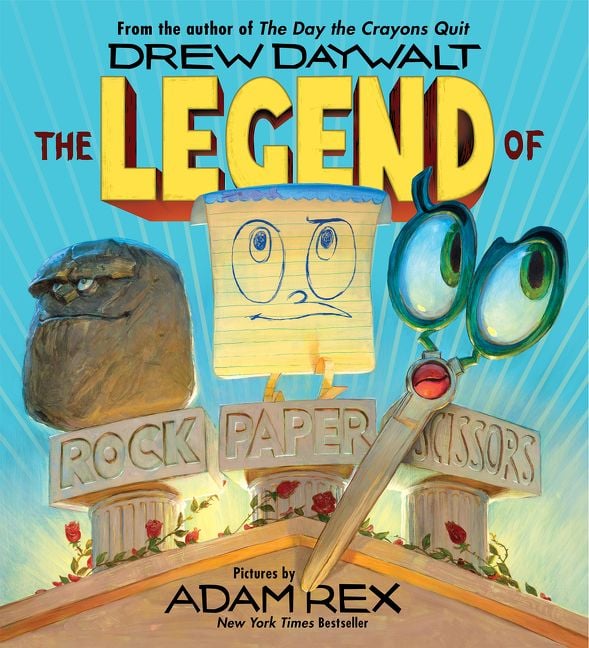
The Legend of Rock Paper Scissors by Drew Daywalt, illustrated by Adam Rex, is a gloriously over-the-top picture book that treats the origins of the playground game as an epic quest — three mighty warriors, each undefeated in their own kingdom, searching the world for a worthy opponent. This guide covers the reading level, recommended age, read-aloud vs. independent reading guidance, themes, and everything parents and teachers need to know about sharing this modern classic with young readers.
For Parents
Find out whether The Legend of Rock Paper Scissors works best as a read-aloud or independent read for your child, what age range it suits, and why this wildly funny picture book rewards repeated readings and enthusiastic performance.
For Teachers
Grade-level data, read-aloud timing, key themes, and discussion questions for one of the funniest picture books of the past decade. Strong for lessons on voice, hyperbole, legend as a narrative form, and the gap between a story’s grand register and its absurd subject matter.
The Legend of Rock Paper Scissors at a Glance
Find on Amazon →| Author | Drew Daywalt |
| Illustrator | Adam Rex |
| Published | 2017 |
| Grade Level | K–2 (our assessment) |
| Recommended Age | 4–8 |
| Best For | Read-aloud ages 4–8; independent reading ages 6–8 |
| Flesch-Kincaid Grade | 3.7 |
| Word Count | ~850 |
| Pages | 40 |
| Genre | Picture book / humor / origin legend |
| Setting | The Kingdom of Backyard, the Empire of Mom’s Kitchen, the universe of Dad’s Office |
For official Lexile and AR levels, visit Lexile.com or AR BookFinder. ReadingVine provides independent editorial assessments.
What Reading Level Is The Legend of Rock Paper Scissors?
The Legend of Rock Paper Scissors is a K–2 reading level by our editorial assessment, with a Flesch-Kincaid grade level of approximately 3.7. At around 850 words it is one of the longer picture books on the K–2 list, and Daywalt’s prose is deliberately elevated — he writes in a mock-heroic register that borrows the cadences of epic legend, complete with formal proclamations, dramatic declarations, and the kind of sweeping battle language you might find in a myth. Words like “undefeated,” “worthy,” “legendary,” and “vanquished” appear throughout.
That gap between the grandeur of the language and the absurdity of the subject — the warriors are a rock, a piece of paper, and a pair of scissors, fighting opponents like a banana and a pine cone — is exactly where the book’s humor lives. Children who are read this aloud will understand every joke even if they can’t decode every word, because the comedy comes from the collision of register and subject matter rather than from vocabulary. For independent readers, the elevated language is a genuine stretch that is also genuinely enjoyable — the words feel fun to say precisely because they are more formal than a child expects in a picture book.
For parents who use specific reading level systems: we recommend checking your child’s level on Lexile.com or AR BookFinder for official scores, or asking your child’s teacher for their Guided Reading or DRA level.
Is The Legend of Rock Paper Scissors a Read-Aloud or Independent Read?
The Legend of Rock Paper Scissors is primarily a read-aloud for ages 4–8 and an independent read for ages 6–8. As a read-aloud it is one of the great performance pieces in K–2 picture books — the mock-heroic language demands to be delivered with complete gravity and zero irony, which is funnier than playing it for laughs, and children who hear it performed well find it hilariously, repeatedly funny. Most adults can read it aloud in about 10–14 minutes.
As a read-aloud, the book has three distinct sections — Rock’s story, Paper’s story, Scissors’ story — each building toward an increasingly absurd final battle, before all three meet and discover their perfect opponents in each other. Adam Rex’s illustrations are extraordinary: rendered in a fully committed epic-painting style, with dramatic lighting, dynamic compositions, and the kind of heroic visual language usually reserved for actual mythology, applied with complete seriousness to a rock fighting a pinecone and a piece of paper defeating a banana. The gap between the visual grandeur and the domestic absurdity of each scene is its own joke, running parallel to the text’s joke, and children who look closely at the illustrations find additional layers of humor the words don’t mention.
For independent reading, a confident first or second grader can handle most of the text, though the elevated vocabulary will stretch some readers pleasurably. The three-part structure is clear enough that children never lose the shape of the story, and the payoff — the three warriors finally meeting and recognizing each other as worthy opponents — lands with satisfying completeness whether read aloud or independently.
There is nothing in this book that requires parental preparation. The battles are comic and consequence-free. No actual scissors are harmed.
Read this one as seriously as you can possibly manage. The temptation is to wink at the absurdity, but the book is significantly funnier when delivered with complete conviction — as if the legend of Rock’s combat with a pinecone is genuinely the most important story ever told. Children who catch the joke between the grandeur of the delivery and the silliness of the subject are experiencing one of the oldest and most satisfying forms of comedy: the mock-heroic. They just don’t know what it’s called yet.
What Is The Legend of Rock Paper Scissors About?
In the Kingdom of Backyard, a great warrior named Rock has defeated every opponent — a stick, a pinecone, a clump of dirt — but craves a truly worthy foe. In the Empire of Mom’s Kitchen, an equally mighty warrior named Paper has vanquished a banana, an apple, and a paper towel, and yearns for something more. In the faraway realm of Dad’s Office, the great Scissors has overcome a piece of tape, a ribbon, and a sticky note, and feels the same burning need for a real challenge. Each warrior, hearing legends of the others, sets off in search of a worthy opponent.
They meet. They fight — Rock against Paper, Paper against Scissors, Scissors against Rock. Each battle is epic, dramatic, and decided by the well-known rules of the game. In the end, having found their perfect opponents in each other, the three warriors become friends and teach their game to the children of the world. The book ends with the rules of rock paper scissors, which children can now play having just been told the legend of how it began. It is absurd, committed, and completely delightful.
The Legend of Rock Paper Scissors Characters
The Legend of Rock Paper Scissors Themes and Lessons
The central comic mechanism of The Legend of Rock Paper Scissors is register incongruity — the humor that comes from treating something trivial with complete epic seriousness. Daywalt writes about a rock fighting a pinecone in exactly the language a writer would use to describe Achilles fighting Hector, and Rex illustrates it in exactly the visual language of heroic painting. The joke is that the grandeur is real even though the subject is absurd, and children who understand this — often intuitively rather than analytically — are grasping one of the fundamental mechanisms of comedy. Mock-heroic writing is one of the oldest forms of humor in literature, and this book is one of the most accessible introductions to it available for young readers.
The book is also a genuine origin story — a legend that explains how something came to be. The structure (three warriors seek worthy opponents, meet, discover their perfect challenge in each other, share their game with the world) follows the shape of a traditional origin myth exactly, which is part of why it works so well as a read-aloud. Children who have heard actual myths and legends recognize the structure and find the parody of it funnier for the recognition.
For teachers, the book is an exceptional mentor text for voice and register. Daywalt’s mock-heroic prose gives children a clear example of how word choice and sentence structure create a specific tone, and how that tone can be used for comic effect. Writing their own origin legend — of a pencil, a lunch box, a sneaker — in the same elevated register is one of the more reliable and delightful writing exercises this book generates in classrooms.
Discussion starters for families: Why is it funny when Rock fights a pinecone? What makes the language sound so serious? Can you think of something silly that you could tell a legend about? What do you think happened after Rock, Paper, and Scissors became friends? Do you think the legend is true?
How Long Is The Legend of Rock Paper Scissors?
The Legend of Rock Paper Scissors has 40 pages and approximately 850 words. Most adults can read it aloud in about 10–14 minutes, though a fully committed performance — delivered with the gravitas the text demands — often runs closer to 14 minutes as the battles escalate toward their conclusion.
A child reading independently at a first- or second-grade level will typically finish in about 12–18 minutes. The three-part structure makes natural stopping points after each warrior’s section, though most children who start it want to finish it in one sitting.
Books Similar to The Legend of Rock Paper Scissors
If your child loves The Legend of Rock Paper Scissors, these titles share its humor, its commitment to an absurd premise, or its particular delight in elevated language applied to silly subjects:
About the Author and Illustrator
Drew Daywalt is an American author and filmmaker best known for The Day the Crayons Quit (2013) and its sequel The Day the Crayons Came Home (2015), both illustrated by Oliver Jeffers. The Legend of Rock Paper Scissors (2017), his collaboration with Adam Rex, extends the same comic sensibility — a completely absurd premise treated with complete narrative seriousness — to a different format and a different illustrator. Daywalt has said that the best comedy comes from total commitment, and both books embody that principle. He is also the author of a growing number of other picture books, all of which share his particular gift for finding the joke that lives inside a premise and then executing it without flinching. His books have spent multiple years on bestseller lists and are widely used in classrooms for their exceptional teachability around voice, perspective, and humor in writing.
Adam Rex is an American author and illustrator whose work spans picture books, middle grade novels, and illustration. He is perhaps best known as the illustrator of Jon Scieszka’s Smash! Crash! and as the author-illustrator of Frankenstein Makes a Sandwich and The True Meaning of Smekday (adapted into the animated film Home). His illustration style is unusually versatile — he works in multiple media including oil paint, digital art, and mixed media — and for The Legend of Rock Paper Scissors he deployed a fully committed epic-painting aesthetic that is the visual heart of the book’s comedy. His ability to render a rock with the gravitas of a Greek hero and a piece of paper with the bearing of a Roman senator, while keeping the humor in the gap between subject and treatment rather than in the depiction itself, is a remarkable feat of illustrative restraint. Rex’s illustrations won him a Caldecott Honor for Frank Viva’s A Long Way Away, and his work on The Legend is among his most celebrated.
The Legend of Rock Paper Scissors: Frequently Asked Questions
What reading level is The Legend of Rock Paper Scissors?
The Legend of Rock Paper Scissors is a K–2 reading level by our editorial assessment, with a Flesch-Kincaid grade level of approximately 3.7. The text is written in a mock-heroic register with elevated vocabulary that is part of the book’s comedy. It works best as a read-aloud for ages 4–8 and as an independent read for ages 6–8. For official Lexile and AR levels, visit Lexile.com or AR BookFinder.
What age is The Legend of Rock Paper Scissors for?
The Legend of Rock Paper Scissors is appropriate for ages 4–8. The humor lands across a wide age range — even young children who don’t grasp every word find the pictures and the escalating battles funny — and older children and adults often find it funnier than younger ones because they catch the mock-heroic joke more fully. As an independent read it suits first and second graders ages 6–8.
Can a kindergartner read The Legend of Rock Paper Scissors alone?
Most kindergartners will need support reading The Legend of Rock Paper Scissors independently — the elevated vocabulary and longer sentence structures are above typical kindergarten independent reading level. By mid-to-late first grade, most children can read it independently. As a read-aloud it works beautifully from age 4, and the humor is fully accessible even when the vocabulary requires support.
How long does it take to read The Legend of Rock Paper Scissors aloud?
Most adults can read The Legend of Rock Paper Scissors aloud in about 10–14 minutes. A fully committed performance — delivered with the complete gravity the mock-heroic text demands — often runs toward the higher end of that range as the battles escalate and each warrior’s confrontations grow increasingly dramatic.
What is The Legend of Rock Paper Scissors about?
The Legend of Rock Paper Scissors is an origin story about how the playground game came to be. Three mighty warriors — Rock from the Kingdom of Backyard, Paper from the Empire of Mom’s Kitchen, and Scissors from the realm of Dad’s Office — each seek a worthy opponent. They find each other, fight epic battles decided by the rules of the game, and become friends, sharing their game with the children of the world. It is written in full mock-heroic style, treating a rock fighting a pinecone with the grandeur of ancient legend.
What is mock-heroic style and why is The Legend of Rock Paper Scissors funny?
Mock-heroic writing uses the grand language and structure of epic stories — myths, legends, heroic tales — to describe something trivial or absurd. The joke is the gap between how seriously the writing takes its subject and how silly the subject actually is. The Legend of Rock Paper Scissors is funny because Drew Daywalt writes about a piece of paper defeating a banana with exactly the language and gravity you would use to describe a legendary warrior’s greatest triumph. Children experience this as funny even before they can name it, and the book is one of the most accessible introductions to this classic form of comedy available for young readers.