
 = Partner Site
Mercy Watson to the Rescue Reading Level: A Complete Guide
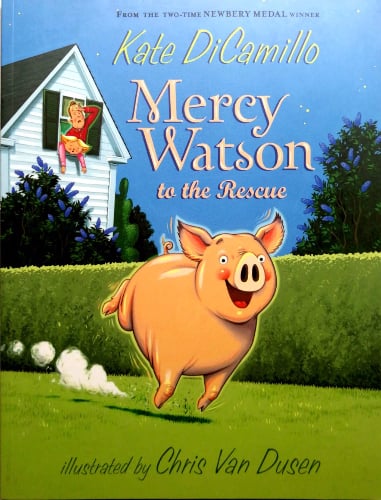
Mercy Watson to the Rescue by Kate DiCamillo, illustrated by Chris Van Dusen, is the first book in the beloved Mercy Watson series — a funny, warmly illustrated early reader about a pig who is treated like a daughter, loves buttered toast above all things, and whose oblivious good cheer has a way of resolving every crisis she causes. This guide covers the reading level, recommended age, read-aloud vs. independent reading guidance, themes, and everything parents and teachers need to know about sharing this book with young readers.
For Parents
Find out whether Mercy Watson to the Rescue works best as a read-aloud or independent read for your child, what age range it suits, and why this gleefully funny early reader is one of the best bridges from picture books to chapter books available.
For Teachers
Grade-level data, read-aloud timing, key themes, and discussion questions for a widely used early reader. Strong for guided reading groups at the K–2 transition level, and for discussions of character voice, humor, and point of view.
Mercy Watson to the Rescue at a Glance
Find on Amazon →| Author | Kate DiCamillo |
| Illustrator | Chris Van Dusen |
| Published | 2005 |
| Grade Level | K–2 (our assessment) |
| Recommended Age | 5–8 |
| Best For | Read-aloud ages 5–7; independent reading ages 6–8 |
| Flesch-Kincaid Grade | 3.2 |
| Word Count | ~2,300 |
| Pages | 80 |
| Chapters | 9 |
| Genre | Early reader / fiction |
| Setting | A suburban house and neighborhood |
For official Lexile and AR levels, visit Lexile.com or AR BookFinder. ReadingVine provides independent editorial assessments.
What Reading Level Is Mercy Watson to the Rescue?
Mercy Watson to the Rescue is a K–2 reading level by our editorial assessment, with a Flesch-Kincaid grade level of approximately 3.2. It is a transitional early reader — longer than Frog and Toad, shorter than a true chapter book — with nine short chapters, around 2,300 words total, and a full illustration on nearly every other page. It sits at the top of the I Can Read Level 2 / beginning of Level 3 range, making it an ideal step for children who have finished Frog and Toad or Henry and Mudge and are ready for more narrative complexity without leaving pictures behind entirely.
The Flesch-Kincaid score accurately captures the decoding demand — DiCamillo uses short chapters, clear paragraph breaks, and mostly familiar vocabulary — but doesn’t capture the sophistication of the comic writing. DiCamillo is one of the finest prose stylists in children’s literature, and even in an early reader she brings the same precision and warmth to her sentences that characterizes her longer work. The humor in Mercy Watson is genuinely funny rather than just silly, which is rarer than it should be at this level.
For parents who use specific reading level systems: we recommend checking your child’s level on Lexile.com or AR BookFinder for official scores, or asking your child’s teacher for their Guided Reading or DRA level.
Is Mercy Watson to the Rescue a Read-Aloud or Independent Read?
Mercy Watson to the Rescue works well as both a read-aloud for ages 5–7 and an independent read for ages 6–8. As a read-aloud, it is one of the most reliably funny books at this level — the Watsons’ cheerful obliviousness, Mercy’s single-minded devotion to buttered toast, and the neighbors’ escalating alarm make for a comic sequence that children find irresistible. Most adults can read the whole book aloud in about 25–35 minutes, or a few chapters at a time over several nights.
As a read-aloud, DiCamillo’s prose rewards a slightly theatrical delivery. The Watsons — Mr. and Mrs. Watson — speak in an elevated, slightly formal register that is itself part of the joke, and reading their dialogue with gentle pomposity while reading Mercy’s moments in a more guileless voice helps the humor land. Chris Van Dusen’s retro-inflected illustrations, rendered in saturated candy colors with a 1950s aesthetic, give the book its warm, slightly absurdist visual atmosphere. Most adults can read the whole book aloud in about 25–35 minutes, or two to three chapters per sitting.
For independent reading, a confident first grader or second grader can handle the text. The nine-chapter structure — each chapter is very short, just two to four pages — makes it an excellent first experience of reading a book in chapters, since each chapter provides a natural stopping point without the story losing momentum. Children who are transitioning from picture books to early readers often find Mercy Watson a revelatory experience: it’s the first book many of them finish on their own in a single sitting and feel proud of.
There is nothing in this book that requires parental preparation. The crisis is mild, the resolution is warm, and Mercy gets buttered toast at the end. It is one of the most purely pleasurable early readers in print.
Read Mr. and Mrs. Watson’s dialogue with a little extra formality — they are the kind of people who say “porcine wonder” instead of “pig” — and let Mercy’s moments be pure, wordless appetite. Children who pick up on the contrast between the Watsons’ elevated tone and Mercy’s complete lack of self-awareness find the book significantly funnier. It also gives them an early, intuitive lesson in how different characters can have different voices.
What Is Mercy Watson to the Rescue About?
Mr. and Mrs. Watson love their pig Mercy as if she were their own child. Mercy sleeps in their bed, eats at their table, and is rewarded regularly with buttered toast, which she loves more than anything in the world. One night, Mercy’s weight in the bed causes it to sink through the floor, trapping Mr. and Mrs. Watson in a hole that grows progressively deeper as the night goes on. They call for help. The neighbors — Baby Lincoln and Eugenia Lincoln — are summoned. Eugenia, who has strong opinions about pigs in beds, calls the fire department. Meanwhile, Mercy, awoken by the commotion and smelling the possibility of buttered toast, has gone looking for breakfast.
The rescue that follows involves the fire department, a crowd of neighbors, and Mercy’s complete obliviousness to the crisis she has caused. The book ends with everyone safe, Mercy in possession of the buttered toast she was after all along, and the Watsons’ bed back more or less where it belongs. It is funny, warm, and absolutely committed to its own absurd internal logic — which is exactly what makes it work.
Mercy Watson to the Rescue Characters
Mercy Watson to the Rescue Themes and Lessons
The central theme of Mercy Watson to the Rescue — and of the series as a whole — is unconditional belonging. The Watsons have decided that Mercy is their daughter, and they proceed from that decision with complete consistency. It never occurs to them to question it, apologize for it, or modify it for anyone else’s comfort. Mercy belongs to them, and they belong to Mercy, and that’s that. For young children, who are also navigating what it means to be part of a family and what families can look like, there is something quietly reassuring about the Watsons’ absolute certainty on this point.
The book is also, more simply, a masterclass in comic timing at the early reader level. DiCamillo structures each chapter as a small comic unit — a setup, a complication, a beat of absurdity — and the cumulative effect of nine such units is a book that feels much funnier than its parts. Children who read it or hear it often laugh out loud, which is not as common as it should be at this level and worth noting when recommending the book.
The supporting cast — particularly the Lincoln sisters — also models something useful about different responses to the same situation. Eugenia finds the whole arrangement objectionable; Baby finds it delightful. Neither is wrong, exactly. Children who notice this dynamic are getting an early, intuitive lesson in perspective and point of view that will serve them well as readers and writers.
Discussion starters for families: Why do the Watsons treat Mercy like their daughter? What does Mercy want more than anything? How is Eugenia Lincoln different from Baby Lincoln? Do you think Mercy knows she caused all the trouble? What would you do if your pet could talk?
How Long Is Mercy Watson to the Rescue?
Mercy Watson to the Rescue has 80 pages across 9 short chapters, with approximately 2,300 words total. Most adults can read the whole book aloud in about 25–35 minutes, or two to three chapters per sitting at bedtime. Each chapter is just two to four pages and functions as a self-contained comic unit, making any chapter a natural stopping point.
A child reading independently at a first- or second-grade level will typically finish the whole book in about 30–45 minutes, often in one sitting. It is one of those early readers that children who have been working their way through the book chapter by chapter often suddenly rush to the end of in a single afternoon, once the momentum of the story takes hold.
Books Similar to Mercy Watson to the Rescue
If your child loves Mercy Watson to the Rescue, these titles share the same warmth, humor, or transitional early reader format:
About the Author and Illustrator
Kate DiCamillo is one of the most celebrated American authors writing for children today. She is the author of Because of Winn-Dixie (2000), which received a Newbery Honor; The Tiger Rising (2001); The Tale of Despereaux (2003), which won the Newbery Medal; The Miraculous Journey of Edward Tulane (2006); and Flora & Ulysses (2013), which won a second Newbery Medal — making her one of only a handful of authors to win the award twice. She served as the National Ambassador for Young People’s Literature from 2014 to 2015. The Mercy Watson series, which she began in 2005, represents a deliberate turn toward younger readers and a lighter comic register than her longer novels, and it succeeds on its own terms completely. The six Mercy Watson books received a Theodor Seuss Geisel Honor in 2006, an award that recognizes the most distinguished books for beginning readers. DiCamillo has said she wrote Mercy Watson after falling in love with the idea of a pig who is loved completely and without qualification, which is both the emotional center of the series and a fair description of how readers tend to feel about Mercy herself.
Chris Van Dusen is an American author and illustrator whose retro-inflected illustration style — saturated candy colors, rounded forms, and a visual vocabulary drawn from mid-century American illustration — is the perfect visual complement to DiCamillo’s comic prose. His illustrations for the Mercy Watson series give the books their distinctive look: warm, slightly absurdist, and completely committed to their own cheerful aesthetic. Van Dusen is also the author-illustrator of several picture books of his own, including King Hugo’s Huge Ego and The Circus Ship, which share the Mercy Watson books’ visual warmth and their pleasure in comic escalation.
Mercy Watson to the Rescue: Frequently Asked Questions
What reading level is Mercy Watson to the Rescue?
Mercy Watson to the Rescue is a K–2 reading level by our editorial assessment, with a Flesch-Kincaid grade level of approximately 3.2. It is a transitional early reader with 9 short chapters and around 2,300 words total. It works best as a read-aloud for ages 5–7 and as an independent read for ages 6–8. For official Lexile and AR levels, visit Lexile.com or AR BookFinder.
What age is Mercy Watson to the Rescue for?
Mercy Watson to the Rescue is appropriate for ages 5–8. It skews slightly older than picture books and simple early readers — children who are ready for it have typically worked through books like Frog and Toad or Henry and Mudge and are ready for more narrative complexity and a longer chapter structure. As a read-aloud it works beautifully from age 5, and as an independent read it is most rewarding for children in first and second grade.
Can a kindergartner read Mercy Watson to the Rescue alone?
Most kindergartners will need support reading Mercy Watson to the Rescue independently — the word count and chapter structure place it above the typical kindergarten independent reading level, though a very confident reader at the upper end of kindergarten may manage it with some support. By first grade, most children who have worked through simpler early readers are ready to read Mercy Watson independently. It is frequently the first chapter book children finish on their own, which is a milestone worth celebrating.
How long does it take to read Mercy Watson to the Rescue aloud?
Most adults can read Mercy Watson to the Rescue aloud in about 25–35 minutes. Each of the nine chapters takes about 3–5 minutes, making it easy to read two or three chapters at a sitting. Many families read the whole book over three or four evenings, though children who get started often want to keep going.
What is Mercy Watson to the Rescue about?
Mercy Watson to the Rescue is about a pig named Mercy who lives with Mr. and Mrs. Watson and is treated as their daughter. When Mercy’s weight in the bed causes it to sink through the floor and trap the Watsons, the neighbors are called, the fire department arrives, and Mercy — oblivious to the crisis she has caused — goes looking for buttered toast. It is a funny, warm story about an unlikely family and the cheerful chaos that attends their pig.
Are there other books in the Mercy Watson series?
Yes — Kate DiCamillo wrote six Mercy Watson books in total: Mercy Watson to the Rescue (2005), Mercy Watson Goes for a Ride (2006), Mercy Watson Fights Crime (2006), Mercy Watson: Princess in Disguise (2007), Mercy Watson Thinks Like a Pig (2008), and Mercy Watson: Something Wonky This Way Comes (2009). All are illustrated by Chris Van Dusen and all are appropriate for the same age range. The series received a Theodor Seuss Geisel Honor in 2006. Most children who love one book want to read the rest immediately.