
 = Partner Site
Nate the Great Reading Level: A Complete Guide
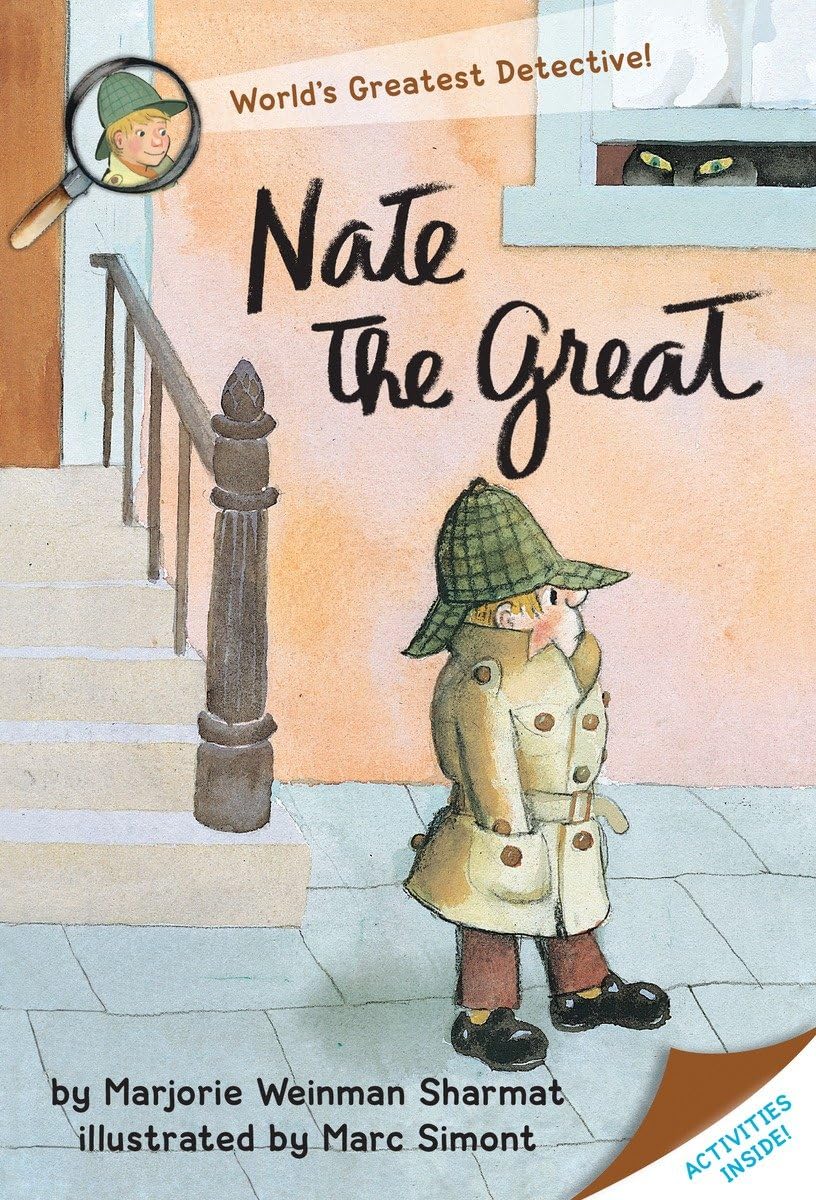
Nate the Great by Marjorie Weinman Sharmat, illustrated by Marc Simont, is a beloved early chapter book in American children’s publishing — a mystery story narrated by Nate himself, a self-described great detective who eats pancakes, wears a deerstalker hat, and solves cases in his neighborhood with the focused efficiency of a child-sized Sam Spade. First published in 1972, Nate the Great launched a series that has appeared on over 28 million boxes of Cheerios and made the deerstalker hat one of the most recognized accessories in early reader literature. This guide covers the reading level, recommended age, read-aloud vs. independent reading guidance, themes, and everything parents and teachers need to know about sharing Nate the Great with young readers.
For Parents
Find out whether Nate the Great works best as a read-aloud or independent read for your child, what age range it suits, and why this early mystery series is one of the most reliably effective books for reluctant readers and children who are ready to move from picture books and simple early readers to something with more narrative heft.
For Teachers
Grade-level data, read-aloud timing, key themes, and discussion questions for one of the most widely used early chapter books for grades 1–2. Exceptional for introducing children to the mystery genre, to first-person narration, and to the particular satisfaction of following a logical chain of reasoning to a solution.
Nate the Great at a Glance
Find on Amazon →| Author | Marjorie Weinman Sharmat |
| Illustrator | Marc Simont |
| Published | 1972 |
| Grade Level | 1–2 (our assessment) |
| Recommended Age | 5–8 |
| Best For | Read-aloud ages 5–8; independent reading ages 6–8 |
| Flesch-Kincaid Grade | 2.6 |
| Word Count | ~1,600 |
| Pages | 80 |
| Chapters | None (continuous narrative) |
| Genre | Early chapter book / mystery |
| Setting | A suburban neighborhood |
| Awards | Library of Congress Book of the Year; Booklist “groundbreaking” designation; NYPL 100 Titles for Reading and Sharing (series) |
For official Lexile and AR levels, visit Lexile.com or AR BookFinder. ReadingVine provides independent editorial assessments.
What Reading Level Is Nate the Great?
Nate the Great is a grade 1–2 reading level by our editorial assessment, with a Flesch-Kincaid grade level of approximately 2.6. At around 1,600 words it is one of the longer early readers on this list, and unlike most books here, it is structured as a sustained narrative mystery rather than a series of short stories or a picture book. The text is written entirely in first person — Nate narrates his own investigation — which gives it a distinctive voice that is both accessible and genuinely funny. Sharmat’s Nate speaks with the terse, self-important gravity of a hard-boiled detective translated into a seven-year-old’s vocabulary: short declarative sentences, matter-of-fact observations, and a deadpan relationship with the absurdity of his situation.
The FK score of 2.6 accurately reflects the decoding demand, but the comprehension demand is slightly higher than comparable books at this level because Nate the Great requires the reader to track a logical chain of clues and follow their implications — a kind of sustained inferential reasoning that simple early readers do not require. Children who follow along successfully with the investigation are doing real critical thinking, dressed up as a story about a boy who loves pancakes. For parents who use specific reading level systems: we recommend checking your child’s level on Lexile.com or AR BookFinder for official scores, or asking your child’s teacher for their Guided Reading or DRA level.
Is Nate the Great a Read-Aloud or Independent Read?
Nate the Great works well as both a read-aloud for ages 5–8 and an independent read for ages 6–8, and it is one of the strongest books on this list for the specific purpose of moving a child from simple early readers to longer independent reading. The mystery format gives the book a narrative momentum that keeps readers engaged from beginning to end; the chapters are absent but the investigation provides its own structure, with each new clue keeping the reader reading. Most adults can read the whole book aloud in about 20–25 minutes.
As a read-aloud, Nate the Great rewards a reader who plays Nate’s voice with the appropriate deadpan seriousness. Nate does not wink at the reader; he is completely committed to his investigation and his own greatness, which is the source of most of the book’s humor. When Nate says “I, Nate the Great, am a great detective,” he means it completely, and the comedy comes from the gap between his self-assessment and the mundane scale of the cases he investigates — a missing picture painted by a child, found in the most obvious possible place. Reading it straight, without irony, delivers the humor more effectively than underlining it.
For independent reading, a confident first grader or any second grader can handle the text. The first-person voice and simple sentence structure are accessible, and the mystery plot provides motivation to keep reading that more episodic early readers sometimes lack. Children who struggle to sustain attention through a longer book often do well with Nate the Great because the case keeps them turning pages. It is one of the books most frequently recommended by teachers and librarians for children who say they don’t like reading — the mystery format is, in practice, almost impossible not to follow to the end.
There is nothing in this book that requires parental preparation. The mystery is a missing painting of a dog. No one is in danger. The solution involves yellow paint and a practical conclusion that children find immensely satisfying.
Stop at the moment when Nate has gathered all the clues but before he announces the solution, and ask your child: “Who do you think took the picture? Why?” Children who have been following the clues actively — thinking about the yellow paint, the dog, the pancakes — often arrive at the right answer, which gives them the particular pleasure of having solved a mystery themselves. That feeling of “I figured it out” is one of the most powerful motivators for continued reading that exists.
What Is Nate the Great About?
Nate the Great is eating breakfast — pancakes, as always — when his friend Annie knocks on his door. Her picture is missing. It was a painting of her dog, Fang, and it was there yesterday and gone today. Nate, who is a great detective, agrees to take the case. He interviews the suspects: Annie, Rosamond (who has four cats and is strange), Harry (who collects things), and others. He follows the clues — including a distinctive yellow paint — and leaves notes for his mother when the investigation requires him to go out. In the end, Nate solves the mystery. The solution is clever, earned, and completely satisfying, requiring neither magic nor coincidence: just observation, logic, and a willingness to follow the evidence wherever it leads, even if that is somewhere unexpected.
Sharmat structured the book as a genuine mystery — the clues are all present, the solution is fair, and a careful reader can solve it before Nate announces it. The pancakes are not incidental; they appear at the beginning and the end, framing the investigation in the domestic routine of a child’s day and reminding the reader that even great detectives have to eat breakfast.
Nate the Great Characters
Nate the Great Themes and Lessons
The central theme of Nate the Great is the satisfaction of systematic reasoning — the particular pleasure of gathering evidence, following its implications, and arriving at a conclusion that is earned rather than guessed. Sharmat built the book as a genuine mystery in the tradition of hard-boiled detective fiction, scaled down to a child’s neighborhood and vocabulary. The clues are real, the suspects are actual suspects, and the solution is discoverable by a careful reader before Nate announces it. Children who follow the investigation — who track the yellow paint, notice the dog’s behavior, consider each suspect’s motive — are practicing the kind of logical reasoning that transfers directly to reading comprehension, scientific thinking, and real-world problem solving.
The book is also a study in first-person voice as a literary tool. Nate’s narration — “I, Nate the Great, am a great detective” — is the book’s most distinctive feature and the source of most of its comedy. He is not boastful in an unpleasant way; he is simply certain, and his certainty is never challenged by the narrative. Children who read Nate the Great are encountering, perhaps for the first time, an unreliable narrator in the most gentle possible form: a narrator who takes himself very seriously in a situation that is also genuinely funny. This is more sophisticated than it sounds, and children who get the joke have understood something important about how narrative voice works.
For teachers, Nate the Great is one of the most effective available books for introducing the mystery genre at the early reader level. The story has all the elements of a real mystery — a crime (or at least a disappearance), suspects, clues, a detective, and a solution — in a form that is accessible to beginning readers. Children who read Nate the Great and like it are ready for the genre as a whole, which is one of the most popular in children’s reading and one that motivates reluctant readers with unusual consistency.
Discussion starters for families: How did Nate know where to look? What clue did you find most important? Could you have solved the mystery before Nate? What makes a good detective? What would you call your detective agency if you had one?
How Long Is Nate the Great?
Nate the Great has 80 pages and approximately 1,600 words. Most adults can read it aloud in about 20–25 minutes. The book has no chapters but the mystery structure provides its own momentum — each new clue and each new interview gives children a reason to keep going, and most families find it difficult to stop in the middle once the investigation is underway.
A child reading independently at a first- or second-grade level will typically finish in about 25–35 minutes. Nate the Great is one of the longer books on the K–2 list, but its mystery plot makes it feel shorter than it is: the question of who took the picture sustains attention in a way that more episodic books sometimes cannot. Children who say they don’t like reading often finish Nate the Great and immediately want the next one, which is one of the most valuable things a book can do.
Books Similar to Nate the Great
If your child loves Nate the Great, these titles share its mystery format, its early chapter book structure, or its place in the Early Reader Bridge cluster:
About the Author and Illustrator
Marjorie Weinman Sharmat (1928–2019) was an American children’s author who wrote more than 130 books for children and young adults over a career spanning more than fifty years. Nate the Great, published in 1972, was inspired by her father, Nathan Weinman, who she described as having the confidence and directness that she gave to Nate — he lived to see the first book published. The other characters in the original book are also drawn from family: Annie is named after her mother Anne, Rosamond after her sister Rosalind, and Harry after her uncle Harry. Sharmat grew up dreaming of both becoming a writer and becoming a detective, and Nate the Great combined both ambitions in a single character. She wrote twenty-five Nate the Great books with various collaborators, including her husband Mitchell Sharmat and her sons. The series has been described by Booklist as “groundbreaking” — it introduced the mystery genre to beginning readers and proved that an early chapter book could have a real plot, real clues, and a fair, earned solution, rather than simply stringing together incidents until it ended.
Marc Simont (1915–2013) was a French-born American illustrator who illustrated nearly a hundred books over a career that lasted more than sixty years. He won the Caldecott Medal for his illustrations in A Tree Is Nice (1957) by Janice May Udry and a Caldecott Honor for his own book The Stray Dog (2001). His illustrations for Nate the Great — loose, expressive pen-and-ink drawings with watercolor washes — give the book its visual personality: Nate in his deerstalker hat, Nate eating his pancakes, the suspects in their various states of puzzlement or suspicion. The deerstalker hat, it should be noted, was Simont’s idea rather than Sharmat’s — he added it to give Nate his detective’s visual signature, and it has been inseparable from the character ever since. Simont illustrated the first twenty books in the Nate the Great series before passing the visual work to other illustrators, who were directed to work in his style.
Nate the Great: Frequently Asked Questions
What reading level is Nate the Great?
Nate the Great is a grade 1–2 reading level by our editorial assessment, with a Flesch-Kincaid grade level of approximately 2.6. At around 1,600 words, it is one of the longer early readers on the K–2 list and is structured as a sustained mystery narrative rather than a series of short stories. It works best as a read-aloud for ages 5–8 and as an independent read for ages 6–8. For official Lexile and AR levels, visit Lexile.com or AR BookFinder.
What age is Nate the Great for?
Nate the Great is appropriate for ages 5–8. It skews slightly older than most books on the K–2 list — it is best suited to children who have some early reading experience and are ready for a longer narrative with a sustained mystery plot. As a read-aloud it works from age 5; as an independent read it suits first and second graders ages 6–8. It is one of the most recommended books for children who are ready to move beyond simple early readers but are not yet ready for longer chapter books.
Is Nate the Great good for reluctant readers?
Nate the Great is one of the most consistently recommended books for reluctant readers at the grade 1–2 level, and for good reason: the mystery format makes it almost impossible to stop reading in the middle. The question of who took the picture sustains attention through the full book in a way that more episodic early readers sometimes cannot. Children who say they don’t like reading often finish Nate the Great and immediately ask for the next one. The first-person narration and Nate’s self-important voice also make the book more engaging than it looks on paper — it is genuinely funny, which helps.
How long does it take to read Nate the Great aloud?
Most adults can read Nate the Great aloud in about 20–25 minutes. The mystery structure makes the reading feel faster than the page count suggests — each new clue and interview provides momentum, and most families find it difficult to stop in the middle once the investigation is underway. It is one of the longer read-alouds on the K–2 list, but the story earns every minute.
What is Nate the Great about?
Nate the Great is about a boy named Nate who is a self-described great detective. His friend Annie’s painting of her dog is missing, and Nate takes the case. He interviews suspects, follows clues — including a significant amount of yellow paint — leaves notes for his mother, and eats pancakes. He solves the mystery through careful observation and logical reasoning. The solution is earned, fair to the reader, and satisfying in the way that only a genuinely constructed mystery can be. It is a detective story for beginning readers that respects both the genre and the reader.
Are there other Nate the Great books?
Yes — Marjorie Weinman Sharmat wrote twenty-five Nate the Great books between 1972 and her death in 2019, with later titles co-written with her husband Mitchell Sharmat and her sons. Marc Simont illustrated the first twenty before passing the visual work to other illustrators. All books in the series follow the same format: a neighborhood mystery, a first-person narration, pancakes, and a fair solution arrived at through evidence and reasoning. The series remains in print and is considered one of the foundational mystery series for early readers.