
 = Partner Site
The Dot Reading Level: A Complete Guide
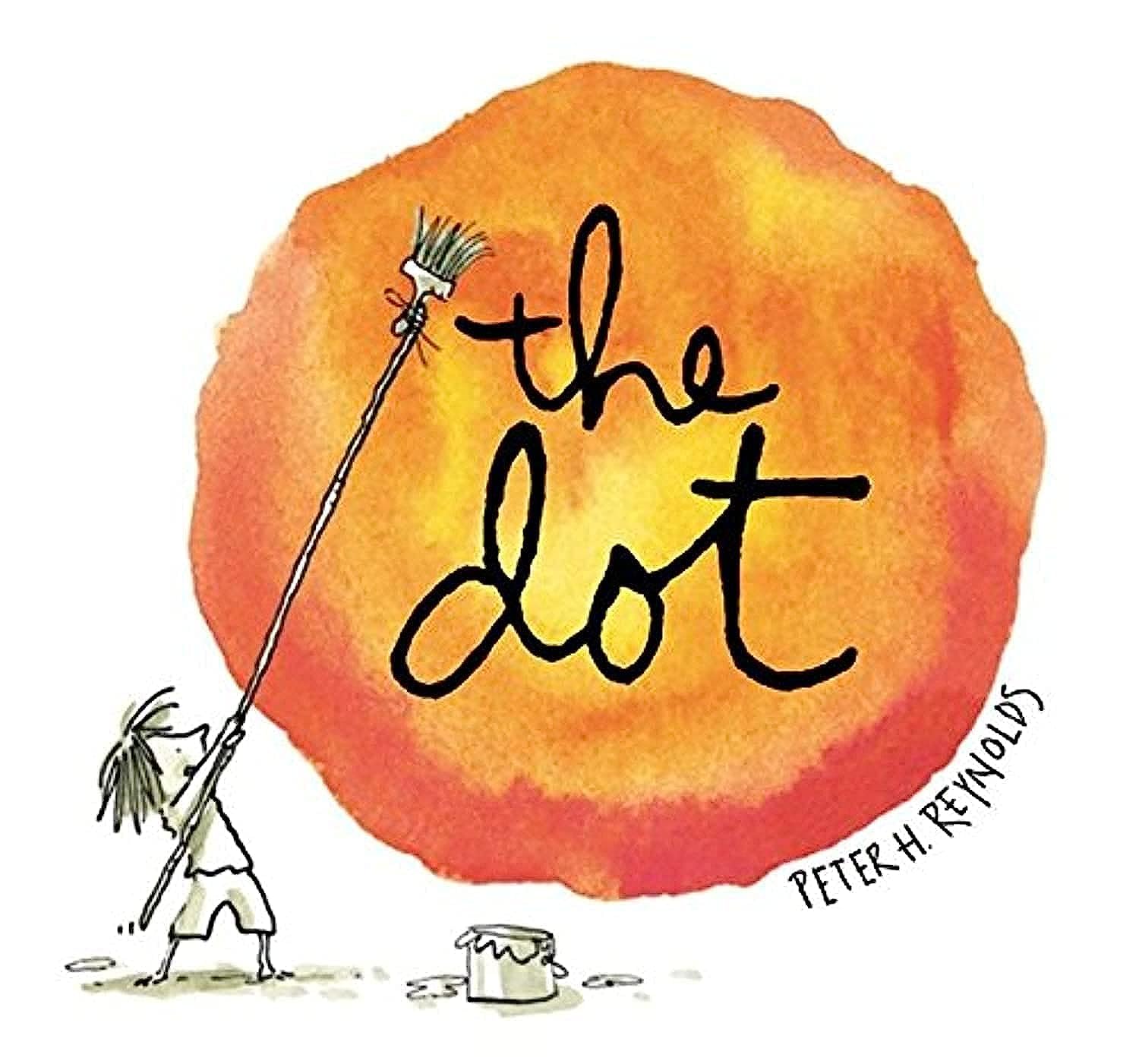
The Dot, written and illustrated by Peter H. Reynolds, is a 32-page picture book about a girl named Vashti who sits in front of a blank piece of paper at the end of art class, certain that she cannot draw. Her teacher does not argue with her. Instead, she leans over and says: “Just make a mark and see where it takes you.” Vashti jabs at the paper with her marker — an angry, dismissive dot, meant to prove the point that she has nothing to offer. Her teacher asks her to sign it. That one small act of witnessed effort becomes the beginning of everything. Published in 2003 by Candlewick Press and a recipient of starred reviews from every major children’s literature journal, The Dot has sold millions of copies, inspired International Dot Day (celebrated in over 120 countries every September 15), and launched a creative practice in classrooms around the world: making a mark and seeing where it takes you. This guide covers The Dot‘s reading level, whether it’s a read-aloud or independent read, what it’s about, its themes, how long it takes to read, and similar books — designed for parents and teachers of K–2 readers.
For Parents
A gentle, beautifully illustrated picture book about creative courage — what happens when a child who believes she can’t make anything is given permission to try anyway. Best as a read-aloud for ages 4–8 and an independent read for ages 5–8. No content concerns. A book that speaks to children who are afraid to begin, and to adults who remember being that child.
For Teachers
A classroom staple for PreK–2 and beyond — used universally on the first day of school, at the start of art units, and whenever a child says “I can’t.” The teacher character’s response — witnessed effort, validation, a simple invitation — is one of the most effective models of encouraging reluctant students in picture book literature. Celebrated worldwide on International Dot Day, September 15. Part of Reynolds’s Creatrilogy alongside Ish and Sky Color.
The Dot at a Glance
Find on Amazon →| Author & Illustrator | Peter H. Reynolds (author & illustrator) |
| Published | 2003 (Candlewick Press) |
| Grade Level | PreK–2 read-aloud; K–3 independent (our assessment) |
| Recommended Age | Read-aloud ages 4–8; independent reading ages 5–8 |
| Best For | Read-aloud ages 4–8; independent reading ages 5–8 |
| Lexile | AD500L |
| ATOS Level | 1.9 |
| Fountas & Pinnell | L |
| Word Count | 326 |
| Pages | 32 |
| Series | Part of the Creatrilogy (The Dot, Ish, Sky Color) |
| Genre | Picture book / realistic fiction / social-emotional |
For official Lexile and AR levels, visit Lexile.com or AR BookFinder. ReadingVine provides independent editorial assessments.
What Reading Level Is The Dot?
The Dot has a Lexile of AD500L and an ATOS level of 1.9. The “AD” designation — Adult Directed — indicates it is designed as a read-aloud, though the ATOS 1.9 suggests it is accessible for early independent reading as well. At 326 words across 32 pages, it sits comfortably in the middle of the K–2 picture book range: longer than Leo the Late Bloomer (164 words) and Knuffle Bunny (211 words), significantly shorter than Lilly’s Purple Plastic Purse (1,148 words). The Fountas & Pinnell Level L corresponds to approximately mid-first grade for independent reading.
As with several other books in this catalog, the reading-level scores accurately capture the prose but not the book’s full reach. The Dot is listed by TeachingBooks at grades PreK–6, reflecting that its message about creative courage speaks meaningfully to readers well into middle school and beyond — and that teachers at every grade level use it as a first-day-of-school or beginning-of-unit touchstone. The text is simple; the experience it describes is universal. For official Lexile and AR scores, visit Lexile.com or AR BookFinder. ReadingVine’s assessments are independent editorial judgments.
Is The Dot a Read-Aloud or Independent Read?
This works beautifully as both a read-aloud for ages 4–8 and an independent read for ages 5–8.
As a read-aloud, The Dot rewards a slow, deliberate pace — particularly at two moments: the teacher’s response when Vashti shows her the angry dot (“It’s just a dot”), and the final moment when a younger boy says he wishes he could draw like Vashti and she responds by handing him a blank piece of paper and saying “Show me.” Pausing at each of these moments gives the emotional landing its full weight. Reynolds’s watercolor-and-ink illustrations — loose, warm, alive with the specific textures of the page and the mark — carry the story’s feeling in a way the words alone do not.
As an independent read, a confident kindergartner or first-grader can work through the text. The sentences are clear and the story moves forward without complication. Many children who love the book will return to it on their own, particularly children who have had their own “I can’t draw” moment and found something in Vashti’s journey that they recognized.
After the first reading, give your child a blank piece of paper and a marker and say, simply: “Just make a mark and see where it takes you.” Do not suggest what kind of mark. Do not demonstrate. Just wait. What happens next is often the best conversation the book can generate — and it is the conversation Reynolds intended.
What Is The Dot About?
Art class is over. Everyone else has left. Vashti sits alone in front of a blank piece of paper, staring at it. She can’t draw. She has nothing to put on it. Her teacher, Marisol, comes and sits beside her — not to lecture or demonstrate, but to offer the simplest possible invitation: “Just make a mark and see where it takes you.” Vashti, to prove that she cannot draw, jabs at the paper with her marker. One angry dot. “There.” Her teacher smiles. She asks Vashti to sign it.
The next week, Vashti walks into art class and sees her dot — framed in gold, hanging on the wall above her teacher’s desk. It stops her. She looks at it. And she thinks: I can do better than that. She gets to work. She makes dots — small dots, large dots, dots in every color and combination. She fills canvas after canvas. The dots multiply and grow until she has an entire exhibition of dot paintings and people are crowding around them in genuine admiration.
At the exhibition, a younger boy finds Vashti and tells her what she told her teacher at the beginning: “I wish I could draw.” Vashti smiles. She hands him a blank piece of paper and says, “Show me.” He picks up a pencil and makes a long, wobbly line. It is not a dot, Vashti notices. It is a line. She tells him to sign it. And she frames it, and hangs it on the wall — having passed on exactly the gift she was given.
The Dot Characters
Vashti is the book’s protagonist and its most fully observed character — a girl whose certainty that she cannot draw is real and stubborn, whose angry dot is genuine defiance rather than play, and whose transformation across the book is gradual and earned rather than sudden. She does not decide to like art; she decides to compete with her own worst effort, and that decision opens everything. Her teacher Marisol is the book’s most important adult character — present for only a few pages, but doing the specific thing that makes everything possible: she does not argue with Vashti’s “I can’t,” she asks for a signature, and she hangs the dot in a gold frame. The signature is the act of witness; the gold frame is the act of validation. Both are simple. Both are everything. The unnamed younger boy at the exhibition is the book’s structural completion: he is Vashti before the dot, and she becomes his Marisol. The gift passes forward.
The Dot Themes and Lessons
The Dot is about creative courage — specifically the courage required to make a first mark when you are certain it will be bad. The blank page is the book’s central object, and Reynolds understands exactly what it represents: the gap between what you can imagine and what you can produce, the terror of putting something of yourself on the page and having it be wrong. Vashti’s angry dot is not a failure; it is an act of showing up. Her teacher recognizes this and treats it accordingly. The gold frame is not a lie about the dot’s quality; it is an honest statement about the value of showing up with what you have.
The pay-it-forward structure of the ending is one of the most elegant choices in the picture book catalog. Vashti begins as someone who believes she cannot; she becomes someone who creates; and she ends as someone who knows how to give another child what she was given. The book argues that creativity is not a talent possessed by some and denied to others — it is a practice that begins with a single mark, witnessed by someone who asks you to sign it. Reynolds makes this argument visually as well as textually: his own illustrations are loose, imperfect, full of energy and mess, deliberately resisting the false standard of “good art” that Vashti is measured against in her own head.
Teachers who use this book on the first day of school often follow it with exactly what Marisol does: they ask students to make a mark — any mark — and sign it. This practice, repeated annually on International Dot Day (September 15), has spread to over 120 countries. The book has generated one of the most organic and sustained classroom traditions of any picture book in recent memory, because it gives teachers a simple script for the most common creative block their students face: “Just make a mark and see where it takes you.”
Talking with your child: Why do you think Vashti said she couldn’t draw? What did her teacher do when Vashti showed her the dot — and why did that matter? When Vashti saw her dot hanging on the wall in a gold frame, what did she think? Have you ever done something you thought was bad and then realized it was actually okay? What would you make if someone said “just make a mark”?
International Dot Day
International Dot Day is celebrated on September 15 each year — the publication date of The Dot — and has grown into one of the largest global literacy and creativity events in education. In 2023, over eight million people in 120 countries participated. Schools, libraries, bookstores, and classrooms around the world mark the day by reading The Dot, making their own dot-inspired art, and sharing their marks under the hashtag #DotDay. Reynolds has said he was astonished by the movement the book generated — it began with a teacher in Montana who decided to celebrate the book’s publication date with her class in 2009, and it spread organically from there. International Dot Day falls in the first weeks of most school years, making it a natural anchor point for beginning-of-year creative courage conversations. Resources for celebrating Dot Day in the classroom are available at peterhreynolds.com.
How Long Is The Dot?
The Dot is 32 pages with 326 words. Most adults can read it aloud in about five to seven minutes. It is part of Reynolds’s Creatrilogy — three companion picture books about creative courage and expression: The Dot (2003), Ish (2004, about a boy who learns that a vase-ish drawing is perfectly valid), and Sky Color (2012, about a girl who discovers that the sky can be any color she needs it to be). Each book is complete on its own; reading all three gives the fullest picture of Reynolds’s argument about creativity and the false standard of “good art.”
Books Similar to The Dot
About Peter H. Reynolds
Peter H. Reynolds was born in 1961 in Scarborough, Ontario, Canada, and grew up in a family that encouraged creativity — he has said that his mother kept a box of art supplies always accessible and that making things was simply what his family did. He studied at Emerson College in Boston and went on to found FableVision, a storytelling and learning company, with his twin brother Paul. He is the illustrator of the Judy Moody series and the author-illustrator of the Creatrilogy (The Dot, Ish, Sky Color), as well as The Word Collector, Happy Dreamer, and other books. He owns and operates The Blue Bunny, an independent bookstore in Dedham, Massachusetts.
Reynolds has said that The Dot was inspired by his own experience as a child who was told he was not artistic and who later discovered that the limitation was in the permission, not in the ability. The book’s teacher character, Marisol, is based on the kind of teacher Reynolds wished he had had — someone who does not judge the first mark but asks for a signature. He has described the response to the book, and particularly International Dot Day, as one of the most humbling experiences of his life: the simple story he wrote in a short time has generated a global movement in which millions of people make their mark every September and celebrate the courage it took to do it.
The Dot: Frequently Asked Questions
What reading level is The Dot?
The Dot has a Lexile of AD500L and an ATOS level of 1.9. The “AD” designation means it is designed as a read-aloud; the ATOS 1.9 makes it accessible for early independent reading. Our assessment: read-aloud for ages 4–8; independent reading for ages 5–8. For official Lexile and AR scores, visit Lexile.com or AR BookFinder.
Can a kindergartner read The Dot alone?
A confident kindergartner or early first-grader can work through the text independently. At 326 words with clear, accessible sentences, it is within the range of an early independent reader. Most children encounter it as a read-aloud first and return to it on their own afterward.
How long does it take to read The Dot aloud?
About five to seven minutes as a read-aloud. The right pace is slow at the two key moments — the teacher’s response to Vashti’s dot, and Vashti’s response to the younger boy at the end. Both moments earn a pause.
What is The Dot about?
Vashti sits alone after art class, convinced she cannot draw. Her teacher asks her to “just make a mark” — so Vashti makes an angry dot to prove her point. Her teacher asks her to sign it, then frames it in gold and hangs it above her desk. Seeing her own dot honored, Vashti begins to experiment. She fills canvases with dots of every size and color, holds an exhibition, and ends the book by passing the same gift to a younger boy who says he can’t draw.
What is International Dot Day?
International Dot Day is celebrated every September 15 — the publication date of The Dot — in over 120 countries. It began in 2009 when a teacher in Montana celebrated the book’s publication date with her class, and spread organically through the education community. On Dot Day, schools and libraries read The Dot, students make their own dot-inspired art, and participants share their marks under #DotDay. It is one of the largest global literacy and creativity events in education. Resources are available at peterhreynolds.com.
What is the Creatrilogy?
Peter H. Reynolds’s Creatrilogy is three companion picture books about creative courage and expression: The Dot (2003), about a girl who discovers she can make art by starting with a single mark; Ish (2004), about a boy who learns that a “vase-ish” drawing is perfectly valid; and Sky Color (2012), about a girl who discovers the sky can be any color she needs it to be. Each book is complete on its own; reading all three gives the fullest picture of Reynolds’s argument about creativity, imperfection, and the false standard of “good art.”
Why does the teacher ask Vashti to sign the dot?
The signature is an act of witness — it makes Vashti own what she made, even if she made it in anger and dismissal. By asking for a signature, Marisol treats the dot as something worth claiming, something that belongs to its maker. The gold frame extends this: the dot is not displayed in spite of what it is but because of who made it. This sequence — make it, sign it, hang it — is the book’s most precise description of what encouragement actually looks like in practice.