
 = Partner Site
Leo the Late Bloomer Reading Level: A Complete Guide
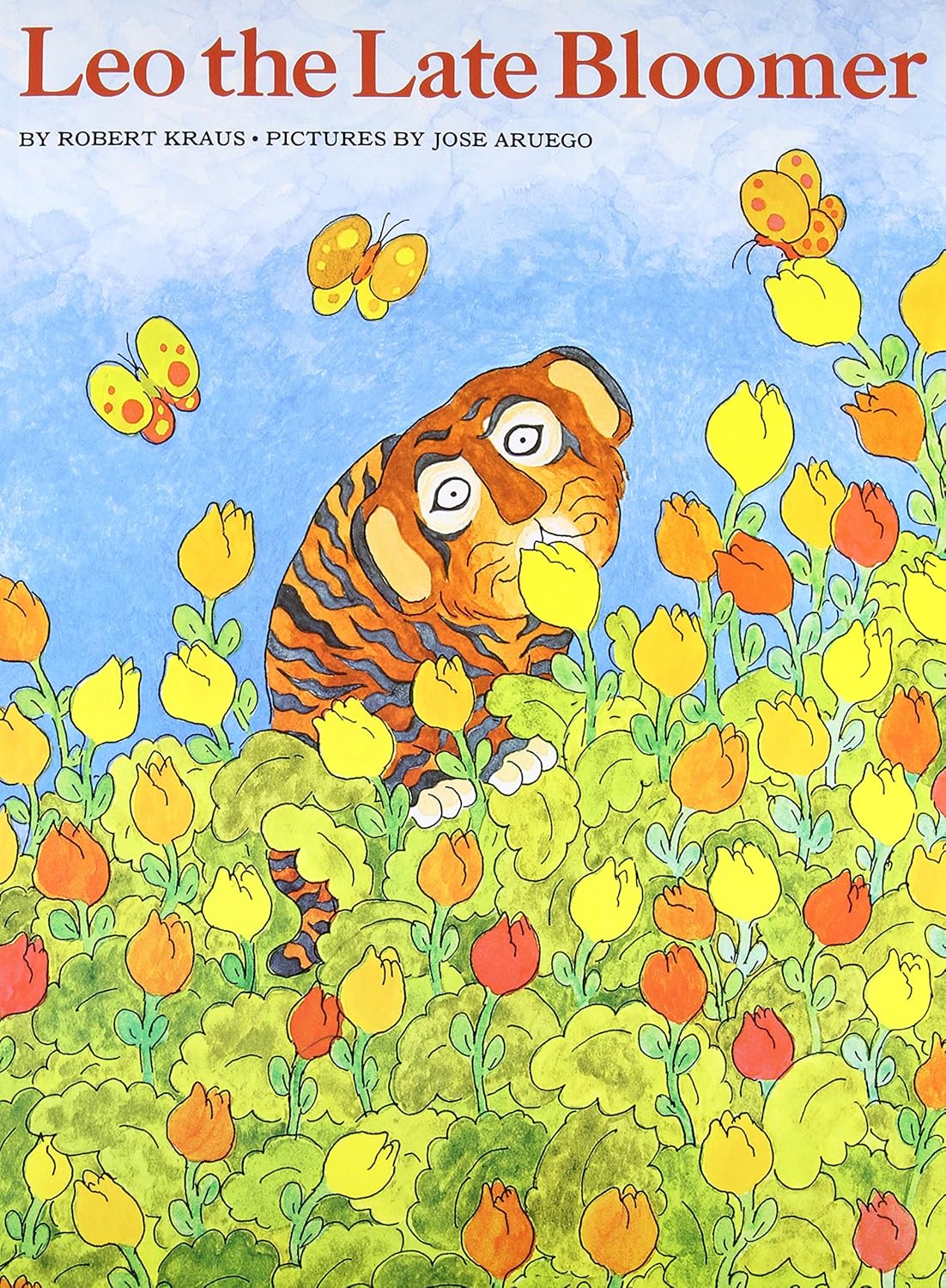
Leo the Late Bloomer, written by Robert Kraus and illustrated by Jose Aruego, is a 32-page picture book about a young tiger named Leo who cannot read, cannot write, cannot draw, and cannot speak — and whose father watches him with growing worry, while his mother watches with patient certainty. Published in 1971 and illustrated with Jose Aruego’s bold, warm jungle art, it has become one of the most widely used picture books in American early childhood education — not just for children who are worried about themselves, but for the parents sitting beside them who are worried about the same thing. At 164 words, it is one of the shortest texts in this catalog; it is also one of the most emotionally precise. “A watched bloomer never blooms,” Leo’s mother says. She is right. This guide covers Leo the Late Bloomer‘s reading level, whether it’s a read-aloud or independent read, what it’s about, its themes, how long it takes to read, and similar books — designed for parents and teachers of K–2 readers.
For Parents
A gentle, funny picture book about a child who is not yet doing what the other children are doing — and about his mother’s patient certainty that he will, in his own time. The book speaks as directly to the worried parent as it does to the child. Best as a read-aloud for ages 3–7. No content concerns. One of the most reassuring picture books in print, recommended by pediatricians, early childhood specialists, and kindergarten teachers for over fifty years.
For Teachers
A PreK–2 classroom staple for discussions of developmental differences, patience, and growth — used widely in early intervention settings, kindergarten classrooms, and parent-teacher conferences where a gentle nudge toward patience is needed. The book’s dual address — to the child who is waiting and to the parent who is watching — makes it one of the few picture books that works in a family read-aloud context to help both generations at once.
Leo the Late Bloomer at a Glance
Find on Amazon →| Author | Robert Kraus |
| Illustrator | Jose Aruego |
| Published | 1971 (Windmill Books / HarperCollins) |
| Grade Level | PreK–K read-aloud; K–1 independent (our assessment) |
| Recommended Age | Read-aloud ages 3–7; independent reading ages 5–7 |
| Best For | Read-aloud ages 3–7; independent reading ages 5–7 |
| Lexile | 120L |
| ATOS Level | 1.2 |
| Guided Reading Level | I |
| Word Count | 164 |
| Pages | 32 |
| Genre | Picture book / realistic fiction / social-emotional |
For official Lexile and AR levels, visit Lexile.com or AR BookFinder. ReadingVine provides independent editorial assessments.
What Reading Level Is Leo the Late Bloomer?
Leo the Late Bloomer has a Lexile of 120L and an ATOS level of 1.2. Different editions cite slightly different scores — some Scholastic editions show 360L, and Bookroo lists it at 120L — reflecting that the book’s very brief text (164 words) and its mix of simple and more complex sentences produce variable results across different scoring runs. The TeachingBooks figure of 120L and ATOS 1.2 are the most consistently cited. Either way, the text is genuinely accessible: at 164 words across 32 pages, it is among the shortest texts in this catalog, and the sentences are short and clear throughout.
Note that a Lexile or ATOS score at this level does not mean the book is intellectually simple — it means the prose is brief and accessible. The emotional content and the book’s dual address (to child and parent simultaneously) are sophisticated in ways no formula captures. A child beginning to read independently in late kindergarten or early first grade can work through the text; most children will encounter it as a read-aloud first, and many will return to it independently afterward. For official Lexile and AR scores, visit Lexile.com or AR BookFinder. ReadingVine’s assessments are independent editorial judgments.
Is Leo the Late Bloomer a Read-Aloud or Independent Read?
This is primarily a read-aloud for ages 3–7, with independent reading accessible for ages 5–7.
As a read-aloud, Leo the Late Bloomer is best experienced slowly — it is short enough to rush through in three minutes, but its emotional weight rewards the pauses. Aruego’s illustrations carry as much of the story as Kraus’s text: Leo’s expression across the book, his father’s hopeful-worried face at the window, the lush jungle world that surrounds them, and the final spread where Leo — with a huge grin — reads, writes, draws, eats neatly, and says, in a word balloon that takes up half the page, “I made it!” are all worth lingering on. The text tells the story; the illustrations tell how it feels.
The read-aloud also works uniquely well because it speaks to both the adult and the child in the room. Parents who read this to a child they are worried about find themselves in Leo’s father — watchful, anxious, hoping. Children who are behind in some way find themselves in Leo — seen, not rushed, eventually triumphant. The book holds both experiences without privileging either.
After the first reading, ask your child which animal they think Leo is most like before he blooms — and which one they think he becomes afterward. Then ask: “Is there something you are still learning that you know you will be able to do someday?” The book is most powerful when it opens a real conversation, not when it delivers a lesson.
What Is Leo the Late Bloomer About?
Leo is a young tiger. His friends can all do things Leo cannot: they can read, write, draw, and eat neatly. Leo cannot do any of these things. He cannot even speak. His father watches him carefully — looking out the window at Leo playing in the snow, hoping to see some sign of progress. “What’s the matter with Leo?” he asks. Leo’s mother, certain and calm, answers: “Nothing. Leo is just a late bloomer.” His father keeps watching. His mother tells him to stop. “A watched bloomer never blooms,” she says.
And so Leo’s father — with enormous effort — stops watching. Winter passes. Spring comes. And then one day, in his own good time, Leo blooms. He reads. He writes. He draws with a beautiful, sweeping line. He eats neatly. And then he speaks: “I made it!” The book ends there, with Leo’s triumphant declaration and Aruego’s illustration of Leo grinning broadly, surrounded by everything he can now do.
The story is complete in fewer than two hundred words. What gives it its lasting power is not its length but its precision: it names a real experience (the child who is not yet doing what others are doing, and the parent watching and worrying), it validates both sides of that experience without dismissing either, and it ends with the only ending that child and parent both need to hear: in his own time, Leo bloomed.
Leo the Late Bloomer Characters
Leo is the book’s protagonist — a young tiger who is behind in multiple areas simultaneously and who is not, in the early part of the book, distressed about this in the way his father is. Leo plays in the snow. He watches TV. He exists in his own time, apparently unbothered, while his father worries nearby. His eventual blooming is not the result of effort or intervention; it simply happens, in its own season, when he is ready. This is the book’s most important argument, and Leo embodies it without commentary. Leo’s mother is the book’s wisest voice — patient, confident, and possessed of the single most quotable line in the book: “A watched bloomer never blooms.” She is not dismissive of Leo’s father’s worry; she simply knows something he has not yet accepted. Leo’s father is the book’s most humanly recognizable figure — the parent at the window, the one who cannot stop watching, who knows intellectually that Leo will bloom and cannot stop emotionally checking for signs. He is gently funny precisely because every adult who reads the book recognizes themselves in him.
Leo the Late Bloomer Themes and Lessons
The book’s most distinctive quality is that it has two audiences simultaneously and serves both. For children, it offers the reassurance that not being ready yet is not a permanent state — that Leo bloomed, and they will too. For parents, it offers something more specific and more difficult: the suggestion that watching and worrying may not help, and may in fact be part of what makes the waiting harder. “A watched bloomer never blooms” is directed at Leo’s father, and it lands differently for adult readers than it does for children. It is both funny and true, and it gives parents permission to exhale.
The book is widely recommended by pediatricians, speech-language pathologists, occupational therapists, and early childhood educators for families navigating developmental delays, late talking, and differences in developmental timing. Its message — that development varies in pace without varying in eventual outcome — is one that early intervention professionals frequently want families to internalize, and the book delivers it in a form that a three-year-old and their parent can experience together. It does not promise that every child will do everything; it promises, in the specific world of this story, that Leo will — and it trusts readers to find their own version of Leo’s “I made it!” in their own time.
Talking with your child: Why do you think Leo’s mother wasn’t worried? What did Leo’s father do differently when his mother told him to stop watching? What is something you are getting better at little by little? Is there something you know you will be able to do someday, even if you can’t do it yet?
How Long Is Leo the Late Bloomer?
Leo the Late Bloomer is 32 pages with 164 words — the shortest text in this catalog alongside Knuffle Bunny at 211 words. Most adults can read it aloud in about three to four minutes. The brevity is a feature: the book earns its ending without overstaying its welcome, and the short text gives Aruego’s illustrations the room they need to carry the emotional weight. At three to four minutes, it can be read multiple times in a single sitting — and many children ask for exactly that, particularly children who find something in Leo that they recognize in themselves.
Books Similar to Leo the Late Bloomer
About Robert Kraus and Jose Aruego
Robert Kraus was born in 1925 in Milwaukee, Wisconsin, and worked as a cartoonist for The New Yorker before turning to children’s books. He founded Windmill Books in 1966, a children’s book imprint, and published Leo the Late Bloomer there in 1971. He went on to write more than fifty children’s books, including Little Louie the Baby Bloomer, a companion to Leo’s story. He died in 2001. Kraus based Leo on his own experience as a child who was considered a late bloomer — he has said he was not reading well when his peers were, and that the reassurance he wished someone had given him then was what he tried to give Leo’s readers.
Jose Aruego was born in Manila, the Philippines, in 1932, and studied law there before deciding he wanted to draw. He moved to New York City in 1956 to study at Parsons School of Design, and began selling cartoons to The New Yorker and The Saturday Evening Post before turning to children’s book illustration. His style — bold outlines, luminous color, expressive animal faces that communicate entire emotional landscapes without a word — is immediately recognizable and was perfectly suited to Leo’s story: the jungle world he creates is warm and lush and filled with creatures whose feelings are entirely readable. He illustrated more than eighty books for children across his career. He died in 2012 in New York City.
Leo the Late Bloomer: Frequently Asked Questions
What reading level is Leo the Late Bloomer?
Leo the Late Bloomer has a Lexile of 120L and an ATOS level of 1.2 — among the lowest reading level scores in this catalog, reflecting its very brief, simple text. The book’s emotional and thematic depth far exceeds what these scores suggest. Our assessment: read-aloud for ages 3–7; independent reading for ages 5–7. For official Lexile and AR scores, visit Lexile.com or AR BookFinder.
Can a kindergartner read Leo the Late Bloomer alone?
A kindergartner who is beginning to read independently can work through the text — at 164 words with short, clear sentences, it is one of the most accessible texts in the catalog. Many children first encounter it as a read-aloud and return to it on their own precisely because they connect with Leo’s experience of being not-yet-ready.
How long does it take to read Leo the Late Bloomer aloud?
About three to four minutes as a read-aloud — the shortest read-aloud time in this catalog. The brevity is a feature: the book earns its ending without overstaying its welcome. Many children ask to hear it again immediately after the first reading, which is easy to accommodate at this length.
What is Leo the Late Bloomer about?
Leo is a young tiger who cannot yet read, write, draw, or speak — while his friends can do all these things. His father watches anxiously. His mother is certain that Leo will bloom in his own time, and tells his father to stop watching: “A watched bloomer never blooms.” His father stops watching. And then, in his own season, Leo blooms — reading, writing, drawing, eating neatly, and finally saying: “I made it!”
Is Leo the Late Bloomer good for a child with a developmental delay?
It is one of the most widely recommended picture books for this context by pediatricians, speech-language pathologists, and early childhood educators. The book validates the experience of developing at a different pace without pathologizing it, offers the child a character who recognizes their experience, and gives parents permission to trust the process rather than intensify the watching. It should not be used as a substitute for professional evaluation when parents have genuine developmental concerns — but as a complementary read-aloud, it has supported many families through exactly this experience for over fifty years.
What does “A watched bloomer never blooms” mean?
It is Leo’s mother’s advice to his father — a riff on the English proverb “A watched pot never boils.” Her point is that anxious observation doesn’t speed Leo’s development; it only makes the waiting harder for his father and potentially communicates anxiety to Leo. The line is the book’s most quoted phrase because it speaks so directly to the parent experience: there is a thing you cannot force, and watching for it obsessively does not help it arrive. Letting go of the watching, and trusting the process, is both harder and more effective.