
 = Partner Site
Chrysanthemum Reading Level: A Complete Guide
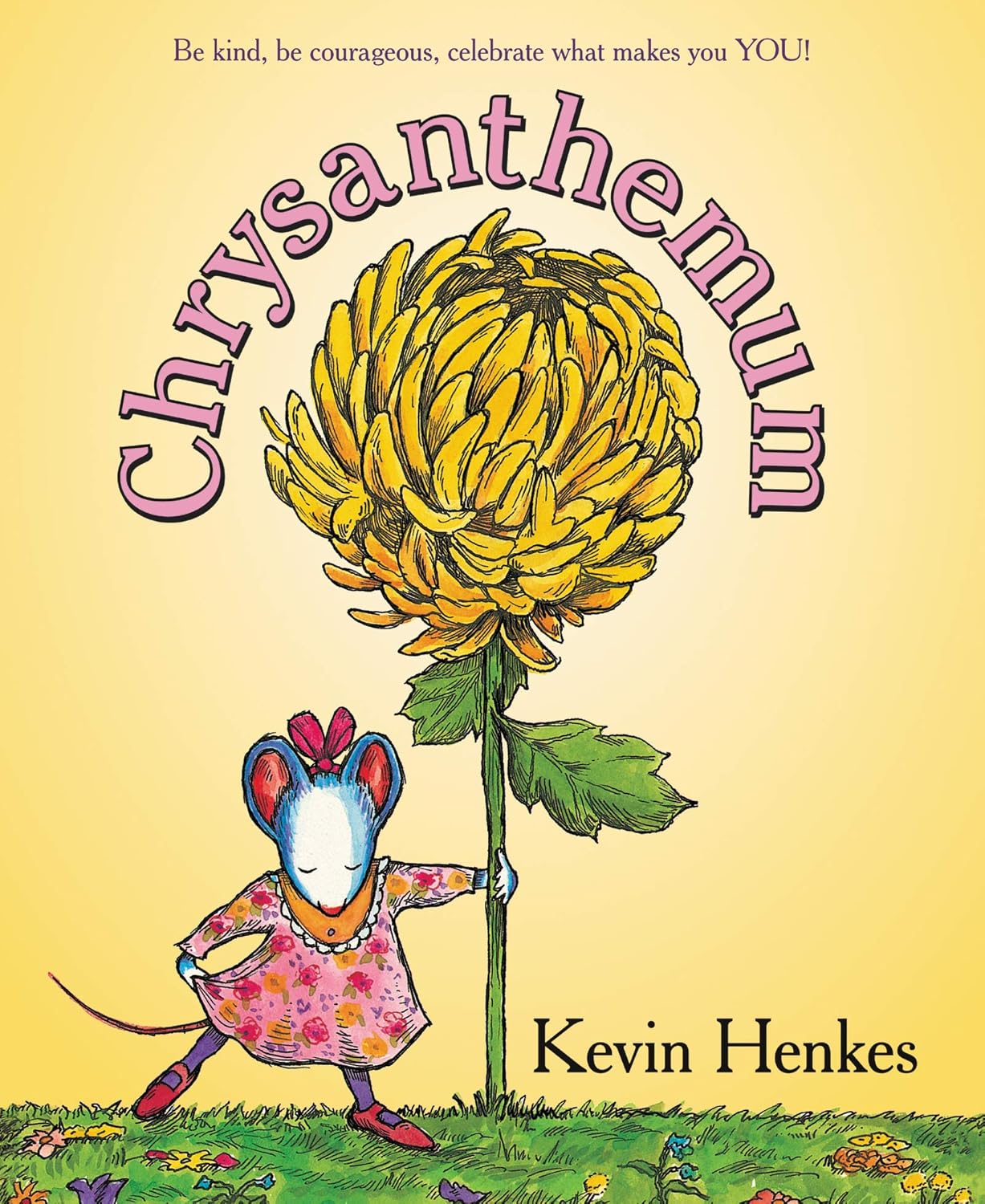
Chrysanthemum by Kevin Henkes is one of the most widely used picture books in K–1 classrooms — a funny, warm, and quietly devastating story about a mouse who loves her name until the first day of school changes everything. This guide covers the reading level, recommended age, read-aloud vs. independent reading guidance, themes, and everything parents and teachers need to know about sharing this modern classic with young readers.
For Parents
Find out whether Chrysanthemum works best as a read-aloud or independent read for your child, what age range it suits, and how to talk about its themes of identity, teasing, and the power of being seen and celebrated exactly as you are.
For Teachers
Grade-level data, read-aloud timing, key themes, and discussion questions for one of the most beloved classroom community-building books in K–1. Central to units on kindness, identity, names, and the impact of words on others.
Chrysanthemum at a Glance
Find on Amazon →| Author & Illustrator | Kevin Henkes |
| Published | 1991 |
| Grade Level | K–2 (our assessment) |
| Recommended Age | 4–7 |
| Best For | Read-aloud ages 4–7; independent reading ages 6–7 |
| Flesch-Kincaid Grade | 3.4 |
| Word Count | ~800 |
| Pages | 32 |
| Genre | Picture book / realistic fiction |
| Setting | A mouse family’s home; an elementary school classroom |
For official Lexile and AR levels, visit Lexile.com or AR BookFinder. ReadingVine provides independent editorial assessments.
What Reading Level Is Chrysanthemum?
Chrysanthemum is a K–2 reading level by our editorial assessment, with a Flesch-Kincaid grade level of approximately 3.4. At around 800 words it is one of the longer picture books on the K–2 list, and Henkes writes with a precision and a sensitivity to children’s inner lives that places this book closer to literary fiction than to a simple classroom read. His sentences are clean and declarative — “Chrysanthemum wilted” appears three times, marking the low points of her week like a refrain — but the emotional territory they cover is substantial.
The book’s vocabulary is mostly accessible, though the name “Chrysanthemum” itself is the longest and most challenging word in the text — a fact the book is completely aware of and builds its entire premise around. Children who can spell their own names and are beginning to understand that names have meaning will find the book’s central joke and its central hurt equally recognizable. For parents who use specific reading level systems: we recommend checking your child’s level on Lexile.com or AR BookFinder for official scores, or asking your child’s teacher for their Guided Reading or DRA level.
Is Chrysanthemum a Read-Aloud or Independent Read?
Chrysanthemum works best as a read-aloud for ages 4–7 and as an independent read for ages 6–7. As a read-aloud it is one of the most emotionally immediate picture books at this level — children who have been teased about their names, their appearance, or anything else about themselves recognize Chrysanthemum’s experience within the first few pages, and many feel the book quite deeply. Most adults can read it aloud in about 8–12 minutes.
As a read-aloud, Henkes’ use of repetition is one of the book’s great tools. “Chrysanthemum wilted” marks each low point; her parents’ reassurances repeat with slight variations each evening; Victoria’s cruelties escalate in a recognizable pattern. Reading these rhythms aloud gives children time to feel each beat — the hurt of the teasing, the comfort of home, the dread of the next morning. Henkes’ illustrations, rendered in soft pencil and watercolor with the rounded, expressive mouse faces that characterize all his work, give every emotional moment a visual anchor that children read as easily as the text.
For independent reading, a confident first grader can handle the text, though the emotional content rewards discussion more than most books at this level. The word “Chrysanthemum” — thirteen letters, five syllables — will be the main vocabulary challenge for early readers, and it appears on nearly every page. Many children find this funny rather than frustrating once they have the hang of it.
A note for parents of children who are sensitive about their own names or have experienced teasing: the book handles Chrysanthemum’s hurt with complete honesty, which means it will resonate deeply for children who have been there. The resolution is warm and complete, but the middle of the book is genuinely painful in the way that only accurate things can be. That pain is the book’s gift — it names the experience — but parents of very sensitive children may want to read it together rather than leaving it to be read independently for the first time.
After the book, ask your child: “What does your name mean? Do you know why your parents chose it?” Many parents have a story about their child’s name that their child has never heard, and Chrysanthemum’s parents tell her exactly that story every night when she is hurting. Sharing your own name story after reading this book is one of the most natural and most memorable things you can do with it.
What Is Chrysanthemum About?
Chrysanthemum is a young mouse who has always loved her name. Her parents chose it carefully, it fits on her perfectly, and she has never had any reason to feel otherwise — until the first day of school, when a classmate named Victoria points out that Chrysanthemum’s name is very long, sounds like a flower, and takes up almost the entire name tag. The teasing spreads. Chrysanthemum comes home each day wilted, and her parents spend each evening rebuilding her confidence with love and reassurance. But the next morning Victoria is always there.
The resolution comes from the most unexpected quarter: the music teacher, Mrs. Twinkle, who is glamorous and beloved and very pregnant, reveals that she intends to name her baby Chrysanthemum. Victoria is silenced. Chrysanthemum blooms. The name that was a source of pain becomes, in a single moment, a badge of honor — not because anything about it changed, but because someone wonderful claimed it as worthy. The book ends with every child in the class wishing their own name were a flower, which is exactly right.
Chrysanthemum Characters
Chrysanthemum Themes and Lessons
The central theme of Chrysanthemum is the fragility and resilience of self-confidence — specifically, how quickly something we love about ourselves can be undermined by someone else’s mockery, and how a single act of genuine recognition can restore it. Chrysanthemum does not change between the beginning and the end of the book. Her name does not change. What changes is whether the people around her see her name as wonderful or ridiculous, and the book is completely honest about how much that external perception matters to a child, even when the internal love is real.
The book is also a precise portrait of how teasing works — not the dramatic, unmistakable bullying of a villain, but the casual, social cruelty of a child who found something to comment on and keeps commenting. Victoria is not a monster. She is a child doing something children do, and Henkes’ refusal to make her cartoonishly mean makes the book more useful for classroom conversations than a simpler story about a clear bully would be. Children recognize Victoria because they have seen her, and some have been her, which is exactly the kind of recognition that makes a classroom conversation productive.
For teachers, Chrysanthemum is one of the most reliable community-building read-alouds for the beginning of the school year precisely because it opens conversation about names, identity, and the effect of words without requiring children to share anything they aren’t ready to share. The story creates the space; children choose what to bring into it.
Discussion starters for families: Why did Chrysanthemum love her name at the beginning of the book? What did Victoria do that hurt Chrysanthemum? Why did Mrs. Twinkle’s words matter so much? Has anyone ever said something that made you feel bad about something you liked about yourself? What made Chrysanthemum feel better — her parents or Mrs. Twinkle — and why?
How Long Is Chrysanthemum?
Chrysanthemum has 32 pages and approximately 800 words. Most adults can read it aloud in about 8–12 minutes. The book’s emotional pacing — the hurt building through the school week, the relief of home, the resolution — benefits from a reading that doesn’t rush, and many families spend the full 12 minutes or longer by pausing to look at Henkes’ illustrations and talk about what Chrysanthemum is feeling on each page.
A child reading independently at a first-grade level will typically finish in about 10–15 minutes. The word “Chrysanthemum” appears frequently enough that by the middle of the book most children have it mastered, which is its own small triumph.
Books Similar to Chrysanthemum
If your child loves Chrysanthemum, these titles share its themes of identity, belonging, and the power of being seen and accepted as you are:
About the Author and Illustrator
Kevin Henkes is one of the most celebrated American author-illustrators working today, with a career spanning more than forty years and more than fifty books. He is best known for his series of mouse-character picture books — Lilly’s Purple Plastic Purse, Owen, Julius, the Baby of the World, and Chrysanthemum among them — all of which feature the same cast of round-faced, expressive mice navigating the emotional landscapes of early childhood with warmth, precision, and considerable humor. Chrysanthemum, published in 1991, has become his most widely used classroom book, in part because it opens so naturally into conversations about identity, names, and kindness. Henkes is also the author of novels for older readers, including Olive’s Ocean (2003), which received a Newbery Honor, and his picture book Kitten’s First Full Moon (2004) won the Caldecott Medal. His illustration style — soft pencil and watercolor, rounded animal forms, faces that communicate volumes with minimal linework — is immediately recognizable and among the most emotionally expressive in the picture book world. Henkes has said that he writes primarily about the fears and insecurities of early childhood because those feelings are universal and because he remembers them clearly, which may be why his books land with such precision for the children who need them most.
Chrysanthemum: Frequently Asked Questions
What reading level is Chrysanthemum?
Chrysanthemum is a K–2 reading level by our editorial assessment, with a Flesch-Kincaid grade level of approximately 3.4. The text is emotionally rich and precisely written, with mostly accessible vocabulary — the main challenge for early readers is the word “Chrysanthemum” itself, which appears on nearly every page. It works best as a read-aloud for ages 4–7 and as an independent read for ages 6–7. For official Lexile and AR levels, visit Lexile.com or AR BookFinder.
What age is Chrysanthemum for?
Chrysanthemum is appropriate for ages 4–7. It works beautifully as a read-aloud from age 4, though it resonates most deeply with children who are at or near school age — the teasing in the book is school-based, and children who have started school recognize it immediately. As an independent read it suits confident first graders ages 6–7. It is particularly powerful at the beginning of the school year, when children are navigating new classrooms and new social dynamics.
Can a kindergartner read Chrysanthemum alone?
Most kindergartners will need support reading Chrysanthemum independently — the word count is higher than most K–1 picture books and the word “Chrysanthemum” is a significant vocabulary challenge for early decoders. By mid-to-late first grade, most children can read it independently and have usually mastered “Chrysanthemum” by the third page. As a read-aloud it is fully accessible and emotionally resonant from age 4.
How long does it take to read Chrysanthemum aloud?
Most adults can read Chrysanthemum aloud in about 8–12 minutes. The book’s emotional pacing benefits from a reading that doesn’t rush — the hurt of the teasing and the relief of home need time to land — and many families naturally extend the reading by pausing to talk about what Chrysanthemum is feeling at each stage of her week.
What is Chrysanthemum about?
Chrysanthemum is about a young mouse who loves her name until the first day of school, when a classmate named Victoria begins teasing her about it — it’s too long, it sounds like a flower, it takes up her whole name tag. Chrysanthemum comes home wilted each day while her parents work to restore her confidence each evening. The resolution comes when the beloved music teacher Mrs. Twinkle reveals she plans to name her own baby Chrysanthemum, silencing Victoria instantly. It is a story about how quickly someone else’s words can undermine what we love about ourselves — and how powerfully a single act of genuine recognition can restore it.
Why is Chrysanthemum used so often in classrooms?
Chrysanthemum is used in virtually every K–1 classroom in America because it opens naturally into conversations about names, identity, kindness, and the impact of words — all without requiring children to share anything they aren’t ready to share. The story creates the space; children choose what to bring into it. It works equally well at the start of the school year, when classroom community is being built, and later when specific incidents of teasing or exclusion need to be addressed. Its emotional honesty — the fact that it doesn’t resolve too easily or preach too loudly — is what makes it last.