
 = Partner Site
Knuffle Bunny Reading Level: A Complete Guide
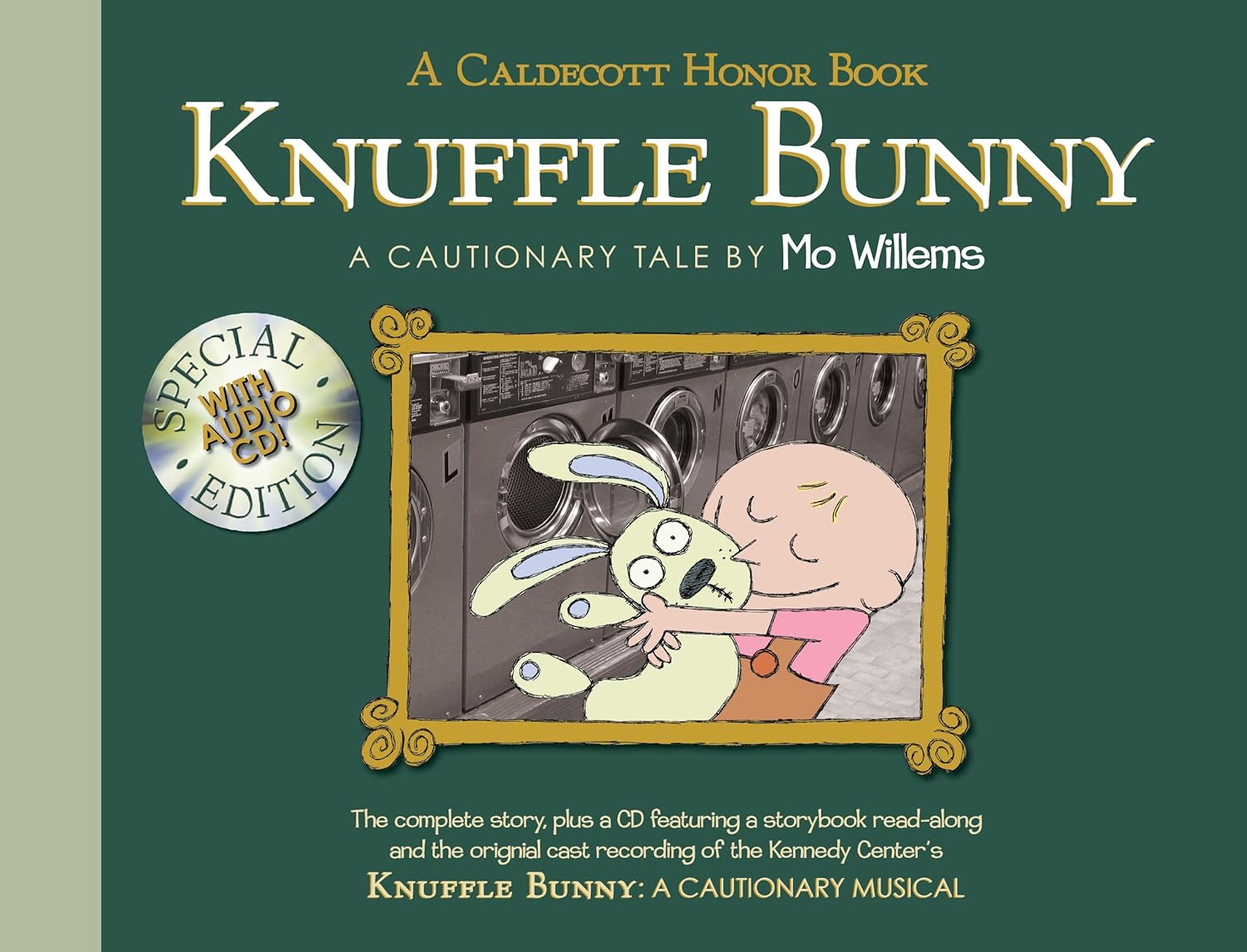
Knuffle Bunny: A Cautionary Tale, written and illustrated by Mo Willems, is a 40-page picture book about a toddler named Trixie who goes to the laundromat with her daddy, accidentally leaves her beloved stuffed rabbit behind, and cannot make her father understand what she has lost — because she does not yet have words. Funny, urgent, and visually unlike anything else in the picture book world, it blends cartoon characters drawn over black-and-white photographs of real Brooklyn streets into something that is simultaneously grounded and absurd. It won the 2005 Caldecott Honor, inspired an animated short, a touring musical, and two sequels, and has been making toddlers and their parents laugh at the same time ever since. This guide covers Knuffle Bunny‘s reading level, whether it’s a read-aloud or independent read, what it’s about, its themes, how long it takes to read, and similar books — designed for parents and teachers of K–2 readers.
For Parents
A pitch-perfect picture book about losing a beloved toy — told from the perspective of a toddler who cannot yet speak, making her frustration both heartbreaking and hilarious. Best as a read-aloud for ages 2–5, with independent reading appropriate for strong kindergarten readers. No content concerns whatsoever. The book that launched Mo Willems’s picture book career.
For Teachers
A classroom staple for PreK–K — used to discuss communication, feelings, and what happens when others don’t understand us. The mixed-media illustration technique (cartoon characters on real photographs) makes it excellent for art and illustration discussions. Pairs naturally with Mo Willems’s other works, particularly the Elephant & Piggie series and Don’t Let the Pigeon Drive the Bus!
Knuffle Bunny at a Glance
Find on Amazon →| Author & Illustrator | Mo Willems (author & illustrator) |
| Published | 2004 (Hyperion Books for Children) |
| Grade Level | PreK–K read-aloud; K independent (our assessment) |
| Recommended Age | Read-aloud ages 2–5; independent reading ages 5–6 |
| Best For | Read-aloud ages 2–5; independent reading ages 5–6 |
| Lexile | 120L |
| AR Level | 1.6 |
| Word Count | 211 |
| Pages | 40 |
| Genre | Picture book / realistic fiction / humor |
| Awards | Caldecott Honor (2005) |
For official Lexile and AR levels, visit Lexile.com or AR BookFinder. ReadingVine provides independent editorial assessments.
What Reading Level Is Knuffle Bunny?
Knuffle Bunny has a Lexile of 120L and an AR level of 1.6. At 211 words across 40 pages, the text is very brief — the illustrations carry the majority of the story, with the words serving as captions and anchors. The Lexile of 120L is low by formula standards, but this book is not primarily about decoding text. It is about reading illustrations, noticing what characters’ faces and bodies communicate, and understanding a story that unfolds across the whole double-page spread rather than in the words alone.
The AR level of 1.6 (mid-first grade) reflects that a strong independent reader in K–1 can work through the text with ease. That said, this book is best experienced as a read-aloud first and an independent read second — not because the words are hard, but because much of what makes it wonderful (Trixie going “boneless” in the street, her face moving from delight to devastation, the way the photographs of real Brooklyn streets ground the cartoon chaos) rewards the shared attention of reading together. For official Lexile and AR scores, visit Lexile.com or AR BookFinder. ReadingVine’s assessments are independent editorial judgments.
Is Knuffle Bunny a Read-Aloud or Independent Read?
This is primarily a read-aloud for ages 2–5 and an independent read for ages 5–6.
As a read-aloud, Knuffle Bunny is close to perfect. The text is short enough to hold any toddler’s attention, the rhythm builds naturally toward Trixie’s breakdown, and the moment when she finally says “Knuffle Bunny!” — her very first words — lands with the kind of joy that makes children want to hear it again immediately. Willems writes Trixie’s pre-verbal attempts to communicate (she goes “boneless,” she “went kinda crazy,” she says “Aggle flaggle klabble!”) in a way that both children and parents recognize instantly and completely. The humor works simultaneously for a two-year-old who gets the slapstick and for a parent who has experienced exactly this kind of communication breakdown.
For independent reading, a strong kindergartner or early first-grader can read the text independently. The words themselves are entirely accessible; the visual reading — noticing where Knuffle Bunny disappears into the laundry, tracking Trixie’s facial expressions, finding the Pigeon cameo hidden in the illustrations — is the real literacy work this book builds.
On the first reading, let your child do the sound effects — Trixie’s “Aggle flaggle klabble!” is meant to be yelled, not read quietly. On the second reading, look together for where Knuffle Bunny disappears into the washing machine. And on any reading, pause at the final page and ask: why do you think those were Trixie’s first words?
What Is Knuffle Bunny About?
Trixie and her daddy walk to the laundromat in their Park Slope, Brooklyn neighborhood — past the park, past the school, down into the basement. Trixie helps load the washing machine. The family walks home. Somewhere between the laundromat and the front door, Trixie realizes: Knuffle Bunny is gone. She tries to tell Daddy. She does not yet have words. She goes “boneless” on the sidewalk. She waves her arms. She says “Aggle flaggle klabble!” Daddy thinks she is being a toddler. He carries her home. When they arrive, Mommy looks at Trixie, looks at Daddy, and says: “Where’s Knuffle Bunny?” The family runs back. Daddy goes through the wet laundry until he finds the toy, sopping wet, and hands it to Trixie. And those were the first words Trixie ever said: “Knuffle Bunny!”
The story is based on a real incident from Willems’s life with his daughter Trixie, and the illustrations are built from actual photographs of the Park Slope neighborhood where they lived — making the book simultaneously autobiography, comedy, and neighborhood portrait.
Knuffle Bunny Characters
Trixie is a toddler with enormous feelings and no vocabulary to express them — the book’s most universally recognized figure, because every adult reading it has been in Daddy’s position and every child has been in Trixie’s. Daddy is well-meaning, loving, and completely unable to understand what his daughter is trying to tell him — not because he doesn’t care but because she genuinely cannot say it yet. Mommy, who appears only at home, demonstrates the specific perceptive power of a parent who knows exactly what is wrong the moment she sees her child’s face. And Knuffle Bunny — the stuffed rabbit — is the book’s fourth character: visible in every spread if you look carefully, tumbling unnoticed into the washing machine in the scene that sets everything in motion.
Knuffle Bunny Themes and Lessons
Knuffle Bunny is fundamentally about the gap between what you feel and what you can say — and about what happens when that gap is filled. Trixie’s experience is universal: she knows exactly what has happened and what she needs, and she cannot make the most important person in her world understand it. Her frustration is depicted with total seriousness and total comedy simultaneously; Willems never condescends to her or finds her ridiculous. She is right and she cannot be heard, and that is both hilarious and exactly fair.
The ending — Knuffle Bunny’s return coinciding with Trixie’s first words — connects the beloved object to language acquisition in a way that feels inevitable in retrospect. She needed those words. She needed them for exactly this. Children who have experienced the joy of suddenly being understood, or adults who remember it, will feel the rightness of this deeply.
Talking with your child: Have you ever tried to tell someone something and they didn’t understand? How did that feel? What do you think Trixie was trying to say? What is your favorite thing you would never want to leave behind?
How Long Is Knuffle Bunny?
Knuffle Bunny is 40 pages with 211 words — making it one of the shortest texts in this catalog, half the word count of even the briefest picture books. Most adults can read it aloud in about five minutes. It rewards multiple readings: the first time children follow the story; on subsequent readings they find Knuffle Bunny hidden in each illustration, notice the details in the real neighborhood photographs, and eventually spot the Pigeon cameo Willems hid as a nod to his other series. The trilogy — Knuffle Bunny Too: A Case of Mistaken Identity (2007) and Knuffle Bunny Free: An Unexpected Diversion (2010) — continues Trixie’s story as she grows; the final book features a letter from Willems to his real daughter, who was in college when it was published.
Books Similar to Knuffle Bunny
About Mo Willems
Mo Willems was born in 1968 and grew up in New Orleans. He studied at New York University’s Tisch School of the Arts and spent nine years writing for and directing segments on Sesame Street, where he won six Emmy Awards. He began publishing picture books in 2003 with Don’t Let the Pigeon Drive the Bus! — which won the first of his three Caldecott Honors. Knuffle Bunny was inspired by a real incident with his daughter Trixie: they went to the laundromat in their Park Slope neighborhood, left Trixie’s stuffed rabbit behind, and Trixie — who was not yet speaking — could not make him understand what was wrong. He made the book as a gift to her and as an act of witness to an experience he recognized as universal. The black-and-white photographs in the illustrations are real photographs of the Park Slope streets where the family lived; Willems drew the cartoon characters directly over the photographs.
The Knuffle Bunny trilogy concluded in 2010 with Knuffle Bunny Free, in which Trixie — now old enough to travel to Holland to visit her grandparents — leaves Knuffle Bunny on the plane and, for the first time, decides she doesn’t need to go back for it. The epilogue of that final book is a letter from Willems to his real daughter Trixie, who was in college when he wrote it, telling her he hoped she would always find her way home. It is one of the most quietly beautiful endings in picture book history. Willems has gone on to create the beloved Elephant & Piggie early reader series, the City of Light, City of Dark graphic novel, and dozens of other titles. He lives in Massachusetts and served as the first Education Artist-in-Residence at the Kennedy Center in Washington, D.C.
Knuffle Bunny: Frequently Asked Questions
What reading level is Knuffle Bunny?
Knuffle Bunny has a Lexile of 120L and an AR level of 1.6. At 211 words, the text is very brief; the illustrations carry most of the story. Our assessment: read-aloud for ages 2–5, independent reading for strong readers ages 5–6. For official Lexile and AR scores, visit Lexile.com or AR BookFinder.
Can a kindergartner read Knuffle Bunny alone?
A strong kindergartner — comfortable with basic sight words and simple sentences — can read the text independently. At 211 words, it is one of the most accessible texts in terms of length. The real reading challenge and pleasure is in the illustrations, not the words.
How long does it take to read Knuffle Bunny aloud?
About five minutes for a straight read-aloud. With time to look at illustrations, find Knuffle Bunny on each page, and let children respond to Trixie’s facial expressions, plan for closer to ten minutes — which is exactly the right length for a toddler or preschooler’s attention span.
What does “Knuffle” mean?
“Knuffle” comes from Dutch — it means to cuddle or hug, and is pronounced k-NUFFLE (not “NUFFLE”). Willems lived in Amsterdam for a time and used the Dutch word for the book. The title is both a description of what the bunny is — a thing to cuddle — and a gentle tongue-in-cheek reference that rewards parents who look it up.
Are there sequels to Knuffle Bunny?
Yes — two. Knuffle Bunny Too: A Case of Mistaken Identity (2007) follows Trixie on her first day of school, where she discovers another child has the exact same bunny. Knuffle Bunny Free: An Unexpected Diversion (2010) completes the trilogy with Trixie old enough to let Knuffle Bunny go. The final book ends with a real letter from Willems to his daughter Trixie, who was in college when it was published.
Is Knuffle Bunny based on a true story?
Yes — Willems based it on a real laundromat trip with his real daughter Trixie in their Park Slope, Brooklyn neighborhood. The black-and-white photographs in the illustrations are actual photos of the streets where they lived. The audio version of the book was narrated by Mo, his wife Cheryl, and Trixie Willems herself and won the 2007 Audie Award for Children’s Titles.