
 = Partner Site
Elephant & Piggie (We Are in a Book!) Reading Level: A Complete Guide
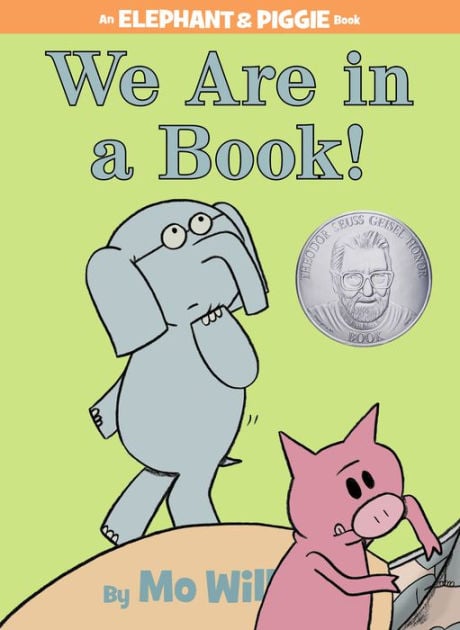
Elephant & Piggie (We Are in a Book!) by Mo Willems is one of the most inventive entries in the beloved Elephant & Piggie series — a funny, self-aware story in which Gerald the elephant and Piggie discover they are characters in a book, and that a reader is looking at them right now. This guide covers the reading level, recommended age, read-aloud vs. independent reading guidance, themes, and everything parents and teachers need to know about sharing this modern classic with young readers.
For Parents
Find out whether Elephant & Piggie works best as a read-aloud or independent read for your child, what age range it suits, and why the Elephant & Piggie series has become the defining early reader of the past two decades.
For Teachers
Grade-level data, read-aloud timing, key themes, and discussion questions for a Theodor Seuss Geisel Medal winner. Exceptional for lessons on dialogue, character voice, reader-response, and the concept of an author’s relationship with their audience.
Elephant & Piggie (We Are in a Book!) at a Glance
Find on Amazon →| Author & Illustrator | Mo Willems |
| Published | 2010 |
| Grade Level | K–1 (our assessment) |
| Recommended Age | 4–7 |
| Best For | Read-aloud ages 4–7; independent reading ages 5–7 |
| Flesch-Kincaid Grade | 1.6 |
| Word Count | ~250 |
| Pages | 64 |
| Genre | Early reader / fiction |
| Setting | The pages of the book itself |
| Awards | Theodor Seuss Geisel Medal (2011) |
For official Lexile and AR levels, visit Lexile.com or AR BookFinder. ReadingVine provides independent editorial assessments.
What Reading Level Is Elephant & Piggie (We Are in a Book!)?
Elephant & Piggie (We Are in a Book!) is a K–1 reading level by our editorial assessment, with a Flesch-Kincaid grade level of approximately 1.6. At around 250 words spread across 64 pages, it has a very low word-per-page ratio — the text is almost entirely dialogue, presented in speech bubbles, with most of the emotional and comedic information conveyed through Willems’ expressive character illustrations. The individual words are simple, but the book’s structure is more sophisticated than its Flesch-Kincaid score suggests: the concept of a book being aware of its own reader is a genuinely complex literary idea, introduced here with such lightness that most children grasp it immediately and find it delightful.
The Elephant & Piggie series as a whole won the Theodor Seuss Geisel Medal, awarded to the most distinguished American book for beginning readers published in a given year, which reflects how successfully the books meet beginning readers where they are. Elephant & Piggie won the medal in 2011 specifically for this title, recognizing it as the standout entry in a series that is already recognized as exceptional. The speech bubble format means children learn to read dialogue in its most natural form — without dialogue tags — which builds a skill they will use for the rest of their reading lives.
For parents who use specific reading level systems: we recommend checking your child’s level on Lexile.com or AR BookFinder for official scores, or asking your child’s teacher for their Guided Reading or DRA level.
Is Elephant & Piggie a Read-Aloud or Independent Read?
Elephant & Piggie works brilliantly as both a read-aloud for ages 4–7 and an independent read for ages 5–7, and it is one of the most participatory read-alouds at this level. The dialogue format and the book’s direct address to the reader — Gerald and Piggie know you are there and keep looking at you — makes children feel like active participants in the story rather than passive listeners. Most adults can read the whole book aloud in about 8–12 minutes, though a participatory reading almost always runs longer.
As a read-aloud, the two-character dialogue format is almost irresistibly suited to being read by two people. Gerald and Piggie have completely distinct voices — Gerald is anxious, verbose, and prone to overreaction; Piggie is cheerful, brief, and irrepressibly pleased with herself — and reading them in character is one of the great easy read-aloud performances. The book’s central joke — that Gerald and Piggie can make the reader say “BANANA!” by pointing to the word on the page — gives children a moment of genuine agency inside a story, which they find thrilling in a way that is hard to explain and easy to observe. Most children, when Gerald and Piggie point to the word “BANANA,” say it without being asked.
For independent reading, the speech bubble format means children do not have to track dialogue tags — they simply follow the bubbles, which are always clearly assigned to Gerald or Piggie by their shape, color, and position. This makes Elephant & Piggie unusually accessible for early readers who are building reading fluency, because the visual format removes one layer of decoding complexity while the expressive illustrations carry the emotional content of each exchange. A child who has learned the names Gerald and Piggie can follow the conversation independently from very early in their reading development.
There is nothing in this book that requires parental preparation. The emotional climax — Gerald’s distress that the book will end — is handled with such lightness and such a good joke that children find it funny rather than sad. The ending is exactly right.
Divide the characters between you and your child — you take Gerald, your child takes Piggie, or vice versa. Gerald has more words and more anxiety; Piggie has fewer words and more confidence. After one reading, switch. Children who take turns playing both characters are getting an intuitive lesson in how the same story feels different depending on whose perspective you inhabit — one of the most important things a reader can learn.
What Is Elephant & Piggie (We Are in a Book!) About?
Piggie notices something — something is watching them. She investigates. She looks at the reader. She discovers, with enormous excitement, that she and Gerald are in a book, and that someone is reading it right now. Gerald is skeptical, then alarmed, then delighted. Piggie shows him they can make the reader say things: she points to the word “BANANA” on the page, and — as you just proved — it works. Gerald is thrilled. They experiment with their power over the reader. They laugh. They have a wonderful time.
Then Gerald notices the page numbers. The book is almost over. When the book ends, will they still exist? Will the reader go away? Gerald begins to panic. Piggie has an answer, characteristically practical and characteristically perfect: the reader can read the book again. Gerald is consoled. The book ends — but the reader can start again from the beginning, which means Piggie was right all along. It is a funny, warm, quietly philosophical little book about stories and readers and the relationship between them, and it works on every level it is aimed at simultaneously.
Elephant & Piggie Characters
Elephant & Piggie Themes and Lessons
The central theme of Elephant & Piggie (We Are in a Book!) is the relationship between a story and its reader — made visible, playful, and immediate in a way that no picture book or early reader had done quite so directly before. Gerald and Piggie do not just exist in a book; they know they exist in a book, they know you are reading it, and they are delighted by this. The book turns the normally invisible relationship between reader and text into the subject of the story, which gives children a genuine and accessible introduction to what literary critics call metafiction — a story that is aware of itself as a story. Willems does this with such lightness that children simply experience it as funny and surprising, which is the best possible way to introduce a complex idea.
The book is also, more simply, about the friendship between Gerald and Piggie — specifically the way their different temperaments fit together. Gerald worries; Piggie solves. Gerald overreacts; Piggie stays cheerful. Gerald needs reassurance; Piggie provides it. This dynamic, repeated across all 25 books in the series, gives children a model of friendship that is not about sameness but about complementarity — the ways two very different people can take care of each other. Children who recognize themselves in Gerald are reassured by Piggie; children who recognize themselves in Piggie are validated by Gerald’s need for them.
For teachers, Elephant & Piggie is one of the most teachable texts in the K–2 library for reader-response and author’s craft conversations. The book makes the reader’s role explicit, which opens the door to conversations about what readers bring to a text, what authors do to create that experience, and what the relationship between them actually is. These are sophisticated literary concepts that Willems makes accessible to kindergartners through humor and directness.
Discussion starters for families: How did Gerald and Piggie know you were reading the book? Why did it make Gerald worried that the book was almost over? Was Piggie right that you could read the book again? What would you say to Gerald and Piggie if they could hear you? Do you think all books have characters who know someone is reading them?
How Long Is Elephant & Piggie (We Are in a Book!)?
Elephant & Piggie has 64 pages and approximately 250 words — the pages are generously sized with large illustrations and speech bubbles, so the page count is higher than the word count suggests. Most adults can read it aloud in about 8–12 minutes, though a participatory reading that pauses for the “BANANA” moment and for children’s reactions to Gerald’s panic typically runs longer.
A child reading independently at a kindergarten or early first-grade level will typically finish in about 10–15 minutes. Many children read it more than once in a sitting, particularly once they have discovered that they can make Piggie’s trick work every time by saying “BANANA” when she points to it.
Books Similar to Elephant & Piggie (We Are in a Book!)
If your child loves Elephant & Piggie, these titles share its humor, its dialogue-driven format, or its portrait of a friendship built on complete mutual devotion:
About the Author and Illustrator
Mo Willems is an American author and illustrator who is widely considered the most important figure in early reader and picture book publishing of the past two decades. Before writing children’s books, he worked as a writer and animator on Sesame Street, where he won six Emmy Awards, and that background in character-driven, dialogue-based comedy is visible on every page of the Elephant & Piggie series. He is the author-illustrator of the Pigeon series (beginning with Don’t Let the Pigeon Drive the Bus!, 2003), the Knuffle Bunny trilogy, the Cat the Cat series, and the 25-book Elephant & Piggie series. The Elephant & Piggie series won the Theodor Seuss Geisel Medal three times — an almost unparalleled achievement for a single series — and individual titles have received additional Geisel Honors. Willems has said that the Elephant & Piggie books were written to give beginning readers the experience of reading with complete comprehension and genuine pleasure, rather than the labored decoding experience that early reading can sometimes feel like. That goal is evident in every book in the series, and in Elephant & Piggie (We Are in a Book!) particularly, where the reader is not just an audience but a participant in the story. Willems served as the Education Artist in Residence at the Kennedy Center from 2019 to 2021.
Elephant & Piggie (We Are in a Book!): Frequently Asked Questions
What reading level is Elephant & Piggie (We Are in a Book!)?
Elephant & Piggie (We Are in a Book!) is a K–1 reading level by our editorial assessment, with a Flesch-Kincaid grade level of approximately 1.6. The text is almost entirely dialogue in speech bubbles, with simple vocabulary and short exchanges. It works best as a read-aloud for ages 4–7 and as an independent read for ages 5–7. For official Lexile and AR levels, visit Lexile.com or AR BookFinder.
What age is Elephant & Piggie for?
Elephant & Piggie is appropriate for ages 4–7. As a read-aloud it works beautifully from age 4 — the humor and the direct address to the reader land immediately, and the “BANANA” moment works on children of almost any age. As an independent read it suits children from late kindergarten through first grade. It is one of those books that children reread immediately after finishing.
Can a kindergartner read Elephant & Piggie alone?
Many kindergartners can read Elephant & Piggie independently, particularly in the second half of kindergarten. The speech bubble format removes the need to track dialogue tags, the vocabulary is simple, and the expressive illustrations carry a great deal of the story’s emotional content. A child who knows the names Gerald and Piggie and can decode simple sentences can follow the whole book. It is one of the most accessible early readers in terms of both format and content.
How long does it take to read Elephant & Piggie aloud?
Most adults can read Elephant & Piggie aloud in about 8–12 minutes. A participatory reading that pauses for the “BANANA” moment, for children’s reactions to Gerald’s discoveries, and for the emotional beats near the end typically runs 12–15 minutes. It is one of those books where the reading experience is genuinely different every time because children bring so much of themselves to it.
What is Elephant & Piggie (We Are in a Book!) about?
Elephant & Piggie (We Are in a Book!) is about Gerald the elephant and Piggie the pig discovering that they are characters in a book and that a reader — you — is reading it right now. They discover they can make the reader say “BANANA!” They have a wonderful time. Then Gerald notices the page numbers and panics that the book will end. Piggie points out that the reader can simply read it again. Gerald is consoled. It is a funny, warm, quietly philosophical book about stories, readers, and the friendship between two very different friends who take care of each other.
Are there other books in the Elephant & Piggie series?
Yes — Mo Willems wrote 25 Elephant & Piggie books between 2007 and 2016, all featuring Gerald and Piggie in different situations and all built on the same dialogue-driven, speech bubble format. The series as a whole won the Theodor Seuss Geisel Medal three times, with individual titles receiving additional honors. All books in the series are appropriate for the same age and reading level range. An extension series, Elephant & Piggie Like Reading!, pairs the characters with books written by other authors and is a good next step for children who have finished the original series.