
 = Partner Site
The Wednesday Wars Reading Level: A Complete Guide
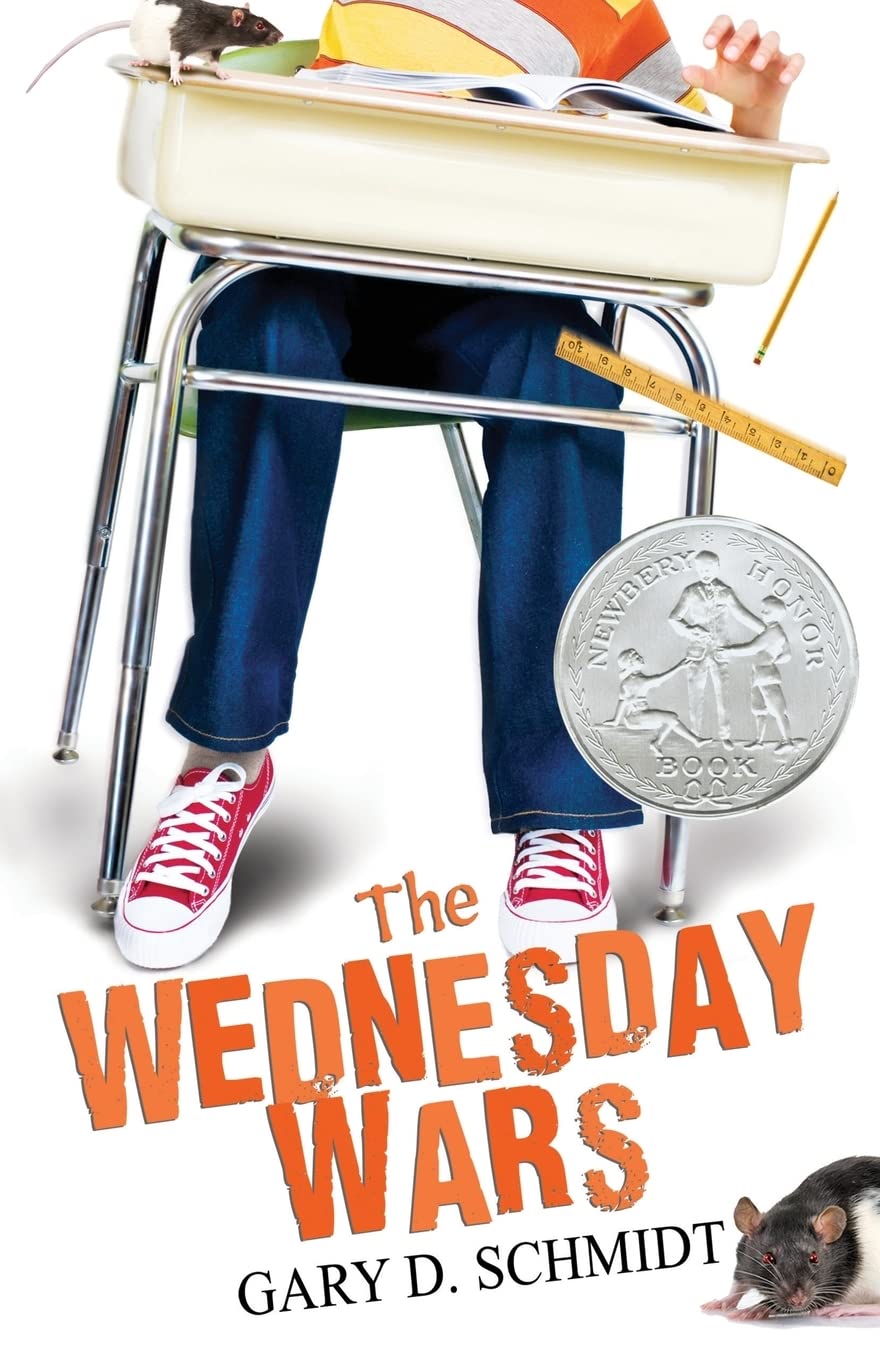
The Wednesday Wars, written by Gary D. Schmidt, is a 264-page coming-of-age novel set during the 1967–68 school year on Long Island, New York. Seventh-grader Holling Hoodhood is the only Presbyterian at Camillo Junior High, which means every Wednesday afternoon when his Catholic and Jewish classmates leave for religious instruction, Holling stays behind with Mrs. Baker — his English teacher, who he is absolutely certain hates his guts. Mrs. Baker assigns him Shakespeare. He reads it. Things happen: cream puffs, rats, yellow tights with feathers, a baseball hero who turns out to be terrible, a father who cares more about his architecture firm’s image than about his children, a sister who wants to run away to California, and Vietnam, which is taking people from the town and sending back telegrams. A Newbery Honor winner in 2008, it received starred reviews from Publishers Weekly, Kirkus, Booklist, Horn Book, and School Library Journal. A sequel, Okay for Now (2011), follows a side character from this novel. This guide covers reading level, age appropriateness, content, themes, and similar books — kept concise.
For Parents
A warm, funny, deeply satisfying coming-of-age novel about a seventh-grader reading Shakespeare with a teacher he’s convinced hates him, against the backdrop of 1967 and Vietnam. Ages 11–14, grades 6–8. Mild content: the Vietnam War is present and real throughout, and some characters are lost to it. Language is mostly Shakespearean when it appears. One of the best middle-grade novels of the past two decades.
For Teachers
A grades 6–8 classroom standard — structurally excellent for studying character development, unreliable narration, and how a novel builds meaning through recurring motifs (Shakespeare, the yellow tights, the Wednesday afternoons). Pairs productively with any Shakespeare unit. The 1967–68 historical context makes it a natural companion for Vietnam-era history. Schmidt is a professor of English; the Shakespeare integration is genuine and teachable.
The Wednesday Wars at a Glance
Find on Amazon →| Author | Gary D. Schmidt |
| Published | 2007 (Clarion Books / Houghton Mifflin) |
| Grade Level | 6–8 (our assessment) |
| Recommended Age | 11–14 |
| Lexile | 990L |
| ATOS Level | 5.9 |
| Guided Reading Level | X |
| Word Count | 74,058 |
| Pages | 264 |
| Genre | Historical fiction / coming-of-age |
| Setting | Long Island, New York; 1967–68 |
| Awards | Newbery Honor (2008); starred reviews from PW, Kirkus, Booklist, Horn Book, SLJ |
For official Lexile and AR levels, visit Lexile.com or AR BookFinder. ReadingVine provides independent editorial assessments.
What Reading Level Is The Wednesday Wars?
Lexile 990L, ATOS 5.9, Guided Reading Level X — consistent with a grades 6–8 placement. The prose is sophisticated but not dense: Schmidt writes with comic precision that makes 264 pages move quickly. The Shakespeare quotations embedded in the text are genuine and occasionally require patience from younger readers, but the novel never becomes an English class exercise; the jokes are too good for that. Our assessment: grades 6–8, ages 11–14. Strong sixth-graders can handle it; eighth-graders who haven’t read it are missing something. For official scores, visit Lexile.com or AR BookFinder.
What Age Is The Wednesday Wars Appropriate For?
Ages 11–14, grades 6–8. The Vietnam War is a sustained presence throughout the novel — characters are drafted, telegrams arrive, the war’s moral weight is part of Holling’s school year. This is handled with maturity appropriate to the recommended age range rather than with graphic content. There is some language when Schmidt quotes Shakespeare directly. No other content concerns.
What Is The Wednesday Wars About?
It is September 1967. Holling Hoodhood is starting seventh grade at Camillo Junior High on Long Island, and he is the only Presbyterian in his class. Every Wednesday afternoon, the Jewish students go to Hebrew school and the Catholic students go to catechism. Holling stays with Mrs. Baker. He is certain she hates him — why else would she make him clean the chalkboard erasers, tend the classroom rats, and read Shakespeare on his own time?
The book is structured as a school year, one chapter per month from September through June. Across those months: Holling reads The Tempest, The Merchant of Venice, Romeo and Juliet, Hamlet, and others, and discovers — gradually, genuinely — that Shakespeare has something to say about his actual life. He is required to perform in a school play in yellow tights decorated with feathers; Doug Swieteck’s brother photographs the performance; the photo circulates. He discovers that a baseball hero he worships is not what he appeared. His sister, Heather, announces she is going to San Francisco to join the counterculture. His father, whose architecture firm is named Hoodhood and Associates and whose greatest concern is the firm’s image, fails his children in slow, steady, specific ways. And Vietnam takes people from town — teachers, brothers, young men who were in this same school not long ago.
Mrs. Baker, who Holling is wrong about from the beginning, turns out to be the most important person in his seventh-grade year. Schmidt earns this revelation completely.
Shakespeare in The Wednesday Wars
The Shakespeare Holling reads is not incidental. Schmidt — who is a professor of English at Calvin University — builds each play into the novel’s structure deliberately: The Merchant of Venice‘s “quality of mercy” speech arrives when Holling most needs it; The Tempest‘s Caliban mirrors Holling’s own anger; Hamlet‘s uncertainty about action and consequence is the novel’s historical backdrop given literary form. Holling’s comment to Mrs. Baker — “There is a part of us that can be so awful. And Shakespeare shows it to us in Caliban. But there’s another part of us, too — a part that uses defeat to grow” — is the book’s most direct statement of what reading Shakespeare actually does.
For classroom use, the Shakespeare integration is genuinely teachable rather than decorative. Each play Holling reads can be paired with the chapter in which it appears for a productive discussion of how Schmidt uses the plays. Students do not need to have read Shakespeare beforehand; the novel provides enough context, and the encounters work better when they’re surprising.
The Wednesday Wars Themes and Lessons
The novel’s deepest argument is about identity under pressure. Holling is expected to become Hoodhood and Associates — his father’s image, his father’s successor, the face his father presents to the world. Every Wednesday afternoon in Mrs. Baker’s classroom is a counterargument: a space where what Holling thinks and feels actually matters, where the question of who he is has an answer that isn’t his father’s answer. The Vietnam War is the historical pressure that makes this personal conflict urgent rather than merely adolescent: the world is violent and random, people don’t always come back, and the question of what you stand for has stakes.
Schmidt handles comedy and grief in the same chapter without either undermining the other, which is a genuinely difficult thing to do. The yellow tights are funny. The telegrams are not. Both are real.
Discussion questions: Why does Holling keep reading Shakespeare even when he’s certain Mrs. Baker assigned it out of hatred? What does Holling’s father want him to be — and how does Holling resist? Which Shakespeare play connects most directly to something that happens in the chapter where Holling reads it? What does Mrs. Baker understand about Holling that he doesn’t understand about himself?
How Long Is The Wednesday Wars?
264 pages, 74,058 words, structured as nine chapters (one per month, September through June). Most assigned readers complete it in one to three weeks. The sequel, Okay for Now (2011), follows Doug Swieteck — a peripheral figure in this novel — through a parallel coming-of-age in the same era. It is equally good and can be read independently.
Books Similar to The Wednesday Wars
About Gary D. Schmidt
Gary D. Schmidt is a professor of English at Calvin University in Grand Rapids, Michigan, and the author of more than fifteen novels for children and young adults. He received both a Newbery Honor and a Printz Honor for Lizzie Bright and the Buckminster Boy (2004) and a Newbery Honor for The Wednesday Wars (2008). His other major works include Okay for Now (2011), a National Book Award finalist; Orbiting Jupiter (2015); and Just Like That (2021). His academic background in English literature and his genuine love of Shakespeare are both visible in every page of The Wednesday Wars — the Shakespeare integration is not pedagogical performance but evidence of a writer who actually believes the plays can change a person.
The Wednesday Wars: Frequently Asked Questions
What reading level is The Wednesday Wars?
Lexile 990L, ATOS 5.9, Guided Reading Level X. Our assessment: grades 6–8, ages 11–14. The prose is sophisticated and comic; the Shakespeare quotations require some patience. For official scores, visit Lexile.com or AR BookFinder.
What is The Wednesday Wars about?
Seventh-grader Holling Hoodhood is the only Presbyterian at his Long Island junior high, which means every Wednesday afternoon he stays with Mrs. Baker — who he’s certain hates him — while his classmates go to religious instruction. She makes him read Shakespeare. Across the 1967–68 school year, Shakespeare turns out to matter, Mrs. Baker turns out to be the opposite of what Holling thought, his father turns out to be the opposite of what a father should be, and Vietnam is taking people from town.
Do I need to know Shakespeare to enjoy The Wednesday Wars?
No — the novel provides enough context, and the encounters with Shakespeare work better when they’re surprising. Schmidt uses the plays as a running lens on Holling’s life, not as material to be mastered. Readers who know the plays will catch more; readers who don’t will still get everything the novel needs them to get.
Is there a sequel to The Wednesday Wars?
Yes — Okay for Now (2011) follows Doug Swieteck, a peripheral character in this novel, through a parallel coming-of-age story in the same era. It is widely considered equally good and can be read independently, though readers who know The Wednesday Wars first will have additional context.
What grade is The Wednesday Wars for?
Grades 6–8, ages 11–14. Strong sixth-graders can handle it comfortably; it’s one of the best novels available for seventh and eighth grade — which is appropriate, since it’s about a seventh-grader having the best and worst year of his life so far.