
 = Partner Site
Wonder Reading Level: A Complete Guide
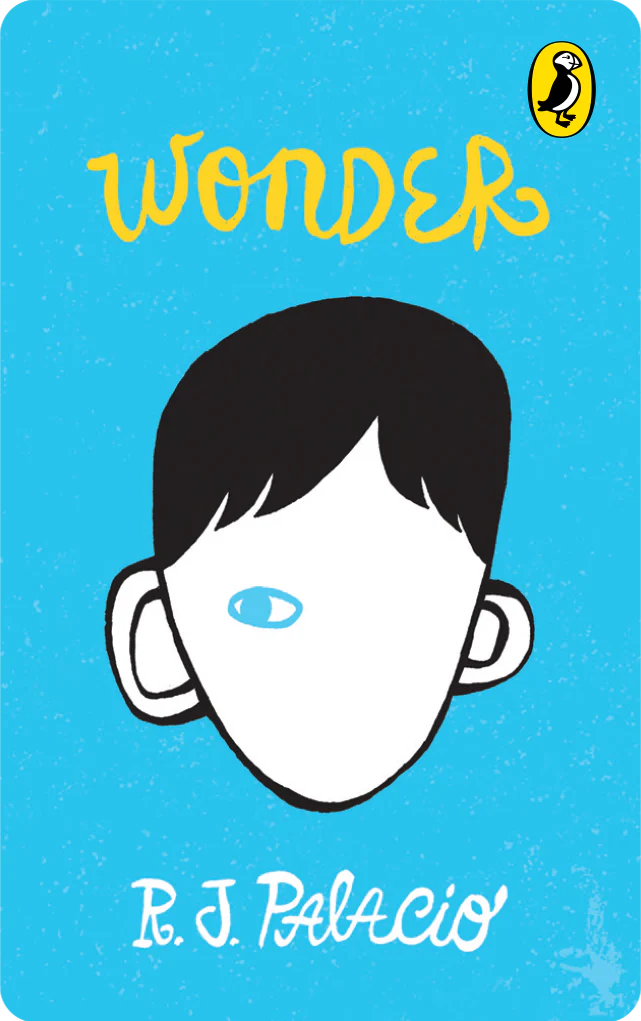
Wonder by R.J. Palacio tells the inspiring story of August Pullman, a boy with severe facial differences who attends mainstream school for the first time in fifth grade. This guide provides parents and teachers with reading level information, age recommendations, content insights, and discussion questions for this beloved modern classic about kindness, acceptance, and choosing to see beyond appearances.
For Parents
Find the right reading level for your child, understand the book’s themes around bullying and difference, and get conversation starters to help your child explore empathy, standing up for others, and what it means to be kind when kindness isn’t easy.
For Teachers
Access grade-level guidance, reading metrics, character analysis support, and thematic discussion questions perfect for classroom use. This modern classic offers rich opportunities for exploring bullying, empathy, multiple perspectives, and building inclusive communities.
Wonder at a Glance
Find on Amazon →| Author | R.J. Palacio |
| Published | 2012 |
| Grade Level | 4–6 (our assessment) |
| Recommended Age | 9–12 |
| Flesch-Kincaid Grade | 4.8 |
| Word Count | ~73,000 |
| Pages | 310 (standard hardcover) |
| Chapters | 8 parts with multiple short chapters |
| Genre | Realistic fiction / contemporary |
| Setting | New York City and suburbs (present day) |
| Awards | Multiple state awards, New York Times bestseller |
For official Lexile and AR levels, visit Lexile.com or AR BookFinder. ReadingVine provides independent editorial assessments.
What Reading Level Is Wonder?
Wonder is appropriate for grades 4–6, with a Flesch-Kincaid grade level of 4.8. The vocabulary is accessible and the sentence structure is straightforward, making it manageable for fourth graders. However, the emotional complexity—understanding bullying, navigating social dynamics, and processing the pain of exclusion—requires maturity that makes it most meaningful for fifth and sixth graders.
Palacio writes in multiple first-person voices, with different sections narrated by Auggie, his sister Via, and various friends. This structure helps readers see the same events from different perspectives and understand how everyone has their own struggles and story. The prose is contemporary and conversational, reflecting how middle schoolers actually think and speak, which makes it highly relatable for the target audience.
While the reading mechanics are accessible to fourth graders, the book resonates most deeply with readers ages 9–12 who are experiencing or about to experience middle school social dynamics. The themes of fitting in, handling bullies, being a good friend, and choosing kindness when it’s hard are especially relevant to this age group. It’s an excellent choice for readers ready to think about perspective-taking and what it means to stand up for others.
What Age Is Wonder Appropriate For?
Wonder is most appropriate for readers ages 9–12. The story deals with bullying, social exclusion, and the challenges of being different in honest but age-appropriate ways. While there are painful moments of cruelty and rejection, the overall tone is hopeful and the message is overwhelmingly positive. The book shows both the worst and best of human behavior.
Bullying and exclusion: Auggie faces mean comments, stares, whispers, and deliberate social exclusion. Kids avoid touching him, make cruel jokes, and some refuse to be his partner in class. These scenes are realistic and can be painful to read.
Physical differences: Auggie has severe facial deformities from Treacher Collins syndrome. While not described in graphic medical detail, his appearance is discussed frankly, including his differences and the surgeries he’s endured.
Friendship betrayal: Characters experience friendship breakups and the pain of being left out or talked about behind their backs. These social struggles are central to the story.
Family stress: Via feels neglected because Auggie requires so much attention. This sibling dynamic is handled honestly, showing resentment alongside love.
A death: A beloved pet dog dies (off-page), and Auggie grieves. This is handled gently but adds to the emotional weight.
What’s NOT in the book: No violence, no profanity (kids say “shut up” and similar mild phrases), no sexual content. The difficult moments come from social cruelty rather than physical danger. The book ultimately celebrates kindness, empathy, and inclusion, with a hopeful, uplifting ending.
What Is Wonder About?
Ten-year-old August “Auggie” Pullman was born with severe facial deformities due to a genetic condition. He’s had 27 surgeries to help him breathe, see, hear, and eat normally, but his face still looks very different from other kids. He’s been homeschooled by his mother his entire life, but now that he’s entering fifth grade, his parents decide it’s time for him to attend Beecher Prep, a mainstream private school in their New York City neighborhood.
Auggie is terrified. He knows people stare at him, gasp, and look away in discomfort. He’s used to wearing an astronaut helmet to hide his face and has developed a thick skin about reactions to his appearance, but middle school is a whole new challenge. His parents arrange for three students—Jack Will, Julian, and Charlotte—to give him a tour before school starts. Julian is immediately cold and makes subtle mean comments, but Jack seems friendly, and Charlotte is polite.
When school starts, Auggie faces exactly what he feared: stares, whispers, kids avoiding him, and the infamous “plague” game where touching Auggie means you need to wash your hands within 30 seconds or you’re infected. Most students keep their distance, but Jack Will genuinely befriends him, along with a girl named Summer who sits with him at lunch when no one else will. These friendships give Auggie hope that maybe he can survive fifth grade.
The story shifts perspective to include other voices. We hear from Via, Auggie’s teenage sister, who has spent her life in Auggie’s shadow. She loves her brother fiercely but also resents how much attention he requires and how her parents don’t always have energy left for her. Her best friend Miranda has suddenly started ignoring her, and Via struggles with feeling invisible in her own family while being hypervisible as “the girl with the deformed brother” at school.
Jack Will’s perspective reveals that he was initially asked by the principal to be Auggie’s friend, but he grew to genuinely like Auggie. However, when Jack overhears Julian asking why he’s friends with “that freak,” Jack punches Julian. This leads to a falling out when Auggie overhears Jack saying something hurtful about him—Jack was actually defending Auggie, but Auggie only hears part of the conversation. The friendship ruptures, and Auggie is devastated.
The middle of the school year is Auggie’s lowest point. Julian orchestrates a campaign of mean notes and photo-shopped pictures, students continue the “plague” game, and Auggie feels isolated even from Jack. But slowly, things begin to shift. Jack apologizes sincerely, and their friendship is restored. Other students start seeing past Auggie’s face and recognizing his humor, intelligence, and kindness. Summer remains a steadfast friend throughout.
The climax comes during the fifth-grade nature retreat, when Auggie and Jack are attacked by older students from another school who make fun of Auggie’s face. Surprisingly, several of their classmates—including some who had previously ignored or avoided Auggie—come to their defense and fight off the bullies. This moment marks a turning point: Auggie’s classmates have chosen to see him as one of them, someone worth protecting.
At the end-of-year ceremony, Auggie receives the Henry Ward Beecher medal, the school’s highest honor, for being a student “whose quiet strength has carried up the most hearts.” The principal explains that greatness isn’t just about academic or athletic achievement—it’s about having the courage to be kind and the strength to make others want to be better. Auggie gets a standing ovation from the entire school. The book ends with Auggie reflecting that everyone should get a standing ovation at least once in their life, acknowledging that while his face will always look different, he’s proven that he belongs and that kindness wins.
Wonder Characters
Wonder Themes and Lessons
At its heart, Wonder is about choosing kindness even when it’s difficult. The book’s central precept, “When given the choice between being right and being kind, choose kind,” runs throughout the story. Auggie faces cruelty, but he also encounters extraordinary kindness from people who choose to see him rather than his face. The book teaches that kindness isn’t passive or easy—it requires courage to sit with someone everyone else avoids, to defend someone who’s being bullied, to choose friendship over social status.
The multiple-perspective structure teaches empathy in a profound way. By hearing from Via, we understand that siblings of children with special needs have their own struggles. By hearing from Jack and Summer, we see that befriending someone different takes courage but brings genuine rewards. Even hearing from Miranda helps us understand that people who seem mean often have their own pain. The book argues that everyone has their own story, and understanding others’ perspectives is essential to being kind.
Discussion questions for families:
- Auggie says he’s “ordinary” at the end. What does he mean? Has he changed, or has everyone else changed?
- Why do you think Palacio includes different characters’ perspectives instead of just Auggie’s? What do we learn from hearing other voices?
- Summer and Jack both choose to be Auggie’s friend when others won’t. What does the book teach about courage in friendship?
- The book includes many “precepts” or life lessons. Which one resonates most with you, and why?
How Many Pages and Chapters in Wonder?
Wonder has 310 pages in the standard hardcover edition and is divided into 8 parts, each told from a different character’s perspective. Within these parts are many short chapters—often just 2–4 pages each—which makes the book feel fast-paced despite its substantial length. The word count is approximately 73,000 words.
For independent readers in the target age range (9–12), the book typically takes 6–8 hours to complete, or about two weeks of reading 30 minutes per day. The short chapters and engaging story keep most readers moving quickly through the book. Many report that once they start, they have trouble putting it down because they want to know what happens next and how Auggie’s year will turn out.
As a read-aloud, Wonder takes approximately 6–7 hours total. The book works beautifully as a family or classroom read-aloud because the bullying scenes and social dynamics naturally prompt discussions about empathy, standing up for others, and how to be a good friend. Many teachers use it to launch discussions about creating inclusive classroom communities.
Books Similar to Wonder
If your child enjoyed Wonder, here are six similar books that explore themes of kindness, acceptance, and navigating social challenges:
About R.J. Palacio
R.J. Palacio (born Raquel Jaramillo in 1963) is an American author and graphic designer who worked in children’s book publishing for many years before writing her own novel. She was inspired to write Wonder after an encounter with a child who had facial differences. Palacio was at an ice cream shop with her own children when they saw a girl with severe facial deformities. Her young son started to cry in fear, and Palacio hurried her children away to avoid upsetting the girl and her family. On the way home, Palacio felt terrible about how she’d handled the situation and wished she’d used it as a teaching moment about differences and compassion. That night, she couldn’t stop thinking about the girl and what her life must be like. This led her to research Treacher Collins syndrome and other craniofacial conditions, and eventually to write Wonder. The book was published in 2012 and became an immediate bestseller, resonating with millions of readers worldwide. Wonder has won numerous state book awards and has been translated into more than 45 languages. Palacio has since written several companion books set in the Wonder universe: The Julian Chapter, Pluto, Shingaling, and Auggie & Me (which collects the first three). She also wrote a follow-up novel, White Bird, about Julian’s grandmother’s experience as a Jewish child in Nazi-occupied France. A film adaptation of Wonder was released in 2017 starring Jacob Tremblay as Auggie. Palacio continues to advocate for inclusion and kindness, and the Wonder movement has inspired countless schools to implement kindness initiatives. She lives in New York City with her family.
Wonder: Frequently Asked Questions
What condition does Auggie have in Wonder?
Auggie has a rare genetic craniofacial condition that affects the development of his face. In the book, Auggie was born with severe facial deformities including a cleft palate, missing cheekbones, and eyes positioned lower than normal. He’s had 27 surgeries to help him breathe, see, hear, and eat more normally, but his face still looks very different from other children.
Is Wonder based on a true story?
Wonder is not based on one specific true story, but it was inspired by R.J. Palacio’s real encounter with a child who had facial differences. After seeing how her own children reacted with fear and how she rushed them away to avoid an uncomfortable situation, Palacio was inspired to write a story that would help children (and adults) learn empathy and see beyond appearances. While Auggie Pullman is fictional, his experiences reflect the real challenges faced by children with craniofacial differences, and many families dealing with similar conditions have said the book accurately captures their experiences.
What grade is Auggie in during Wonder?
Auggie is in fifth grade during the events of Wonder. He’s ten years old at the beginning of the book (turning eleven during the school year), and this is his first year attending mainstream school after being homeschooled his entire life. The book follows his complete fifth-grade year at Beecher Prep, from the nervous first days of school through the end-of-year ceremony where he receives the school’s highest honor.
What is the main message of Wonder?
The main message is captured in the book’s central precept: “When given the choice between being right and being kind, choose kind.” Wonder teaches that kindness requires courage, especially when it means going against social norms or risking your own social status. The book emphasizes that everyone deserves to be treated with compassion regardless of how they look, that we should judge people by their character rather than their appearance, and that one person’s choice to be kind can inspire others and create positive change in a community. It also teaches that everyone has their own struggles and story—practicing empathy means trying to understand others’ perspectives.
Does Wonder have a happy ending?
Yes, Wonder has an uplifting, hopeful ending. By the end of fifth grade, Auggie has genuine friends who value him for who he is, his classmates have learned to see beyond his appearance, and he receives the school’s highest honor for his quiet strength and the way he’s inspired others. While the book doesn’t pretend that all of Auggie’s challenges will disappear—people will still stare, and he’ll still face difficulties—it shows that he’s found belonging and proven he can thrive in mainstream school. The ending celebrates Auggie’s triumph not because his face changed, but because he and those around him changed how they see what matters.
Is Wonder appropriate for 4th grade?
Yes, Wonder is appropriate for most fourth graders and is commonly taught in fourth, fifth, and sixth grade classrooms. The reading level is accessible to fourth grade, and the themes of kindness and acceptance are age-appropriate. However, the bullying scenes can be emotionally difficult, and some fourth graders may need support processing the social cruelty Auggie experiences. The book works well with teacher or parent guidance to facilitate discussions about empathy, standing up for others, and what to do when you witness bullying. Many schools use it as a springboard for creating more inclusive classroom communities.
Are there sequels or companion books to Wonder?
While there isn’t a direct sequel following Auggie’s story, R.J. Palacio has written several companion books set in the Wonder universe. The Julian Chapter, Pluto, and Shingaling tell the stories of Julian, Christopher, and Charlotte respectively, showing events from their perspectives. These three books are collected together in Auggie & Me. Palacio also wrote White Bird, which tells the story of Julian’s grandmother as a Jewish child hidden by a classmate’s family during the Holocaust in Nazi-occupied France. These books expand the Wonder universe while exploring similar themes of kindness, courage, and empathy from different angles.
Why do kids play the “plague” game in Wonder?
The “plague” game is a cruel game where students pretend that touching Auggie will infect them with a disease, and they have 30 seconds to wash their hands or they’re “contaminated.” Kids play this game as a form of bullying and social exclusion—it’s a way to justify avoiding Auggie and treating him as someone to fear rather than a person to know. The game represents how children sometimes create elaborate social rituals to enforce exclusion and make themselves feel powerful or part of the in-group. By the end of the book, most students have stopped playing it as they’ve gotten to know Auggie and realized how cruel it was.