
 = Partner Site
Bridge to Terabithia Reading Level: A Complete Guide
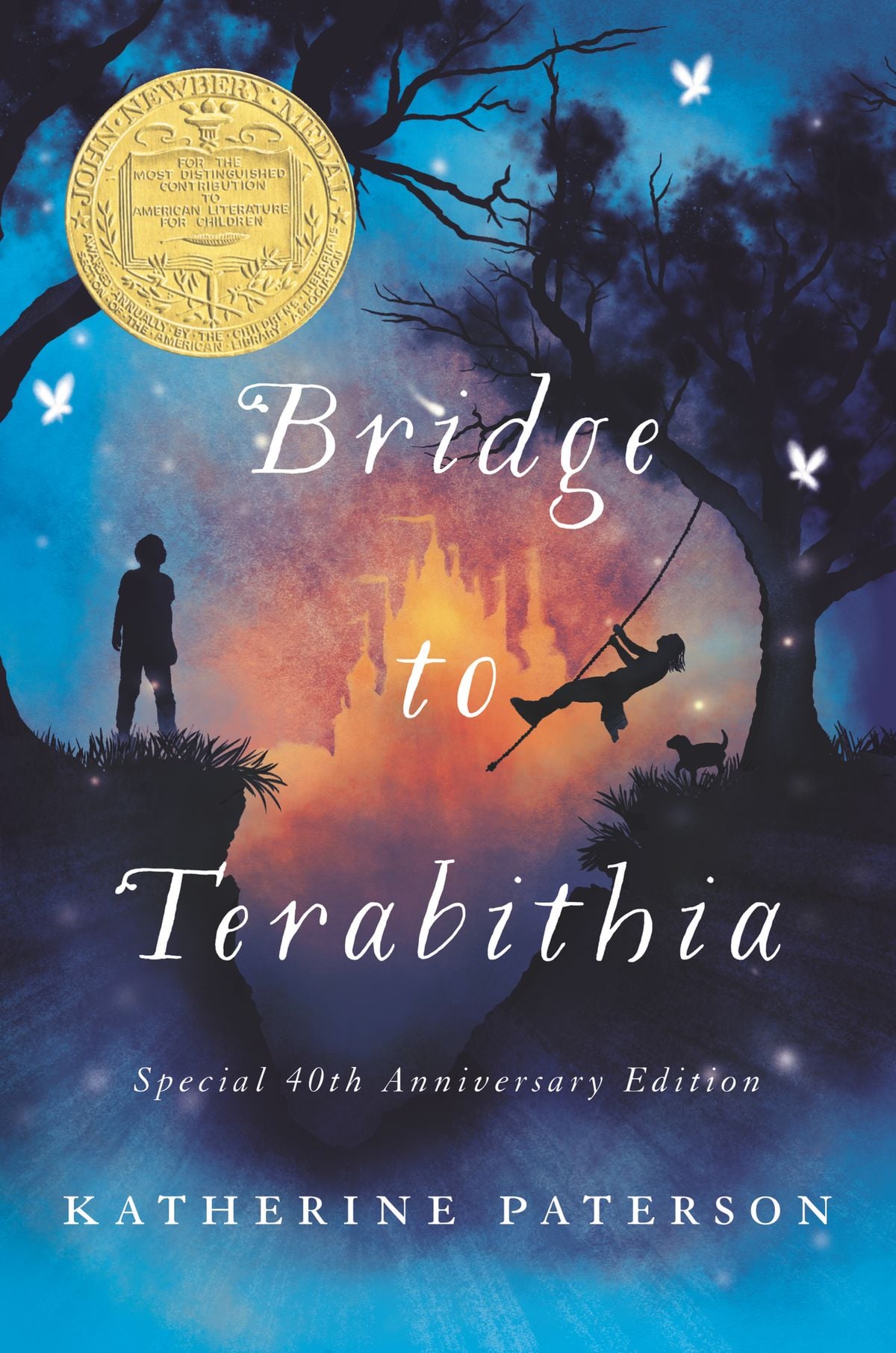
Bridge to Terabithia by Katherine Paterson is one of the most beloved and most emotionally demanding books in the middle grade canon — a novel about friendship, imagination, and grief that has been assigned in American classrooms for nearly fifty years and that continues to surprise readers who come to it expecting a straightforward adventure story. It is the story of Jess Aarons and Leslie Burke, two fifth-grade outsiders who build an imaginary kingdom in the woods behind their houses and find in each other the kind of friendship that changes who you are. This complete guide covers the reading level, age appropriateness, themes, characters, and everything parents and teachers need to know about this essential Newbery Medal novel.
For Parents
Bridge to Terabithia is assigned across grades 4 through 8, and it is one of the books parents are most likely to encounter without realizing what it contains. The novel includes the sudden, accidental death of a central character — a death that arrives without warning and that the book takes seriously, following Jess through the full weight of grief without softening or resolving it quickly. This is handled with extraordinary care and is widely considered one of the most important and most honest treatments of childhood grief in American literature. Parents should be prepared to discuss loss and death with children reading this book, and many find that the conversation the book opens is one of its greatest gifts. There is no violence, no sexual content, and mild profanity.
For Teachers
Bridge to Terabithia is an exceptional classroom text for teaching the relationship between imagination and identity, the nature of friendship across difference, and how literature handles grief honestly. Paterson’s prose is clean and accessible, and the novel’s emotional architecture — the way it builds Terabithia as a real place before testing what that world can and cannot hold — offers rich material for discussion of narrative structure, point of view, and how authors prepare readers for difficult events. It pairs naturally with units on loss, coming-of-age, and the role of creativity in children’s emotional lives. Teachers should be prepared to create space for students’ emotional responses; for many children this is the first book that makes them cry, and that experience deserves acknowledgment.
Bridge to Terabithia at a Glance
Find on Amazon →| Author | Katherine Paterson |
| Published | 1977 |
| Grade Level | 4–8 (our assessment) |
| Recommended Age | 9–14 |
| Flesch-Kincaid Grade | 4.6 |
| Word Count | ~32,000 |
| Pages | 163 (standard paperback) |
| Chapters | 13 |
| Genre | Realistic fiction / coming-of-age |
| Setting | Rural Virginia, contemporary (late 1970s) |
| Awards | Newbery Medal (1978) |
For official Lexile and AR levels, visit Lexile.com or AR BookFinder. ReadingVine provides independent editorial assessments.
What Reading Level Is Bridge to Terabithia?
Word and sentence difficulty: Bridge to Terabithia has a Flesch-Kincaid grade level of approximately 4.6. This score reflects sentence length and syllable count — Paterson writes in plain, direct prose that moves quickly, and the formula scores those qualities accurately as mid-elementary difficulty. As a measure of how hard the words and sentences are to decode, the score is reasonable. Most readers who are comfortable in third or fourth grade will find the text fluent. For official Lexile and Accelerated Reader scores, visit Lexile.com or AR BookFinder.
Thematic and literary complexity: The novel’s actual demands on a reader are almost entirely emotional and thematic rather than linguistic. Bridge to Terabithia asks its readers to sit with grief — real, unresolved, unsoftened grief — and to understand something about how imagination functions as a way of processing a world that does not always make sense. The book does not explain its themes; it enacts them. The relationship between Terabithia as an imagined place and the emotional work it does for Jess and Leslie is the novel’s deepest subject, and understanding it requires more emotional sophistication than vocabulary. This is one of the few books at this grade level where emotional readiness matters as much as reading readiness.
Typical teaching placement: Our editorial assessment is grades 4–8 for classroom use, with the book most commonly introduced in 4th or 5th grade and continuing to appear in middle school curricula through grade 8. It is a Newbery Medal winner widely included in state reading standards. Grade placement reflects both reading fluency and emotional readiness — the book is accessible to strong third-grade readers in terms of word difficulty, but most teachers and parents find it better suited to fourth grade and up, when children have more context for processing the events of the story. At the upper end of the range, middle school students engage with the novel’s themes of grief, identity, and the function of imagination at a more analytical level.
What Age Is Bridge to Terabithia Appropriate For?
We recommend Bridge to Terabithia for readers ages 9–14. The word-level difficulty is accessible to younger readers, but the emotional content — specifically the sudden death of a central character and the grief that follows — is the reason most parents and teachers aim for ages 9 and up. At that age, most children have enough emotional context to engage with the book’s subject matter in a way that is meaningful rather than simply distressing. At the upper end of the range, older middle schoolers bring additional maturity to the novel’s themes and often engage with it in a more reflective, analytical way.
The central content concern in Bridge to Terabithia is the sudden, accidental death of Leslie Burke, one of the novel’s two main characters. The death occurs without foreshadowing — this is deliberate on Paterson’s part, as it mirrors the way sudden loss actually happens — and it arrives roughly two-thirds of the way through the book. The novel then follows Jess through grief in honest, unsparing detail: shock, denial, guilt, anger, and the slow movement toward acceptance and meaning. There is no violence, no frightening imagery, and no death depicted on the page; the death occurs offscreen and is reported to Jess and the reader simultaneously. The book also touches on mild bullying, economic class differences between families, and a child’s complicated feelings about religion and what happens after death. There is no sexual content and mild profanity. The novel’s difficulty is entirely emotional.
Parents who are concerned about introducing the book should know that Katherine Paterson wrote it in direct response to the death of her son’s best friend, who was struck by lightning at age eight. The book’s treatment of grief is not gratuitous — it is the whole point, and it has helped generations of children process loss in their own lives. Many families find it becomes a conversation-opener about death and grief that they are grateful for, even if the reading experience is difficult.
What Is Bridge to Terabithia About?
Jess Aarons is a fifth-grader in rural Virginia who has spent the summer practicing to be the fastest runner in his grade. On the first day of school, he is beaten in a race by the new girl next door, Leslie Burke — and the sting of that defeat turns quickly into something else entirely. Leslie is unlike anyone Jess has met: she is confident and imaginative and unconcerned with the social rules that govern life at Lark Creek Elementary, and she sees something in Jess — his artistic ability, his inner life — that no one else has thought to notice. A friendship forms that is the most important thing in either of their lives.
Together, Jess and Leslie claim a stretch of woods on the other side of a creek as their own kingdom. They name it Terabithia, rule it together, and fill it with imagined creatures and invented stories and the specific freedom that comes from having a place that belongs entirely to you and one other person. Terabithia becomes the space where both children are fully themselves — where Jess’s artistic sensitivity is not a liability and Leslie’s unconventional confidence is not a source of ridicule. The novel moves through the school year, tracing the friendship through its joys and its small trials, building the world of Terabithia with enough care and specificity that it feels entirely real.
Then something happens that changes everything. The novel’s second half follows Jess through a grief that is as honestly rendered as any in children’s literature — and through his eventual understanding of what Terabithia means, what Leslie gave him, and what he can do with that gift. Paterson wrote the book after her son’s best friend, Lisa Hill, died after being struck by lightning in 1974. The book is her attempt to give her son — and all children — a way to understand and survive loss.
Bridge to Terabithia Characters
Is Bridge to Terabithia Banned?
Bridge to Terabithia has appeared on the American Library Association’s lists of most frequently challenged books multiple times since its publication. Challenges have come primarily from parents objecting to the book’s treatment of death, its depiction of a child dying, and its perceived inappropriateness for the elementary grades where it is most commonly assigned. Some challenges have also cited mild profanity (the book contains a small number of mild words) and what some parents describe as anti-religious content — the novel includes Jess’s complicated feelings about religion and what happens after death, which some readers have found troubling. The vast majority of challenges have not been sustained, and the book remains one of the most widely assigned titles in American elementary and middle school education, consistently included in state reading standards and on recommended reading lists. The American Library Association and the National Council of Teachers of English have consistently defended its literary and educational merit.
Bridge to Terabithia Themes and Lessons
The novel’s deepest theme is the relationship between imagination and emotional survival — the argument, enacted rather than stated, that the ability to build and inhabit an imagined world is not an escape from reality but a way of developing the capacity to face it. Terabithia is not a place where Jess and Leslie go to avoid their lives; it is where they become strong enough to live them. The kingdom they build together is the space where Jess learns that his sensitivity is a strength, that his artistic gifts matter, and that he is capable of more than his circumstances suggest. When Terabithia is tested by the novel’s central event, the question the book asks is not whether imaginary worlds are real — it is what we carry with us from the places we have loved and lost.
Friendship across difference is the novel’s second great theme. Jess and Leslie come from different worlds — different economic circumstances, different family cultures, different relationships to education and imagination — and the book is precise about those differences without making them insurmountable. What brings them together is recognition: each sees something in the other that no one else has noticed, and that mutual recognition is the foundation of a friendship that is neither sentimental nor easy. The novel’s treatment of grief is inseparable from this theme: what Jess loses when he loses Leslie is not just a friend but the version of himself she helped him become, and the work of the novel’s final chapters is the work of figuring out whether that self can survive her absence.
Discussion starters for classrooms and families: Why do Jess and Leslie become friends when so many other children keep their distance from Leslie? What does Terabithia give each of them that they cannot get anywhere else? How does Paterson prepare the reader for the novel’s central event — or does she? What does it mean that Jess builds a bridge at the end of the novel? What do you think Leslie would say about how Jess carries on after losing her?
How Many Pages and Chapters Are in Bridge to Terabithia?
The standard paperback edition of Bridge to Terabithia is 163 pages, divided into 13 chapters with an approximate word count of 32,000 words. It is a relatively short novel for its grade range, and a motivated reader in the target age group will typically finish it in two to four hours of reading time. Read aloud at a comfortable pace — as many teachers do with this book — it runs approximately four to six hours, making it well suited to a one- to two-week classroom read-aloud.
For readers in the target age range of 9–14, the book reads quickly in terms of pacing — Paterson’s chapters move efficiently and the story builds momentum — but many readers find themselves pausing, especially in the novel’s second half. The brevity of the book is part of its design: Paterson does not linger or over-explain, and the compression gives the emotional moments their force. Teachers frequently use individual chapters as the basis for close reading discussions, particularly the chapters that establish Terabithia and the chapters that follow the novel’s central loss.
Books Similar to Bridge to Terabithia
About Katherine Paterson
Katherine Paterson was born in 1932 in Qing Jiang, China, the daughter of American missionary parents, and grew up moving between China and the American South. She is the author of more than thirty books for children and young adults and is one of the most decorated writers in the history of American children’s literature, having won two Newbery Medals — for Bridge to Terabithia (1978) and Jacob Have I Loved (1981) — as well as two National Book Awards and the Hans Christian Andersen Award, the highest international recognition in children’s literature. Bridge to Terabithia was written in direct response to the death of Lisa Hill, the best friend of Paterson’s son David, who was struck by lightning at age eight. Paterson has said that she wrote the book because her son needed it — a way to grieve that honored what he had lost and gave him language for what he was feeling. The book was dedicated to David and Lisa. Paterson served as the National Ambassador for Young People’s Literature from 2010 to 2011 and has been a tireless advocate for children’s access to books and libraries throughout her career.
Bridge to Terabithia: Frequently Asked Questions
What reading level is Bridge to Terabithia?
Bridge to Terabithia has a Flesch-Kincaid grade level of approximately 4.6, which reflects the accessibility of Paterson’s plain, direct prose at the word and sentence level. As a measure of decoding difficulty, the score is accurate. As a measure of how demanding the book is to read and understand, it is not the right tool — the novel’s demands are emotional and thematic rather than linguistic, and those are not things any readability formula can capture. Our editorial assessment is grades 4–8 for classroom use. For official Lexile and AR scores, visit Lexile.com or AR BookFinder.
Does Bridge to Terabithia have a sad ending?
Yes — and parents should know this going in. The novel includes the sudden, accidental death of Leslie Burke, one of the two central characters, which occurs without warning roughly two-thirds of the way through the book. The novel then follows Jess through grief in honest, unsparing detail. The ending is not without hope — Jess builds a bridge to Terabithia for his younger sister May Belle, a gesture that suggests that what Leslie gave him survives her — but it is not a conventionally happy ending, and Paterson does not offer false comfort. The grief is real, and the book earns it.
Is Terabithia a real place?
No — Terabithia is the imaginary kingdom that Jess and Leslie create together in the woods behind their houses, reached by swinging across a creek on a rope. The name was invented by Leslie, who takes it from the fantasy worlds she has read about. Within the novel, Terabithia is presented as genuinely real in the sense that matters: it is a place that shapes the children who inhabit it, and its meaning persists long after the physical space of the woods is gone. The name Terabithia may be a nod to C.S. Lewis’s Narnia, which Leslie’s family likely reads — but Paterson has not confirmed a direct connection.
Why did Katherine Paterson write Bridge to Terabithia?
Paterson wrote the book in response to the death of Lisa Hill, the best friend of her son David, who was struck by lightning and killed in 1974 when she was eight years old. David was devastated, and Paterson found that she did not have adequate language to help him grieve. She wrote the book for him — as a way of giving his loss a form it could inhabit, a story in which a child experiences something like what he experienced and survives it. The book was published in 1977 and dedicated to David Paterson and Lisa Hill. Paterson has spoken and written extensively about the origins of the book, and it remains one of the most direct examples in American children’s literature of a book written from necessity.
What does the bridge symbolize at the end of Bridge to Terabithia?
The bridge Jess builds at the novel’s end — a proper crossing over the creek, replacing the rope swing that Leslie fell from — is the novel’s central symbol of inheritance and continuation. It is Jess’s way of bringing May Belle into Terabithia, of passing on what Leslie gave him rather than keeping it as a private shrine to his grief. The bridge is also an act of making: Jess is an artist, and building something is how he processes and honors experience. The bridge says that Terabithia continues, that what is built in imagination does not die when the person who helped build it is gone, and that the right response to loss is not to close the door but to open it wider.
Is Bridge to Terabithia appropriate for a 7- or 8-year-old?
Most parents and educators recommend waiting until age 9 or so, not because the words are too hard — a strong 7- or 8-year-old reader can decode the text fluently — but because the emotional content requires some context to process productively. The sudden death of a child character and the grief that follows are subjects that very young children may find more distressing than illuminating without adult guidance. For 8-year-olds who have experienced loss, or who are reading with a parent who can guide the conversation, the book can be deeply valuable at that age. For classroom use, most teachers find grades 4 and up the right entry point.
What grade is Bridge to Terabithia typically assigned in?
Bridge to Terabithia is most commonly assigned in grades 4 and 5, though it appears regularly through grade 8, particularly in units on grief, friendship, or Newbery Medal literature. It is included in reading standards across numerous states and is one of the most frequently assigned novels in American elementary and middle school education. Teachers typically spend one to two weeks on the book, using it as a text for both literary analysis and social-emotional discussion. At the middle school level, older students often revisit the novel with more analytical distance, exploring Paterson’s narrative structure and how she prepares — or deliberately does not prepare — the reader for the central event. The book is also a popular choice for parent-child read-alouds, particularly in families who want to have conversations about death and loss in a supported context.