
 = Partner Site
Bear Snores On Reading Level: A Complete Guide
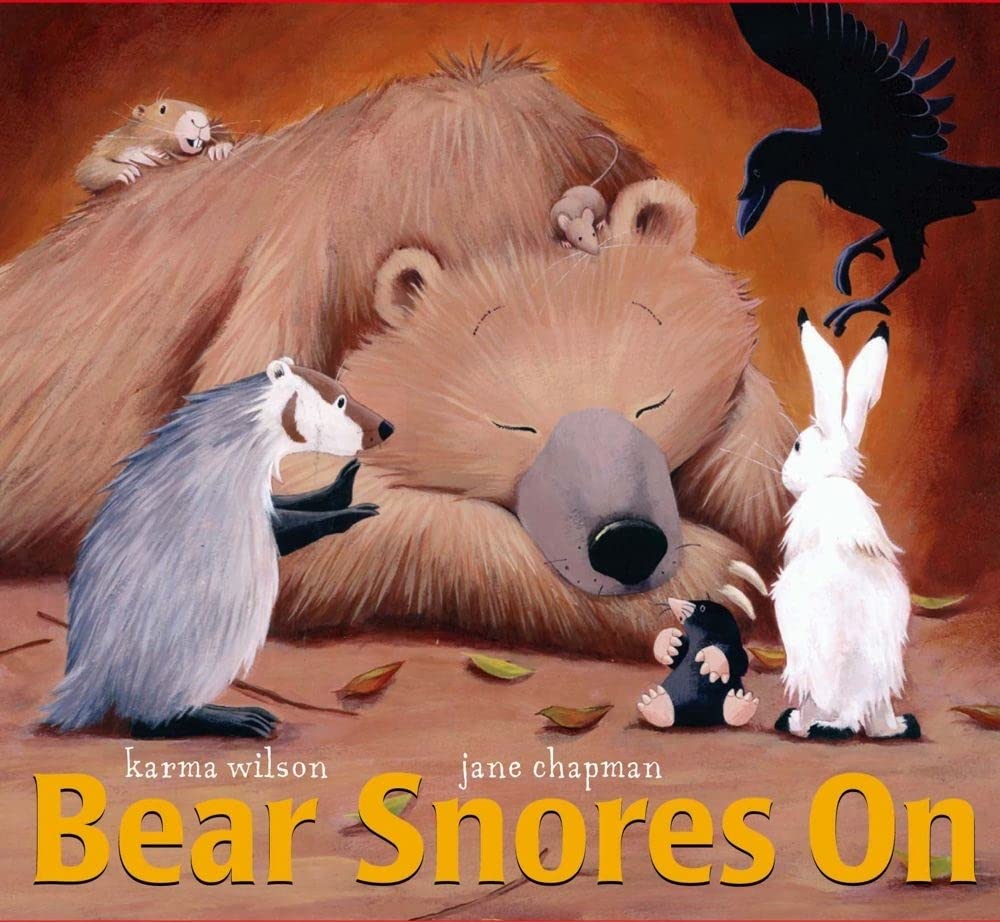
Bear Snores On, written by Karma Wilson and illustrated by Jane Chapman, is a 32-page rhyming picture book about a great brown bear hibernating in his cave on a cold winter night — and about the procession of woodland animals who find the warm cave and help themselves to a party while he sleeps. Mouse builds a fire. Hare brings tea. Badger pops corn. Wren and raven arrive. Mole and gopher join in. Through all of it — the crackling fire, the brewing tea, the laughter and the tall tales and the honey nuts — the bear snores on. Until a bit of pepper corn falls in his nose. He sneezes himself awake. And he is sad, because he missed it all. Published in 2002 by Margaret K. McElderry Books, it won the Oppenheim Platinum Book Award and launched a beloved series of more than a dozen Bear Books by Wilson and Chapman. The cumulative rhyming structure, the warm winter cave setting, and the gentle twist ending — in which the bear finally gets his party and his friends fall asleep one by one — make it one of the most satisfying winter read-alouds in picture book literature. This guide covers Bear Snores On‘s reading level, whether it’s a read-aloud or independent read, what it’s about, its themes, how long it takes to read, and similar books — designed for parents and teachers of K–2 readers.
For Parents
A warm, rhyming winter picture book about a hibernating bear whose cave fills with woodland party guests — with a twist ending that turns the whole premise on its head. Best for ages 3–8. No content concerns. One of the coziest winter read-alouds in the catalog, perfect for a cold evening by any light source.
For Teachers
A PreK–2 classroom staple for winter and hibernation units — the cumulative rhyme structure, the repeating refrain, and the woodland animal cast make it ideal for choral reading, sequencing activities, and prediction. Natural companion to The Mitten for a winter animals unit. The Bear Books series offers sequels for every season and situation.
Bear Snores On at a Glance
Find on Amazon →| Author | Karma Wilson |
| Illustrator | Jane Chapman |
| Published | 2002 (Margaret K. McElderry Books / Simon & Schuster) |
| Grade Level | PreK–2 (our assessment) |
| Recommended Age | 3–8 |
| Lexile | AD470L |
| ATOS Level | 2.2 |
| Word Count | 404 |
| Pages | 32 |
| Genre | Picture book / rhyming / winter / cumulative tale |
| Awards | Oppenheim Platinum Book Award |
| Series | The Bear Books (12+ titles) |
For official Lexile and AR levels, visit Lexile.com or AR BookFinder. ReadingVine provides independent editorial assessments.
What Reading Level Is Bear Snores On?
Bear Snores On has a Lexile of AD470L and an ATOS level of 2.2. The AD designation — Adult Directed — indicates it is designed as a read-aloud, though the ATOS 2.2 places comfortable independent reading at approximately mid-first grade. At 404 words across 32 pages, the text is brief and rhythmically driven: Wilson writes in a bouncing, anapestic verse that gives each animal’s arrival its own rhyming couplet and returns again and again to the refrain “but the bear snores on.” The cumulative structure provides strong scaffolding for young readers who can predict the pattern after the second or third animal arrives.
The rhyme scheme and refrain are genuine reading supports: children who cannot yet decode independently can join in the refrain after a single hearing and will anticipate it correctly before the words arrive. For official Lexile and AR scores, visit Lexile.com or AR BookFinder. ReadingVine’s assessments are independent editorial judgments.
Is Bear Snores On a Read-Aloud or Independent Read?
This is an excellent read-aloud for ages 3–8 and an independent read for strong K–1 readers. As a read-aloud, the repeating refrain (“but the bear snores on”) is designed for children to join in after the first few repetitions — and they will, reliably, regardless of age. The growing warmth and chaos of the cave party, the escalating absurdity of the sleeping bear, and the gentle pivot when he finally wakes all build toward a satisfying landing that makes the whole thing feel complete.
For independent reading, the rhyme scheme provides strong decoding support and the story’s humor rewards returning to it. Children who love the book will often re-read it specifically to deliver the refrain themselves — being the one who says “but the bear snores on” with full dramatic weight is one of the small pleasures this book offers its independent readers.
Teach your child the refrain before you start — say it together once: “But the bear snores on.” Then, every time it appears, pause and let them deliver it. By the fourth or fifth repetition they will be saying it before you even pause, which is exactly right. When the refrain finally changes at the end — “but the friends snore on” — let the change land. Pause. Let them notice. Ask: “What’s different about what it says this time?”
What Is Bear Snores On About?
In a cave in the woods, in his deep dark lair, through the long cold winter, sleeps a great brown bear. A mouse scurries in out of the cold and builds a small fire with a stick. Hare arrives, cold and shivering, and Mouse brews tea. Badger comes — “Now who’s there?” cries hare. Badger pops corn. One by one, more animals arrive: a wren, a raven, a mole, a gopher. They tell tall tales. They eat honey nuts. They sing and celebrate, and through all of it — the fire, the tea, the corn, the tales, the music, the laughter — the bear snores on.
Until a bit of pepper corn falls in his nose. He twitches. He rumbles. He sneezes himself awake to find his cave full of uninvited guests having the party of the winter. He is bewildered. He is put out. He missed it all — the fire, the tea, the corn, the stories, the honey nuts. He did not get to be there. He is sad, and he says so.
But the animals do not leave. They share the corn with Bear and brew him fresh tea. They tell the stories again. They stay with him until the long winter night has passed, and by morning Bear has had his party too. The book ends with the animals — all of them — curled in the warm cave, fast asleep. The bear, now awake, watches over them. The last lines reverse the refrain: the friends, not the bear, snore on.
Bear Snores On Characters
Bear is the book’s center even when he is unconscious — his enormous sleeping presence fills the cave and the illustrations, and every animal arrival is a negotiation with his snoring mass. When he wakes, his sadness is genuine and immediate: he is not angry, he is left out, and that is worse. Mouse is the book’s quiet initiator — the first to find the cave, the one who starts the fire that makes everything possible, the quiet engine of the whole party. The ensemble — hare, badger, wren, raven, mole, gopher — arrive one by one and collectively create the warmth that Bear, asleep, cannot share in. Jane Chapman’s illustrations give each animal a distinct personality in their posture and expression: the badger’s comfortable authority, the wren and raven’s quick energy, the mole’s nearsighted warmth.
The Refrain and the Twist
Bear Snores On is a cumulative tale built around a single repeating refrain: “But the bear snores on.” Each animal’s arrival, each new element of the party, each moment of warmth and laughter — all are punctuated by this line, which functions simultaneously as a running joke (the bear keeps sleeping through everything) and as a quiet build toward something. The refrain is identical every time, until the last page, when it changes: “but the friends snore on.”
This reversal is the book’s most elegant structural choice. The refrain that has described Bear’s exclusion from the party becomes, at the end, the description of his friends’ contented sleep in his cave — and Bear is now the one who is awake, watching over them. He has moved from the sleeping outsider to the awake host. The party is over, but something has been given back to him. The refrain that marked his absence now marks his presence. Children who track the change in the refrain understand something precise and true about how the book works and what it has been building toward.
Bear Snores On Themes and Lessons
Bear’s distress when he wakes — “But I missed it! I missed all the fun!” — is one of the most relatable feelings in children’s emotional experience: the fear of having been left out of something wonderful while you were away. Wilson takes this feeling seriously without dramatizing it. Bear is sad. His friends respond not with explanation but with action: they share what they have, they tell the stories again, they make sure he is included in what remains. The solution to being left out is not going back to fix the past but being included in what comes next — and his friends understand this intuitively.
The book also works beautifully as a science and nature text: hibernation, winter woodland animals, the cave as a habitat. Teachers who use it in winter or animal units find that the story carries the science naturally, and that children who understand why Bear is asleep in January have a richer context for the party’s absurdity.
Talking with your child: Why do you think Bear kept sleeping through everything? How did he feel when he woke up — and why? What did his friends do to make him feel better? What is different about the very last line — who is snoring now? Have you ever missed something and felt sad about it? What helped?
How Long Is Bear Snores On?
Bear Snores On is 32 pages with 404 words. Most adults can read it aloud in about six to eight minutes — the cumulative structure adds some length as the animal list grows, but the refrain keeps the pace moving. It is the first book in the Bear Books series, which now includes more than twelve titles by Wilson and Chapman covering every season and situation: Bear Wants More (spring, 2003), Bear’s New Friend (2006), Bear Feels Sick (2007), Bear Feels Scared (2008), Bear’s Loose Tooth (2011), and others. The series is available in board book format for the youngest readers and has been read aloud by David Tennant in an audio edition. The bear’s cave, the woodland ensemble, and the warm Chapman illustrations are consistent across the series, making each new title immediately welcoming to children who love the first.
Books Similar to Bear Snores On
About Karma Wilson and Jane Chapman
Karma Wilson grew up in Idaho and now lives in Montana. She began writing children’s books after years of rejection — her agent Steven Malk, who eventually represented her, had already rejected her once before accepting her. Bear Snores On was her first published book and immediately established her as one of the most beloved voices in rhyming picture books. She has written more than forty books for children, including the full Bear Books series and numerous standalone titles. She has said that the Bear Books grew from her love of winter, of warm caves and cold nights, and of the specific pleasure of being inside when the weather outside is impossible.
Jane Chapman graduated from Brighton University with a First Class Honours degree in illustration and has now illustrated more than one hundred books for children in over twenty countries, working under both her own name and the pseudonym Jack Tickle. Her acrylic illustrations for the Bear Books — warm, detailed, with soft golden light and richly textured fur — are among the most celebrated in contemporary picture book illustration. She is married to fellow children’s illustrator Tim Warnes. Her favorite thing to paint, she has said, is snow. She lives in Dorset, England.
Bear Snores On: Frequently Asked Questions
What reading level is Bear Snores On?
Bear Snores On has a Lexile of AD470L and an ATOS of 2.2. Our assessment: PreK–2, ages 3–8. The AD designation means it is designed as a read-aloud; the ATOS 2.2 places comfortable independent reading at approximately mid-first grade. For official Lexile and AR scores, visit Lexile.com or AR BookFinder.
What is Bear Snores On about?
A hibernating bear’s cave fills with woodland animals having a winter party while he sleeps through everything — the fire, the tea, the popcorn, the stories. When a bit of pepper corn falls in his nose and he sneezes awake, he is sad he missed it all. His friends share with him and tell the stories again, and by morning Bear has had his party too — and the friends fall asleep while Bear stays awake to watch over them.
What animals are in Bear Snores On?
Mouse (who arrives first and starts the fire), hare, badger, wren, raven, mole, and gopher — all woodland animals who arrive one by one out of the winter cold and join the party in Bear’s warm cave. Each animal’s arrival is announced with a rhyming couplet and punctuated by the refrain “but the bear snores on.”
What is the twist ending of Bear Snores On?
The repeating refrain throughout the book is “but the bear snores on” — marking Bear’s exclusion from the party happening around him. At the very end, after Bear has been included and the animals fall asleep one by one, the refrain changes: “but the friends snore on.” Bear has gone from the sleeping outsider to the awake host. The refrain that marked his absence now marks his presence. Children who notice this change understand something precise about how the book works.
Is there a Bear Snores On series?
Yes — the Bear Books series now includes more than twelve titles by Wilson and Chapman: Bear Wants More (2003), Bear’s New Friend (2006), Bear Feels Sick (2007), Bear Feels Scared (2008), Bear’s Loose Tooth (2011), and others. Each features the same woodland animal cast, Wilson’s rhyming text, and Chapman’s warm acrylic illustrations. The series is available in board book format for the youngest readers and was read aloud by David Tennant in an audio edition.
How long does it take to read Bear Snores On aloud?
About six to eight minutes. The cumulative structure adds some length as the animal list grows, but the refrain keeps the pace moving. The ending — the reversal of the refrain — rewards a deliberate pause to let children notice the change.