
 = Partner Site
The Mitten Reading Level: A Complete Guide
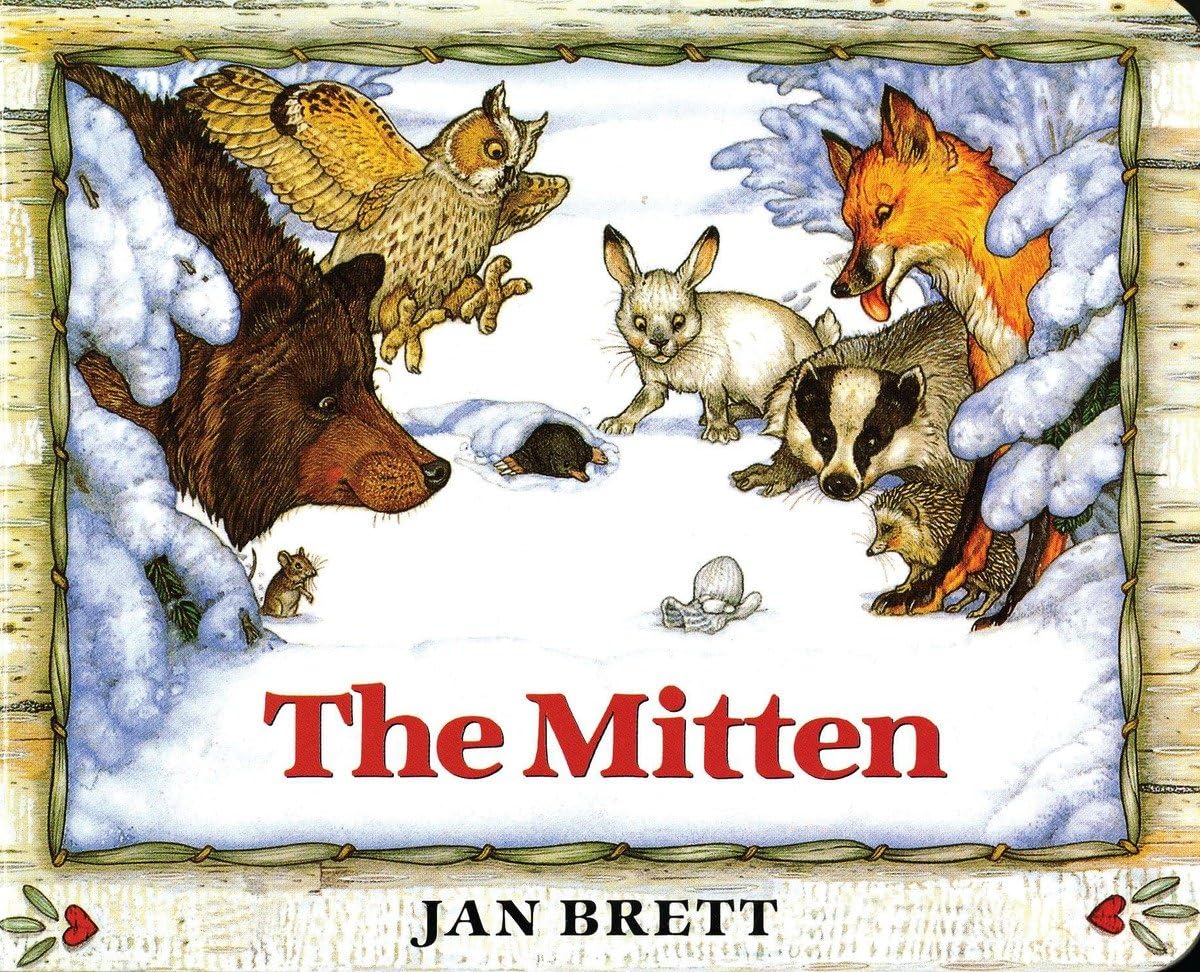
The Mitten, retold and illustrated by Jan Brett, is a 32-page picture book based on a traditional Ukrainian folktale about a boy named Nicki who drops one of his white mittens in the snow. One by one, woodland animals discover the warm mitten and crawl inside: a mole, a rabbit, a hedgehog, an owl, a badger, a fox, and finally a great brown bear — each animal larger than the last, all impossibly crammed into the stretching mitten. When a tiny meadow mouse follows the bear inside and tickles his nose, the bear’s mighty sneeze sends every animal flying and launches the mitten back to Nicki’s hand. Published in 1989 and Jan Brett’s most beloved book among her more than thirty titles, it is distinguished by her bordered illustration format: the left border of each page shows the next animal approaching; the right border shows Nicki walking obliviously through the snowy woods. With over thirty-four million copies in print, it is one of the bestselling picture books in American publishing history. This guide covers The Mitten‘s reading level, whether it’s a read-aloud or independent read, what it’s about, its themes, how long it takes to read, and similar books — designed for parents and teachers of K–2 readers.
For Parents
A beloved Ukrainian folktale retold with Jan Brett’s extraordinary bordered illustrations — warm, funny, and visually rich in ways that reward reading slowly and looking carefully. Best for ages 3–8. No content concerns. One of the great winter picture books, with illustrations children return to over and over.
For Teachers
A PreK–2 classroom staple for sequencing, prediction, and cumulative story structure — with Brett’s border illustrations providing one of the most teachable examples of visual foreshadowing in picture book history. The Ukrainian cultural origin is meaningful context worth discussing. Available in Spanish as El mitón.
The Mitten at a Glance
Find on Amazon →| Author & Illustrator | Jan Brett (author & illustrator) |
| Published | 1989 (G.P. Putnam’s Sons) |
| Grade Level | PreK–2 (our assessment) |
| Recommended Age | 3–8 |
| Lexile | 600L |
| ATOS Level | 3.9 |
| Word Count | 584 |
| Pages | 32 |
| Genre | Picture book / folktale / Ukrainian folklore |
| Origin | Adapted from a traditional Ukrainian folktale |
For official Lexile and AR levels, visit Lexile.com or AR BookFinder. ReadingVine provides independent editorial assessments.
What Reading Level Is The Mitten?
The Mitten has a Lexile of 600L and an ATOS level of 3.9 — notably high for a book with only 584 words. The scores reflect that Brett’s prose is denser than the word count suggests: the sentences are grammatically complete, the animal names include some that may be unfamiliar to young children (hedgehog, badger), and the folktale register gives the language a slightly formal quality. The ATOS 3.9 places it at the same level as Jumanji despite being a much shorter text.
In practice the book is widely used as a PreK–2 read-aloud and as an independent reader for strong K–1 students. The cumulative structure — each new animal arriving with a recitation of who is already inside — provides strong predictive scaffolding, and the border illustrations carry the full narrative for children who cannot yet process the prose. For official Lexile and AR scores, visit Lexile.com or AR BookFinder. ReadingVine’s assessments are independent editorial judgments.
Jan Brett’s Border Illustrations — The Book’s Most Distinctive Feature
The Mitten‘s most celebrated quality is Jan Brett’s bordered illustration format. Each spread has a central illustration framed by decorative panels on the left and right — and these panels carry separate, simultaneous narrative tracks. The left border shows the next animal approaching the mitten before it arrives in the main story. The right border shows Nicki walking obliviously through the snowy woods, unaware of everything happening to his lost mitten.
This creates a picture book equivalent of dramatic irony: the reader knows more than Nicki does and can predict each arrival before the text confirms it. For classroom use, the border format makes The Mitten one of the most structurally teachable picture books available — a concrete, visible example of foreshadowing and parallel narrative that children can identify and discuss without needing the vocabulary to name it. Ask a child “what’s happening over here while the animals are doing that?” and they will show you exactly what parallel narrative means.
The borders also carry detailed information about Ukrainian folk art: embroidery motifs, traditional wooden architecture, winter clothing, and decorative patterns researched and faithful to Ukrainian tradition. For classrooms interested in cultural context, the borders are a primary source of visual information about the folk tradition from which the story comes.
Is The Mitten a Read-Aloud or Independent Read?
This works excellently as both a read-aloud for ages 3–8 and an independent read for strong K–1 readers. As a read-aloud the cumulative structure builds irresistible momentum: each new animal must be introduced with the full list of who is already inside, the mitten grows more absurdly full with every page, and the bear sneeze payoff is one of picture book literature’s most satisfying climaxes. Children who have been tracking the escalating list feel the full release of it.
For independent reading, the repetitive structure and the illustrations’ strong narrative support make it very accessible for children working toward independence. Even pre-readers can follow the full narrative through the borders and main illustrations without processing the text.
Before turning each page, pause at the left border and ask: “Who do you think is coming next?” After the animal arrives, confirm: “There they were, in the border! Did you see them?” By the third animal, your child will be racing ahead to check the border before you even ask — which is exactly the prediction and inference practice Brett designed the format to generate.
What Is The Mitten About?
Nicki wants white mittens — the color of snow — even though his grandmother Baba warns him that a white mitten dropped in white snow will be impossible to find. She knits them anyway. He sets out into the snowy woods. He drops one mitten. He doesn’t notice.
A mole finds the mitten and crawls inside for warmth. A rabbit arrives and asks to come in — the mole makes room. A hedgehog, then an owl, then a badger, then a fox — each one larger than the last, each greeted by an increasingly implausible but unstoppable hospitality. The mitten stretches. Then a great brown bear arrives. Impossibly, the animals inside make room for him too. The mitten, now swollen to the size of a large sack, contains all seven animals. It is very full.
Then a tiny meadow mouse arrives. Surely there is room for one small mouse. She crawls in and snuggles against the bear’s nose. His nose twitches. He sneezes — a bear-sized sneeze that blasts every animal into the air in an explosion of fur, feathers, and snow. The mitten rockets skyward. Nicki turns and sees it flying toward him. He catches it. He never knows what happened. On the last page, Baba looks at the mitten — stretched enormously out of shape — and raises an eyebrow.
The Mitten Characters
Nicki is the book’s frame character — present at the beginning and end, absent from the middle, entirely unaware of the drama. His obliviousness is part of the comedy: the right border shows him walking contentedly through the woods while a bear is being squeezed into his lost mitten. Baba, his grandmother, is the book’s wisest figure — she warned him, she was right, and her final raised eyebrow says everything. The seven animals — mole, rabbit, hedgehog, owl, badger, fox, bear — are individualized by Brett’s illustrations, each with a distinct personality visible in their expressions and posture as they negotiate the increasingly crowded mitten. The meadow mouse is the book’s comic catalyst: the smallest character, the one who finally breaks the mitten’s impossible capacity, and the one whose tiny presence triggers the bear-sneeze climax.
The Ukrainian Folktale Tradition
The Mitten is based on a traditional Ukrainian folktale that exists in multiple versions — some with a mitten, some with a glove, some with other containers — collected by Ukrainian and Eastern European folklorists. The “accumulation” or “pancake” story structure (in which a series of characters pile into a small space until something gives) is one of the oldest and most widespread in oral folk tradition, appearing across cultures in dozens of variants. Jan Brett researched the Ukrainian tradition specifically, incorporating folk art motifs, traditional Ukrainian architectural details, and traditional embroidery patterns into her borders.
For American classrooms, the Ukrainian origin of this story carries particular resonance since 2022. Teachers who use The Mitten have an opportunity to acknowledge that this story comes from a real place with a living culture — not a generic “once upon a time” land — and that the folk art in Brett’s borders represents a tradition that Ukrainians have worked to preserve. This does not need to be a heavy conversation; even a simple “this story comes from Ukraine, which is a real country in Europe” gives children genuine cultural information and names the source of the beauty they are looking at.
The Mitten Themes and Lessons
The book’s deepest comic logic is the hospitality paradox: each animal in the mitten makes room for the next one, and this generosity — which is charming and funny — is also what leads to the inevitable explosion. The bear should not fit in the mitten. He does not fit in the mitten. And yet the other animals make room, because that is what the animals in this story do. The meadow mouse is the character who finally breaks the physics of the situation — not because she is large, but because there is simply no more room and she is in exactly the right position to trigger the sneeze.
This makes The Mitten one of the clearest picture book examples of cumulative consequence: each individual decision (let the rabbit in, let the hedgehog in) seems reasonable; the cumulative effect (a bear crammed into a child’s mitten) is absurd. Children who find this funny are understanding cause and effect at a genuinely sophisticated level.
The ending’s detail — Baba’s raised eyebrow at the stretched-out mitten — is the book’s most quietly perfect moment. She does not ask questions. She does not need to. She warned him. She was right. The mitten tells the whole story, and she reads it perfectly.
Talking with your child: Can you remember all the animals in order — who went in first? Why did each animal let the next one in, even when there wasn’t much room? Which animal surprised you most when it fit? Why do you think the tiny mouse was the one who finally made the bear sneeze? What do you think Baba is thinking at the end when she looks at the stretched mitten?
How Long Is The Mitten?
The Mitten is 32 pages with 584 words. Most adults can read it aloud in about seven to nine minutes — the cumulative recitations of animals as each new one arrives slow the pace pleasantly and give children time to anticipate the next arrival. Jan Brett has written several companion winter books that make natural follow-ups: The Hat (1997), which follows a similar lost-winter-item structure with a hedgehog as the central character; The Three Snow Bears (2007), her adaptation of the Three Bears story set in the Arctic; and The Snowy Nap (2018), a Jan and the Hedgehog winter story. All feature the same bordered illustration format and the same detailed, warm visual world.
Books Similar to The Mitten
About Jan Brett
Jan Brett was born in 1949 in Hingham, Massachusetts, and grew up near the ocean on Boston’s South Shore. As a child she spent hours drawing and reading, and she has said she remembers feeling she could enter the pages of her picture books. She studied at the Boston Museum School and published her first book in 1981. She is now one of the most prolific and bestselling author-illustrators in American children’s publishing, with over thirty-four million books in print across more than thirty titles. She is particularly known for her winter and holiday books, for the distinctive bordered illustration format she developed, and for the deep research she brings to each book’s visual world: she and her husband, Boston Symphony Orchestra musician Joe Hearne, travel extensively, and she incorporates the architecture, folk art, and costume traditions of the countries she visits into her illustrations.
The bordered format — simultaneously showing the main action, the approaching next event, and a parallel character’s separate experience — was Brett’s own invention and has become her most recognized contribution to picture book illustration. She has applied it across dozens of books, always using the borders to carry narrative information rather than decoration. She lives in a seacoast town in Massachusetts.
The Mitten: Frequently Asked Questions
What reading level is The Mitten?
The Mitten has a Lexile of 600L and an ATOS of 3.9 — relatively high for 584 words, reflecting Brett’s grammatically complete sentences and folktale vocabulary. Our assessment: PreK–2, ages 3–8. The cumulative structure and border illustrations make it accessible well below the ATOS level as a read-aloud. For official Lexile and AR scores, visit Lexile.com or AR BookFinder.
What is The Mitten about?
Nicki drops his white mitten in the snow. One by one, woodland animals find it and crawl inside for warmth — a mole, rabbit, hedgehog, owl, badger, fox, and bear, each larger than the last. A tiny meadow mouse follows the bear inside and tickles his nose. The bear sneezes, blasting all seven animals into the air and launching the mitten back to Nicki’s hand. Baba looks at the stretched mitten and raises an eyebrow.
What animals are in The Mitten in order?
Mole, rabbit, hedgehog, owl, badger, fox, bear — followed by the meadow mouse who triggers the sneeze. Each animal is larger than the one before it, making the mitten’s escalating capacity the book’s central comic premise.
What is the significance of Jan Brett’s borders in The Mitten?
The left border of each spread shows the next animal approaching the mitten before it arrives in the main story — allowing readers to predict each new arrival. The right border shows Nicki walking through the woods, unaware of what is happening. Together the borders create a three-track simultaneous narrative: the mitten story, the approaching animal, and Nicki’s oblivious parallel journey. The format is Brett’s most celebrated illustration technique and one of the clearest visual examples of foreshadowing available in picture book form.
Is The Mitten a real Ukrainian folktale?
Yes — Brett adapted it from a traditional Ukrainian folktale that exists in multiple versions across Eastern European folk traditions. The story structure (animals accumulating in a small space until something gives) is one of the oldest in oral tradition. Brett researched the Ukrainian tradition specifically, incorporating authentic folk art motifs, embroidery patterns, and architectural details into her illustrated borders. The book is also available in Spanish as El mitón.
How long does it take to read The Mitten aloud?
About seven to nine minutes. The cumulative recitations of animals as each new one arrives pleasantly slow the pace and give children time to anticipate the next arrival through the border illustrations. The sneeze climax and the animals scattering tend to produce noise and laughter that add time — which is exactly the right outcome.
Are there other books like The Mitten by Jan Brett?
Yes — Brett’s companion winter book The Hat (1997) follows a similar lost-winter-item structure with a hedgehog as the central character. The Three Snow Bears (2007) is her Arctic retelling of the Three Bears. All feature the same bordered illustration format and the same richly detailed visual world. The hedgehog from The Mitten appears as a character in The Hat, giving the two books a natural connection.