
 = Partner Site
How the Grinch Stole Christmas! Reading Level: A Complete Guide
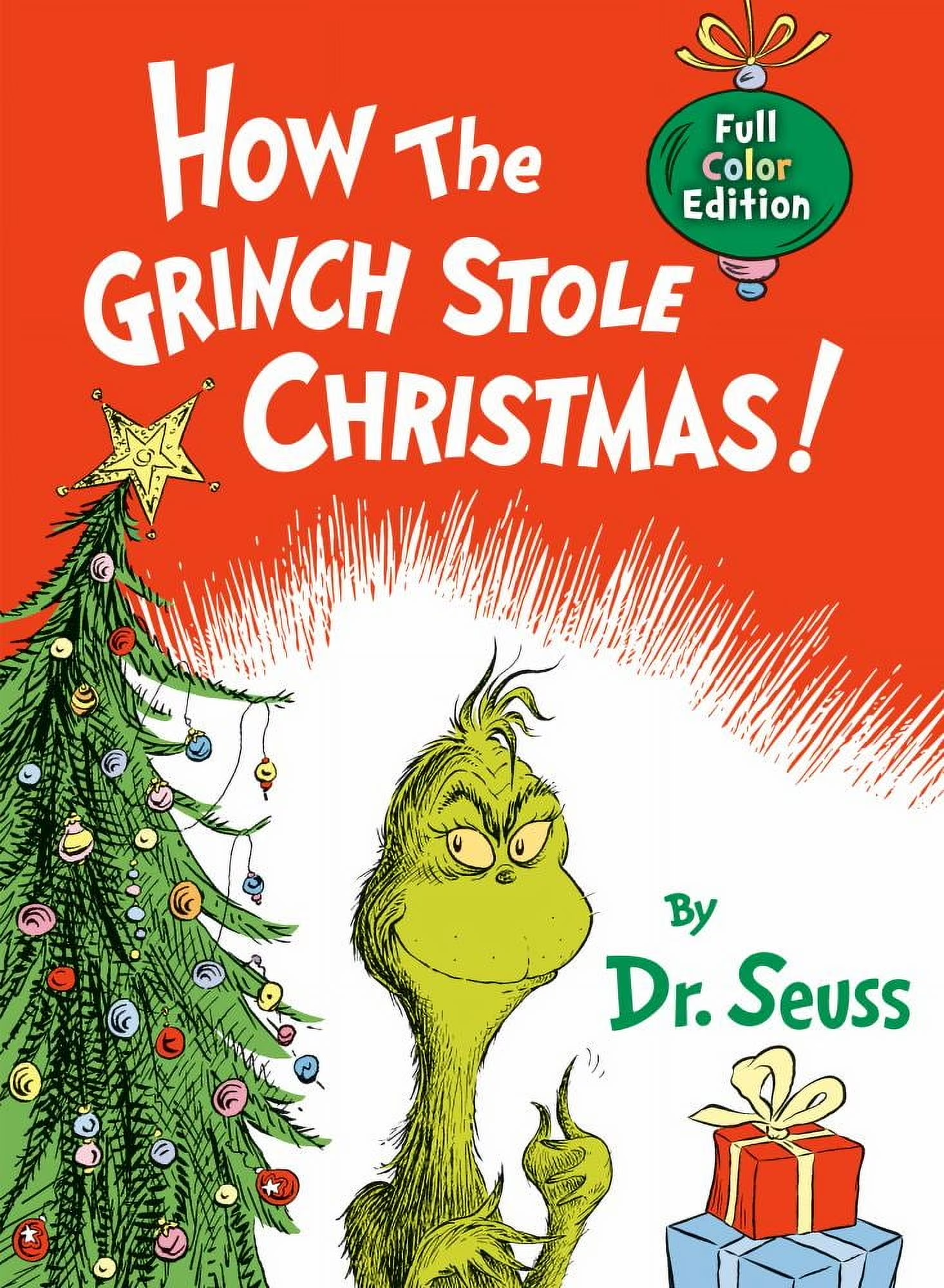
How the Grinch Stole Christmas!, written and illustrated by Dr. Seuss, is a 64-page holiday picture book in rhymed verse about the Grinch — a solitary, grouchy creature who lives north of Who-ville and who has hated Christmas and all its noise for fifty-three years. One Christmas Eve he decides to do something about it: he will steal every decoration, every present, every last crumb of Christmas food from every house in Who-ville, and then Christmas will not come. It does not work out as he planned. First published in 1957 and debuted simultaneously in a Redbook magazine issue, it is one of the bestselling and most widely recognized children’s books in American publishing history — adapted as a celebrated 1966 animated television special, a 2000 live-action film, and a 2018 Illumination animated feature. Written as a critique of Christmas’s commercialization, it carries one of the simplest and most durable arguments in picture book literature: the thing that makes the holiday real is not the stuff. This guide covers How the Grinch Stole Christmas!‘s reading level, whether it’s a read-aloud or independent read, what it’s about, its themes, how long it takes to read, and similar books — designed for parents and teachers of K–2 readers.
For Parents
A holiday classic in rhymed verse about a grouchy creature who tries to steal Christmas and discovers he cannot — because Christmas isn’t about the stuff. Best as a read-aloud for ages 4–8 and an independent read for ages 6–9. No content concerns. One of the most re-readable picture books in American children’s literature, beloved equally by children and the adults reading it to them.
For Teachers
A December classroom staple across PreK–3, used for holiday read-alouds, discussions of empathy and belonging, and the critique of consumerism that older readers can engage with directly. The Grinch’s transformation is one of picture book literature’s most satisfying character arcs. Pairs naturally with Last Stop on Market Street for units on gratitude and community, and with The Sneetches for Dr. Seuss author studies.
How the Grinch Stole Christmas at a Glance
Find on Amazon →| Author & Illustrator | Dr. Seuss (Theodor Seuss Geisel) |
| Published | 1957 (Random House) |
| Grade Level | K–2 read-aloud; 1–3 independent (our assessment) |
| Recommended Age | Read-aloud ages 4–8; independent reading ages 6–9 |
| Best For | Read-aloud ages 4–8; independent reading ages 6–9 |
| Lexile | 590L |
| ATOS Level | 3.0 |
| Guided Reading Level | M |
| Word Count | ~1,355 |
| Pages | 64 |
| Genre | Picture book / holiday / verse |
For official Lexile and AR levels, visit Lexile.com or AR BookFinder. ReadingVine provides independent editorial assessments.
What Reading Level Is How the Grinch Stole Christmas?
How the Grinch Stole Christmas! has a Lexile of 590L and an ATOS level of 3.0, with a Guided Reading Level of M and a grade level equivalent of 2. Unlike The Sneetches, which received a Non-Prose (NP) Lexile designation because of its verse form, the Grinch carries a standard prose Lexile score — a reflection of how different scoring systems handle the same verse format differently. The 590L is a reasonable proxy for the book’s reading demands: the anapestic verse is accessible and rhythmically predictable, the vocabulary is rich with Seuss invented words (Grinch, Whos, Who-ville, Whoville’s Who-pudding, roast beast) that are context-readable, and the sentence structures run longer than in simpler picture books.
The ATOS 3.0 and grade level equivalent of 2 suggest that a solid second-grader can read it independently with confidence; first-graders who have heard it many times can work through it with the rhythm as a guide. As a read-aloud it is appropriate from preschool onward — the vocabulary and the narrative stakes are entirely accessible to a four-year-old, and the Grinch’s green-faced scowl and the Whos’ inexplicable cheerfulness are funny at any age. At approximately 1,355 words across 64 pages, most adults read it aloud in about twelve to fifteen minutes. For official Lexile and AR scores, visit Lexile.com or AR BookFinder. ReadingVine’s assessments are independent editorial judgments.
Is How the Grinch Stole Christmas a Read-Aloud or Independent Read?
This is an excellent read-aloud for ages 4–8 and an independent read for ages 6–9.
As a read-aloud, How the Grinch Stole Christmas! rewards performance. The anapestic verse builds its own momentum — the heist sequence, in which the Grinch and his dog Max steal every last Who-pudding and Who-hash, moves at a pace that is almost musical, and reading it aloud lets the rhythm carry the comedy. The book’s famous opening — “Every Who down in Who-ville liked Christmas a lot / But the Grinch, who lived just north of Who-ville, did NOT!” — is one of the most recognizable sentences in American children’s literature for exactly this reason: it sounds like something, and what it sounds like is mischief. The ending, when the Grinch’s heart grows three sizes and he returns everything, benefits from a deliberate slowdown that a read-aloud makes possible in a way that silent reading may not.
For independent reading, a confident first- or second-grader who has heard the book multiple times can navigate the verse with real pleasure, using the rhythm as a decoding scaffold. Many children who know the story from television or film encounters will be motivated to read the original book on their own.
Let your child do the Grinch’s voice for his scheming dialogue — the more sinister, the better. When you reach the moment the Grinch pauses on the mountain and hears the Whos singing, slow down completely. That moment earns its pause. Ask afterward: “Why do you think the Whos were still singing? What does that tell us about what Christmas actually is?”
What Is How the Grinch Stole Christmas About?
The Grinch lives alone on Mount Crumpit, just north of Who-ville, with only his dog Max for company. For fifty-three years — a detail Seuss added knowing he was fifty-three himself when he wrote the book — the Grinch has endured the noise of Who-ville’s Christmas celebrations: the singing, the bells, the feast, the crackers. He hates it all. And one December night, looking down at the lights of Who-ville, he hatches a plan: he will steal Christmas. Every decoration, every present, every last can of Who-hash. If Christmas requires stuff, then without the stuff, Christmas cannot come.
He dresses as Santa Claus, harnesses Max to a makeshift sleigh, and descends on Who-ville. He goes from house to house, taking everything — stuffing presents up the chimney, loading the tree, even taking the logs from the fireplace. In the last house he visits, he encounters a small girl named Cindy Lou Who, who has come downstairs for a drink of water. She asks why he is taking their Christmas tree. He lies — he says it needs a repair — and she goes back to bed, satisfied. The Grinch takes the last crumbs and rides back up to Mount Crumpit with the sleigh piled high, ready to watch the Whos wake up to nothing.
But then he hears something unexpected: the Whos are singing. They have woken up to find everything gone, and they are standing hand in hand in the town square, singing. Not crying. Not demanding their stuff back. Singing. The Grinch cannot understand it. And in not understanding it, he begins to understand something: Christmas, he thinks now, must mean something more. His heart, which the narrator describes as two sizes too small, grows three sizes. He stops the sleigh at the edge of the mountain. He turns it around. He brings everything back. And he carves the roast beast.
How the Grinch Stole Christmas Characters
The Grinch is the book’s entire moral center — a character who is simultaneously the villain and the protagonist, whose arc from contempt to transformation is the whole story. Seuss has said he identified with the Grinch; the book was written while his wife was ill and he himself felt “very Grinch-ish” about Christmas that year, looking in a mirror on December 26. The Grinch is not evil in the way that fairy tale villains are evil; he is isolated, irritable, and convinced that the thing the Whos value is worth contempt. His transformation is not a defeat — it is a discovery. Max, his beleaguered dog, is the book’s comic heart: drafted into service as a reindeer, wearing an improvised antler, suffering cheerfully through everything the Grinch puts him through, and rewarded at the end with his own place at the feast. Cindy Lou Who — the small girl who catches the Grinch mid-heist and asks an innocent question — is present for only a few pages, but she is the moral test the Grinch fails in the moment and passes in the end: she trusted him, he lied to her, and eventually he comes back and makes it right.
How the Grinch Stole Christmas Themes and Lessons
Dr. Seuss wrote the book explicitly as a critique of Christmas’s commercialization — he said so in the December 1957 issue of Redbook, where the story first appeared alongside the book’s publication. He was disturbed by what he saw as the holiday’s reduction to shopping, and the Grinch’s initial theory — that Christmas is simply its stuff, and that without the stuff it cannot exist — is the theory he wanted to test and disprove. The Whos’ response disproves it entirely: they have nothing, and they celebrate anyway, which means the thing they are celebrating was never the stuff.
This is a more sophisticated argument than it might appear at first glance, and it is worth taking seriously at any age. The Grinch is not simply wrong to be grouchy about Christmas — Seuss gives him real reasons to be tired of noise and spectacle — and his transformation is not a surrender but an enlargement. He does not stop being the Grinch; he becomes a Grinch who belongs. The book’s ending, with the Grinch carving the roast beast at the head of the Who table, is not about the Grinch being absorbed into the Whos’ world but about the Whos making room for him in it. He is still himself. He is simply no longer alone.
For older readers and adults, the book’s argument about consumerism is the one worth pausing on. The Grinch’s theory that Christmas equals stuff is not unreasonable — it is, in fact, a fairly accurate description of how the holiday is presented by most commercial culture. That the Whos prove him wrong by not caring about the stuff is both the book’s most idealistic and its most radical move: they are not upset about what was taken. They sing. The book asks what we are actually celebrating, and whether the answer to that question depends on any of the things that can be put on a sleigh and carried up a mountain.
Talking with your child: Why do you think the Grinch hated Christmas? Why did he think stealing all the stuff would stop Christmas from coming? Why were the Whos still singing when they woke up to find everything gone? What does the Grinch figure out? What is your favorite part of the holidays that couldn’t be stolen?
The Grinch on Screen: Which Version Is Which?
The Grinch has been adapted three times for screen, and parents often ask which version is closest to the book.
The 1966 animated television special — narrated and voiced by Boris Karloff, with the voice of the Grinch himself, and with the Tony Award-winning song “You’re a Mean One, Mr. Grinch” by Thurl Ravenscroft — is the most faithful adaptation and the one that established the Grinch’s visual identity for most of the twentieth century. It is approximately twenty-six minutes, rated G, and widely considered one of the finest animated specials in American television history. It adds the song and some visual comedy but follows the book’s story and moral closely. Available to stream annually; the closest experience to reading the book for children who have not encountered it.
The 2000 live-action film starring Jim Carrey, directed by Ron Howard, significantly expands the story — adding backstory for the Grinch’s isolation, making Cindy Lou Who a larger character, and giving the Grinch a more comedic and more sympathetic origin. It is rated PG, runs 104 minutes, and is significantly darker and more adult in humor than the book. The expansion adds context at the cost of the original’s simplicity; children who love the book will enjoy it but should know it is a substantially different experience.
The 2018 Illumination animated film starring Benedict Cumberbatch as the Grinch is the most child-friendly of the adaptations — gentle, colorful, and contemporary in its humor. Also rated PG, runs 86 minutes. It further softens the Grinch’s menace and adds several new plot threads; it is the adaptation most aligned with a young child’s experience of the story but the least aligned with the book’s critique of commercialism.
How Long Is How the Grinch Stole Christmas?
How the Grinch Stole Christmas! is 64 pages with approximately 1,355 words — about 21 words per page, reflecting Seuss’s characteristic use of generous illustration space. Most adults can read it aloud in twelve to fifteen minutes. It is the right length for a complete holiday read-aloud session: long enough to build real narrative momentum through the heist sequence and the transformation, short enough to finish in one sitting without losing a child’s attention. It rewards annual rereading — families who read it every December find new things in the illustrations and bring their own associations to the Whos’ singing each time through.
Books Similar to How the Grinch Stole Christmas
About Dr. Seuss
Dr. Seuss was the pen name of Theodor Seuss Geisel, born March 2, 1904, in Springfield, Massachusetts. He wrote How the Grinch Stole Christmas! in early 1957, the same year he published The Cat in the Hat — two books that together define the peak of his cultural influence. He has said that both the Cat and the Grinch were versions of himself: “the Cat was Ted on his good days, and the Grinch was Ted on his bad days,” according to his stepdaughter Lark Dimond-Cates. He was fifty-three when he wrote the Grinch — exactly the same age he gave the Grinch for enduring the Whos’ Christmas celebrations — and the book grew from his own ambivalence about the holiday that December: he looked in the mirror on December 26 and saw a very Grinch-ish countenance looking back, and decided to write about it to see if he could rediscover what he had lost about Christmas. He did. He drove a car with a license plate that read “GRINCH” for the rest of his life.
For a fuller biography of Dr. Seuss, see our Sneetches guide. He died on September 24, 1991, in La Jolla, California. How the Grinch Stole Christmas! was not among the six Dr. Seuss titles withdrawn from publication by Dr. Seuss Enterprises in March 2021; it remains in print and in active use in classrooms and homes across the country.
How the Grinch Stole Christmas: Frequently Asked Questions
What reading level is How the Grinch Stole Christmas?
How the Grinch Stole Christmas! has a Lexile of 590L, ATOS 3.0, and Guided Reading Level M — grade level equivalent 2. Our assessment: read-aloud for ages 4–8; independent reading for ages 6–9. For official Lexile and AR scores, visit Lexile.com or AR BookFinder.
Can a kindergartner read How the Grinch Stole Christmas alone?
A strong kindergartner familiar with the story from read-alouds can follow along with the verse; independent reading with full decoding is most comfortable for first- and second-graders. The anapestic rhythm is a strong scaffold — children who can feel the beat can often decode words they have not seen before.
How long does it take to read How the Grinch Stole Christmas aloud?
About twelve to fifteen minutes as a read-aloud. At approximately 1,355 words across 64 pages, it is the right length for a complete holiday session — long enough to build real narrative momentum, short enough to finish in one sitting with a young child.
What is How the Grinch Stole Christmas about?
The Grinch, a grouchy creature who has hated Christmas for fifty-three years, steals every decoration, present, and crumb of food from Who-ville on Christmas Eve — believing that without the stuff, Christmas cannot come. He is wrong: the Whos wake up and sing anyway. Their singing changes him. He returns everything and joins them for the feast.
What is the moral of How the Grinch Stole Christmas?
That Christmas — and by extension, any celebration of community and belonging — is not located in its decorations, presents, or feast. The Whos prove this by celebrating without any of those things. The Grinch’s theory that you can steal Christmas by stealing its stuff is disproved by people who know what they are actually celebrating. The deeper argument is about consumerism: Seuss wrote the book explicitly to push back against what he saw as Christmas’s reduction to shopping.
Is the Grinch based on Dr. Seuss?
Yes, by Seuss’s own account. He wrote in the December 1957 Redbook that he noticed a “very Grinch-ish countenance” in the mirror on December 26, 1956, and wrote the book to rediscover what he had lost about Christmas. He was fifty-three at the time — exactly the age he gave the Grinch for hating Christmas. His stepdaughter said the Cat in the Hat was Seuss on his good days and the Grinch on his bad days. He drove a car with a “GRINCH” license plate for the rest of his life.
Which Grinch movie is best for young children?
The 2018 Illumination animated film (Benedict Cumberbatch, PG) is the most child-friendly adaptation — gentle, colorful, and kind. The 1966 animated special (Boris Karloff, G, 26 minutes) is the most faithful to the book and the most beloved by adults who grew up with it. The 2000 Jim Carrey live-action film (PG, 104 minutes) is the darkest and most adult in humor, best for children ages 7 and up who enjoy broad comedy.