
 = Partner Site
The Pout-Pout Fish Reading Level: A Complete Guide
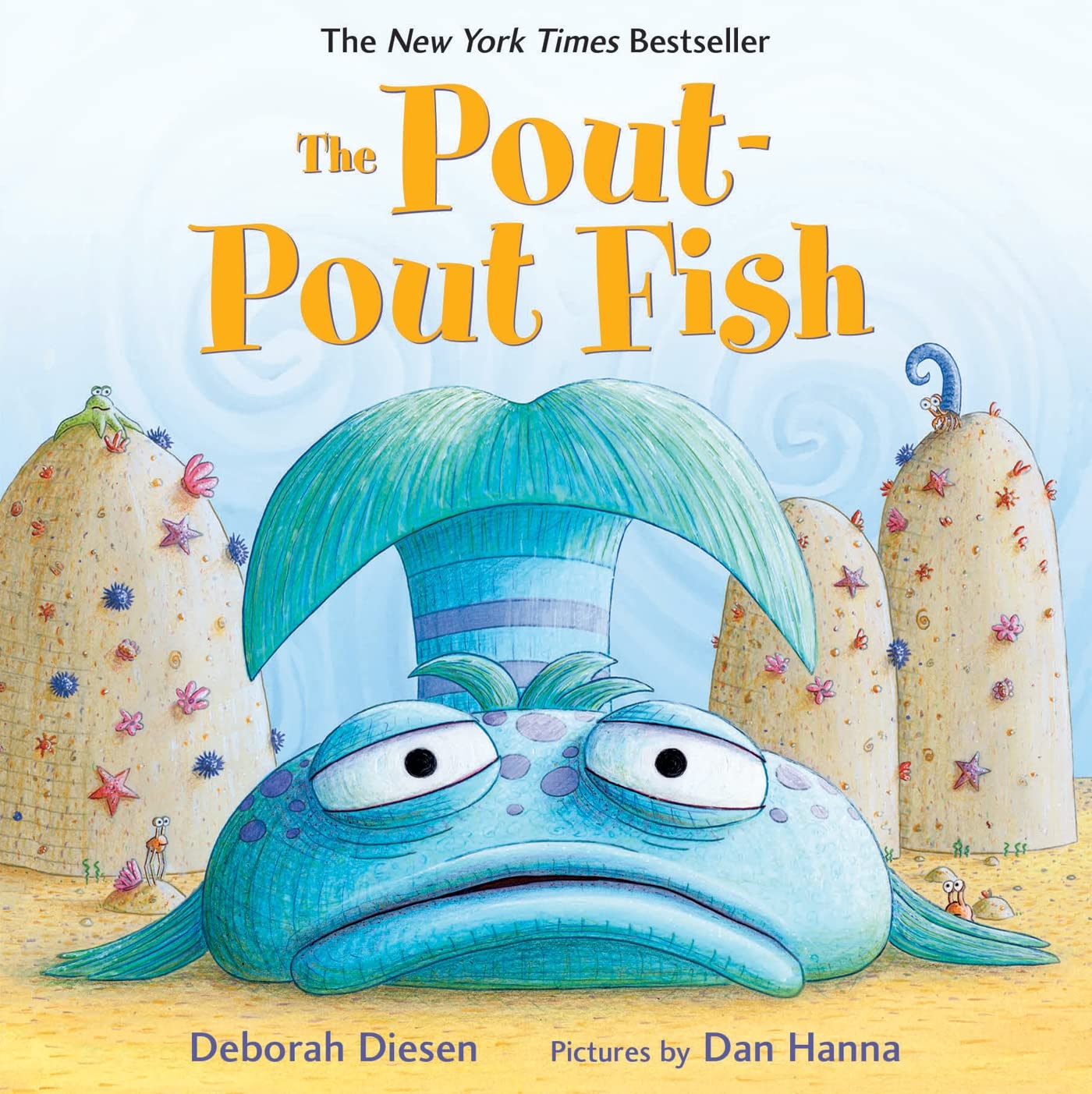
The Pout-Pout Fish, written by Deborah Diesen and illustrated by Dan Hanna, is a 32-page picture book in rhyming verse about a fish who believes it is his destiny to swim through the sea with a pout-pout face, spreading the drearies wherever he goes. Friend after friend swims by and tries to help — a clam, a jellyfish, an octopus, a shark, a whale — offering advice and suggestions, none of which change anything. Then a passing fish gives him a kiss, and he realizes that he is not a pout-pout fish at all; he is a kiss-kiss fish, and his destiny is to spread smiles rather than gloom. Published in 2008 by Farrar Straus Giroux, it became a New York Times bestseller and launched an extensive series of more than ten books. It is one of the most widely owned picture books in American homes and classrooms for children ages 3–6, beloved for its bouncy rhyme, vivid underwater illustrations, and the Mr. Fish’s memorable refrain: “I’m a pout-pout fish with a pout-pout face, so I spread the drearies all over the place.” This guide covers The Pout-Pout Fish‘s reading level, whether it’s a read-aloud or independent read, what it’s about, its themes, how long it takes to read, and similar books — designed for parents and teachers of K–2 readers.
For Parents
A bouncy, rhyming picture book about a fish who is convinced he can’t be happy — until an unexpected gesture changes his mind. Best as a read-aloud for ages 3–7. No content concerns; some parents have noted the book’s resolution (a stranger’s kiss transforms the fish) as worth discussing with children. One of the most popular picture books in its age range.
For Teachers
A PreK–1 classroom staple for discussions of feelings, fixed mindset vs. growth mindset, and the power of small kindnesses. The rhyme and refrain make it ideal for choral reading and participation. The extensive Pout-Pout Fish series offers companion books for school, holidays, and the ocean environment. Pairs naturally with other books about feelings and self-perception.
The Pout-Pout Fish at a Glance
Find on Amazon →| Author | Deborah Diesen |
| Illustrator | Dan Hanna |
| Published | 2008 (Farrar Straus Giroux) |
| Grade Level | PreK–1 (our assessment) |
| Recommended Age | 3–7 |
| Lexile | NP660L (Non-Prose — written in rhyme) |
| ATOS Level | 3.0 |
| Word Count | 468 |
| Pages | 32 |
| Genre | Picture book / verse / social-emotional |
For official Lexile and AR levels, visit Lexile.com or AR BookFinder. ReadingVine provides independent editorial assessments.
What Reading Level Is The Pout-Pout Fish?
The Pout-Pout Fish has a Lexile of NP660L and an ATOS level of 3.0. The “NP” prefix stands for Non-Prose — the same designation used for Dr. Seuss books and other verse texts, indicating that the Lexile formula cannot reliably score rhyming narrative. The numeric 660L attached to the NP designation is not directly comparable to prose Lexile scores. The ATOS 3.0 is the more useful measure for this book: it reflects the vocabulary and sentence complexity of the verse, which is accessible but occasionally elevated (“discontented,” “drearies,” “destined”).
Our editorial assessment places it at PreK–1, ages 3–7. The rhyming couplets and strong rhythm make the text more accessible for read-aloud and participation than the ATOS 3.0 might suggest for independent reading — children who know the refrain can join in before they can decode the words. For official Lexile and AR scores, visit Lexile.com or AR BookFinder. ReadingVine’s assessments are independent editorial judgments.
Is The Pout-Pout Fish a Read-Aloud or Independent Read?
This is primarily a read-aloud for ages 3–7, with independent reading accessible for strong first- and second-graders who know the book well. The rhyming verse is built for read-aloud participation — Mr. Fish’s refrain (“I’m a pout-pout fish with a pout-pout face, so I spread the drearies all over the place. Blub, blub, blub”) invites children to join in after the first hearing, and the repetitive structure of each friend’s visit makes the pattern predictable enough for even the youngest listeners to anticipate.
For independent reading, the rhyme and rhythm provide strong scaffolding for early decoders. Children who love the book will often return to it on their own to recite the refrain, and that rehearsed recitation is one of the most natural bridges to actual independent reading.
Teach your child the refrain before you start — say it together once or twice: “I’m a pout-pout fish with a pout-pout face, so I spread the drearies all over the place.” Then let them deliver it each time Mr. Fish does throughout the book. On the last reading, ask: “What changed Mr. Fish’s mind — and do you think you could change your mind about something too?”
What Is The Pout-Pout Fish About?
Mr. Fish swims through the ocean wearing a pout. He is convinced this is simply who he is — a pout-pout fish with a pout-pout face, doomed to spread the drearies. One by one, his underwater neighbors stop to notice and offer help: a clam suggests he try to smile. A jellyfish offers to wave her tentacles to cheer him up. An octopus brings eight-armed hugs. A bright white shark offers to flash his grin. A passing whale offers encouraging words. Each time, Mr. Fish listens, nods, and repeats his refrain: he is a pout-pout fish, and it is his destiny to spread the drearies. No amount of advice or cheerfulness from his friends reaches him.
Then a beautiful fish swims by, looks at him thoughtfully, and gives him a kiss. Mr. Fish is startled. He looks at himself differently. He feels something shift. He realizes that he is not a pout-pout fish at all — he is a kiss-kiss fish, and his true nature is to spread smiles rather than drearies. He swims off happy, and the ocean brightens around him.
The Pout-Pout Fish Characters
Mr. Fish is the book’s protagonist — a large, blue, determinedly unhappy fish whose refrain is both the book’s comedy and its central problem. His friends — the clam, jellyfish, octopus, shark, and whale — represent the well-meaning advice that doesn’t land: each offers something reasonable, each is met with the same resigned pouty response. The mystery fish who gives the kiss is the book’s catalyst — unnamed, beautiful, simply acting rather than advising — whose wordless intervention succeeds where every word has failed. This contrast between advice and action is the book’s most interesting structural choice.
The Pout-Pout Fish Themes and Lessons
The book’s central argument is about fixed mindset — Mr. Fish has decided who he is (“a pout-pout fish”) and what he does (“spread the drearies”), and no amount of advice or encouragement from those who love him changes this story. What changes it is a simple, unexpected gesture from a stranger. This is an honest observation about how identity shifts sometimes happen: not through sustained persuasion but through a moment of connection that opens a new possibility. Children who have ever been stuck in a bad mood and had it suddenly lifted by something small will recognize the experience.
A note that some parents and educators have raised: the transformation is triggered by a kiss from a stranger — an unexpected physical gesture that the fish did not ask for or consent to. Some adults who use this book with children have found it worthwhile to acknowledge this directly: “The fish didn’t expect the kiss and it surprised him — was that okay? What if he hadn’t wanted it?” This conversation does not undermine the book’s warmth but adds a layer of age-appropriate thinking about physical kindness and consent that is entirely compatible with the book’s message.
Talking with your child: Why do you think Mr. Fish was so sure he was a pout-pout fish — could he have changed before the kiss? Why didn’t his friends’ advice help? Have you ever been in a bad mood that suddenly lifted? What changed it? What do you think Mr. Fish will do differently now that he knows he’s a kiss-kiss fish?
How Long Is The Pout-Pout Fish?
The Pout-Pout Fish is 32 pages with 468 words. Most adults can read it aloud in about six to eight minutes. It is the first book in a series of more than ten titles by Diesen and Hanna, including The Pout-Pout Fish in the Big-Big Dark (2010, about fear of the dark), The Pout-Pout Fish Goes to School (2014, about first-day anxiety), The Not-Very-Merry Pout-Pout Fish (2015, a holiday book), and several others. The series is also available in board book format for the youngest readers, and there is a beginning reader spin-off series. Mr. Fish’s school-themed adventure makes The Pout-Pout Fish Goes to School a natural companion to First Day Jitters and Wemberly Worried for back-to-school units.
Books Similar to The Pout-Pout Fish
About Deborah Diesen and Dan Hanna
Deborah Diesen has worked as a librarian and a bookseller and currently works for a nonprofit organization. She lives in Grand Ledge, Michigan. She wrote the original Pout-Pout Fish story in verse and was surprised by how fully the character took on a life of its own in readers’ responses — Mr. Fish became recognizable to children in a way that made the series possible and the character durable. She has written more than ten books in the Pout-Pout Fish series, covering a range of situations and emotions from first-day-of-school anxiety to holiday blues to ocean conservation.
Dan Hanna is an illustrator whose colorful, expressive underwater world gives The Pout-Pout Fish much of its visual delight. His Mr. Fish — large, blue, dramatically pouty — is one of the most recognizable character designs in recent picture book publishing, and the ocean world he inhabits is specific and lively enough to reward looking beyond the main character. Hanna has illustrated the full Pout-Pout Fish series alongside Diesen.
The Pout-Pout Fish: Frequently Asked Questions
What reading level is The Pout-Pout Fish?
The Pout-Pout Fish has a Lexile of NP660L (Non-Prose — written in rhyme) and an ATOS level of 3.0. The ATOS is the more useful measure for this verse text. Our assessment: PreK–1, ages 3–7. The rhyming couplets and strong refrain make it more accessible as a read-aloud than the ATOS suggests for independent reading. For official Lexile and AR scores, visit Lexile.com or AR BookFinder.
What is The Pout-Pout Fish about?
Mr. Fish is convinced he is a pout-pout fish destined to spread drearies wherever he swims. His ocean friends try to cheer him up with advice and kindness, but nothing works. Then a passing fish gives him a kiss, and he realizes he is actually a kiss-kiss fish — destined to spread smiles. He swims off happy.
What is the message of The Pout-Pout Fish?
That the story you tell about yourself is not necessarily fixed — and that a small, unexpected gesture of kindness can shift how you see yourself more effectively than any amount of well-meaning advice. Mr. Fish is not changed by his friends’ encouragement; he is changed by a moment of connection. The book also suggests that our moods are not our identities: Mr. Fish was never truly a pout-pout fish; that was just the story he was telling.
Is there a series of Pout-Pout Fish books?
Yes — more than ten books, all by Deborah Diesen and Dan Hanna. The most commonly used in classrooms include The Pout-Pout Fish in the Big-Big Dark (2010, about fear of the dark), The Pout-Pout Fish Goes to School (2014, a natural companion to back-to-school units), and The Not-Very-Merry Pout-Pout Fish (2015, a holiday book). A board book series and a beginning reader spin-off series are also available.
What does “spread the drearies” mean in The Pout-Pout Fish?
“Drearies” is Diesen’s invented word for the gloom and sadness that a pouty, unhappy presence spreads to those around it — the emotional equivalent of a gray cloud following someone through the ocean. Mr. Fish believes this is his purpose and his destiny. The word is one the book coins and that children reliably adopt: “I have the drearies today” is something many children say after reading this book, which makes it an effective emotional vocabulary builder.
How long does it take to read The Pout-Pout Fish aloud?
About six to eight minutes. The rhyming verse and repeated refrain make it feel shorter than it is — the momentum of the couplets carries the reading forward. Children typically want to go back and deliver the refrain again immediately after the first reading.