
 = Partner Site
When Sophie Gets Angry — Really, Really Angry Reading Level: A Complete Guide
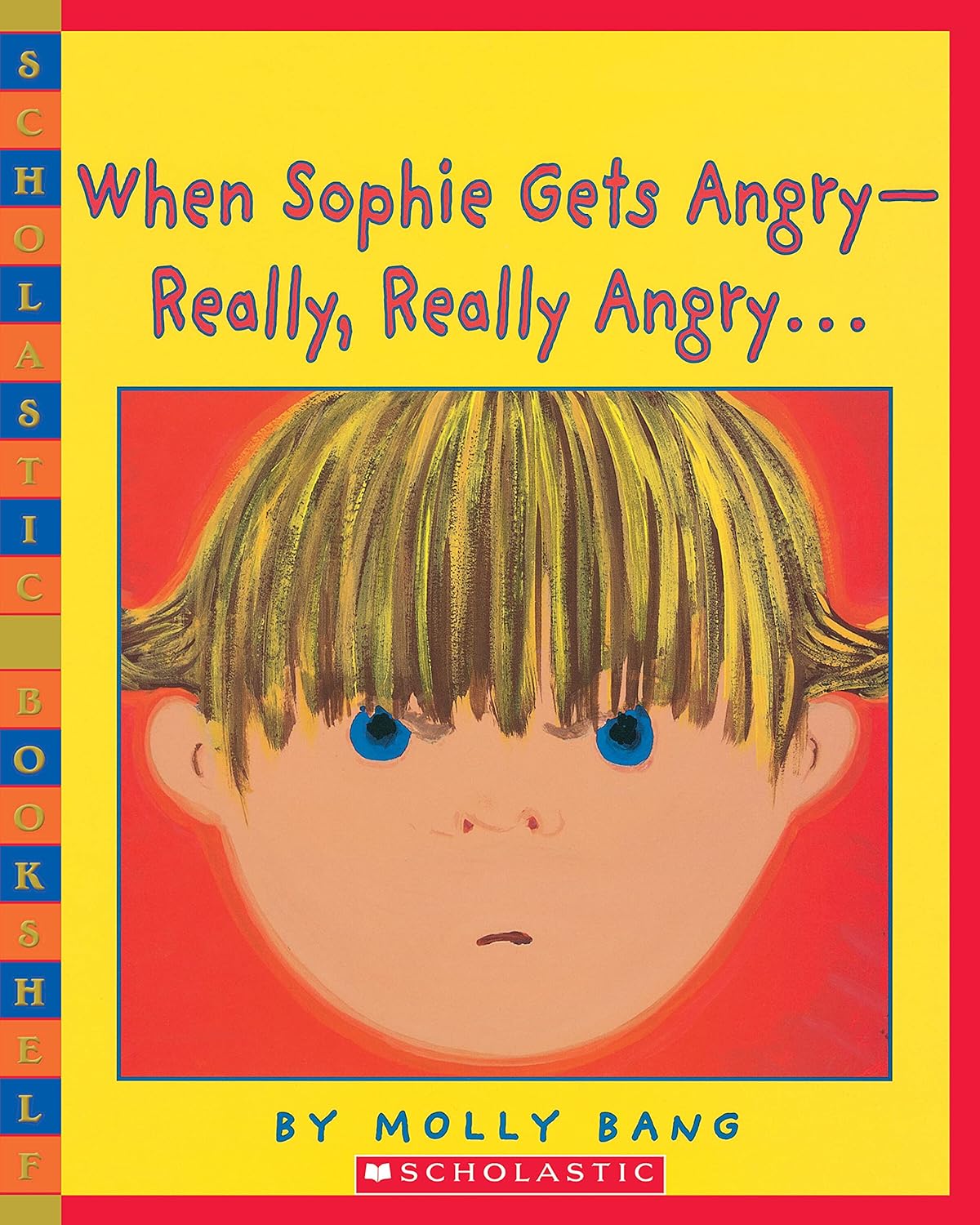
When Sophie Gets Angry — Really, Really Angry, written and illustrated by Molly Bang, is a 32-page picture book about a girl who gets very angry when her sister takes her toy gorilla, runs out of the house into the woods, climbs a beech tree, and comes home calmer and ready. Published in 1999 and a 2000 Caldecott Honor book, it received starred reviews from School Library Journal and the New York Times Book Review and has become one of the most widely used picture books in American early childhood classrooms for discussions of anger, big feelings, and self-regulation. What makes it distinctive is not its story — simple, almost wordless — but its illustrations: Bang uses color as a direct expression of emotional state, moving from blazing reds and oranges during Sophie’s rage to cool blues and greens as she calms in nature, giving children a visual vocabulary for what anger looks like and what calm feels like. This guide covers When Sophie Gets Angry‘s reading level, whether it’s a read-aloud or independent read, what it’s about, its themes, how long it takes to read, and similar books — designed for parents and teachers of K–2 readers.
For Parents
A short, visually powerful picture book about a child who gets very angry and finds her own way back to calm — without adult intervention. Best as a read-aloud for ages 3–7. No content concerns. One of the most useful books available for opening a conversation with a young child about what to do with big feelings.
For Teachers
A PreK–2 SEL staple for discussions of anger, self-regulation, and coping strategies. Bang’s color-as-emotion technique is one of the most teachable illustration choices in picture book literature — children can track Sophie’s feelings by the colors on the page and connect those colors to their own emotional experience. Used widely by early childhood therapists and counselors as well as classroom teachers.
When Sophie Gets Angry at a Glance
Find on Amazon →| Author & Illustrator | Molly Bang (author & illustrator) |
| Published | 1999 (Scholastic / Blue Sky Press) |
| Grade Level | PreK–K read-aloud; K–1 independent (our assessment) |
| Recommended Age | Read-aloud ages 3–7; independent reading ages 5–7 |
| Best For | Read-aloud ages 3–7; independent reading ages 5–7 |
| Lexile | 340L |
| ATOS Level | 1.4 |
| Word Count | 166 |
| Pages | 32 |
| Genre | Picture book / realistic fiction / social-emotional |
| Awards | Caldecott Honor (2000); Jane Addams Honor Award |
For official Lexile and AR levels, visit Lexile.com or AR BookFinder. ReadingVine provides independent editorial assessments.
What Reading Level Is When Sophie Gets Angry?
When Sophie Gets Angry has a Lexile of 340L and an ATOS level of 1.4 — at 166 words, one of the shortest texts in this catalog, with approximately ten words per page. The prose is simple and direct; a confident kindergartner can read the text independently. The reading level scores accurately reflect the words but not the book’s most significant demand, which is visual: the illustrations carry the emotional arc of the story in color and composition, and reading this book well means reading the pictures as carefully as the text. A child who rushes through the words misses most of what the book is doing.
The 340L Lexile is notably higher than some other very short picture books (Leo the Late Bloomer is 120L; Knuffle Bunny is 120L) despite a similar word count, reflecting that Bang’s sentences, while brief, tend toward slightly more complex structures than those simpler texts. For official Lexile and AR scores, visit Lexile.com or AR BookFinder. ReadingVine’s assessments are independent editorial judgments.
Is When Sophie Gets Angry a Read-Aloud or Independent Read?
This is primarily a read-aloud for ages 3–7, and one whose power is almost entirely in the illustrations — meaning the experience of reading it together, looking at each spread carefully, is what makes it work. A child reading independently will follow the story; a child reading it with an adult who pauses to ask “what color is this page?” and “why do you think Bang chose that color?” gets the full experience.
For independent reading, a confident K–1 reader can manage the text easily. The book is short enough that children often return to it on their own — particularly children who found something in Sophie’s anger that they recognized and want to revisit.
Before you start, look at the cover together and ask your child: “What do you think Sophie is feeling right now? How can you tell?” As you read, pause at the shift from red-orange pages to blue-green pages and ask: “What’s happening to Sophie’s feelings? How do the colors tell you?” After the book, ask: “What do you do when you get really, really angry?” The color conversation is the book’s real gift — it gives children a way to name and track their own emotional states using color.
What Is When Sophie Gets Angry About?
Sophie is playing with her gorilla when her sister takes it right out of her hands. Sophie’s mother tells her to let her sister have a turn. As the gorilla is snatched away, Sophie trips over a toy truck. She gets angry — really, really angry. She runs outside, past the garden, past the fence, into the woods. She cries. She runs until she can’t run anymore and then she climbs a beech tree, high up into the branches, where the wide world surrounds her and the wind and the sound of the waves slowly return her to herself.
By the time she climbs back down, she is ready. She walks home. The family is there. Everything feels okay. The book ends with Sophie coming through the door, the house warm and welcoming, the anger resolved — not through discussion or apology, but through Sophie’s own self-regulation in nature and her own decision to return.
This resolution — Sophie calming herself without adult help, coming home when she is ready — is both the book’s greatest strength and its most-discussed limitation. It shows children that they have the capacity to manage their own feelings. It does not show them how to resolve the conflict that caused the anger, or how to repair a relationship after it. Parents and teachers who use the book typically extend the conversation beyond the ending.
When Sophie Gets Angry Characters
Sophie is the book’s only fully realized character — a young girl whose anger is depicted with total seriousness and whose coping strategy (running, climbing, being in nature, returning when ready) is shown as genuinely effective. She does not apologize; she does not explain herself; she simply goes away, regulates, and comes back. The sister who triggers the crisis appears only briefly, as does Sophie’s mother. Their presence is enough to establish the situation; the book then follows Sophie alone. The gorilla — the contested object — appears in the first and last pages, bookending a story about what happens in between.
When Sophie Gets Angry Themes and Lessons
The book’s most important teaching tool is its color. Bang moves deliberately from warm, explosive colors — the reds, oranges, and yellows that fill the pages during Sophie’s rage, which some reviewers describe as looking like fire or a volcano — through a gradual transition into the cool blues and greens of the forest and the ocean as Sophie calms. This color arc is not subtle; it is the book’s primary argument. Children who understand color emotionally — who know that red feels different from blue in their bodies — can use this book as a literal map of their own emotional landscape. Early childhood therapists have used the color progression to help children identify where they are in their own anger cycle, asking “are you in a red page or a green page right now?”
The coping strategy Sophie uses — physical movement, solitude, nature, time — is one of the most research-supported approaches to emotional regulation available, and it is significant that Bang chose it rather than having Sophie talk about her feelings or have an adult help her calm down. Sophie does this herself. The book’s implicit message is one of genuine confidence in a child’s capacity to self-regulate: Sophie doesn’t need to be fixed; she needs space and time, and she takes both. This makes it particularly useful for children who are told to “calm down” but have never been shown what that actually looks like from the inside.
The book does not address the sibling conflict that caused the anger, and it does not model an apology or a repair. This is a genuine limitation worth discussing with children — getting calm is the first step, not the whole journey. Many teachers use the book to open a conversation about what comes after the green pages: “Sophie came home feeling better. What do you think she might have said to her sister? What would you say?”
Talking with your child: What made Sophie so angry? Have you ever felt that angry? What do you notice about the colors when Sophie is really mad — and what do the colors look like when she starts to feel better? What does Sophie do to calm down — and is there something like that you do? What do you think happened when Sophie got home?
How Long Is When Sophie Gets Angry?
When Sophie Gets Angry is 32 pages with 166 words — among the shortest texts in this catalog. Most adults can read it aloud in about four to five minutes. The brevity is appropriate: Sophie’s emotional arc from rage to calm is compressed and direct, and the book does not overstay its welcome. It rewards slow reading — pausing at each spread to look at the colors, to notice what is happening in the background, to track Sophie’s body language across the pages — more than it rewards rushing through. The read-aloud time nearly doubles when you stop to look at the illustrations properly, which is exactly the right pace.
Books Similar to When Sophie Gets Angry
About Molly Bang
Molly Bang was born in 1943 in Princeton, New Jersey, and grew up in a family with deep connections to Japan — her mother was a scholar of Japanese art and her parents lived in Japan for extended periods. She studied Far Eastern Studies at the University of Arizona and at Harvard, worked as a reporter, and spent time as an educator on public health projects in Bangladesh and West Africa before turning to children’s books. She has written and illustrated more than twenty books for young readers, earning three Caldecott Honors: for Ten, Nine, Eight (1983), The Grey Lady and the Strawberry Snatcher (1981), and When Sophie Gets Angry (2000) — making her one of the few illustrators to receive three Caldecott Honors. She is also the author of Picture This: How Pictures Work, a widely used guide to visual composition and the emotional impact of color, line, and shape in illustration — the theoretical framework underlying the color choices in When Sophie Gets Angry.
When Sophie Gets Angry: Frequently Asked Questions
What reading level is When Sophie Gets Angry?
When Sophie Gets Angry has a Lexile of 340L and an ATOS level of 1.4. At 166 words, it is among the shortest texts in this catalog — accessible to kindergartners as an independent reader. Our assessment: read-aloud for ages 3–7; independent reading for ages 5–7. For official Lexile and AR scores, visit Lexile.com or AR BookFinder.
What is When Sophie Gets Angry about?
Sophie’s sister takes her toy gorilla and Sophie gets very angry — really, really angry. She runs out of the house into the woods, climbs a beech tree, watches the ocean, and slowly calms down. When she is ready, she walks home. The book follows Sophie’s emotional arc from explosion to regulation, using color to track each stage of her feelings.
How does Molly Bang use color in When Sophie Gets Angry?
The pages during Sophie’s rage are filled with reds, oranges, and yellows — colors that evoke fire and heat. As Sophie runs into the woods and begins to calm, the colors shift to blues and greens — cool, quiet, natural. The transition from warm to cool mirrors Sophie’s emotional arc from anger to calm, giving children a visual language for tracking their own feelings. This color progression is the book’s most distinctive and most discussed quality.
Can a kindergartner read When Sophie Gets Angry alone?
A confident kindergartner can read the text independently — at 166 words with straightforward sentences, it is very accessible. Most children will benefit from encountering it as a read-aloud first, with an adult who pauses to look at the illustrations and discuss the colors. The words alone tell a simple story; the illustrations tell the emotional one.
Does Sophie apologize at the end of When Sophie Gets Angry?
No — Sophie comes home when she is ready and the family welcomes her, but there is no apology or explicit resolution of the sibling conflict. This is one of the book’s most discussed features: it shows children how to self-regulate but not how to repair. Most teachers and parents extend the conversation beyond the book’s ending by asking what Sophie might say to her sister when she gets home.
How long does it take to read When Sophie Gets Angry aloud?
About four to five minutes for the text alone. The experience doubles in length when you pause to look at the illustrations carefully — which is the right pace. The color transitions between pages are where the book’s argument lives, and rushing past them misses most of what makes it work.