
 = Partner Site
Chasing Vermeer Reading Level: A Complete Guide
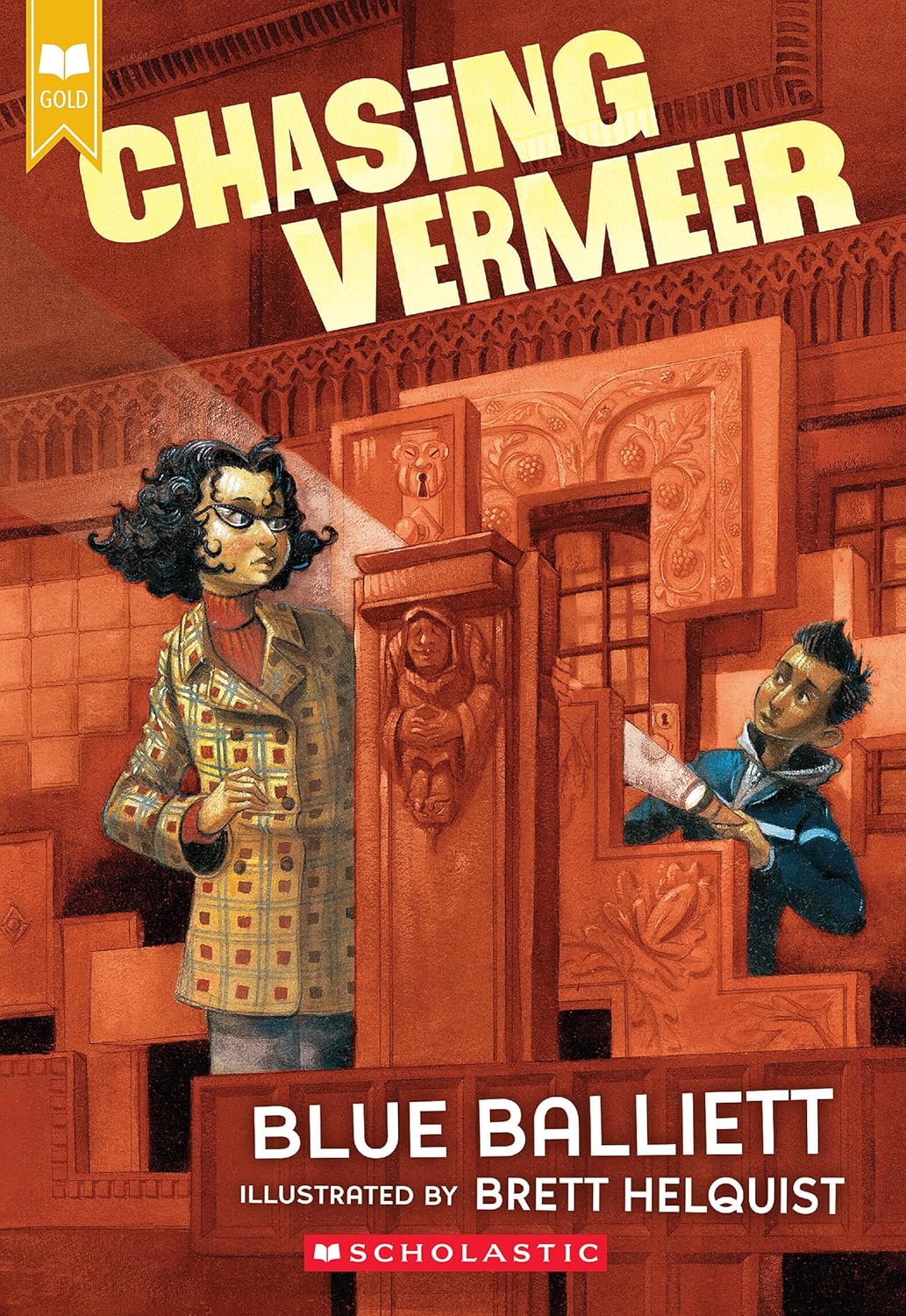
Chasing Vermeer, written by Blue Balliett and illustrated by Brett Helquist, is a 272-page art mystery about two sixth-graders — Petra Andalee and Calder Pillay — whose seemingly unrelated lives begin to intertwine after each receives an anonymous letter about a book of unexplained coincidences. When Vermeer’s A Lady Writing is stolen in transit to the Art Institute of Chicago, and the thief publishes newspaper advertisements demanding the art world rethink which paintings attributed to Vermeer he actually painted, Petra and Calder find themselves at the center of an international art scandal that has stumped even the FBI. Their investigation uses Calder’s pentominoes — a set of geometric puzzle tiles that he carries everywhere and consults for intuitive guidance — alongside Petra’s visual imagination and her ability to see patterns others miss. Published in 2004 by Scholastic Press, an Edgar Award winner and an Agatha Award winner, it launched a trilogy about the same two characters and has been used in classrooms as an entry point to art history, critical thinking, and the mystery of coincidence. Brett Helquist, the illustrator of the A Series of Unfortunate Events books, provides illustrations throughout. This guide covers reading level, age appropriateness, content, themes, and similar books.
For Parents
An art mystery about two sixth-graders who investigate the theft of a Vermeer painting using puzzle tiles, visual intuition, and a willingness to follow improbable connections. Ages 9–13, grades 4–7. No content concerns. A natural companion to art museum visits and to art history discussions. Brett Helquist’s illustrations are embedded throughout.
For Teachers
A grades 4–7 classroom text with strong connections to art history (the historical Johannes Vermeer, the question of attribution and authenticity), visual literacy (Helquist’s hidden-image illustrations), and critical thinking (pentomino puzzles as a model for problem-solving through intuition). Edgar Award and Agatha Award winner. The illustrations contain hidden visual puzzles that reward close looking. Balliett wrote the book while teaching at the University of Chicago Laboratory Schools.
Chasing Vermeer at a Glance
Find on Amazon →| Author | Blue Balliett |
| Illustrator | Brett Helquist |
| Published | 2004 (Scholastic Press) |
| Grade Level | 4–7 (our assessment) |
| Recommended Age | 9–13 |
| Lexile | 770L |
| ATOS Level | 5.4 |
| Word Count | 39,699 |
| Pages | 272–304 (editions vary) |
| Genre | Mystery / realistic fiction / art |
| Setting | Hyde Park, Chicago; contemporary |
| Awards | Edgar Award – Best Juvenile Novel (2005); Agatha Award |
| Series | Chasing Vermeer trilogy (3 books) |
For official Lexile and AR levels, visit Lexile.com or AR BookFinder. ReadingVine provides independent editorial assessments.
What Reading Level Is Chasing Vermeer?
Lexile 770L, ATOS 5.4, interest level grades 3–8. Our assessment: grades 4–7, ages 9–13. The 770L reflects Balliett’s clear, atmospheric prose — accessible but with the density and layering of a book that asks readers to notice more than is stated directly. The 39,699-word count puts it in the same range as From the Desk of Zoe Washington (54,194 words) but more compact; most readers in the target range complete it in one to two weeks. The book is also notable for its visual layer — Helquist’s illustrations contain hidden pentomino shapes and visual puzzles that readers who look carefully will find and that are not present for readers who don’t. For official scores, visit Lexile.com or AR BookFinder.
What Is Chasing Vermeer About?
Three strangers each receive a mysterious anonymous letter about injustice, the value of art, and the idea that the world operates on hidden connections most people don’t notice. Separately, two sixth-graders at a school near the University of Chicago begin to be drawn together: Calder Pillay, who thinks in pentominoes — a set of twelve geometric tiles he carries everywhere, each with a letter, that he uses as a kind of intuitive oracle — and Petra Andalee, who has vivid visual imagination and a tendency to notice details others overlook. When Vermeer’s A Lady Writing is stolen on its way to the Art Institute of Chicago, and a thief begins publishing newspaper advertisements demanding recognition of the fact that many paintings attributed to Vermeer may not be his, Calder and Petra find that the clues they’ve each been noticing independently are pointing toward the same answer.
Their investigation takes them through the University of Chicago neighborhood — its buildings, its eccentrics, its specific Chicago winter — while the FBI pursues the painting internationally. The solution, when it comes, involves both the art historical question the thief raised (which paintings are genuinely Vermeer’s?) and the specific circumstances of the theft. Both Calder’s pentominoes and Petra’s visual intuition turn out to be essential; neither could have solved it alone.
Johannes Vermeer — The Real Painter
Johannes Vermeer (1632–1675) was a Dutch Golden Age painter from Delft whose work was largely forgotten for two centuries before being rediscovered in the 1860s by French art critic Théophile Thoré-Bürger. The question of which paintings are genuinely Vermeer’s — rather than misattributed works by other artists — is a real and ongoing scholarly debate; only about 34–36 paintings are now accepted as Vermeer’s, and the authentication question drives much of the novel’s central conceit. The forger Han van Meegeren famously sold fake Vermeers in the 1930s and 1940s, including to Hermann Göring — a real case of art world deception that the novel’s thief echoes in spirit if not in fact.
The painting at the center of the novel, A Lady Writing, is a real Vermeer in the collection of the National Gallery of Art in Washington, D.C. Balliett’s use of real paintings, real museums, and real art historical questions gives the book’s mystery a grounding in actual scholarship that rewards readers who are curious enough to look further.
Pentominoes — Calder’s Thinking Tool
Pentominoes are geometric shapes made by connecting five squares edge-to-edge — there are twelve possible configurations, each assigned a letter. Calder uses a set of pentomino tiles as a thinking and intuition tool throughout the novel, pulling them from his pocket and interpreting the letter or shape that comes out as a clue to the direction his thinking should take. The twelve pentomino shapes are named by the letters they resemble: F, I, L, N, P, T, U, V, W, X, Y, Z.
Balliett uses pentominoes not merely as a character quirk but as a structural argument: that some problems are best approached through pattern recognition and intuition rather than linear logic, and that a flexible, playful mind — one that can see connections across apparently unrelated things — is a valid and valuable form of intelligence. Pentomino puzzles are a standard recreational mathematics tool, and teachers who want to extend the book’s curriculum connections can find published pentomino puzzle sets and activities that parallel Calder’s approach in the novel.
Brett Helquist’s Hidden Illustrations
Brett Helquist — who illustrated the A Series of Unfortunate Events books for Lemony Snicket — embedded pentomino shapes and other visual puzzles throughout his illustrations for Chasing Vermeer. Readers who examine the illustrations carefully will find hidden shapes, hidden letters, and visual information that parallel the novel’s mystery content. This makes the illustrations genuinely interactive rather than decorative: looking closely at them is itself a form of investigation. For classroom use, the illustrations provide a natural visual literacy exercise — asking students to look carefully, describe what they see, and consider what might be hidden.
Chasing Vermeer Themes and Lessons
The novel’s central argument is about different kinds of intelligence and how they complement each other. Calder thinks in patterns and shapes; Petra thinks in images and visual associations. Neither approach alone solves the mystery; both are necessary, and neither is presented as superior. This is the same argument The Mysterious Benedict Society makes through its four-child team — and it is made here through two children whose collaboration is the result of following the connections they each notice rather than following a plan.
The book also asks, quietly, what art is for and who it belongs to. The thief’s argument — that great paintings belong to everyone, not to the institutions that hold them, and that the art world’s attribution practices have corrupted the meaning of authenticity — is presented as wrong in its methods and partly right in its underlying concern. Balliett doesn’t resolve this fully, and she doesn’t need to: the question of what art is worth and who should have access to it is genuinely open.
Discussion questions: How are Petra and Calder different from each other — and what does each one contribute that the other can’t? What does the thief want — is any part of the thief’s argument valid? What do the pentominoes help Calder do? What did you find in Helquist’s illustrations that you might have missed on a first look?
The Chasing Vermeer Trilogy
The trilogy follows Petra and Calder across three art mysteries: Chasing Vermeer (2004), The Wright 3 (2006, in which a third friend Tommy joins the investigation of the threatened Robie House by Frank Lloyd Wright), and The Calder Game (2008, involving the sculptor Alexander Calder). Each book uses a different artist or artwork as its focus and introduces its own set of visual and conceptual puzzles. The books should be read in order; later books refer to events of the earlier ones and the characters develop significantly across the series.
Books Similar to Chasing Vermeer
About Blue Balliett
Blue Balliett (born Elizabeth Balliett) grew up in New York City, the daughter of jazz critic Whitney Balliett of The New Yorker. She spent her childhood visiting the Metropolitan Museum of Art, the Guggenheim, and the Frick Collection, and studied art history at Brown University. She taught third grade at the University of Chicago Laboratory Schools for years before becoming a full-time writer; Chasing Vermeer grew directly from her classroom experience. She received the Chicago Public Library’s 21st Century Award, the first time the award was given to a children’s book author. Her other works include the Chasing Vermeer sequels, Hold Fast (2013, a contemporary realistic novel about homelessness), and The Danger Box (2010). She lives in Chicago.
Chasing Vermeer: Frequently Asked Questions
What reading level is Chasing Vermeer?
Lexile 770L, ATOS 5.4, interest level grades 3–8. Our assessment: grades 4–7, ages 9–13. Atmospheric, layered prose with a visual dimension in Helquist’s illustrations. For official scores, visit Lexile.com or AR BookFinder.
What is Chasing Vermeer about?
Sixth-graders Petra Andalee and Calder Pillay find themselves investigating the theft of a Vermeer painting — A Lady Writing — stolen in transit to the Art Institute of Chicago. The thief publishes newspaper ads demanding the art world reconsider Vermeer attribution. Calder uses pentomino tiles for intuitive problem-solving; Petra uses visual pattern recognition. Together they solve what the FBI couldn’t.
What are pentominoes?
Geometric shapes made by connecting five squares edge-to-edge — twelve possible configurations, each with a letter name. Calder carries a set and consults them as a thinking tool throughout the novel. Pentomino puzzles are a real recreational mathematics tool; published sets are available and make a natural classroom companion to the book.
Is Chasing Vermeer part of a series?
Yes — a trilogy: Chasing Vermeer (2004), The Wright 3 (2006, about Frank Lloyd Wright’s Robie House), and The Calder Game (2008, about the sculptor Alexander Calder). The same characters appear across all three. Read in order.
Who illustrated Chasing Vermeer?
Brett Helquist, who also illustrated the A Series of Unfortunate Events books for Lemony Snicket. His illustrations for Chasing Vermeer contain hidden pentomino shapes and visual puzzles that reward careful looking — making the illustrations interactive rather than decorative.