
 = Partner Site
Click, Clack, Moo: Cows That Type Reading Level: A Complete Guide
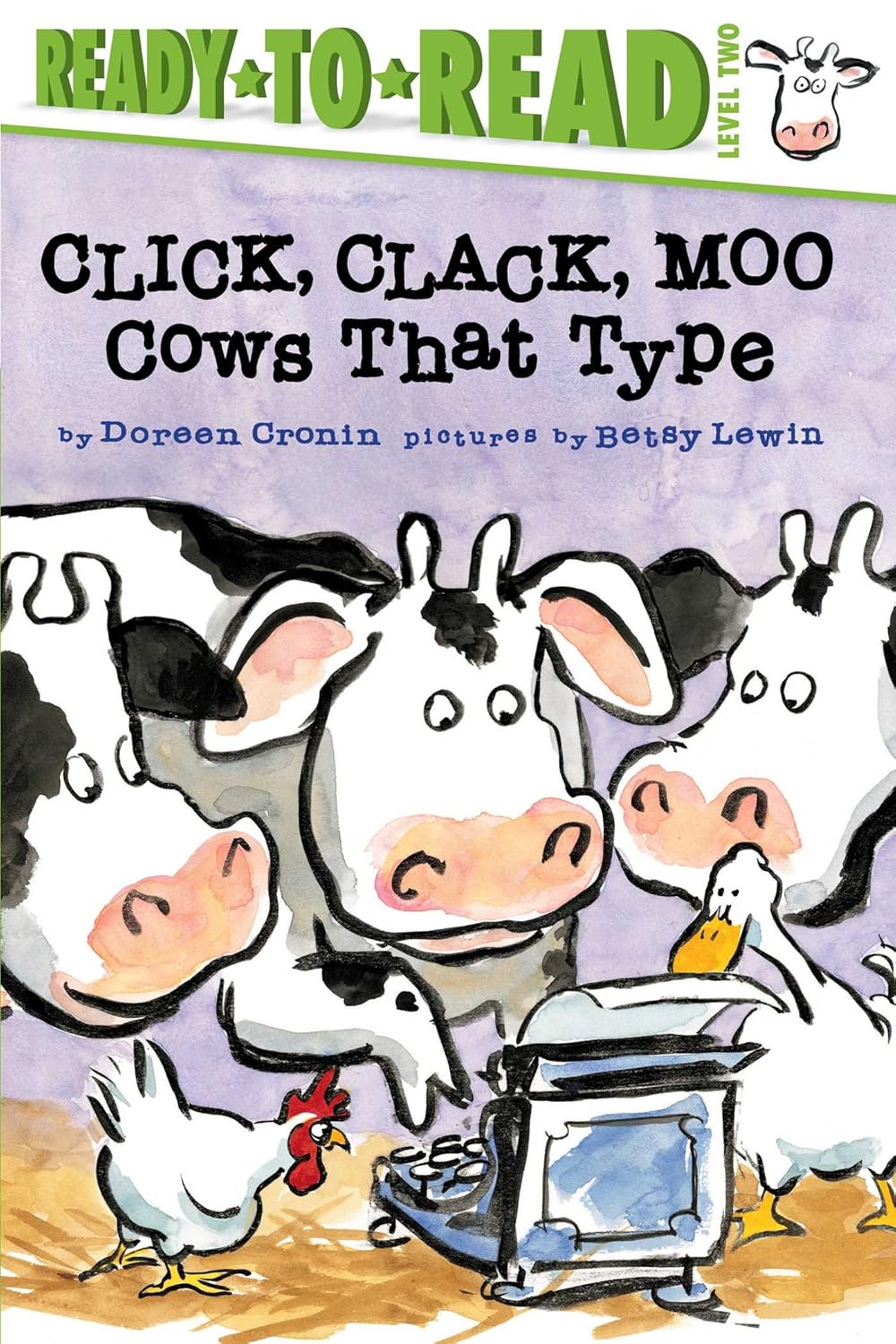
Click, Clack, Moo: Cows That Type, written by Doreen Cronin and illustrated by Betsy Lewin, is a 32-page picture book about a farmer whose cows discover an old typewriter in the barn and begin using it to send him demand letters. They want electric blankets. The barn is cold. When Farmer Brown refuses, the cows go on strike — no milk. The hens join in solidarity — no eggs. Duck serves as the neutral party to broker negotiations. The cows agree to exchange the typewriter for the electric blankets. The very next morning, Duck delivers a note from the ducks: they would like a diving board for the pond. Published in 2000 and a 2001 Caldecott Honor book, it is a New York Times bestseller that reads simultaneously as a very funny picture book about typing cows and as a very accurate picture book about collective bargaining, work stoppages, neutral arbitration, and the inevitable next round of demands once a negotiation succeeds. Children find it hilarious. Adults find it uncomfortably relatable. The combination is what makes it one of the most beloved read-alouds in American classrooms. This guide covers Click, Clack, Moo‘s reading level, whether it’s a read-aloud or independent read, what it’s about, its themes, how long it takes to read, and similar books — designed for parents and teachers of K–2 readers.
For Parents
A genuinely funny picture book about cows who type demand letters and go on strike — with a twist ending that adults will recognize as a perfect joke about how negotiations actually work. Best for ages 3–8. No content concerns. One of those rare picture books that works equally well for the child and the adult reading it.
For Teachers
A PreK–2 classroom staple for discussions of problem-solving, negotiation, and compromise — with the adult subtext of labor relations available for older or more sophisticated discussions. Betsy Lewin’s loose, energetic watercolor cartoons make it ideal for illustration style studies. The first book in a beloved series; Duck for President is the natural follow-up for election units.
Click, Clack, Moo at a Glance
Find on Amazon →| Author | Doreen Cronin |
| Illustrator | Betsy Lewin |
| Published | 2000 (Simon & Schuster Books for Young Readers) |
| Grade Level | PreK–2 (our assessment) |
| Recommended Age | 3–8 |
| Lexile | AD470L |
| ATOS Level | 2.3 |
| Guided Reading Level | M |
| Word Count | 403 |
| Pages | 32 |
| Genre | Picture book / humor / barnyard comedy |
| Awards | Caldecott Honor (2001); Irma S. Black Award Honor |
For official Lexile and AR levels, visit Lexile.com or AR BookFinder. ReadingVine provides independent editorial assessments.
What Reading Level Is Click, Clack, Moo?
Click, Clack, Moo has a Lexile of AD470L and an ATOS level of 2.3, with a Guided Reading Level of M. The AD designation indicates it is designed as a read-aloud, though the ATOS 2.3 and GRL M suggest it is also accessible for independent reading at the K–1 level. At 403 words across 32 pages, the text is brief and largely composed of short, punchy sentences and the cows’ and farmer’s typed notes — which are reproduced directly in the illustrations, making the back-and-forth negotiation visible on the page as well as in the narration.
The reading challenge in this book is not the vocabulary or syntax — both are simple and direct — but the comprehension of what the cows are actually doing. Children who do not know what a typewriter is, what a strike is, or what a neutral party does will still find the book very funny; children who do know these things will find it even funnier. The book’s comedy operates simultaneously at a child’s level (typing cows!) and at an adult’s level (this is a labor negotiation), and both levels are completely available without explanation. For official Lexile and AR scores, visit Lexile.com or AR BookFinder. ReadingVine’s assessments are independent editorial judgments.
Is Click, Clack, Moo a Read-Aloud or Independent Read?
This works beautifully as both a read-aloud for ages 3–8 and an independent read for ages 5–8. As a read-aloud it rewards distinct voices: Farmer Brown’s baffled indignation, the cows’ calm implacability, and Duck’s officious neutrality are all there in the text, waiting to be performed. The typewriter sound — “Click, clack, moo” — is the book’s recurring beat and is best read with the rhythmic emphasis of someone actually hearing it from outside the barn.
For independent reading, a confident K–1 reader can navigate the text easily. The short sentences, direct dialogue, and the transcribed notes make it a particularly satisfying independent read because the notes function as a different visual register — they look like real letters and give the story a documentary quality that children who have seen typed correspondence will recognize immediately.
Before you start, ask your child: “If you were a cow and your barn was cold, what would you do about it?” Read the book. Afterward: “Did the cows and Farmer Brown solve the problem? Was it fair? And what do you think about the ducks?” The duck twist ending generates the best conversations — children who feel the cows were right are often surprised to find they have mixed feelings about the ducks making the exact same move.
What Is Click, Clack, Moo About?
Farmer Brown’s cows have found an old typewriter in the barn. All day long he hears: click, clack, moo. Click, clack, moo. Clickety, clack, moo. Then a note appears on the barn door. The cows have typed a letter: the barn is cold at night, they want electric blankets. Farmer Brown is not sympathetic. “No milk today,” reads the next note — the cows have gone on strike.
The hens, whose coop is also cold, join in solidarity. No eggs either. Farmer Brown is furious and types his own note: “You are cows and hens. I demand milk and eggs.” The animals are unmoved. Duck, described as “a neutral party,” is dispatched to broker a deal: the cows and hens will exchange the typewriter for the electric blankets. Farmer Brown accepts. The exchange is made. The milk and eggs resume. The typewriter goes to Duck.
The next morning, Farmer Brown finds a note under his door. Duck has typed it. The ducks would like a diving board for the pond. Farmer Brown is staring at the note when the book ends. Click, clack, moo.
The ending is the book’s masterstroke. The cows and hens got what they wanted by organizing and negotiating. Now Duck, having been the neutral party, has acquired the typewriter and is immediately using it for exactly the same purpose. The system the cows invented has been taken up by the next party. Whether Farmer Brown will ever get a quiet morning again is left entirely to the reader’s imagination.
Click, Clack, Moo Characters
Farmer Brown is the book’s audience surrogate — the reasonable person who finds an unreasonable situation escalating beyond his control, and whose bafflement is entirely sympathetic. His typed note (“You are cows and hens. I demand milk and eggs”) is the book’s funniest single moment because it is so earnest and so completely missing the point. The cows are calm, organized, and absolutely certain they are right — which they are. The hens join without hesitation. Duck is the book’s cleverest figure: presented as a neutral party, impartial and procedurally correct, Duck executes the exchange with perfect propriety — and then immediately exploits the position to make the exact same demand the cows made. Duck understood the system all along. The diving board note is not opportunism; it is the logical next step of an animal who has been paying close attention.
Click, Clack, Moo Themes and Lessons
The book operates on two registers simultaneously, and both are completely valid. For children: typing cows are funny, a barn strike is funny, Duck getting the typewriter and immediately using it is funny. For adults: this is a precise and accurate depiction of how labor negotiations work, right down to the neutral arbitrator who turns out to have their own interests, and the moment a successful negotiation produces the next round of demands. Teachers who use this book to discuss negotiation and compromise with young children are genuinely using it correctly; teachers who use it with older students to discuss collective bargaining and the dynamics of labor relations are also using it correctly. The book does both without any didacticism at either level.
The cows’ specific weapon — literacy — is worth discussing with children who are old enough to notice it. The cows did not overpower Farmer Brown; they wrote to him. Their ability to communicate their demands in writing is what gives them leverage. A typewriter found in a barn becomes the instrument of their collective empowerment. Farmer Brown’s problem is not that his cows are strong; it is that his cows can type. This is a picture book argument for literacy as power, and it is made entirely through comedy.
Talking with your child: How did the cows and hens get what they wanted — did they use force, or something else? Was their deal with Farmer Brown fair? What was Duck’s plan all along? If you could send a typed note to anyone asking for something you want, who would you send it to and what would it say?
How Long Is Click, Clack, Moo?
Click, Clack, Moo is 32 pages with 403 words. Most adults can read it aloud in about five to seven minutes. It is the first book in a substantial series by Cronin and Lewin including Giggle, Giggle, Quack (2002), Duck for President (2004), Dooby Dooby Moo (2006), and many others, all featuring the same barnyard characters. Duck for President is the natural follow-up for any classroom doing a unit on elections or civic participation — Duck runs for farmer, then governor, then president, with entirely predictable results. The series is available in board book, picture book, and Ready-to-Read formats.
Books Similar to Click, Clack, Moo
About Doreen Cronin and Betsy Lewin
Doreen Cronin was born in 1966 and lives in Brooklyn, New York. She worked as an attorney before turning to writing children’s books. Click, Clack, Moo was her debut picture book and immediately established her as one of the most original voices in American children’s publishing. She has since written more than thirty books, including the full Click Clack series with Lewin, the Chicken Squad mystery series, and the picture book Bloom. Duck for President (2004), her follow-up with Lewin, was her second book and features the same barnyard animals in an election storyline that has made it a classroom staple for civic education units. She has said that Click, Clack, Moo came from a single image: a cow at a typewriter. The rest — the strike, the neutral party, the diving board — followed from that image’s logic.
Betsy Lewin is a graduate of Pratt Institute in Brooklyn and a prolific illustrator of children’s books. Her signature style — bold ink lines with loose, gestural watercolor washes in warm yellows and browns — gives the barnyard in Click, Clack, Moo an energy that perfectly matches Cronin’s deadpan comedy. Booklist called her illustrations “perfectly suited to this barnyard farce.” She has illustrated more than fifty books and lives in Brooklyn, New York.
Click, Clack, Moo: Frequently Asked Questions
What reading level is Click, Clack, Moo?
Click, Clack, Moo has a Lexile of AD470L and an ATOS of 2.3, with a Guided Reading Level of M. Our assessment: PreK–2, ages 3–8. The text is simple and direct; the comedy operates at both a child’s level and an adult’s level simultaneously. For official Lexile and AR scores, visit Lexile.com or AR BookFinder.
What is Click, Clack, Moo about?
Farmer Brown’s cows find a typewriter and use it to demand electric blankets because the barn is cold. When Farmer Brown refuses, the cows strike — no milk. The hens join — no eggs. Duck serves as neutral party to broker a deal: the cows exchange the typewriter for the blankets. The very next morning, Duck delivers a note from the ducks requesting a diving board for the pond.
What is the moral of Click, Clack, Moo?
For young children: if you have a problem, communicate clearly and work together to solve it. For older readers: collective action works, neutral parties have their own interests, and a successful negotiation tends to generate the next round of demands. The book delivers both morals without stating either — entirely through the comedy of cows, a strike, and Duck’s diving board note.
Who is Duck in Click, Clack, Moo?
Duck serves as the “neutral party” who brokers the exchange between the cows and Farmer Brown — carrying notes between the two sides and facilitating the deal. What becomes clear at the end is that Duck understood the situation better than anyone: having served as neutral party, Duck acquires the typewriter and immediately uses it to make the same demand the cows made. Duck was never truly neutral. Duck was waiting.
Is there a series after Click, Clack, Moo?
Yes — a substantial one. The most notable sequels include Giggle, Giggle, Quack (2002), in which Farmer Brown’s brother babysits the farm with disastrous results; Duck for President (2004), in which Duck runs for farmer, then governor, then president; and Dooby Dooby Moo (2006), in which the animals enter a talent show. The series has over a dozen entries, all by Cronin and Lewin, all featuring the same characters. Duck for President is the classroom follow-up for election and civic participation units.
How long does it take to read Click, Clack, Moo aloud?
About five to seven minutes. At 403 words across 32 pages it is on the shorter end of picture books in this catalog. The comedy benefits from a deliberate pace — Farmer Brown’s bafflement needs a beat, and the duck’s final note landing needs its moment — rather than being rushed through.