
 = Partner Site
East of Eden Reading Level: A Complete Guide
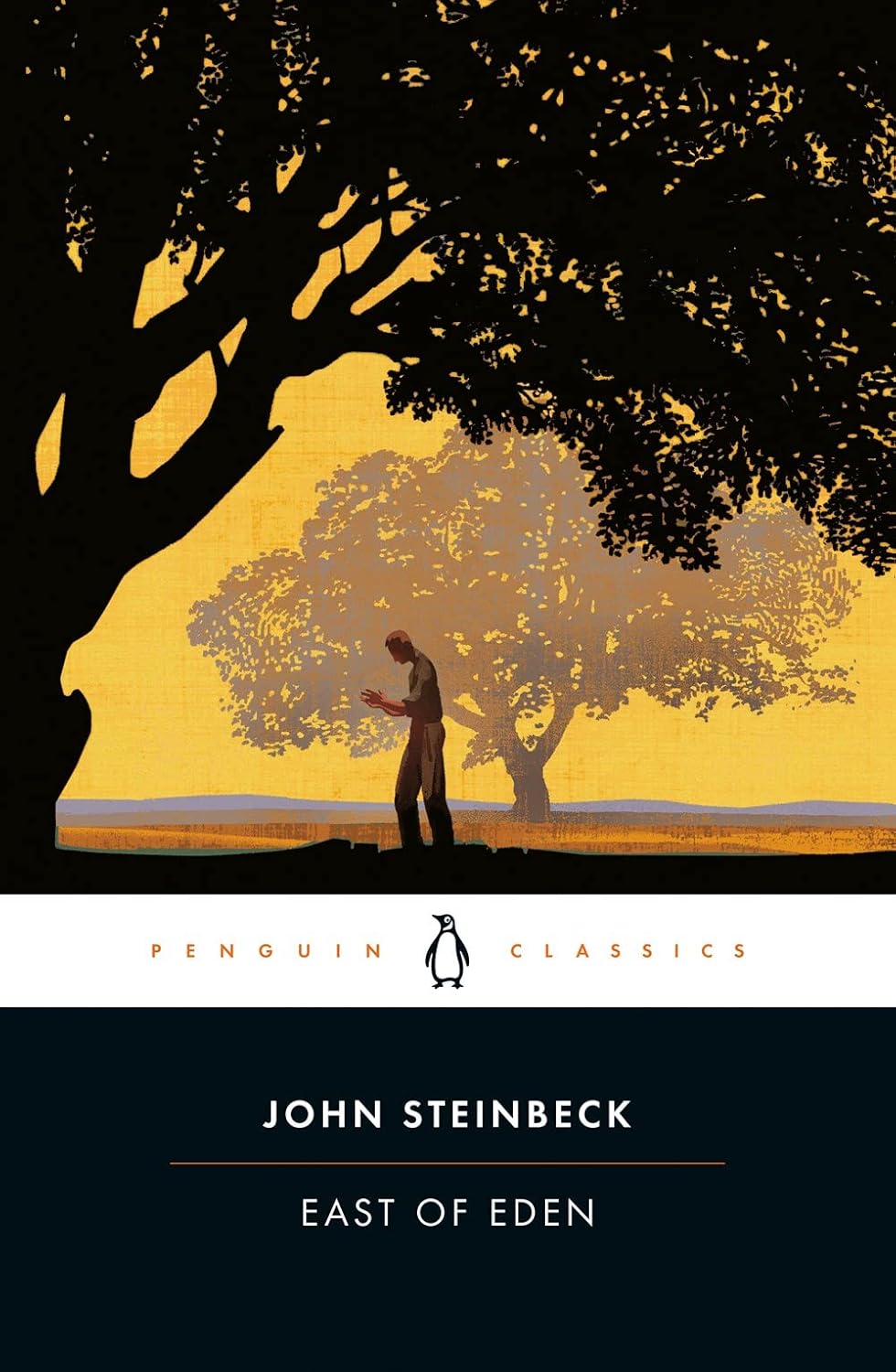
East of Eden by John Steinbeck is a multigenerational family saga set in California’s Salinas Valley, following two intertwined families — the Trasks and the Hamiltons — across roughly sixty years from the Civil War era to the end of World War I. Structured as a retelling of the Cain and Abel story from Genesis, it is Steinbeck’s longest, most ambitious, and most personally invested novel; he called it in his journal “the first book” and considered it his true work. Published in 1952, it won immediate popular success, became the book that revived Oprah’s Book Club in 2003, and remains a fixture of American high school and college reading lists. This complete guide covers East of Eden‘s reading level, recommended age, content considerations, characters, themes, and books similar to East of Eden, designed for parents, teachers, and students.
For Parents
A long, morally serious, and emotionally demanding novel — Steinbeck is working at the scale of biblical narrative, and the darkness of certain characters, particularly Cathy Ames, is sustained and purposeful rather than incidental. Appropriate for mature readers ages 15 and up. The sexual content, violence, and moral complexity are adult in register and require that level of maturity.
For Teachers
A demanding grades 11–12 text with exceptional material on free will and determinism, biblical allegory, the function of myth in American identity, and the relationship between parental love and child development. The “timshel” discussion in Chapter 22 — one of the most carefully constructed philosophical dialogues in American fiction — can anchor an entire unit on free will. Pairs naturally with Genesis, with The Grapes of Wrath, and with American historical context from the Gilded Age through World War I.
East of Eden at a Glance
Find on Amazon →| Author | John Steinbeck |
| Published | 1952 (Viking Press) |
| Grade Level | 11–12 (our assessment) |
| Recommended Age | 15+ |
| Flesch-Kincaid Grade | ~5.3 |
| Word Count | ~225,000 |
| Pages | 601 (Penguin Centennial paperback) |
| Chapters | 55 (in 4 parts) |
| Genre | Family saga / realist fiction / biblical allegory |
| Setting | Connecticut; Salinas Valley, California; Civil War era through ~1918 |
| Awards | National Book Award (1952) |
For official Lexile and AR levels, visit Lexile.com or AR BookFinder. ReadingVine provides independent editorial assessments.
What Reading Level Is East of Eden?
East of Eden carries a Flesch-Kincaid grade level of around 5.3 and a Lexile of 700L — scores that place it significantly below the novel’s actual demands, for the same reason those metrics fail Steinbeck’s earlier work: they measure sentence and vocabulary complexity, and Steinbeck writes much of his dialogue in plain vernacular that keeps the scores low. The novel’s actual demands are those of serious adult literary fiction.
At roughly 225,000 words and 601 pages, East of Eden is a genuinely long novel — substantially longer than The Grapes of Wrath — and it operates across a span of decades with a large cast of characters whose relationships and symbolic functions require sustained attention. The biblical allegory running beneath the surface narrative demands familiarity with Genesis; the philosophical discussion of free will in Chapter 22 requires readers who can engage with abstract moral argument at length; and Steinbeck’s shifts between intimate character study and sweeping historical panorama require the kind of readerly flexibility that develops with practice. The novel rewards rereading in ways that most high school fiction does not. Most readers in a classroom context work through it over four to six weeks; independent readers who commit fully may take longer. For official Lexile and AR scores, visit Lexile.com or AR BookFinder. ReadingVine’s assessments are independent editorial judgments.
What Age Is East of Eden Appropriate For?
We recommend East of Eden for readers ages 15 and up. The novel is adult literary fiction in its content, complexity, and emotional register, and there is no version of assigning or reading it that sidesteps this. It is widely taught in grades 11 and 12, and that is the appropriate context.
The novel contains significant sexual content, including scenes involving prostitution (Cathy’s work as a brothel madam occupies a substantial portion of the narrative), a sexual assault, and various adult relationships depicted with frankness. Violence is recurring and purposeful: Cathy is severely beaten by a character early in the novel; a character’s death is prolonged and disturbing; wartime deaths are rendered directly. Cathy Ames — the novel’s most discussed character — is portrayed as a person without ordinary human empathy, possibly as a form of congenital moral deficit, whose manipulation and harm of others is detailed across hundreds of pages. This characterization is Steinbeck’s deliberate choice and is central to the novel’s argument about the existence of evil as a force in human experience, but parents should be aware that Cathy’s sections are among the darkest sustained characterizations in American literary fiction. The novel also deals frankly with the deaths of children and with parental failures of devastating consequence.
What Is East of Eden About?
The novel opens with Steinbeck’s lyrical evocation of the Salinas Valley, the land he grew up in and the landscape that shapes everything that follows. Two families are then introduced in parallel: the Trasks, a Connecticut family whose generations will reenact the Cain and Abel story in different forms, and the Hamiltons, the Irish immigrant family of Steinbeck’s own maternal grandfather, who settle on unforgiving land in the Salinas Valley and build a large, boisterous, loving household on practically nothing.
The Trask story begins with Cyrus Trask, a Civil War veteran who parlays a minor wound into a career as a military administrator, amassing money and influence by dishonest means. His two sons — Adam and Charles — are the novel’s first Abel and Cain: Adam gentle and dreamy, Charles darker and harder, their father favoring Adam in a way Charles cannot forgive. From this sibling rivalry the novel’s central pattern is established. Adam eventually marries Cathy Ames — a woman Steinbeck describes as a monster in the original moral sense, a person who lacks the capacity for love or conscience that constitutes normal humanity — and settles in the Salinas Valley. Cathy shoots Adam and abandons him and their newborn twin sons immediately after their birth, returning to her career as a prostitute and eventually as a brothel owner.
Adam, devastated and passive for years, raises the twins — Caleb (Cal) and Aron — with the help of his Chinese-American servant Lee, who becomes the novel’s moral and philosophical center. Lee is the character through whom Steinbeck works out the novel’s central argument about free will. The twins reenact the Cain and Abel pattern once more: Aron is fair, well-liked, and devoted to a simplified moral worldview; Cal is darker, more complex, sharper-eyed, and haunted by the fear that his nature comes from his mother. His need for his father’s acknowledgment and love, and the consequences of not receiving it, drive the novel’s devastating final movement.
Woven through the Trask story is the Hamilton family’s chronicle — Sam Hamilton and his wife Liza, their nine children, their poverty and their warmth. The Hamiltons are the novel’s emotional counterweight to the Trasks: where the Trask men struggle with darkness and rivalry, the Hamiltons are characterized by humor, affection, and the dignity of people who have found meaning in work and family without illusion. Sam Hamilton and Lee together provide Adam with the philosophical companionship — and the debate over timshel — that is the novel’s intellectual core.
East of Eden Characters
Is East of Eden Banned?
East of Eden has been challenged in some schools and libraries over the decades, primarily on grounds of sexual content — Cathy’s occupation as a brothel madam and the directness with which Steinbeck depicts her sexual history have drawn objections from parents in several districts. These challenges have not resulted in widespread removal. The novel appears on the ALA’s list of challenged books but has not been a frequent target of formal challenge campaigns. It is widely taught in AP English and college-level American literature courses.
East of Eden Themes and Lessons
The novel’s philosophical argument turns on a single Hebrew word: timshel. In Chapter 22, Lee recounts how he and a group of elderly Chinese scholars spent two years studying the original Hebrew of Genesis 4:7, in which God speaks to Cain after Abel’s death. The King James translation renders the passage “thou shalt rule” over sin — a command. Another translation renders it “do thou rule” — also a command, but more urgent. The Hebrew, Lee argues, says “timshel” — “thou mayest.” Not a command. Not a promise. A possibility. The difference is the entire argument of the novel: if virtue is a command, then obedience is not virtue; if it is a promise, then damnation is predetermined. Only if it is a possibility — a freedom — does the choice to live with integrity carry actual moral weight.
This argument is what the Cain and Abel pattern in the Trask generations is designed to test. Adam and Charles, then Cal and Aron: in each generation, a father favors one son, the other son is consumed by resentment, and a catastrophe follows. But the pattern is not destiny. Cal is not Cain because he must be; he is Cal, who has the capacity to choose otherwise, and who fails in one crucial moment not because his nature determined it but because his father failed to give him what he needed. Adam’s final blessing — “timshel,” the last word of the novel — is the answer to everything: you may choose. Even now. It is always possible.
Cathy Ames functions in the novel’s argument as the proof that evil is real and not simply the absence of good — Steinbeck insists on this, refuses the comfortable liberalism that explains bad people as merely damaged. But she also functions as the limit case: even Cathy, in her final chapters, shows something that might be a vestigial human feeling. Steinbeck does not resolve whether this matters. The point is that her sons are not her, that inheriting her blood does not determine Cal’s choices, and that the fear of inheriting evil is one of the things the novel most wants to free its readers from.
Discussion questions for classrooms and families: What does “timshel” mean and why does it matter that it says “thou mayest” rather than “thou shalt”? Is Cathy Ames a realistic character or a symbol — and does it matter which she is? Why does Steinbeck return to the same pattern — father favoring one son, other son destroyed by the favoritism — across two generations? What does Lee’s role in the novel say about who Steinbeck considers the carrier of wisdom? Does Adam’s final blessing redeem him as a father, or is it too late?
How Many Pages and Chapters in East of Eden?
The Penguin Centennial paperback is 601 pages across 55 chapters organized into four parts. The parts are structurally asymmetrical: Parts 1, 2, and 3 each contain 11 chapters, while Part 4 contains 22 — reflecting the shift in the novel’s second half toward the Cal and Aron story, which requires more room because it is the argument’s culmination. Word count is approximately 225,000 words, making it substantially longer than The Grapes of Wrath.
Most readers in a classroom context complete it over four to six weeks when reading assigned sections. The novel’s rhythm varies considerably — some chapters are brief and intense, others panoramic and discursive — and the pace rewards following the structure rather than reading at a uniform rate. Steinbeck intended the reader to feel the difference between the generations’ stories in their texture as well as their content.
Books Similar to East of Eden
About John Steinbeck
John Steinbeck was born in 1902 in Salinas, California — the town at the center of East of Eden‘s setting, and the hometown of the Hamilton family, who are based directly on Steinbeck’s own maternal relatives. He described East of Eden as his most personal work: “I have put everything I have into it,” he wrote in his journal during its composition. The novel was written alongside a daily journal of letters to his editor Pascal Covici — published posthumously as Journal of a Novel: The East of Eden Letters — in which Steinbeck worked out his intentions, his doubts, and his sense of the book’s place in his life. He considered it the culmination of everything he had been working toward.
The novel was published in 1952, the same year it won the National Book Award. Steinbeck received the Nobel Prize for Literature in 1962. His other major works include Of Mice and Men, The Grapes of Wrath, Cannery Row, Tortilla Flat, and The Pearl. He died in New York City in 1968. The Salinas Valley where he grew up — the landscape he described with such love in East of Eden‘s opening pages — is now officially designated John Steinbeck Country by the state of California.
East of Eden: Frequently Asked Questions
What reading level is East of Eden?
East of Eden has a Flesch-Kincaid grade level of approximately 5.3 and a Lexile of 700L — scores that substantially underrepresent the novel’s actual demands, as Steinbeck’s vernacular prose keeps the sentence-level metrics low. The novel is roughly 225,000 words of serious adult literary fiction. Our editorial assessment places it at grades 11–12, ages 15 and up. For official Lexile and AR scores, visit Lexile.com or AR BookFinder.
What grade is East of Eden appropriate for?
We recommend grades 11–12, ages 15 and up. The novel contains substantial sexual content, sustained violence, and moral complexity at the level of adult literary fiction. It is most commonly assigned in AP English and senior-year American literature courses.
How many pages are in East of Eden?
The Penguin Centennial paperback is 601 pages across 55 chapters organized into four parts. Word count is approximately 225,000 words. Most classroom readers complete it over four to six weeks.
What is East of Eden about?
Two California families — the Trasks and the Hamiltons — across several generations from the Civil War era through World War I, structured as a retelling of the Cain and Abel story. The novel’s central argument is about free will: whether human beings are condemned by their nature or genuinely free to choose who they become. Steinbeck considered it his most important work.
What does “timshel” mean in East of Eden?
“Timshel” is the Hebrew word at the heart of the novel’s argument about free will. In Chapter 22, the character Lee recounts how he and a group of scholars studied Genesis 4:7, where God speaks to Cain. The King James Bible translates the key phrase as “thou shalt rule” over sin — a command. Lee argues the Hebrew actually says “thou mayest” — a possibility, not a command. This distinction is Steinbeck’s central theme: that virtue must be a choice, freely made, for it to have moral meaning. Adam’s final word in the novel is “timshel.”
Who is Cathy Ames in East of Eden?
Cathy Ames — later known as Kate — is Adam Trask’s wife and the mother of Cal and Aron. Steinbeck portrays her as a person who was born without the normal human capacity for love or conscience — a “monster” in the sense of a deviation from human type. She manipulates, abandons, and harms everyone around her throughout the novel. She is the novel’s embodiment of evil as a real force in human experience, and her existence is Steinbeck’s argument against the comfortable belief that all harmful behavior is simply the product of damage or circumstance.
Is East of Eden based on a true story?
Partially. The Hamilton family in the novel is based directly on Steinbeck’s own maternal family — Samuel Hamilton is his grandfather, and Steinbeck himself appears briefly as a minor character in the narrative. The Trask family is fictional, but set in the same real landscape of the Salinas Valley. Steinbeck described the novel as his attempt to give his own sons — to whom the book is dedicated — an account of the world they were born into and the valley he came from.
Is there an East of Eden movie?
Yes — a 1955 film directed by Elia Kazan, starring James Dean in his debut major film role as Cal Trask. The film adapts only the novel’s final section — the Cal and Aron story — and is widely credited with making James Dean a cultural phenomenon. It is rated not rated (pre-MPAA system) and is appropriate for the same age range as the novel. It does not represent the full scope of Steinbeck’s novel but is a powerful adaptation of its emotional core.