
 = Partner Site
Brave New World Reading Level: A Complete Guide
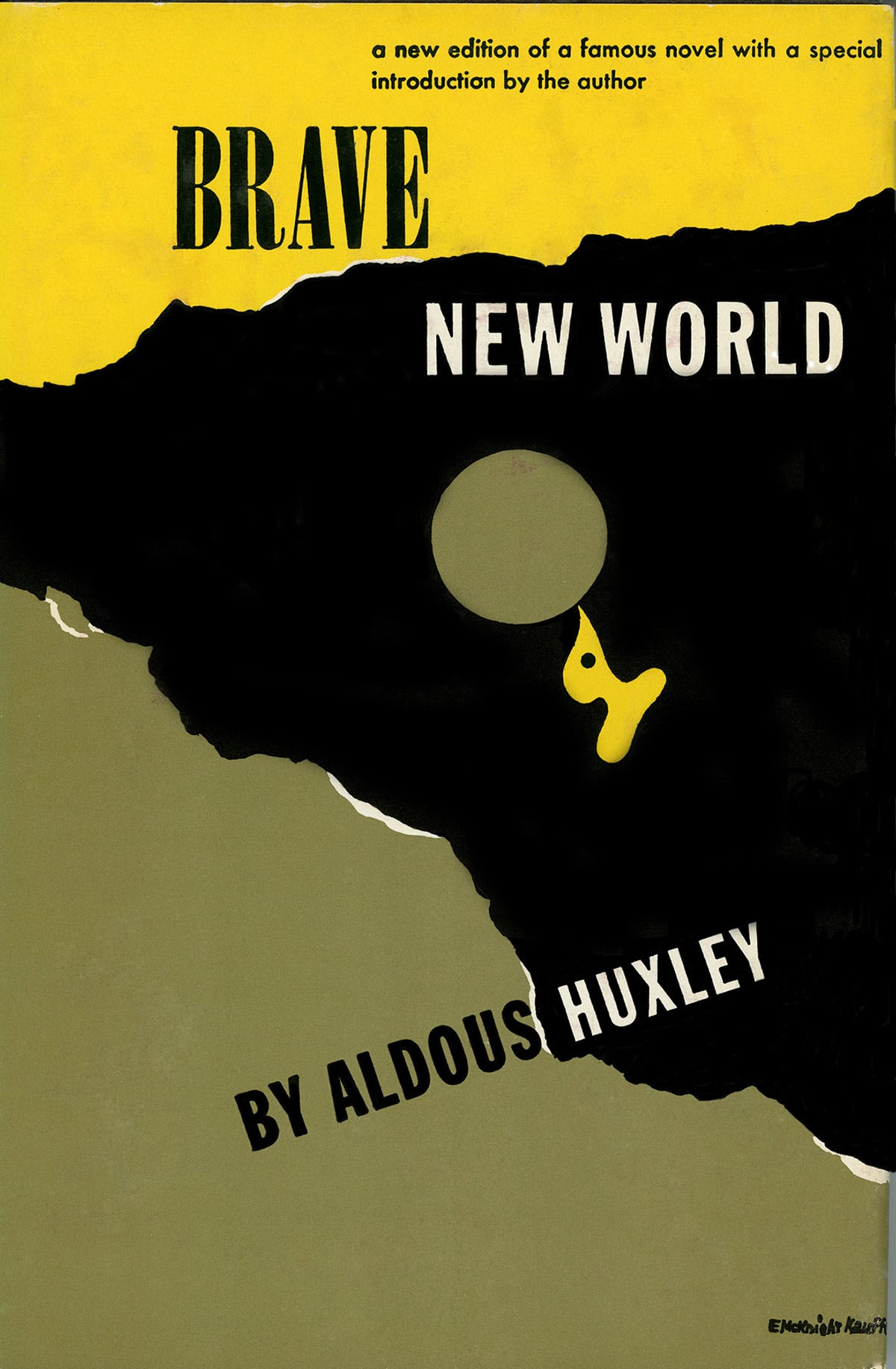
Brave New World by Aldous Huxley is a landmark dystopian novel set six hundred years in the future, in a world where human beings are manufactured in hatcheries, conditioned from birth to fill predetermined social roles, and kept docile by a pleasure drug called soma. First published in 1932, it is one of the most widely taught and widely debated novels in the high school and college canon — a prescient, unsettling, and often darkly funny book about the price of stability, the cost of happiness, and what is sacrificed when a society eliminates suffering by eliminating everything that makes suffering meaningful. This complete guide covers Brave New World‘s reading level, recommended age, content considerations, characters, themes, and books similar to Brave New World, designed for parents, teachers, and students.
For Parents
Brave New World contains explicit sexual content, drug use presented without moral condemnation, and themes — the abolition of family, romantic love, religion, and individual identity — that are handled with philosophical provocation rather than reassuring framing. It is best suited for readers ages 15 and up, and parents should be aware that its content and ideas are more challenging than many books assigned alongside it in the dystopian canon.
For Teachers
A cornerstone of the dystopian literature unit for grades 10–12, Brave New World rewards close reading of satire, utopia versus dystopia, and the philosophical traditions Huxley is engaging with — particularly the tension between happiness and freedom. Pairs productively with 1984 for a unit on totalitarianism, and with The Giver or Fahrenheit 451 for a broader dystopia unit across grade levels.
Brave New World at a Glance
Find on Amazon →| Author | Aldous Huxley |
| Published | 1932 |
| Grade Level | 10–12 (our assessment) |
| Recommended Age | 15+ |
| Flesch-Kincaid Grade | ~8.4 |
| Word Count | ~64,000 |
| Pages | ~311 (Harper Perennial paperback) |
| Chapters | 18 |
| Genre | Dystopian fiction / satire |
| Setting | London and a New Mexico reservation, AF 632 (far-future setting) |
| Awards | — |
For official Lexile and AR levels, visit Lexile.com or AR BookFinder. ReadingVine provides independent editorial assessments.
What Reading Level Is Brave New World?
By our editorial assessment, Brave New World reads at a grade 10–12 level. The Flesch-Kincaid formula places it at approximately grade 8.4 — a score that undersells the true difficulty of the novel, which lies not in sentence length but in the density of Huxley’s ideas and the sophistication of his satirical method. Huxley writes with wit and precision, and the prose is never opaque, but the novel requires a reader who can hold philosophical arguments in mind, track irony across long passages, and engage with concepts — utilitarianism, conditioning, the relationship between suffering and meaning — that are genuinely demanding.
The opening chapters in particular require patience: Huxley spends considerable time building the world of the World State through exposition and guided tours of its hatcheries and conditioning centers before the novel’s characters and their conflicts come into focus. Readers who approach Brave New World expecting the pacing of contemporary dystopian fiction will need to adjust. Those who give it the attention it asks for will find a novel that is frequently funny, consistently provocative, and more relevant to the present moment than most books published ninety years ago.
For official Lexile and Accelerated Reader scores, visit Lexile.com or AR BookFinder. ReadingVine’s assessments are independent editorial judgments.
What Age Is Brave New World Appropriate For?
We recommend Brave New World for readers ages 15 and up. The novel is most commonly assigned in 11th and 12th grade and is standard in AP English Literature curricula. It contains content that makes it genuinely unsuitable for younger middle-school readers, and parents should be aware of the specifics before handing it to a younger teenager.
Brave New World contains explicit and frequent sexual content. In the World State, sexual promiscuity is not only permitted but actively encouraged as a social norm — monogamy and romantic attachment are considered antisocial and destabilizing, and multiple sexual partnerships are the expected standard. Several scenes depict or describe sexual activity with some explicitness, and the novel’s treatment of sex as a recreational commodity rather than an intimate act is central to Huxley’s satirical argument. The novel also depicts casual and universal drug use: soma, a government-distributed euphoric, is taken by all World State citizens throughout the novel and is presented as a tool of social control without being explicitly condemned by the narrative — Huxley expects the reader to supply the condemnation. There is moderate violence in the novel’s final section, including a flogging scene and a suicide. The novel also contains period language regarding race that reflects 1932 attitudes, particularly in the depiction of the New Mexico Reservation and its inhabitants, which warrants contextual discussion in a classroom setting.
None of this content is gratuitous — every element serves Huxley’s satirical purpose — but the sexual content in particular is substantial enough that parents of younger or more sensitive teenagers should be aware of it. The novel is successfully taught at the 11th and 12th grade level, and the maturity of its ideas is fully matched by the maturity it requires of its reader.
What Is Brave New World About?
The World State, set in approximately 2540 CE, has achieved stability. Human beings are no longer born — they are decanted from bottles in Central London Hatchery and Conditioning Centre, where they are also sorted into one of five castes: Alphas and Betas, who perform intellectual and managerial work, and Gammas, Deltas, and Epsilons, who are chemically stunted during development to perform progressively simpler labor. From decanting onward, every citizen is conditioned through hypnopaedia (sleep-teaching) and Pavlovian techniques to love their caste, their work, and their place in the social order. Soma — a perfect pleasure drug with no hangover — handles whatever discomfort conditioning leaves behind. The World State’s motto is Community, Identity, Stability. It has delivered all three, at a cost it considers invisible because it has conditioned its citizens not to notice it.
The novel’s central characters are Bernard Marx, an Alpha-Plus psychologist who is physically smaller than his caste norm and harbors a persistent, uncomfortable awareness that something is missing from his life; Lenina Crowne, a pneumatic Beta who is fond of Bernard but genuinely cannot understand his dissatisfaction; and Helmholtz Watson, a gifted writer who feels, vaguely, that his talent is being wasted on feelie scripts and synthetic music. Bernard and Lenina travel to a Savage Reservation in New Mexico — one of the few remaining areas outside World State control — where they encounter John, a young man born naturally to a World State woman who was accidentally left behind on a previous visit. John has been raised on Shakespeare and on the Reservation’s own religious practices, and he has a full emotional and moral vocabulary that the World State has made unthinkable. Bernard brings John back to London.
The novel’s second half is largely John’s story: his encounter with a civilization that has abolished everything he considers sacred — family, love, suffering, God, death — and his increasing inability to find a way to live within it or outside it. Huxley uses the confrontation between John’s Shakespearean romanticism and the World State’s frictionless hedonism to stage his central argument: that a life from which suffering, struggle, and transcendence have been removed is not a fully human life, regardless of how pleasant it is. The ending is genuinely bleak and deliberately without resolution.
Brave New World Characters
Is Brave New World Banned?
Brave New World has been one of the most frequently challenged books in American schools and libraries for decades and appears regularly on the American Library Association’s lists of banned and challenged books. Challenges have cited the novel’s sexual content, its positive or neutral depiction of drug use, its perceived anti-family and anti-religious themes, and its profanity. It has been removed from school curricula and library shelves in multiple documented incidents across the United States.
The challenges present an irony that teachers have noted for years: a novel whose central argument is that a society which removes discomfort and difficulty from its citizens’ lives produces something less than fully human is challenged for containing discomfort and difficulty. Huxley’s sexual content and drug depictions are not incidental — they are the mechanism of the World State’s control, and understanding them as such is essential to understanding the novel’s critique. Brave New World remains widely taught at the high school and college level and is considered a cornerstone of the dystopian literary canon.
Brave New World Themes and Lessons
Huxley’s central question — would you choose happiness or freedom if you could only have one? — is posed most directly in the novel’s climactic debate between John and Mustapha Mond. Mond argues without embarrassment that the World State has made the rational trade: suffering, war, instability, and the ache of unfulfilled desire have been eliminated, and the cost — art, science, religion, passionate love — was worth paying. John argues, from Shakespeare and from his own formation, that a life without the capacity for suffering, transcendence, or genuine human connection is not worth living regardless of its comfort. Huxley does not resolve this debate cheaply. Mond’s position is given its full intellectual weight, and John’s position is given its full emotional weight, and the novel’s ending refuses to declare a winner.
What Huxley does make clear is that the World State’s stability depends on its citizens never having the philosophical vocabulary to ask Mond’s question in the first place. The conditioning that produces Lenina’s cheerful compliance is not a conspiracy visited on unwilling subjects — it is a system that works precisely because it removes the capacity to imagine alternatives. This is the novel’s most uncomfortable observation, and the one that has kept it relevant: the most effective form of control is not one that suppresses dissent but one that makes dissent unthinkable.
The novel also operates as a satire of early 20th-century trends — Fordism, behaviourism, consumerism, the cult of efficiency — that Huxley extrapolated forward with considerable accuracy. His World State is not a warning about a distant future so much as a description of tendencies already present in 1932, taken to their logical conclusion. Readers encountering the novel today will find that the distance between Huxley’s satire and the present moment has not increased as much as they might hope.
Discussion questions for classrooms: Is the World State a utopia or a dystopia — and does the answer depend on who you are within it? What does John mean when he says he claims the right to be unhappy? Is Mustapha Mond a villain? What does Huxley suggest about the relationship between art and suffering? How does the novel’s treatment of soma compare to contemporary discussions about social media, pharmaceuticals, or entertainment as tools of social management?
How Many Pages and Chapters in Brave New World?
The standard Harper Perennial paperback edition of Brave New World is approximately 311 pages, including Huxley’s 1946 foreword in which he reflects on the novel’s argument and its limitations. The novel itself runs 18 chapters across roughly 260 pages, with a word count of approximately 64,000 words. It is a relatively short novel by the standards of its ambitions — Huxley moves quickly, and the compression is part of the satire’s effect.
For readers in the recommended age range, expect a reading time of roughly 5–8 hours. As a classroom text, Brave New World rewards slow, discussion-heavy reading more than quick consumption — the world-building chapters at the opening and the philosophical debate chapters near the end in particular benefit from extended classroom time. A three-to-four week unit is standard, with the Mond-John debate in Chapter 17 serving as the natural culmination of the novel’s argument and the most productive single passage for discussion.
Books Similar to Brave New World
About Aldous Huxley
Aldous Huxley was born in 1894 in Godalming, Surrey, England, into one of the most distinguished intellectual families in Victorian Britain — his grandfather was the biologist T.H. Huxley, his great-uncle the poet Matthew Arnold. A childhood eye condition left him nearly blind for several years and prevented him from pursuing the scientific career he had planned, turning him instead toward literature. He studied English at Balliol College, Oxford, and began publishing novels, poetry, and criticism in the early 1920s, establishing himself as one of the most brilliant satirists of his generation before he was thirty.
Brave New World, published in 1932, was written in four months and drew on Huxley’s extensive reading in biology, psychology, and social theory — on Pavlov’s conditioning experiments, Ford’s assembly-line manufacturing, and the early behaviourist movement — as well as on his growing alarm at the direction of Western consumer society. He revisited its argument in the 1958 nonfiction work Brave New World Revisited, concluding that the trends he had satirized were advancing faster than he had predicted. Huxley emigrated to California in 1937, became deeply interested in Vedanta and mysticism, and continued writing until his death in 1963 — on the same day, as it happened, that John F. Kennedy was assassinated, which largely displaced news of his passing. His final novel, Island (1962), is a utopian counterpoint to Brave New World, imagining a society that has achieved wisdom rather than merely stability.
Brave New World: Frequently Asked Questions
What reading level is Brave New World?
Brave New World has a Flesch-Kincaid grade level of approximately 8.4, though this undersells its difficulty — the challenge lies in the density of Huxley’s ideas and the sophistication of his satire rather than in sentence complexity. Our editorial assessment places it at grades 10–12 (ages 15+). For official Lexile and AR scores, visit Lexile.com or AR BookFinder.
What grade is Brave New World appropriate for?
We recommend grades 10–12 as the standard range. It is most commonly assigned in 11th grade and is a fixture of AP English Literature curricula. The sexual content, drug themes, and philosophical complexity make it unsuitable for middle school and most 9th-grade readers.
How many pages are in Brave New World?
The standard Harper Perennial paperback is approximately 311 pages, including Huxley’s 1946 foreword. The novel itself is 18 chapters and roughly 64,000 words. It is a short novel relative to its philosophical ambitions and can be read in 5–8 hours by a fluent reader.
What is Brave New World about?
A future world society has achieved total stability by eliminating family, romantic love, religion, and individual identity — replacing them with conditioning, soma, and universal consumer pleasure. The novel follows Bernard Marx, an Alpha who is vaguely dissatisfied, and John the Savage, a man raised outside the World State who arrives in London with a full human emotional vocabulary and cannot survive what he finds there. At its core it is a debate about whether happiness is worth having if it comes at the cost of freedom, suffering, and meaning.
Is Brave New World a banned book?
Yes — it is one of the most frequently challenged books in American schools and libraries, appearing regularly on the ALA’s lists of banned and challenged books. Challenges have cited its sexual content, drug depictions, and anti-family and anti-religious themes. It has been removed from curricula and library shelves in multiple documented incidents, while remaining widely taught at the high school and college level.
What is soma in Brave New World?
Soma is a government-distributed euphoric drug taken by all World State citizens — described as having all the advantages of Christianity and alcohol with none of their defects. It produces a pleasant, dreamlike state and is used to manage any emotional discomfort the World State’s conditioning has not already eliminated. Huxley presents soma as the most efficient tool of social control in the World State’s arsenal: it makes citizens not merely obedient but genuinely, chemically content with their obedience.
What is the difference between Brave New World and 1984?
Both are landmark dystopian novels, but they describe opposite mechanisms of control. Orwell’s 1984 controls through surveillance, fear, pain, and the suppression of pleasure; Huxley’s World State controls through abundance, pleasure, conditioning, and the elimination of anything that might create dissatisfaction. Neil Postman’s summary is often quoted: Orwell feared those who would ban books; Huxley feared there would be no reason to ban them because no one would want to read.
What does the title Brave New World mean?
The title comes from Shakespeare’s The Tempest, Act V: Miranda, who has grown up isolated on an island, sees other human beings for the first time and exclaims, “O brave new world, that has such people in’t.” The phrase is ironic in Shakespeare — Miranda’s wonder is innocent and will be tested — and Huxley deploys it with the same irony. John the Savage, who has grown up on Shakespeare, uses the phrase in the novel upon first seeing the World State, and the reader is meant to hear both the wonder and the coming disillusionment simultaneously.