
 = Partner Site
Never Let Me Go Reading Level: A Complete Guide
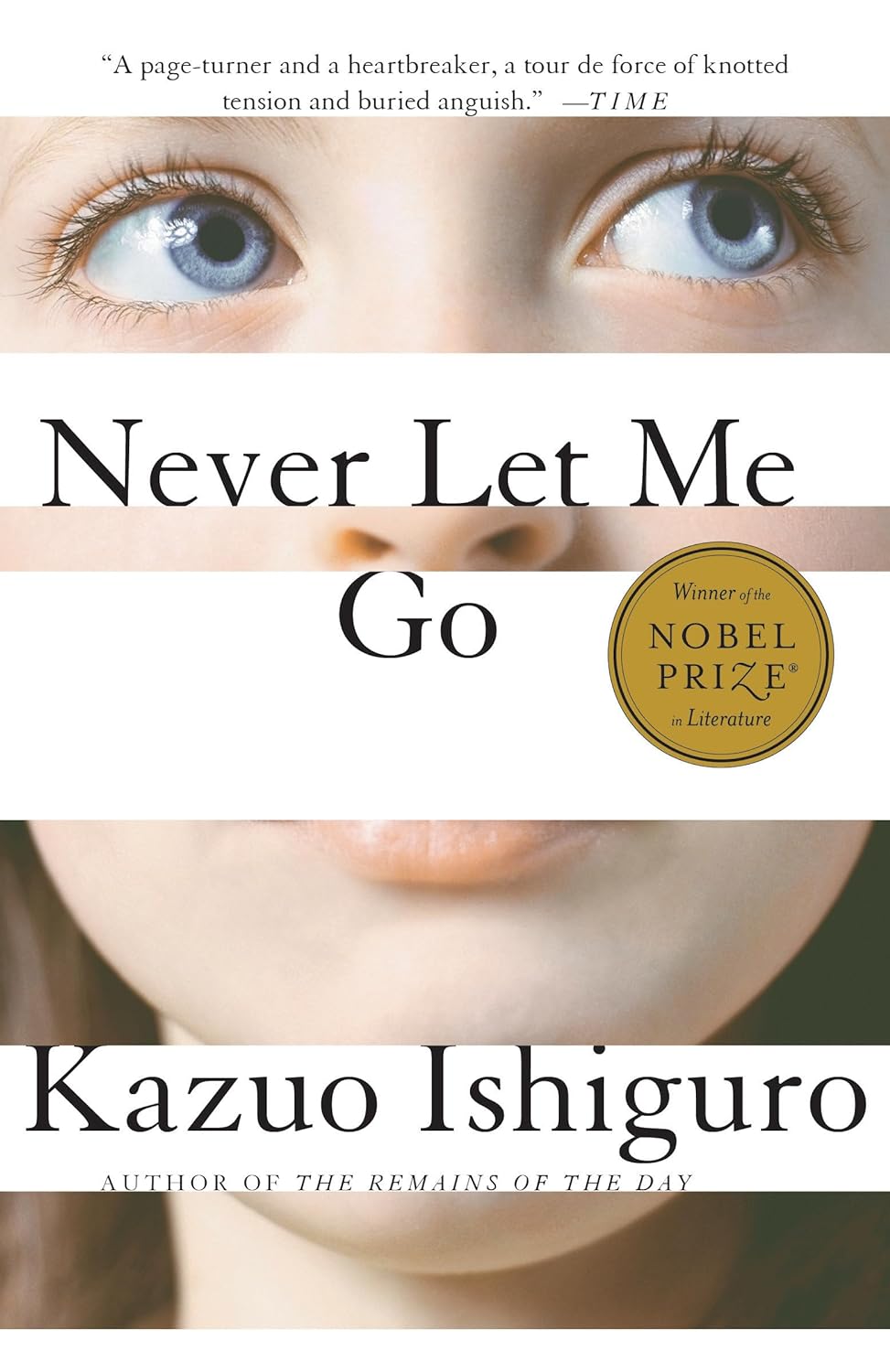
Never Let Me Go by Kazuo Ishiguro is a novel narrated by Kathy H., a thirty-one-year-old woman looking back on her childhood at Hailsham, an English boarding school, and on what happened to her and her closest friends Ruth and Tommy in the years after they left it. Published in 2005 and shortlisted for the Man Booker Prize, it is a dystopian novel that withholds the full nature of its premise for as long as possible — the reader discovers alongside Kathy what Hailsham actually was — and a meditation on memory, loss, and the human capacity to accept the unacceptable. Ishiguro received the Nobel Prize in Literature in 2017. This complete guide covers Never Let Me Go‘s reading level, recommended age, content considerations, characters, themes, and books similar to Never Let Me Go, designed for parents, teachers, and students.
For Parents
A quiet, devastating novel told in the voice of a narrator so composed in the face of her situation that the horror of it arrives slowly rather than all at once — which is Ishiguro’s most deliberate formal choice and the source of the novel’s particular emotional power. No graphic violence, minimal sexual content. The darkness is entirely in the premise and in Kathy’s acceptance of it. Appropriate for readers ages 14 and up.
For Teachers
An excellent grades 10–12 text for teaching unreliable narration, the ethical dimensions of speculative fiction, and the relationship between dystopia and social critique. Kathy’s narrative voice — calm, retrospective, occasionally deflecting, never quite naming what she is describing — is a masterclass in first-person technique. Pairs productively with Brave New World for a unit on dystopia and consent, and with bioethics readings on organ donation and human cloning.
Never Let Me Go at a Glance
Find on Amazon →| Author | Kazuo Ishiguro |
| Published | 2005 (Faber & Faber / Knopf) |
| Grade Level | 10–12 (our assessment) |
| Recommended Age | 14+ |
| ATOS Reading Level | 6.0 |
| Lexile | 970L |
| Word Count | 96,374 |
| Pages | 288 (Vintage International paperback) |
| Chapters | 23 (in 3 parts) |
| Genre | Literary fiction / dystopian fiction |
| Setting | England; late 1990s (alternate history) |
| Awards | Booker Prize shortlist (2005); ALA Alex Award (2006); Nobel Prize context (2017) |
For official Lexile and AR levels, visit Lexile.com or AR BookFinder. ReadingVine provides independent editorial assessments.
What Reading Level Is Never Let Me Go?
Never Let Me Go has an ATOS reading level of 6.0 and a Lexile of 970L. These scores are closer to accurate than most of the literary fiction in this catalog — Ishiguro writes in a more conventionally structured prose than Hemingway or Steinbeck, with longer sentences and a richer vocabulary — but they still underrepresent the novel’s actual demands in the ways that matter most. The reading challenge here is not lexical or syntactic but interpretive: Kathy’s narrative voice is a sustained exercise in what she does not say directly, and understanding the full horror of what she is describing requires the reader to work significantly harder than the calm, composed surface of the prose suggests.
Ishiguro has described his narrative technique as using the first-person narrator to simultaneously reveal and conceal — Kathy tells her story in a way that assumes the reader shares her frame of reference, which gradually forces the reader into Kathy’s position: a person who knows what is happening and has found a way to live with it that does not require directly acknowledging it. This technique is sophisticated enough that younger readers frequently miss the weight of what they are reading until it arrives with full force at the novel’s end. Most classroom readers complete the novel over two to three weeks; the short chapters and readable prose make the pace feel faster than the emotional demands warrant. For official Lexile and AR scores, visit Lexile.com or AR BookFinder. ReadingVine’s assessments are independent editorial judgments.
What Age Is Never Let Me Go Appropriate For?
We recommend Never Let Me Go for readers ages 14 and up. The novel contains some sexual content — Kathy and Tommy’s relationship is depicted with adult directness — and its subject matter involves the systematic exploitation and killing of a class of human beings who have been conditioned to accept their fate. There is no graphic violence; the deaths are described with the same calm composure as everything else Kathy narrates. The content concern is not any specific scene but the cumulative ethical weight of the premise, which requires a reader mature enough to sit with what Ishiguro is asking rather than deflecting it.
The novel’s full premise — that Kathy, Ruth, Tommy, and all the other students at Hailsham are clones raised to donate their organs to other humans, and that they will die in the process — is revealed gradually over the course of the reading experience rather than announced at the outset. This is Ishiguro’s deliberate structural choice, and discovering it alongside Kathy is part of the novel’s intended effect. Parents and teachers should be aware that the premise involves eugenics and the systematic creation of human beings as medical resources, which is ethically serious material. The novel treats it with full moral seriousness and does not aestheticize or resolve it. Some readers, particularly those who encounter the novel without any prior context, find the gradual revelation disorienting; others find it the most affecting reading experience they have had. Both responses are valid.
What Is Never Let Me Go About?
Kathy H. is thirty-one years old and has been a carer — someone who looks after people making organ donations — for eleven years, longer than most carers last. She is beginning to think about the time when she will stop being a carer and become a donor herself. As she drives between donation centers, she finds herself returning in memory to her childhood at Hailsham, the boarding school where she grew up with Ruth and Tommy, and to the years that followed.
Hailsham is, on its surface, an idyllic English school — beautiful grounds, dedicated teachers called guardians, an emphasis on art and creativity, regular health checks, and a library of cassette tapes from which Kathy once retrieved a copy of Judy Bridgewater’s album Songs After Dark, on which there was a song called “Never Let Me Go” that she used to dance to alone in her room. The school is also strange in ways the children sense but do not articulate: they have no contact with the outside world, they are never told they can leave, and the guardians speak about their futures with an unusual combination of care and evasion.
The novel’s three parts follow Kathy, Ruth, and Tommy from Hailsham through a transitional period at a communal house called the Cottages, and finally into their adult lives as carers and donors. The relationship between the three — Ruth’s manipulation of Kathy and Tommy’s feelings, Kathy’s sustained love for Tommy across years of separation, their eventual reunion — is the novel’s human center. The dystopian premise, which becomes fully explicit about halfway through, is the framework within which Ishiguro places this very ordinary story of friendship, jealousy, love, and loss: three people navigating their relationships with each other against the knowledge of what is coming.
The novel’s most discussed scene is the final meeting between Kathy and Tommy, and Kathy and Ruth’s deathbed conversation in which Ruth acknowledges what she did to keep them apart. The final image — Kathy standing alone in a field, rain approaching — is Ishiguro’s last word on what the novel has been about: not the dystopia, but the person inside it.
Never Let Me Go Characters
Is Never Let Me Go Banned?
Never Let Me Go has not been banned or formally challenged in American schools or libraries and does not appear on any significant challenged books lists. It is widely used in AP English and college introductory literature courses. The novel’s subject matter — human cloning for organ donation — and its treatment of a class of human beings created for exploitation have not generated formal challenge activity at any documented scale.
Never Let Me Go Themes and Lessons
The novel’s most disturbing argument is not about cloning — it is about accommodation. Kathy, Tommy, and Ruth know what they are from relatively early; they are not kept entirely ignorant. What they are given instead is a framework for understanding their situation that makes acceptance feel like the only rational response. They have been educated to be the kind of people who accept their fate with dignity. Hailsham’s cultivation of their creativity was, Miss Emily explains, an attempt to prove that they had souls — and therefore deserved better treatment. The irony is devastating: the education that was meant to demonstrate their humanity became the means by which they were made capable of their own passive destruction.
Ishiguro has said that the novel is not primarily about cloning — the premise could be replaced with other forms of exploitation and the novel would work the same way. What it is actually about is the human capacity to accommodate injustice, to find ways of living inside systems that are destroying you without the kind of active resistance that might change them. Kathy’s narrative voice is the formal embodiment of this: she describes her situation with a composure so complete that the reader initially mistakes it for acceptance rather than recognizing it as the psychological mechanism by which a person survives what cannot be survived otherwise.
The novel’s treatment of memory — Kathy is reconstructing her past from within it, and the reader gradually understands that her reconstruction is shaped by what she needs to believe rather than what was true — connects Ishiguro’s formal concerns in this novel to those of his earlier work, particularly The Remains of the Day. Both novels are narrated by people who have accommodated themselves to situations that have cost them everything they actually wanted, and who are only partially able to see the cost clearly. Both use the retrospective first person as a way of showing the reader more than the narrator can bear to show themselves.
Discussion questions for classrooms and families: Why does Kathy tell her story with such composure — what does her composure cost her, and what does it protect? What is Miss Emily’s defense of Hailsham — is it coherent? Is it moral? What does Ruth’s final apology accomplish — does it change what she did? What does Ishiguro gain by setting the novel in an alternate 1990s rather than a distant future? How is the novel’s dystopia different from the dystopias of Brave New World or 1984 — and what does the difference reveal about what Ishiguro is actually arguing?
How Many Pages and Chapters in Never Let Me Go?
The Vintage International paperback is 288 pages across 23 chapters organized into three parts. Part One covers Hailsham; Part Two covers the Cottages; Part Three covers the characters’ adult lives as carers and donors. Word count is 96,374. Most classroom readers complete the novel over two to three weeks; the short chapters and readable prose make it feel faster than its emotional demands warrant.
The three-part structure is worth noting: each part represents a distinct phase of Kathy’s life, and the accumulation of loss across the three sections is deliberate. By the time the reader reaches Part Three, Hailsham itself has been established as a kind of lost paradise — the most protected and in some ways the most human period of the characters’ lives — which is Ishiguro’s most pointed structural irony: the place that was built on their exploitation is also, genuinely, the place where they were most loved.
Books Similar to Never Let Me Go
About Kazuo Ishiguro
Kazuo Ishiguro was born in 1954 in Nagasaki, Japan, and moved to England with his family at the age of five. He studied English and philosophy at the University of Kent and creative writing at the University of East Anglia. He published his first novel, A Pale View of Hills, in 1982 and established his reputation as a major English-language novelist with The Remains of the Day (1989), which won the Booker Prize. He has said in interviews that Never Let Me Go began developing in his mind in the 1990s and that he spent years trying to understand what kind of story he was actually trying to tell before he found the approach that worked: a first-person narrator telling her story retrospectively, from within her situation rather than looking back on it from outside.
Ishiguro received the Nobel Prize in Literature in 2017, with the committee citing his novels of great emotional force that uncovered the abyss beneath the illusory sense of connection with the world. His other major works include The Remains of the Day, An Artist of the Floating World, When We Were Orphans, and The Buried Giant. Both The Remains of the Day and Never Let Me Go have sold more than two million copies and were adapted into films. He holds a knighthood for services to literature and lives in London.
Never Let Me Go: Frequently Asked Questions
What reading level is Never Let Me Go?
Never Let Me Go has an ATOS reading level of 6.0 and a Lexile of 970L. These scores reflect Ishiguro’s more conventionally structured prose but still underrepresent the novel’s interpretive demands: Kathy’s narrative voice requires readers to work hard to understand what is not being said directly. Our editorial assessment places it at grades 10–12 (ages 14+). For official Lexile and AR scores, visit Lexile.com or AR BookFinder.
What grade is Never Let Me Go appropriate for?
We recommend grades 10–12, ages 14 and up. The novel contains some sexual content and its premise involves the systematic exploitation and death of a class of human beings. The darkness is not graphic but cumulative and serious. Widely used in AP English and college-level literature courses.
How many pages are in Never Let Me Go?
The Vintage International paperback is 288 pages across 23 chapters in three parts. Word count is 96,374. Most classroom readers complete it over two to three weeks.
What is Never Let Me Go about?
Kathy H., a thirty-one-year-old carer, narrates her childhood at Hailsham boarding school and the years that followed with her friends Ruth and Tommy. As she reconstructs her past, the full nature of what Hailsham was and what her future holds gradually becomes clear: she and her friends are clones created to donate their organs to other humans, and they will die in the process. The novel is about memory, friendship, love, and the human capacity to live within a situation of profound injustice.
What is the twist in Never Let Me Go?
The novel’s premise is not a twist so much as a gradual revelation: the reader discovers alongside Kathy that she and her friends are clones raised to be organ donors. Ishiguro withholds this information not to surprise but to force the reader into Kathy’s position — inhabiting her frame of reference before fully understanding it. By the time the full picture is clear, the reader has already been inside Kathy’s composure long enough to understand something about how she has survived it.
Is Never Let Me Go science fiction?
Technically yes — the novel is set in an alternate England of the late 1990s in which cloning technology for organ donation became widespread. But Ishiguro has consistently described it as a novel that uses a speculative premise to explore questions about memory, humanity, and accommodation to injustice that are not primarily about science or technology. It is closer in spirit to literary fiction that happens to have a speculative premise than to genre science fiction. The alternate history is kept deliberately vague — Ishiguro does not explain how or when the cloning program developed — because the mechanics are not the point.
Why do Kathy and the other clones accept their fate?
This is the novel’s central question, and Ishiguro does not fully resolve it. The clones have been conditioned to accept their fate through education and through the absence of any framework for resistance; they have been given a language for understanding their situation that makes acceptance feel like dignity. Miss Emily’s explanation — that Hailsham was the most humane version of the system available — also reveals why no one challenged the system: those with the moral clarity to object still found ways to participate in it, believing their participation made things slightly better. The novel asks the reader to consider whether this dynamic is specific to its fictional world.
Is there a Never Let Me Go movie?
Yes — a 2010 British film directed by Mark Romanek, starring Carey Mulligan as Kathy, Keira Knightley as Ruth, and Andrew Garfield as Tommy. It is rated R and is generally considered a faithful and emotionally powerful adaptation that captures the novel’s elegiac tone and the three leads’ performances. The film is appropriate for the same age range as the novel.