
 = Partner Site
The Grapes of Wrath Reading Level: A Complete Guide
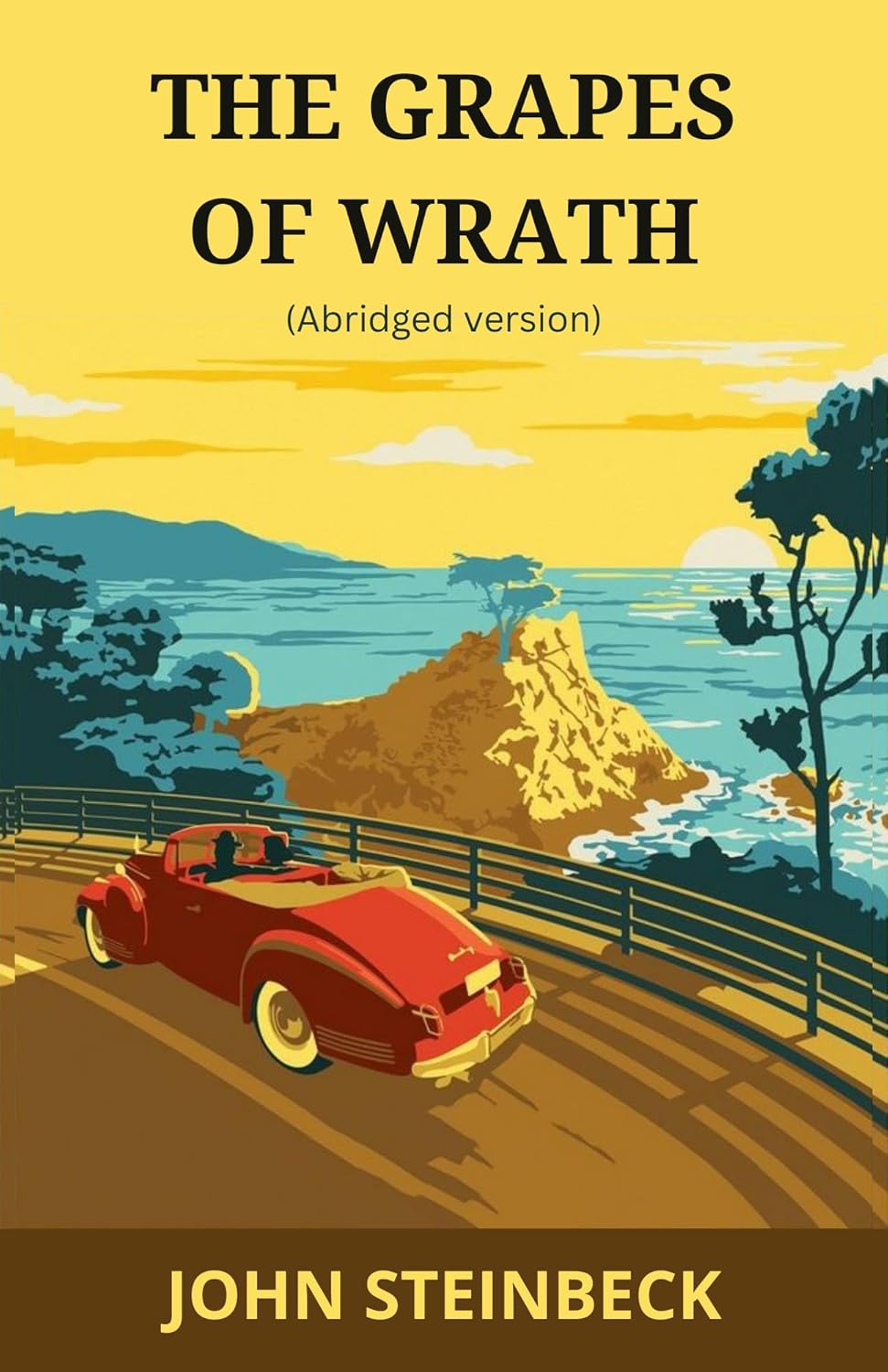
The Grapes of Wrath by John Steinbeck is a novel about the Joad family — Oklahoma tenant farmers driven off their land during the Dust Bowl and Great Depression of the 1930s — and their journey west to California in search of work and survival. Published in 1939, it won the Pulitzer Prize for Fiction in 1940 and was cited prominently when Steinbeck received the Nobel Prize for Literature in 1962. It is a landmark of American realist fiction, a work of sustained moral anger about poverty, exploitation, and the failure of institutions to protect the people most dependent on them. This complete guide covers The Grapes of Wrath‘s reading level, recommended age, content considerations, characters, themes, and books similar to The Grapes of Wrath, designed for parents, teachers, and students.
For Parents
A long, demanding, and deeply serious novel about poverty and human dignity — Steinbeck writes at the level of full adult fiction, and the emotional weight of the Joads’ story accumulates across nearly 170,000 words. Appropriate for readers ages 14 and up. The language, some sexual content, and the novel’s final scene require parental awareness at the lower end of the range.
For Teachers
A staple of 11th and 12th grade American literature curricula and a Common Core ELA Text Exemplar for grades 9–10. The intercalary chapter structure — alternating between the Joad family’s narrative and broader documentary passages about the migrant experience — is the novel’s most distinctive formal element and a rich subject for structural analysis. Pairs naturally with primary source documents about the Dust Bowl and the New Deal.
The Grapes of Wrath at a Glance
Find on Amazon →| Author | John Steinbeck |
| Published | 1939 (Viking Press) |
| Grade Level | 9–12 (our assessment) |
| Recommended Age | 14+ |
| Flesch-Kincaid Grade | ~4.9 |
| Word Count | 169,481 |
| Pages | ~464 (Penguin Classics paperback) |
| Chapters | 30 |
| Genre | Realist fiction / social protest novel |
| Setting | Oklahoma and California; 1930s Dust Bowl and Great Depression |
| Awards | Pulitzer Prize (1940); cited in Nobel Prize (1962) |
For official Lexile and AR levels, visit Lexile.com or AR BookFinder. ReadingVine provides independent editorial assessments.
What Reading Level Is The Grapes of Wrath?
The Grapes of Wrath carries a Flesch-Kincaid grade level of approximately 4.9 and a Lexile of 680L — scores that place it, on paper, well below its recommended grade range of 9–12. This gap is real and important: both metrics measure sentence and word complexity, and Steinbeck deliberately writes much of the novel in the plain vernacular speech of Oklahoma farm families, which keeps individual sentences short and direct. The actual reading demands of the novel are far higher than these scores suggest.
What the formulas cannot measure is the weight of what Steinbeck is doing. The novel is 169,481 words long — nearly twice the length of most contemporary young adult novels — and sustains a moral and emotional argument across that entire distance. The intercalary chapters, which shift between the Joads’ story and panoramic documentary passages about migrant workers as a class, require readers to move fluidly between personal narrative and social analysis. The themes — economic exploitation, the failure of capitalism to protect the poor, the nature of collective versus individual survival — are adult in their complexity. Steinbeck’s prose in the intercalary chapters is frequently biblical in its cadences and demands a reader who can meet that register. The novel is assigned in grades 11 and 12 for good reasons. For official Lexile and AR scores, visit Lexile.com or AR BookFinder. ReadingVine’s assessments are independent editorial judgments.
What Age Is The Grapes of Wrath Appropriate For?
We recommend The Grapes of Wrath for readers ages 14 and up. The novel contains profanity, some sexual content, and a final scene that parents and teachers should be prepared to discuss. It is a work of full adult literary fiction that happens to be widely assigned in secondary school, and it should be approached with that understanding.
The novel contains recurring profanity, including religious profanity, which is specific to the vernacular voice Steinbeck is rendering. There is a brief sexual encounter between characters that is depicted directly but not graphically. The novel’s final scene — in which Rose of Sharon, who has just delivered a stillborn baby, nurses a starving adult man at her breast — has been the most frequently cited source of challenges since the book’s publication. Steinbeck’s purpose is clearly symbolic: a gesture of radical human charity in the face of despair, drawing on Madonna-and-child imagery. It is nonetheless an unexpected and confronting image that parents should know is coming. Beyond specific content, the novel’s sustained engagement with poverty, starvation, infant death, and institutional indifference to suffering constitutes its most significant challenge for younger readers. This is not darkness deployed for effect; it is Steinbeck’s documentary record of what happened to real people, and it is relentless.
What Is The Grapes of Wrath About?
Tom Joad is released from McAlester State Penitentiary in Oklahoma after serving four years for manslaughter — a killing he considers justifiable — and returns home to find the family farm empty and his family preparing to leave. The banks and the large landowners have consolidated the Dust Bowl farmlands and mechanized the work; tenant farmers across Oklahoma are being evicted, their houses bulldozed, their livelihoods ended. The Joads — Tom, his parents, his grandparents, his siblings, his sister Rose of Sharon and her husband Connie, and the former preacher Jim Casy — load everything onto a rickety Hudson truck and join the westward migration on Route 66 toward California, where handbills promise work and wages.
The journey is brutal. Grampa dies before they reach the state line. Gramma holds on longer. They cross the desert at night to avoid the heat and arrive in California to find hundreds of thousands of migrants like themselves competing for a handful of jobs, deliberately held scarce by landowners who understand that desperate workers accept any wage. The handbills lied. The work that exists pays pennies; the company stores that extend credit to workers are designed to keep them permanently indebted. California’s established residents fear and despise the “Okies,” who are homeless, ragged, and numerous. The police serve the landowners. The law is a tool of economic interest.
What the Joads encounter in California is the systematic exploitation of workers who have no alternatives and no recourse — the very condition that the labor movement and the New Deal were, at the time Steinbeck was writing, struggling to address. The novel’s second half follows the family’s deterioration as members leave, die, or give in to despair, while Tom and Casy come to understand that individual survival is not possible without collective resistance. The novel ends in a flooded boxcar during a winter storm, Rose of Sharon’s baby dead, the family reduced to a remnant — and Rose of Sharon performing the novel’s final act of defiant human charity.
The thirty chapters alternate between chapters that follow the Joads directly and shorter intercalary chapters that widen the lens to describe the migrant experience as a whole: the used car lots, the Route 66 roadside diners, the history of California land ownership, the turtle crossing the highway at the novel’s opening. These intercalary passages are Steinbeck at his most formally ambitious and his most politically direct, and they transform a family story into a document of a historical catastrophe.
The Grapes of Wrath Characters
Is The Grapes of Wrath Banned?
The Grapes of Wrath has a ban history that extends back to within months of its publication. In August 1939 — the same year the novel appeared — the Kern County, California Board of Supervisors voted to ban it from county libraries and schools. Kern County was the endpoint of the Joad family’s migration in the novel, and local politicians, landowners, and growers objected strenuously to Steinbeck’s portrayal of their treatment of migrant workers. The ban prompted condemnation from librarians and civil liberties advocates across the country and contributed directly to the American Library Association’s development of formal intellectual freedom policies.
The novel has been challenged repeatedly in the decades since, in school districts across the country, on grounds that include profanity, sexual content, the use of religious language, and the novel’s final scene. A 1939 challenge in East St. Louis cited communist sympathies. A 1986 challenge in Burlington, North Carolina, described it as “full of filth.” It was challenged in Missoula, Montana in 2009. It appears on the ALA’s list of Banned and Challenged Classics. Despite this history, it remains widely taught in American high schools and is a Common Core ELA Text Exemplar for grades 9–10. The challenges have not prevented it from being recognized as a central text of the American literary tradition.
The Grapes of Wrath Themes and Lessons
Steinbeck’s central argument is that poverty is not a failure of individual character but a product of economic systems that benefit from keeping workers desperate. The migrant crisis he depicts is not accidental: the scarcity of California jobs is deliberately maintained by landowners who understand that hungry workers accept lower wages. The banks that foreclosed on Oklahoma farms were not acting out of malice but out of institutional logic that has no room for the human consequences of its operations. Steinbeck is not interested in villains; he is interested in systems, and in the way systems produce outcomes that no individual within them has chosen or could prevent alone.
Jim Casy’s evolving theology — his sense that human beings are holy collectively in a way they cannot be individually — is Steinbeck’s philosophical framework for arguing that survival requires solidarity. Tom Joad’s conversion to this position, after Casy’s death, is the novel’s moral arc. Tom’s final speech articulates what this means practically: that wherever people are fighting for dignity, he will be there. This is explicitly the language of the labor movement and implicitly the language of what would become the broader civil rights tradition, and its resonance has extended well beyond the immediate context of 1930s California.
The intercalary chapters are Steinbeck’s formal argument that the Joads’ story is not unique — that they are representative of hundreds of thousands of people caught in the same machinery. The chapter about the turtle crossing the highway, which opens the novel, is a sustained metaphor for the migrants’ persistence in the face of forces trying to knock them off the road. The chapter about the California land’s history — how it was taken from its original inhabitants, carved up, monopolized — places the current dispossession in a longer context of American theft and consolidation. These passages make the novel something beyond a family story; they make it a record.
Discussion questions for classrooms and families: Why does Steinbeck alternate between the Joad family’s story and the broader intercalary chapters — what does each mode of narration do that the other cannot? What is the difference between Tom Joad’s understanding of justice at the novel’s beginning and at its end? What does Ma Joad’s authority within the family reveal about how the Joads are organized and what holds them together? What is Steinbeck arguing about whether poverty is a personal or systemic problem? How does the novel’s final scene function as a response to everything that has come before it?
How Many Pages and Chapters in The Grapes of Wrath?
The Penguin Classics paperback is approximately 464 pages across 30 chapters. Word count is 169,481 words, making it a genuinely long novel — comparable in length to Harry Potter and the Order of the Phoenix, though it reads differently because of its formal ambition and the weight of its subject matter. Most readers in a high school classroom context finish it over three to four weeks when reading assigned chapters. Independent readers who engage fully with the material may take longer; the intercalary chapters reward slow reading and resist being skimmed.
The 30 chapters divide roughly between 16 narrative chapters following the Joads and 14 intercalary chapters providing broader documentary context. The longest chapters are in the California section, where the family’s situation grows most complex. The chapter headings are not titled, simply numbered, which is consistent with Steinbeck’s documentary ambition — this is a record, not a story with named episodes.
Books Similar to The Grapes of Wrath
About John Steinbeck
John Steinbeck was born in 1902 in Salinas, California — a farming town in the same agricultural region where much of The Grapes of Wrath‘s California section is set. He studied at Stanford University intermittently but never completed a degree, and worked at various manual labor jobs before establishing himself as a writer. He published several novels before Tortilla Flat (1935) brought him his first significant recognition, followed by Of Mice and Men (1937), which prepared the ground for The Grapes of Wrath.
The research for The Grapes of Wrath was extensive: Steinbeck spent time in the migrant camps of California’s Central Valley, talking to workers and documenting conditions, and published a series of newspaper articles — “The Harvest Gypsies” — in the San Francisco News in 1936, three years before the novel. The novel was written in 100 days of intensive work in 1938 and published in 1939. Its immediate bestseller status and the controversy it generated were simultaneous: it sold nearly half a million copies in its first year while being banned in Kern County, burned in St. Louis, and debated in the U.S. Senate.
Steinbeck won the Nobel Prize for Literature in 1962. His other major works include Of Mice and Men, East of Eden, Tortilla Flat, Cannery Row, and The Pearl. He died in 1968 in New York City. His family’s roots in the Salinas Valley, his sympathy for agricultural workers, and his disgust at the exploitation he documented in The Grapes of Wrath remained constant features of his work and his public life.
The Grapes of Wrath: Frequently Asked Questions
What reading level is The Grapes of Wrath?
The Grapes of Wrath has a Flesch-Kincaid grade level of approximately 4.9 and a Lexile of 680L — scores that significantly underrepresent the actual demands of the novel. Steinbeck writes much of the book in plain vernacular that keeps sentence-level complexity low, but the novel is 169,481 words long and demands adult literary comprehension. Our editorial assessment places it at grades 9–12, ages 14 and up. For official Lexile and AR scores, visit Lexile.com or AR BookFinder.
What grade is The Grapes of Wrath appropriate for?
We recommend grades 9–12, ages 14 and up. The novel contains profanity, some sexual content, and the final scene described in the content note above. More significantly, its sustained engagement with poverty, starvation, infant death, and institutional indifference is adult in its weight. It is most commonly assigned in grades 11 and 12.
How many pages are in The Grapes of Wrath?
The Penguin Classics paperback is approximately 464 pages across 30 chapters. Word count is 169,481 words. Most high school readers finish it over three to four weeks when reading assigned chapters.
What is The Grapes of Wrath about?
The Joad family — Oklahoma tenant farmers evicted during the Dust Bowl — join the westward migration to California during the Great Depression, only to find exploitation, poverty, and hostility at their destination. The novel follows their deterioration across the journey while alternating with documentary passages about the migrant experience as a whole. It is an argument about economic systems, collective survival, and human dignity under conditions designed to destroy it.
Why is The Grapes of Wrath banned?
The novel was first banned in Kern County, California, within months of publication in 1939 — local politicians and landowners objected to Steinbeck’s portrayal of their treatment of migrant workers. Subsequent challenges have cited profanity, sexual content, religious language, the final scene, and — particularly in the 1940s and 50s — communist sympathies. It appears on the ALA’s list of Banned and Challenged Classics despite remaining widely taught in American high schools.
What are the intercalary chapters?
Steinbeck called them “pace changers” — the shorter chapters interspersed throughout the novel that zoom out from the Joad family’s story to describe the broader migrant experience. These chapters cover the used car dealers on Route 66, the history of California land ownership, the Route 66 diners, the labor camps, and the destruction of food to keep prices high. They transform a family narrative into a documentary record of a historical catastrophe, and they are where Steinbeck is most formally ambitious and most politically direct.
What is the ending of The Grapes of Wrath?
The novel ends in a flooded boxcar during a winter storm. Rose of Sharon has just delivered a stillborn baby. A starving man is dying nearby. In the final lines of the novel, Rose of Sharon nurses the dying man at her breast — an act of radical human charity drawn on Madonna-and-child imagery. The ending is deliberately unexpected and refuses easy comfort: Steinbeck provides no resolution to the family’s material circumstances, only an assertion that human dignity persists even when everything else has been stripped away. It has been the most challenged element of the novel since 1939.
Is there a Grapes of Wrath film?
Yes. John Ford’s 1940 film adaptation starring Henry Fonda as Tom Joad is a recognized classic of American cinema. It won two Academy Awards and is generally considered faithful to the emotional core of Steinbeck’s novel, though it softens the ending and some of the most politically direct material. It is rated not rated (pre-MPAA rating system) and is appropriate for the same age range as the novel.