
 = Partner Site
Refugee Reading Level: A Complete Guide
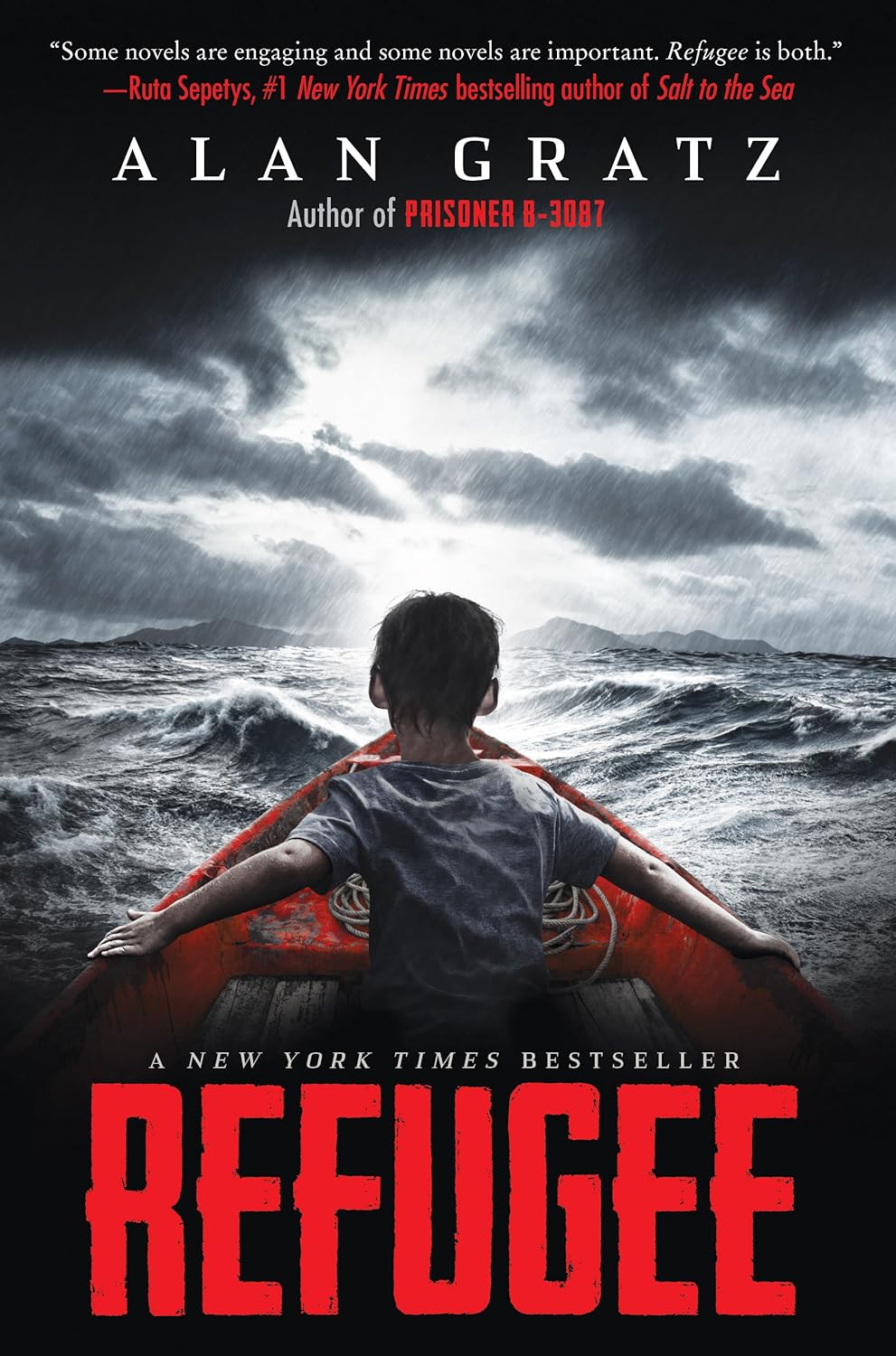
Refugee by Alan Gratz is a middle-grade novel that follows three children fleeing danger across three different decades and three different parts of the world — a Jewish boy leaving Nazi Germany in 1939, a Cuban girl crossing the Florida Straits in 1994, and a Syrian boy making his way across Europe in 2015 — whose stories gradually reveal connections across time. First published in 2017, it is one of the most widely assigned novels in contemporary middle-grade classrooms: urgent, propulsive, and constructed with the kind of craft that makes a complex historical subject into a highly engaging story. This complete guide covers Refugee‘s reading level, recommended age, content considerations, characters, themes, and books similar to Refugee, designed for parents, teachers, and students.
For Parents
Refugee is a fast-paced, emotionally intense novel that puts three children in genuine, sustained danger across three of the twentieth and twenty-first centuries’ defining crises. It does not soften the violence, loss, or desperation of its characters’ situations, but it handles them with craft and purpose. Best for readers ages 10–14, it is one of the most effective books available for helping young readers understand the experience of people forced to flee their homes.
For Teachers
One of the most commonly assigned middle-grade novels of the past decade, Refugee is an excellent text for teaching parallel narrative structure, historical context across multiple periods, and the difference between empathy and sympathy. It connects naturally to units on World War II, the Castro-era Cuba and the Cuban rafters crisis of the 1990s, and the Syrian refugee crisis, and pairs well with Inside Out and Back Again or The Unwanted for a unit on the refugee experience across genres and forms.
Refugee at a Glance
Find on Amazon →| Author | Alan Gratz |
| Published | 2017 |
| Grade Level | 5–7 (our assessment) |
| Recommended Age | 10–14 |
| Flesch-Kincaid Grade | ~5.3 |
| Word Count | ~86,000 |
| Pages | ~338 (Scholastic paperback) |
| Chapters | 73 (alternating between three narrators) |
| Genre | Historical fiction |
| Setting | Germany / Atlantic Ocean, 1939; Cuba / Florida Straits, 1994; Syria / Europe, 2015 |
| Awards | Sydney Taylor Book Award (2018) |
For official Lexile and AR levels, visit Lexile.com or AR BookFinder. ReadingVine provides independent editorial assessments.
What Reading Level Is Refugee?
By our editorial assessment, Refugee reads at a grade 5–7 level. The Flesch-Kincaid formula places it at approximately grade 5.3 — accessible to a confident fifth-grade reader at the sentence level. Gratz writes in a deliberately propulsive style: short chapters, clear prose, and a relentless forward momentum that keeps pages turning. The three-narrator structure, alternating between Josef, Isabel, and Mahmoud in short bursts, is easy to track and gives the novel much of its energy.
The linguistic accessibility sits alongside genuine historical complexity. Each of the three storylines requires the reader to hold a different historical context — Nazi Germany and the St. Louis voyage, Castro-era Cuba and the Mariel boatlift’s legacy, the Syrian civil war and the European refugee crisis — and the novel moves between them quickly without extensive background explanation. Readers who come to it without prior knowledge of any of these periods will understand the emotional stakes immediately but may benefit from additional context for the historical specifics. This is one of the most productive aspects of the novel as a classroom text: it generates genuine curiosity about history that extends naturally into research.
For official Lexile and Accelerated Reader scores, visit Lexile.com or AR BookFinder. ReadingVine’s assessments are independent editorial judgments.
What Age Is Refugee Appropriate For?
We recommend Refugee for readers ages 10–14. The novel’s content is more intense than many books assigned at the same grade level, and parents should be prepared for a story that does not soften the violence, death, or desperation of its characters’ situations.
Refugee contains violence, death, and sustained depictions of danger across all three storylines. Josef’s story includes Nazi persecution, the threat of concentration camps, suicide, and a devastating climactic choice that the novel asks the reader to hold without easy resolution. Isabel’s story includes political violence in Cuba, a dangerous open-ocean crossing on a makeshift raft, a shark attack, and a death that readers will be deeply attached to. Mahmoud’s story includes the Syrian civil war, bombing, drowning, human trafficking, and the specific cruelties of the European refugee system. None of this content is gratuitous — Gratz handles all of it with purpose — but it is sustained and at times graphic enough that parents of younger or more sensitive readers should be aware of the specifics before handing it over. The novel also contains a suicide, handled without detail but with emotional weight, that may be worth discussing with younger readers. For most children ages 10 and up, the intensity is appropriate and purposeful; for sensitive readers at the lower end of the age range, parental awareness and conversation are recommended.
The novel’s intensity is inseparable from its argument: Gratz is asking the reader to understand what refugees actually face, and softening the danger would undermine the point. For readers ages 10 and up who are emotionally prepared for a demanding story, Refugee is one of the most effective and important books in the middle-grade catalog.
What Is Refugee About?
Josef Landler is thirteen years old in 1939, the son of a Jewish psychiatrist who has just been released from a concentration camp. His family boards the MS St. Louis, a German ocean liner carrying more than nine hundred Jewish refugees from Hamburg to Cuba, where they have visas and, they believe, safety. Josef’s father is still shattered from what he experienced in the camp. Josef must decide, over the course of a voyage that goes catastrophically wrong, what it means to be the man of the family — and what he is willing to do to protect the people he loves.
Isabel Fernandez is eleven years old in 1994, the daughter of a family in Castro’s Cuba where food is scarce and the economy has collapsed following the Soviet Union’s fall. When her father is arrested during a protest, the family makes the decision to flee on a homemade raft across the ninety miles of the Florida Straits to the United States. Their journey is measured in dwindling food and water, approaching storms, circling sharks, and the Coast Guard policy that will send them back if they are caught at sea rather than on land.
Mahmoud Bishara is twelve years old in 2015, a boy from Aleppo, Syria, who has learned that the safest way to survive in a city being bombed into rubble is to be invisible — to not draw attention, to not be noticed, to not exist in any way that makes you a target. When his family’s apartment building is destroyed, they join the millions of Syrians on the road to Europe, crossing the Aegean Sea in an overcrowded inflatable boat, navigating hostile borders, and living in the transit camps of a continent that mostly wishes they would go somewhere else.
Gratz alternates between the three stories in short chapters that build toward a convergence the reader senses coming but cannot quite predict. The historical connections between the three storylines are the novel’s most deliberate structural achievement: decisions made in 1939 echo through 1994 and 2015, and the question each story asks — who will open the door? who will let them in? — is always and obviously also a question about the present moment.
Refugee Characters
Is Refugee Banned?
Refugee has been challenged in a small number of school districts, primarily due to its depictions of violence, death, and the political content of the Syrian and Cuban storylines. It has appeared on some lists of challenged books but has not been widely banned and does not appear on the American Library Association’s most frequently challenged titles lists. The challenges that have occurred have generally not resulted in removal from curricula or library shelves.
The novel’s political subject matter — refugee policy, border enforcement, the history of countries turning away Jewish refugees during the Holocaust — has made it a target in some communities for concerns about political bias in school reading materials. Gratz has addressed these challenges publicly, noting that the novel presents historical facts rather than political arguments and that the experience of children being forced to flee their homes is not a political position but a human reality.
Refugee Themes and Lessons
The novel’s central argument — made through structure as much as through content — is that the refugee experience is not a recent phenomenon, not a problem specific to one region or religion or political moment, but a recurring human emergency that has always asked the same question of the people in a position to help: will you open the door? The three storylines are chosen to demonstrate that this question was asked in 1939, in 1994, and in 2015, and that the answers given have consequences that echo across generations. The structural connection between Josef’s story and the resolution of Mahmoud’s is the novel’s most explicit statement of this argument, and it lands with considerable force.
Mahmoud’s arc — from a boy who has made himself invisible to survive to a boy who steps forward and demands to be seen — is where Gratz makes his most personal argument about what it costs to be a refugee and what it costs to treat refugees as invisible. The strategy of erasure that has kept Mahmoud safe in Aleppo becomes, in Europe, a different kind of danger: the danger of a system that is only too willing to not notice you. His decision to stand in front of a car on a highway and force the people inside to see him is the novel’s moral turning point, and it is worth spending classroom time on what exactly he is demanding and why.
The novel is also, more quietly, about what people carry when they flee. Isabel’s trumpet. Josef’s sister. Mahmoud’s family. Gratz is consistent about insisting that every refugee is a person with specific, irreplaceable things they are trying to protect — not a category, not a crisis, not a political problem, but a person making terrible choices in impossible circumstances because the alternative is worse.
Discussion questions for classrooms and families: Why does Gratz tell three stories instead of one — what does the parallel structure argue that a single story couldn’t? What does Mahmoud mean when he decides to stop being invisible? What connections does the novel draw between the three storylines, and what is it saying about history? Josef makes a choice near the end of his story that is almost impossible to evaluate — how do you think about it? What does the novel suggest about the responsibility of people who are not refugees toward people who are?
How Many Pages and Chapters in Refugee?
The Scholastic paperback edition of Refugee is approximately 338 pages across 73 short chapters — the chapters alternate between Josef, Isabel, and Mahmoud in a tight, rotating structure that rarely lets any single storyline run for more than a few pages before cutting to the next. At roughly 86,000 words, it is a substantial novel that reads considerably faster than its word count suggests because of the momentum Gratz builds through the alternating structure and the short chapter format. Most readers in the target age range finish it in one to two weeks, and many report being unable to stop once the three storylines begin to converge.
For classroom use, the novel works well in a three-week unit. The three-narrator structure is the most productive formal element to discuss — tracking the parallels between the three stories, the historical contexts each requires, and the connections Gratz builds between them gives students genuinely interesting analytical work to do alongside the emotional experience of the novel. A historical background component — on the MS St. Louis, on Cuban emigration policy, on the Syrian civil war — enriches the reading considerably and is worth building into the unit plan.
Books Similar to Refugee
About Alan Gratz
Alan Gratz was born in 1972 in Knoxville, Tennessee, and studied English and creative writing at the University of Tennessee. He worked for years as a teacher and a writer before his debut novel, Samurai Shortstop, was published in 2006. His subsequent novels have established him as one of the most consistently readable writers of historical fiction for middle-grade readers, with a particular gift for taking large historical subjects — World War II, the atomic bomb, the refugee crisis — and finding the human story at their center.
Refugee, published in 2017, became one of the best-selling middle-grade novels of the decade and is now among the most widely assigned books in American middle school classrooms. Its success has been attributed in part to its timing — published in the middle of the global refugee crisis and the American political debate over refugee admissions — and in part to Gratz’s structural ingenuity in finding a form that makes three separate historical stories feel like a single urgent argument. His subsequent novels include Allied, Ground Zero — which returns to the Afghanistan refugee experience — and Projekt 1065. He lives in Asheville, North Carolina.
Refugee: Frequently Asked Questions
What reading level is Refugee?
Refugee has a Flesch-Kincaid grade level of approximately 5.3. Our editorial assessment places it at grades 5–7 (ages 10–14). The prose is propulsive and accessible, but the novel’s historical complexity and sustained emotional intensity make it best suited to readers 10 and up. For official Lexile and AR scores, visit Lexile.com or AR BookFinder.
What grade is Refugee appropriate for?
We recommend grades 5–7 as the primary range, most commonly assigned in 6th and 7th grade. The violence, death, and emotional intensity of all three storylines make it better suited to readers 10 and up; parents of sensitive readers at the lower end of the range should be aware of the content specifics outlined above.
How many pages are in Refugee?
The Scholastic paperback is approximately 338 pages across 73 short alternating chapters. Word count is roughly 86,000 words. The short-chapter structure and propulsive pacing mean most readers finish it faster than the page count suggests — typically one to two weeks in the target age range.
What is Refugee about?
Three children — a Jewish boy fleeing Nazi Germany in 1939, a Cuban girl crossing the Florida Straits on a raft in 1994, and a Syrian boy making his way across Europe in 2015 — tell their stories in alternating chapters that gradually reveal unexpected connections across time. Each story asks the same question: will the people in a position to help open the door?
Is Refugee based on a true story?
The three storylines are fictional, but they are grounded in real historical events. Josef’s story is based on the actual voyage of the MS St. Louis in 1939 — a ship carrying 937 Jewish refugees that was turned away from Cuba, the United States, and Canada before returning to Europe. Isabel’s story draws on the Cuban rafters crisis of the 1990s. Mahmoud’s story reflects the Syrian refugee crisis that began in 2011. Gratz conducted extensive historical research for all three storylines and includes an author’s note and historical sources at the end of the novel.
How are the three stories in Refugee connected?
The three storylines are connected through history and through the choices individuals make at moments of crisis — specifically the question of whether to help someone in flight or turn them away. The connection between Josef’s 1939 story and Mahmoud’s 2015 story is the novel’s most explicit structural link, revealed near the end, and is best experienced without prior knowledge of exactly how it works. The novel earns this connection carefully across hundreds of pages.
What is the MS St. Louis in Refugee?
The MS St. Louis was a German ocean liner that sailed from Hamburg in May 1939 carrying 937 Jewish refugees with Cuban visas. Cuba refused to honor most of the visas upon arrival; the United States and Canada also turned the ship away. The ship was forced to return to Europe, where the passengers disembarked in France, Belgium, the Netherlands, and England. Of those who landed in continental Europe, an estimated 254 were killed in the Holocaust. The voyage became known as the “Voyage of the Damned” and is one of the clearest historical examples of what happens when countries close their doors to refugees.
Is Refugee part of a series?
No, Refugee is a standalone novel. Alan Gratz has written other novels that use a similar parallel-narrative structure across historical periods — including Ground Zero, which follows an Afghan boy in 2001 and an American girl in 2019 — but these are separate works with different characters rather than sequels.