
 = Partner Site
Inside Out and Back Again Reading Level: A Complete Guide
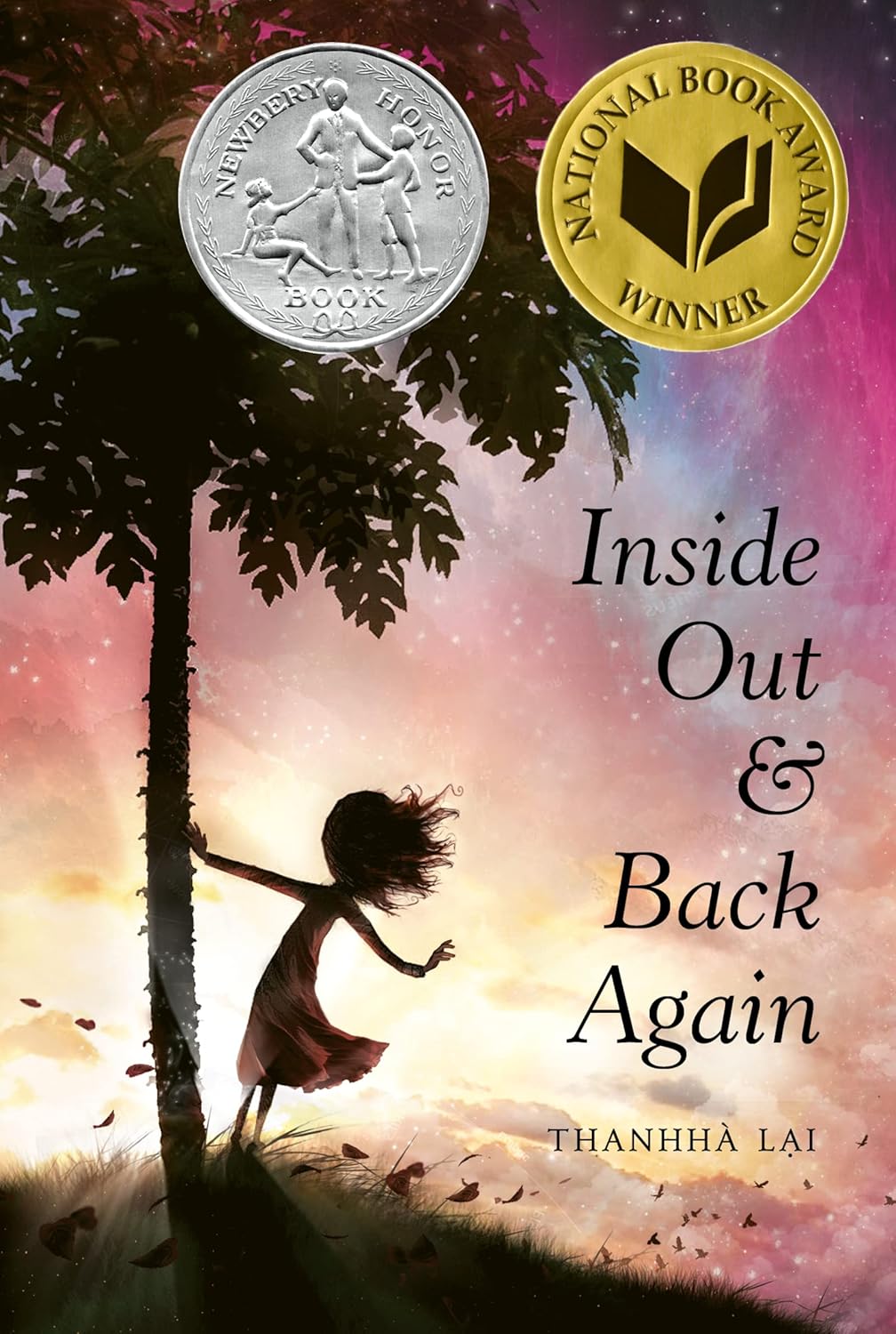
This complete guide to Inside Out & Back Again by Thanhha Lai covers everything parents, teachers, and students need to know — from reading level and recommended age to characters, key themes, and similar books. Whether you’re encountering this National Book Award and Newbery Honor winner for the first time or preparing to teach it, you’ll find clear, honest information here to help you understand what makes this spare, powerful verse novel unlike almost anything else in middle grade literature.
For Parents
Inside Out & Back Again is a moving, semi-autobiographical story about a ten-year-old Vietnamese refugee girl’s first year in America. It deals honestly with bullying, racism, and the grief of war and displacement, but does so through the eyes of a resilient, funny, and deeply relatable child narrator. The verse format keeps individual poems short and accessible, making it an excellent read-aloud even for reluctant readers.
For Teachers
A 2012 Newbery Honor and National Book Award winner, this is one of the most commonly taught verse novels in grades 4–7. Its individual poems model powerful figurative language, sensory detail, and compression, making it an exceptional mentor text for writing instruction. The book pairs naturally with history units on the Vietnam War, immigration, and refugee experiences, and its short poem structure allows for targeted close reading and discussion.
Inside Out & Back Again at a Glance
Find on Amazon →| Author | Thanhha Lai |
| Published | 2011 |
| Grade Level | 4–6 (our assessment) |
| Recommended Age | 9–12 |
| Flesch-Kincaid Grade | 4.8 |
| Word Count | ~14,925 (verse novel) |
| Pages | 262–288 (varies by edition) |
| Poems / Sections | ~68 poems across 4 parts |
| Genre | Verse novel / Historical fiction |
| Setting | Saigon, Vietnam; at sea; Alabama, USA (1975) |
| Awards | National Book Award (2011), Newbery Honor (2012) |
For official Lexile and AR levels, visit Lexile.com or AR BookFinder. ReadingVine provides independent editorial assessments.
What Reading Level Is Inside Out & Back Again?
Based on our editorial assessment, Inside Out & Back Again is best suited for readers in grades 4–6. The book carries a Lexile score of 800L and an Accelerated Reader level of 4.8. Our Flesch-Kincaid calculation aligns with the AR level at approximately grade 4.8 — but those numbers require important context, because this is a verse novel, and standard readability metrics work differently when applied to poetry than to prose.
Because each poem uses compressed, spare language rather than full narrative sentences, the word-level difficulty reads as lower than a comparable prose novel. What those metrics don’t measure is the interpretive work poems require: readers must infer setting, emotion, and meaning from images and fragments rather than having them spelled out. The poems also shift tone rapidly — from funny to heartbreaking within the same page — which rewards attentive, experienced readers. For these reasons, the book is most powerful and fully appreciated at grades 4–6, even though capable third grade readers can access the words themselves. It is also an outstanding classroom read-aloud for grades 3–5, where a teacher can model how to read and discuss individual poems before moving on.
For official Lexile and AR scores, visit Lexile.com or AR BookFinder. ReadingVine’s assessments are independent editorial evaluations.
What Age Is Inside Out & Back Again Appropriate For?
We recommend Inside Out & Back Again for readers ages 9–12. The story deals with difficult real-world subjects — war, displacement, racist bullying, and ambiguous loss — but handles them through the perspective of a child narrator who processes the world with humor, curiosity, and resilience. The tone never becomes hopeless, and the emotional honesty of the book is one of its greatest strengths as a teaching tool. Younger readers ages 7–8 can enjoy it as a family read-aloud with discussion.
The book depicts racial bullying directed at the Vietnamese protagonist, including name-calling, hair-pulling, and a physical threat. Hà’s father is a soldier who has been missing in action for nine years; by the end of the novel, her mother concludes he is almost certainly dead. The family’s escape from Vietnam is tense, and the book references the fall of Saigon and the violence of war as background context. There is no sexual content or strong language. Parents should be prepared to discuss the bullying scenes and the grief of the father’s loss with younger readers.
The bullying content, while real and uncomfortable, is handled with purpose — Hà’s eventual response to her bully (with her brother’s help and her own growing confidence) is one of the most satisfying character moments in the book. Teachers and parents have found the bullying storyline opens productive conversations about empathy, xenophobia, and what it means to be new.
What Is Inside Out & Back Again About?
The story is told entirely in free verse through the voice of ten-year-old Hà, the youngest child in a Vietnamese family living in Saigon in early 1975. Hà’s father, a South Vietnamese naval officer, has been missing in action for nine years — captured, they believe, by Communist forces from the North. Hà’s life revolves around small, vivid pleasures: the papaya tree she tends in the backyard, the market treats she sneaks with her coin money, the evening stories her family shares. But the Vietnam War is closing in on Saigon, and the city’s fall — what history calls the Fall of Saigon — is coming fast.
On April 30, 1975, Hà and her mother and three older brothers flee on a navy ship. The book follows them through a refugee camp in Guam, a transit camp, and finally to their new home in Alabama, sponsored by a warm-hearted man Hà calls “the Cowboy” because of his hat and boots. Alabama in 1975 is not always welcoming: Hà faces a cruel bully at school, struggles furiously with English, mourns her papaya tree and her whole former life, and watches her capable brothers reduced to starting over from scratch. But she also finds unexpected kindnesses — most importantly from a neighbor named Miss Washington, who gives the family English lessons and whose own connection to Vietnam gives her a particular reason to help.
The novel is autobiographical in spirit. Thanhha Lai, who was born in Vietnam and fled the country as a ten-year-old in 1975, spent fifteen years trying to write this story before discovering that verse was the form that could hold it. The result is a book that received four starred reviews and is regularly described as one of the most important American middle grade novels of the past twenty years.
Inside Out & Back Again Characters
Is Inside Out & Back Again Banned?
Inside Out & Back Again has not been widely banned and does not appear on the American Library Association’s most frequently challenged books lists. It is occasionally subject to classroom review due to its depictions of bullying and racial prejudice, and some parents have expressed concern about the scenes of school harassment. However, the consensus among educators is that these elements are handled with appropriate sensitivity and serve important pedagogical purposes. The book is widely assigned in grades 4–7 and is included in multiple state and national curriculum frameworks, including as a Common Core ELA text. It remains freely available in school and public library collections across the country.
Inside Out & Back Again Themes and Lessons
The most resonant theme in the novel — and the one that gives it its title — is the experience of having your world turned inside out and having to find your way back. Everything Hà knows and values about herself gets scrambled in America: she goes from being near the top of her class to understanding nothing in school; she goes from being a Vietnamese girl with a name and a history to being a strange, foreign object for others to gawk at; she goes from a home with a papaya tree to a borrowed house in an unfamiliar land. The novel’s emotional arc is her slow, hard rebuilding of herself — not into the person she was, but into someone new who contains both worlds.
Thanhha Lai’s choice to tell the story in verse is itself thematically meaningful: Vietnamese is a tonal language, and Lai has spoken about how verse helped her capture the rhythms and compressed imagery of her first language while writing in English. The result is a style that feels simultaneously like translation and original invention. Discussion questions worth exploring: What does Hà mean when she says things in America are “not the same, but not bad”? Why does language feel like such a central loss for Hà? How does Miss Washington’s connection to Vietnam change the meaning of her kindness toward the family?
How Many Pages and Poems in Inside Out & Back Again?
Inside Out & Back Again is a verse novel, which means it is structured as individual poems rather than traditional prose chapters. The book contains approximately 68 poems across four named parts — Saigon, at Sea, Florida, and Alabama — and runs 262 to 288 pages depending on the edition. Because poetry uses far fewer words per page than prose, the total word count of the novel is approximately 14,925 — much lower than a typical middle grade novel of the same page count. This makes the book faster to read than its page length suggests: most readers ages 9–12 can finish it in 4–6 hours of reading time. In a classroom setting, individual poems make natural short reading assignments; teachers often assign a section of poems per night and use class time to discuss them, making the book work well across three to four weeks of instruction.
Books Similar to Inside Out & Back Again
About Thanhha Lai
Thanhha Lai was born in Vietnam during the Vietnam War and fled the country with her mother and eight older brothers in 1975, when she was ten years old. Her family settled in Alabama, making her early American experience almost exactly parallel to Hà’s in the novel. After high school, she earned a degree in journalism from the University of Texas at Austin, worked for several years covering the local Vietnamese community for a California newspaper, and then earned a Master of Fine Arts in creative writing from New York University. She has said that she spent fifteen years struggling to write Inside Out & Back Again in prose before discovering that verse — with its compression, its rhythm, and its ability to hold fragmented memory — was the right form for this story. The novel won the National Book Award for Young People’s Literature in 2011 and a Newbery Honor in 2012. Lai has since written two other novels for young readers that also center Vietnamese and Vietnamese American experiences: Listen, Slowly (2015) and the YA novel Butterfly Yellow (2019). She teaches composition at Parsons The New School for Design in New York.
Inside Out & Back Again: Frequently Asked Questions
What reading level is Inside Out & Back Again?
Inside Out & Back Again is best suited for grades 4–6, based on our editorial assessment. The Accelerated Reader level is 4.8 and the Lexile score is 800L. Because the book is a verse novel — written entirely in free verse poems rather than prose — standard readability metrics measure it differently than a traditional novel. The poems require interpretive work that makes the reading experience more demanding than a word-level score alone suggests. It is also an excellent classroom read-aloud for grades 3–5.
What is the Lexile level of Inside Out & Back Again?
Inside Out & Back Again has a Lexile level of 800L. For the most current and official score, visit Lexile.com directly.
What AR level is Inside Out & Back Again?
The Accelerated Reader level for Inside Out & Back Again is 4.8, with an AR point value of 2.0. For the most current data, check AR BookFinder.
Is Inside Out & Back Again based on a true story?
Yes — closely. Thanhha Lai fled Vietnam with her mother and brothers in 1975, when she was ten years old, and the family settled in Alabama. The novel is not a strict memoir but a fictionalized account inspired by her own first year in America. Lai has said the hardest part of writing the book was not reliving the escape from Vietnam, but capturing what it felt like to arrive — to be suddenly foreign in a place that became home. She changed details, created composite characters, and shifted the family size (Hà has three brothers; Lai had eight), but the emotional truth of the story is hers.
What is a verse novel, and how does it affect reading the book?
A verse novel tells a full narrative story entirely through poems — in this case, free verse poems without rhyme or a fixed meter. Each poem in the book functions like a short chapter: it captures a single moment, image, or emotional beat in Hà’s year. Because poems compress language rather than expanding it, the book reads faster than its page count suggests and often leaves white space on the page. The format rewards slow, attentive reading — pausing on a poem, noticing what’s said and what’s left unsaid — and it makes the book an excellent text for writing instruction, since every word choice carries significant weight.
Does the father come back in Inside Out & Back Again?
No. Hà’s father has been missing in action for nine years at the start of the novel, captured during his service in the South Vietnamese navy. Near the end of the book, a letter from his family in North Vietnam confirms that no one has heard anything from him since the war ended. Hà’s mother comes to accept that he is gone. This ambiguous grief — not knowing with certainty, but accepting the probable truth — is one of the novel’s most emotionally resonant threads and an honest reflection of what many Vietnamese families experienced.
What does the title Inside Out & Back Again mean?
The title refers to the experience of having your entire world turned upside down — “inside out” — by displacement and immigration, and then slowly, painfully finding your way back to a sense of self and belonging. At the start of the novel, a fortuneteller warns Hà’s mother that the coming year will “twist inside out.” By the end, Hà has not returned to the life she lost, but she has reconstructed something new — not the same as before, but, as she puts it in the book’s final emotional turn, “not bad.”
How long does it take to read Inside Out & Back Again?
Despite running 262–288 pages, the verse format means the actual word count is much lower than a typical middle grade novel. Most readers ages 9–12 can finish it in approximately 4–6 hours of reading time. In a classroom setting, it typically takes three to four weeks when individual poems or poem groups are discussed in depth.