
 = Partner Site
Where the Mountain Meets the Moon Reading Level: A Complete Guide
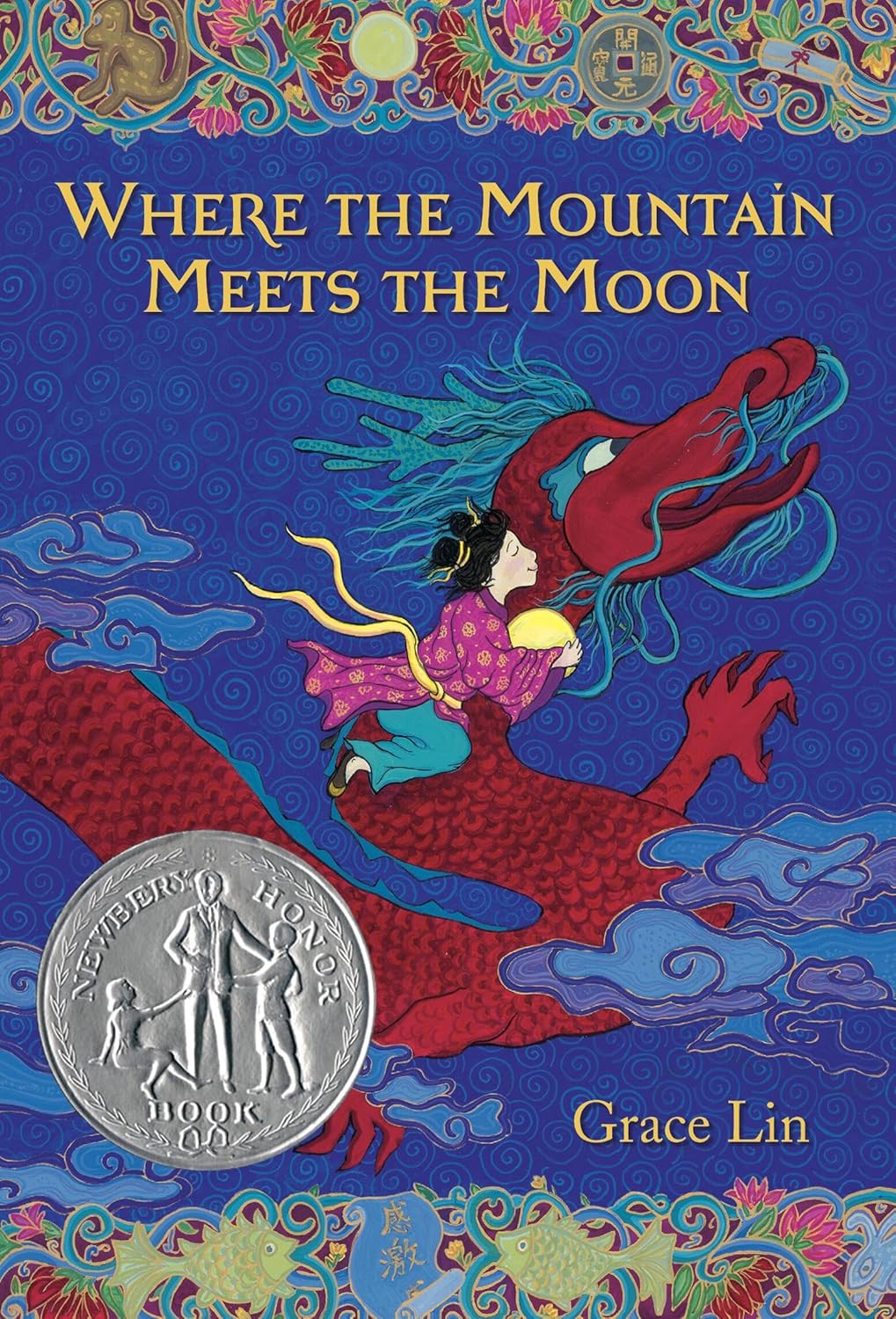
This complete guide to Where the Mountain Meets the Moon by Grace Lin covers everything parents, teachers, and students need to know — from reading level and recommended age to a full character list, key themes, and similar books. Whether you’re discovering this Newbery Honor winner for the first time or using it in a classroom unit on fantasy and Chinese folklore, you’ll find honest, practical information here to help you get the most out of this enchanting story-within-a-story adventure.
For Parents
Where the Mountain Meets the Moon is a gentle, beautifully written fantasy with no violence beyond a brief encounter with a tiger, no mature themes, and a warmly optimistic message about gratitude, family, and the true nature of good fortune. Its stories-within-stories structure mirrors traditional storytelling, and it works wonderfully as a family read-aloud for a wide range of ages. Grace Lin’s own full-color illustrations appear throughout.
For Teachers
A 2010 Newbery Honor winner and an ELA Common Core Text Exemplar for grades 4–5, this novel offers rich material for studying narrative structure, Chinese folklore, figurative language, and theme. Its embedded folktales — original stories Lin wove throughout Minli’s quest — give students a powerful model of stories-within-stories and open up meaningful discussion about how cultures use narrative to transmit wisdom and values.
Where the Mountain Meets the Moon at a Glance
Find on Amazon →| Author & Illustrator | Grace Lin |
| Published | 2009 |
| Grade Level | 4–6 (our assessment) |
| Recommended Age | 9–12 |
| Flesch-Kincaid Grade | 4.8 |
| Word Count | 42,634 |
| Pages | 278–320 (varies by edition) |
| Chapters | 31 |
| Genre | Fantasy / Folklore-inspired fiction |
| Setting | A mythical land inspired by ancient China |
| Awards | Newbery Honor (2010), Mythopoeic Fantasy Award (2010) |
For official Lexile and AR levels, visit Lexile.com or AR BookFinder. ReadingVine provides independent editorial assessments.
What Reading Level Is Where the Mountain Meets the Moon?
Based on our editorial assessment, Where the Mountain Meets the Moon is best suited for readers in grades 4–6. The book carries a Lexile score of 810L and an Accelerated Reader level of 5.5, both of which place it solidly in the upper elementary range. Our Flesch-Kincaid calculation puts sentence-level difficulty at approximately grade 4.8 — a number that reflects the novel’s clear, flowing prose rather than its full complexity as a reading experience.
What the quantitative scores don’t capture is the book’s layered narrative structure. Where the Mountain Meets the Moon is not a straightforward linear story — it contains more than a dozen embedded folktales and shorter stories told by characters Minli meets along her journey, each of which weaves back into the main plot in meaningful ways. Tracking those connections requires a level of reading attention that makes the book more demanding in practice than its Lexile might suggest for some readers. Strong readers in grade 3 can handle it, but the experience is richest for readers in grades 4–6 who can follow the layered storytelling and reflect on how the embedded tales illuminate the central themes. It is an especially effective classroom read-aloud for grades 3–5, where a teacher can pause to discuss the stories-within-stories structure as it unfolds.
For official Lexile and AR scores, visit Lexile.com or AR BookFinder. ReadingVine’s assessments are independent editorial evaluations.
What Age Is Where the Mountain Meets the Moon Appropriate For?
We recommend Where the Mountain Meets the Moon for readers ages 9–12. It is one of the most universally appropriate titles in middle grade fantasy — the content is gentle, the tone is warm throughout, and the emotional themes are accessible to a wide age range. Younger readers ages 6–8 will enjoy it as a read-aloud and can follow the adventure without difficulty, even if some of the thematic layers land more fully with older readers.
The book contains one scene in which an antagonist tiger is tricked into killing himself, handled briefly and without graphic detail. A dragon character is wounded in the same encounter but recovers. There is mild peril throughout the quest, consistent with the fairy tale tradition the book draws from. There is no language, no sexual content, and no content of concern for the vast majority of families. The book is entirely appropriate for the full elementary age range.
Grace Lin’s decision to illustrate her own novel adds a visual dimension that makes the book especially appealing to younger readers and reluctant readers who respond well to art integrated with text. The full-color illustrations appear at the opening of each chapter and throughout key scenes, giving the story a picture book warmth that belies its chapter book length.
What Is Where the Mountain Meets the Moon About?
In a mythical land inspired by ancient China, a young girl named Minli lives with her parents in a poor village at the foot of Fruitless Mountain — a bare, barren peak under a curse that keeps nothing growing. While her mother, Ma, grows bitter and resigned to their poverty, Minli’s father, Ba, fills their evenings with wonderful stories: tales of the Jade Dragon, the Old Man of the Moon who holds everyone’s destiny in his great Book of Fortune, and a magical land called Never-Ending Mountain where all questions can be answered. Minli is entranced. If she could reach the Old Man of the Moon and ask him one question, she believes she could change her family’s fortune forever.
On an impulse, Minli uses one of her family’s two precious copper coins to buy a talking goldfish from a street peddler who claims it will bring good luck. When her mother scolds her for the foolishness of the purchase, Minli frees the fish in the river — and the goldfish, grateful, tells her how to begin her journey to Never-Ending Mountain. What follows is a classic quest: Minli travels alone through a fantastical landscape, encountering monsters, kings, a boy and his water buffalo, mischievous monkeys, and magical twins — and at every stop, the people she meets tell her stories that mirror and deepen the themes of her own journey. Most importantly, she rescues a dragon who cannot fly and who joins her as a companion on the road.
The novel’s signature structure is its embedded folktales. As Minli’s outer journey unfolds, characters tell her — and she tells the reader — stories from the same mythical world that illuminate what fortune, happiness, family, and gratitude truly mean. Lin created all of these tales herself, drawing on the conventions and imagery of traditional Chinese folklore while weaving them into an entirely original narrative. The result is a book that feels ancient and freshly invented at the same time.
Where the Mountain Meets the Moon Characters
Is Where the Mountain Meets the Moon Banned?
Where the Mountain Meets the Moon has no history of being banned or challenged, and it does not appear on any American Library Association challenged books lists. It is one of the most warmly received middle grade novels of the past two decades, with starred reviews from School Library Journal and Kirkus Reviews and recognition as both a Newbery Honor book and a Common Core ELA Text Exemplar. The book is widely held in school and public library collections and has no content that has generated any documented concern from parents or educators.
Where the Mountain Meets the Moon Themes and Lessons
The central question driving Where the Mountain Meets the Moon is one that every reader — child or adult — eventually faces: what does it actually mean to have good fortune? Minli begins her journey assuming that fortune is a matter of material wealth, something the Old Man of the Moon can simply grant. What she discovers along the way — through the stories she hears and the people she meets — is that fortune is already around her: in her father’s imagination, in the love of her family, in the friendships she forges on the road. The novel’s climactic scene, in which Minli must choose between asking for her own wish or Dragon’s, is among the more elegant moral moments in contemporary middle grade fiction.
Lin also uses the embedded folktales to show that stories themselves are a form of fortune — a gift parents give their children, and a way communities preserve their wisdom across generations. Ba’s stories don’t just entertain Minli; they shape who she is and give her the tools she needs for her journey. Discussion questions worth exploring: Why does Minli choose Dragon’s question instead of her own? What does “You only lose what you cling to” mean — and how does it apply to Ma? If you could ask the Old Man of the Moon one question, what would it be?
How Many Pages and Chapters in Where the Mountain Meets the Moon?
Where the Mountain Meets the Moon is divided into 31 chapters, with page count varying by edition — the original hardcover runs approximately 278 pages, while other editions run up to 320 pages including an Author’s Note and Reader’s Guide. The exact word count is 42,634. For a reader ages 9–12 reading at a comfortable pace of 25–30 pages per hour, the book takes approximately 9–12 hours of reading time. The relatively short chapters — most run 8–12 pages — make it a natural fit for assigned nightly reading in a classroom setting, where the embedded folktales also provide natural discussion pauses. At a classroom pace of two or three chapters per session, the book typically takes four to five weeks to complete.
Books Similar to Where the Mountain Meets the Moon
About Grace Lin
Grace Lin is the award-winning author and illustrator of more than two dozen books for children, including picture books, early readers, and middle grade novels. She grew up in upstate New York, the daughter of Taiwanese immigrants, and has said that she spent her childhood rarely seeing herself reflected in the books she loved — an experience that shaped her commitment to writing stories featuring Asian protagonists and drawing on Asian cultural traditions. Where the Mountain Meets the Moon, published in 2009, drew on Chinese folklore she had researched and admired for years; all of the embedded folktales in the novel are original to Lin but rooted in traditional Chinese narrative forms. The book won the Newbery Honor and the Mythopoeic Fantasy Award in 2010 and led to two companion novels: Starry River of the Sky (2012) and When the Sea Turned to Silver (2016), which was a National Book Award finalist. Her picture book A Big Mooncake for Little Star won a Caldecott Honor in 2019. Lin illustrated Where the Mountain Meets the Moon herself, producing the full-color artwork that opens each of the novel’s 31 chapters.
Where the Mountain Meets the Moon: Frequently Asked Questions
What reading level is Where the Mountain Meets the Moon?
Where the Mountain Meets the Moon is best suited for grades 4–6, based on our editorial assessment. The Accelerated Reader level is 5.5 and the Lexile score is 810L. The prose reads more accessibly than those numbers might suggest, but the book’s layered stories-within-stories structure makes the reading experience richer and more demanding than a single number can capture. It is also an excellent classroom read-aloud for grades 3–5.
What is the Lexile level of Where the Mountain Meets the Moon?
Where the Mountain Meets the Moon has a Lexile level of 810L. For the most current and official score, visit Lexile.com directly.
What AR level is Where the Mountain Meets the Moon?
The Accelerated Reader level for Where the Mountain Meets the Moon is 5.5, with an AR point value of 7.0. For the most current data, check AR BookFinder.
Is Where the Mountain Meets the Moon based on real Chinese folklore?
The folktales embedded within the novel are original stories written by Grace Lin — they are not direct retellings of specific traditional Chinese tales. However, Lin drew deeply on the conventions, imagery, and themes of Chinese folklore to create them, and the novel’s world, characters, and motifs (the Old Man of the Moon, red threads of destiny, dragons, jade, the moon festival) are all rooted in real Chinese cultural traditions. Lin includes an Author’s Note at the end of the book explaining her research and inspirations. The result is a novel that feels authentically rooted in a living storytelling tradition while being entirely Lin’s own creation.
Does Where the Mountain Meets the Moon have sequels or companion books?
Yes. Grace Lin wrote two companion novels set in the same mythical world: Starry River of the Sky (2012) and When the Sea Turned to Silver (2016). Each follows a different protagonist on a new quest, and each uses the same stories-within-stories structure. The three books can be read independently, but readers who love one typically love all three. When the Sea Turned to Silver was a finalist for the National Book Award.
What is the significance of the red thread in Where the Mountain Meets the Moon?
The red thread is a reference to the real Chinese legend of the “red thread of fate” — the idea that the Old Man of the Moon ties a red thread between people who are destined to meet, forming invisible bonds of connection and destiny. In the novel, Lin uses the red thread as a symbol of the relationships and stories that bind people together across time and circumstance, and it becomes a key plot object in Minli and Dragon’s journey to Never-Ending Mountain.
Why does Minli use her wish for Dragon instead of her family?
This is the moral heart of the novel. When Minli reaches the Old Man of the Moon and learns she can ask only one question, she must choose between asking how to restore her family’s fortune or asking Dragon’s question — why he cannot fly. She chooses Dragon’s question. By this point in the story, Minli has come to understand, through all the tales she has heard and people she has met, that her family already has what truly matters: love, stories, and each other. The fortune she sought was already around her. Her selfless choice also sets off a chain of events that ultimately brings her family more than she ever could have asked for directly.
How long does it take to read Where the Mountain Meets the Moon?
At a reading pace of 25–30 pages per hour, most readers ages 9–12 will finish the book in approximately 9–12 hours. In a classroom setting with two or three chapters assigned per session, it typically takes four to five weeks to complete.