
 = Partner Site
The Girl Who Drank the Moon Reading Level: A Complete Guide
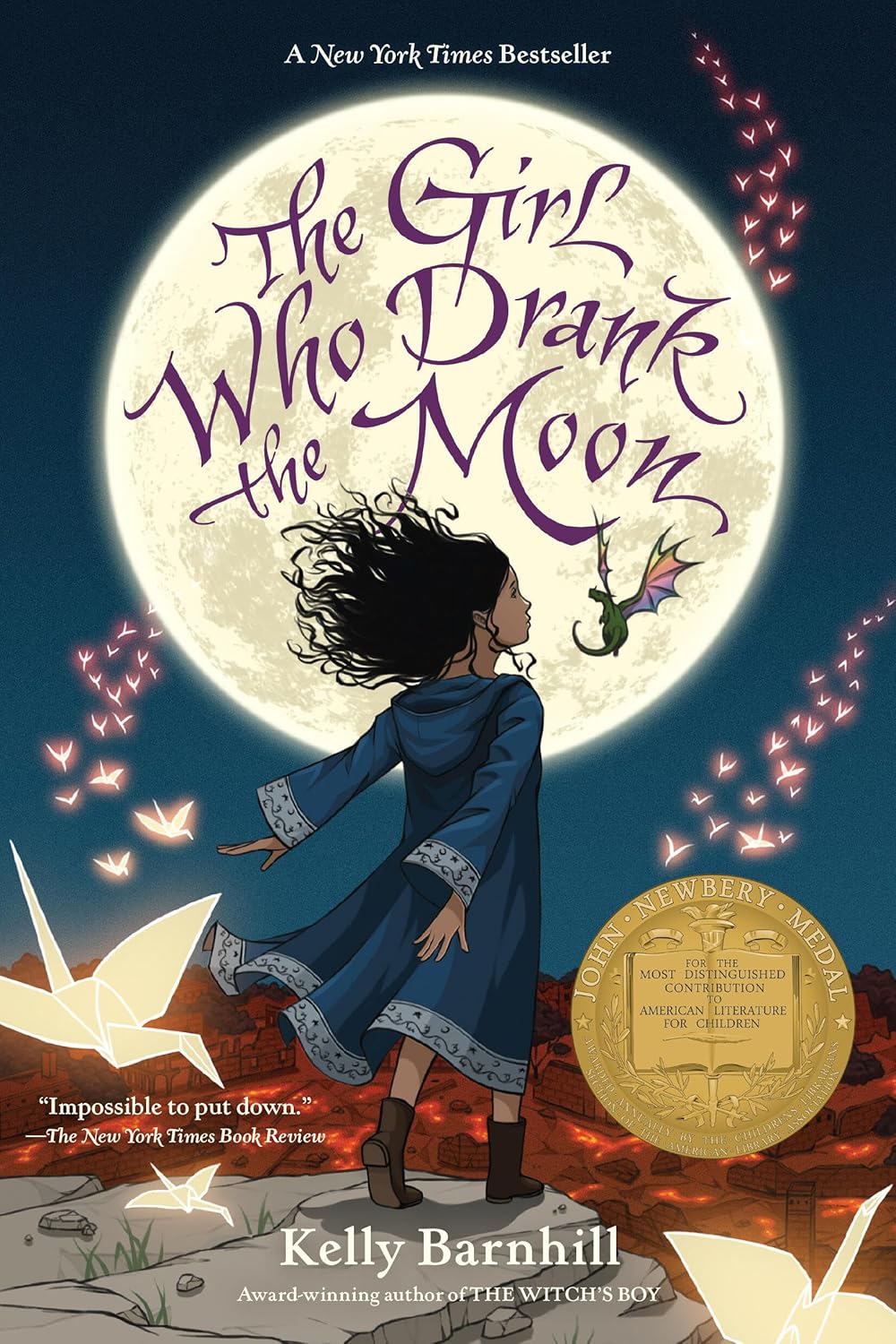
The Girl Who Drank the Moon by Kelly Barnhill is a Newbery Medal-winning fantasy novel of uncommon beauty — a story about magic, memory, sacrifice, and love told through the interweaving perspectives of a witch, a monster, a Perfectly Tiny Dragon, and a girl who does not know who she really is. Lyrical, inventive, and deeply felt, it is one of the most celebrated children’s fantasy novels of the past decade. This complete guide covers the reading level, age appropriateness, themes, characters, and everything parents and teachers need to know about this extraordinary book.
For Parents
The Girl Who Drank the Moon is a fantasy novel in the tradition of the great fairy tales — it takes love, grief, and sacrifice seriously, it contains genuine darkness, and it ends with hard-won hope rather than easy happiness. Best suited for readers ages 9-12, it is more demanding than most middle grade fantasy in both its prose style and its emotional complexity, and it rewards patient, attentive readers who are willing to sit with ambiguity.
For Teachers
A Newbery Medal winner that stands apart from most middle grade fantasy for the quality of its prose and the sophistication of its structure, The Girl Who Drank the Moon is an excellent text for teaching literary fantasy, narrative point of view, and how fairy tale conventions can be used to explore serious themes. Barnhill’s rotating perspectives and her use of the Protectorate’s mythology as a parallel narrative make it a rich text for discussing how storytelling shapes community and power. Best suited to grades 4-7, with discussion support for younger readers.
The Girl Who Drank the Moon at a Glance
Find on Amazon →| Author | Kelly Barnhill |
| Published | 2016 |
| Grade Level | 4-6 (our assessment) |
| Recommended Age | 9-12 |
| Flesch-Kincaid Grade | 5.3 |
| Word Count | ~90,000 |
| Pages | 386 (standard hardcover) |
| Chapters | 51 |
| Genre | Fantasy / fairy tale / literary fiction |
| Setting | A fictional world: the Protectorate and the forest beyond |
| Awards | Newbery Medal (2017) |
For official Lexile and AR levels, visit Lexile.com or AR BookFinder. ReadingVine provides independent editorial assessments.
What Reading Level Is The Girl Who Drank the Moon?
The Girl Who Drank the Moon reads at approximately a 4th-6th grade level by our editorial assessment, with a Flesch-Kincaid grade level of around 5.3. The individual sentences are not especially difficult — Barnhill writes with clarity even when she is being lyrical — but the book as a whole is considerably more demanding than its word-level score suggests.
The novel’s structure asks a great deal of its readers. Multiple distinct narrative threads weave through the book simultaneously: the witch Xan’s perspective, the girl Luna’s perspective, the monster Glerk’s perspective, the imprisoned mother Adara’s perspective, and the Protectorate’s official mythology. Following these threads requires sustained attention and a willingness to hold uncertainty — many chapters end without resolving what they raised, and the full picture only emerges gradually across hundreds of pages.
Barnhill’s prose is also more literary than most middle grade fantasy — she writes in a style closer to classic fairy tale than contemporary children’s fiction, with a formal, incantatory quality in places that rewards slow reading. For readers who love A Wrinkle in Time or The Hobbit, the style will feel natural and inviting. The book is most commonly recommended for grades 4-6 and ages 9-12, though many strong readers in 3rd grade and many adults find it equally rewarding. For official Lexile and Accelerated Reader scores, visit Lexile.com or AR BookFinder.
What Age Is The Girl Who Drank the Moon Appropriate For?
We recommend The Girl Who Drank the Moon for readers ages 9-12. The book is a genuine fairy tale in the old sense: it contains real darkness, genuine loss, and emotional complexity that is not softened for young readers. It is never graphic, but it does not flinch from the weight of what it is about.
The novel’s central premise involves a community that sacrifices one infant per year to appease what they believe is a dangerous witch in the forest. A mother loses her child and grieves so profoundly that she loses her mind — her institutionalization and slow recovery are depicted with honesty. There is magic-related peril and a climactic confrontation involving real danger. A character dies. The tone is that of a serious literary fairy tale rather than a horror story, and none of the difficult content is graphic, but parents should know this book treats its dark themes with full seriousness rather than deflecting them.
Sensitive readers who are frightened by fairy tale darkness may find the book challenging. For readers who have loved The Graveyard Book, A Wrinkle in Time, or classic fairy tales without sanitization, it will feel exactly right. As a read-aloud with a parent or teacher who can provide context, it works beautifully with readers as young as 8.
What Is The Girl Who Drank the Moon About?
Every year, the people of the Protectorate leave their youngest infant at the edge of the forest as a sacrifice to the witch they believe lives there and threatens their community. The Elders enforce this tradition with fear and grief, and the Protectorate has organized its entire civic life around the ritual — the Day of Sacrifice, the Sorrow, the careful maintenance of collective terror.
What the people of the Protectorate do not know is that the witch is real — but she is nothing like what they fear. Xan is a kind, practical, somewhat absent-minded old woman who wanders the forest doing good where she can. When she discovers the abandoned infants each year, she carries them through the forest to loving families in the free cities beyond, feeding them starlight on the journey. But one year, distracted by the beauty of the night sky, she accidentally feeds a baby moonlight instead — and moonlight, for a child, is magic. Enmagicked. Dangerous if not properly controlled.
Xan brings the baby home. She names her Luna. She seals Luna’s magic away until the girl is old enough to handle it, and she raises her with the help of her companions: Glerk, a swamp monster of enormous gentleness and philosophical depth, and Fyrian, a tiny dragon who believes himself to be simply enormous. Luna grows up beloved, curious, and unaware of what she is or where she came from. But memory is not easily contained, and neither is magic — and as Luna’s thirteenth birthday approaches, everything sealed away begins to press against its boundaries.
Meanwhile, back in the Protectorate, a young man named Antain questions the ritual for the first time. And in the tower where the mad are kept, a woman named Adara fills the walls with drawings of a baby, a witch, and a forest — and waits, in her grief, for something she cannot name. Kelly Barnhill has described the book as growing from her interest in how communities use fear to control their members, and how the stories a community tells about itself can become more real than the truth.
The Girl Who Drank the Moon Characters
Is The Girl Who Drank the Moon Banned?
The Girl Who Drank the Moon has not been banned or widely challenged and does not appear on lists of frequently challenged books. Its themes — infant sacrifice as a community ritual, a mother’s grief-induced madness, the use of fear as political control — are handled with the gravity of serious literary fairy tale rather than sensationalism, and the book has been embraced by educators, librarians, and critics as a distinguished and appropriate work of children’s fantasy. It is widely shelved and frequently recommended across the country.
The Girl Who Drank the Moon Themes and Lessons
The novel’s deepest theme is the relationship between story and power — how the stories a community tells about itself can become instruments of control, and how fear, once institutionalized, becomes self-perpetuating even when the original danger is long gone. The Protectorate’s Elders have maintained their power for generations through a narrative about a dangerous witch that is entirely false. The tragedy is not that the Elders are cartoonishly evil — some of them genuinely believe the story — but that the story has taken on a life independent of anyone’s intentions. This is one of the more sophisticated political observations in recent children’s literature, rendered through the language of fairy tale.
Running alongside this is a meditation on love in its most demanding forms. Xan’s love for Luna requires her to sacrifice her own future. Adara’s love sustains her through madness. The novel asks what it means to love someone enough to let them become themselves, to accept loss as the price of genuine care. Memory is a third major thread — Luna’s sealed memories, Adara’s obsessive drawings, the Protectorate’s carefully maintained false history are all variations on the same question: what happens when truth is prevented from being known?
Discussion starters for families: Why do the people of the Protectorate believe the story about the witch? Who benefits from keeping the story alive? What does Xan give up by keeping Luna? How does Adara’s grief affect how she sees the world? What does the novel suggest about what love actually costs?
How Many Pages and Chapters Are in The Girl Who Drank the Moon?
The standard hardcover edition of The Girl Who Drank the Moon is 386 pages, divided into 51 chapters. The word count is approximately 90,000 words — substantial for a middle grade novel. The chapters are short for that page count, averaging around seven to eight pages, which creates a fast-turning quality despite the lyrical prose.
For readers in the target age range of 9-12, expect a reading time of roughly 8-12 hours, or about two weeks of steady reading at 30 minutes per session. The short chapters make it well suited to read-aloud sessions with natural stopping points. As a classroom text, plan for three to four weeks, allowing time for the thematic discussions the book’s political and emotional content invites. The novel works beautifully as a family read-aloud for parents and children reading together.
Books Similar to The Girl Who Drank the Moon
About Kelly Barnhill
Kelly Barnhill is an American author based in Minneapolis, Minnesota, who has established herself as one of the finest writers of literary fantasy for children working today. The Girl Who Drank the Moon won the Newbery Medal in 2017; she is also the author of The Witch’s Boy, Iron Hearted Violet, and Dreadful Young Ladies and Other Stories, a collection of short fiction for adults. Barnhill has spoken about her deep roots in the tradition of the literary fairy tale — Angela Carter, George MacDonald, Ursula K. Le Guin — and that lineage is evident in her prose: formal, incantatory, and committed to the idea that children’s fantasy can carry the same philosophical weight as adult literary fiction. She worked for many years as a teacher before becoming a full-time writer.
The Girl Who Drank the Moon: Frequently Asked Questions
What reading level is The Girl Who Drank the Moon?
The Girl Who Drank the Moon has a Flesch-Kincaid grade level of approximately 5.3. Our editorial assessment places it at grades 4-6 (ages 9-12). The prose is clear but literary, and the novel’s multi-threaded structure is more demanding than its word-level score suggests. Strong readers in 3rd grade often love it; the book also works well for adults. For official Lexile and AR scores, visit Lexile.com or AR BookFinder.
Is The Girl Who Drank the Moon too scary for kids?
It depends on the child. The book contains genuine darkness — a community that sacrifices infants, a mother who loses her mind from grief, a villain of real menace — but it is fairy tale darkness rather than horror. Nothing is gratuitous or graphic. Children who have enjoyed The Graveyard Book, classic fairy tales in their unvarnished forms, or A Wrinkle in Time should be well prepared. Children who need consistently safe and reassuring narratives may want to wait a year or two. As a read-aloud with a parent, it works beautifully with children as young as 8.
What does it mean that Luna drank the moon?
When Xan carries the infant Luna through the forest, she normally feeds babies starlight to sustain them on the journey — a gentle, harmless magic. But distracted by the full moon, she accidentally feeds Luna moonlight instead. Moonlight, for a child, is raw magic — it enmagicks Luna, filling her with power she is far too young to control. Xan seals this power away until Luna is old enough to handle it, but the sealed magic presses against its boundaries as Luna grows. This accident is the inciting event that sets the entire novel in motion.
What is the Protectorate in The Girl Who Drank the Moon?
The Protectorate is an enclosed community where Luna’s birth mother lives — a society built around the annual ritual sacrifice of an infant to appease the witch believed to live in the forest. Its Elders maintain power through collective fear and grief, and its founding mythology is entirely false. The Protectorate is the novel’s political allegory: a portrait of how communities can be organized around manufactured terror and how that terror becomes self-sustaining even after everyone who created it is gone.
Is The Girl Who Drank the Moon part of a series?
No. It is a standalone novel with a complete, self-contained story. It is not connected to any of Kelly Barnhill’s other books, though readers who love this novel are likely to enjoy her other work, particularly The Witch’s Boy and Iron Hearted Violet, which share its fairy-tale sensibility and literary prose style.
What grade is The Girl Who Drank the Moon typically assigned in?
The Girl Who Drank the Moon is most commonly recommended for grades 4-6 and assigned in grades 5-7 in classroom settings. It appears frequently on Newbery reading lists and in fantasy literature units. Its thematic richness makes it productive for discussion at the upper end of elementary school and into middle school.
Why did The Girl Who Drank the Moon win the Newbery Medal?
The Girl Who Drank the Moon won the Newbery Medal in 2017 for the beauty and precision of Barnhill’s prose, the sophistication of the novel’s multi-threaded structure, and its ability to use the conventions of fairy tale to explore serious questions about power, memory, love, and truth. The Medal committee recognized a work of children’s fantasy that met the highest literary standards without compromising its accessibility or emotional generosity toward young readers.
Who is Fyrian, and is he really tiny?
Fyrian is a Perfectly Tiny Dragon who lives with Xan and Glerk — a creature about the size of a large moth who is absolutely, cheerfully, unshakeably convinced that he is Simply Enormous. His self-delusion is played entirely for warmth and comedy, and he is one of the most beloved characters in the book. He is, to be clear, extremely tiny. His belief to the contrary is one of the novel’s great ongoing jokes, and his courage when it finally matters is one of its great surprises.