
 = Partner Site
The Handmaid’s Tale Reading Level: A Complete Guide
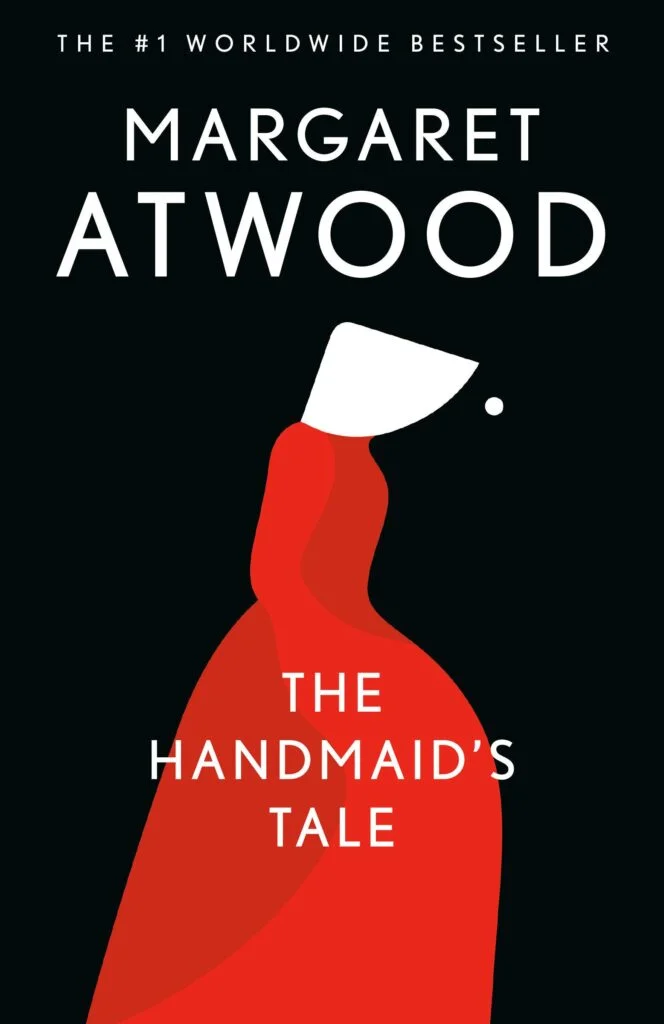
The Handmaid’s Tale by Margaret Atwood is a novel narrated by a woman called Offred, a Handmaid in the Republic of Gilead — a near-future theocratic state built on the ruins of New England, where a violently patriarchal government has stripped women of their rights, their names, their property, and their freedom of movement, and assigned those deemed reproductively viable to powerful men for the sole purpose of bearing children. Offred remembers the world before Gilead: her husband Luke, her daughter, her job, her name. In the present, she exists as a state-controlled reproductive vessel, documenting her experience in secret. Published in 1985, it won the Governor General’s Award and the Arthur C. Clarke Award, was nominated for the Booker Prize, and has been challenged or banned in American schools and libraries continuously since its publication — reaching #1 on the ALA’s most challenged list in 2023. This complete guide covers The Handmaid’s Tale‘s reading level, recommended age, content considerations, characters, themes, and books similar to The Handmaid’s Tale, designed for parents, teachers, and students.
For Parents
Adult literary fiction widely assigned in grades 11–12 AP English and IB Literature. Contains explicit sexual content including ritualized rape as a state institution, violence, and sustained depictions of totalitarian patriarchal control. Not appropriate below grade 10. Atwood’s rule — that nothing in the novel depicts something that has not already happened to women in some time or place — is essential context for reading it.
For Teachers
One of the defining texts of the AP and IB secondary English canon — rich in formal complexity (the framing narrative, the unreliable narrator, the Historical Notes epilogue), political and religious satire, and feminist theory. The challenge history is extensive and current, making it productive for teaching alongside censorship and intellectual freedom. Atwood’s rule that everything in Gilead has historical precedent is the novel’s most powerful pedagogical dimension: almost every Gileadean practice can be traced to a documented real-world example.
The Handmaid’s Tale at a Glance
Find on Amazon →| Author | Margaret Atwood |
| Published | 1985 (McClelland and Stewart; US: Houghton Mifflin) |
| Grade Level | 10–12 (our assessment) |
| Recommended Age | 15+ |
| Lexile | Not published for standard editions |
| Word Count | ~102,000 |
| Pages | 311 (Anchor Books paperback) |
| Chapters | 46 chapters in 15 named sections, plus Historical Notes epilogue |
| Genre | Dystopian literary fiction / speculative fiction |
| Setting | Republic of Gilead (near-future New England); late 20th century |
| Awards | Governor General’s Award (1985); Arthur C. Clarke Award (1987) |
For official Lexile and AR levels, visit Lexile.com or AR BookFinder. ReadingVine provides independent editorial assessments.
What Reading Level Is The Handmaid’s Tale?
Standard Lexile scores are not published for The Handmaid’s Tale in widely available databases. Atwood writes in dense, lyrical, associative prose: long paragraphs in which Offred’s present-tense perceptions are interwoven with her memories of the world before Gilead and her analysis of her own situation. The sentences are not syntactically complex in the way that raises Lexile scores, but the density of implication — the gap between what Offred says and what she means, between what she perceives and what she cannot say directly — is the novel’s primary intellectual demand.
Booksource’s interest level is “9-A” — grade 9 through adult — which accurately describes the audience that can engage with it but does not capture the content maturity required. Our editorial assessment places it at grades 10–12, most appropriate for AP English and IB Literature in grades 11–12, and readable by mature 10th-grade students in courses with strong teacher support. This is adult literary fiction assigned in secondary school, not a novel written for secondary school students, and the distinction matters for content decisions. At approximately 102,000 words and 311 pages across 46 chapters, most classroom readers complete it in three to four weeks. For official Lexile and AR scores, visit Lexile.com or AR BookFinder. ReadingVine’s assessments are independent editorial judgments.
What Age Is The Handmaid’s Tale Appropriate For?
We recommend The Handmaid’s Tale for readers ages 15 and up. The novel contains explicit sexual content — most significantly the Ceremony, a monthly ritual in which the Commander has intercourse with his Handmaid while his wife holds her, framed by Gilead’s religious language as a reproductive act. This is state-sanctioned rape depicted without euphemism, and it is the novel’s central and recurring institutional violation. The novel also contains violence, torture (referenced and depicted), suicide, and the systematic psychological degradation of women under a totalitarian system.
The Ceremony is depicted multiple times and is the novel’s most consistently disturbing element: ritualized, state-mandated intercourse between the Commander and Offred while his wife Serena Joy holds Offred’s hands. Atwood’s depiction is clinical rather than gratuitous, but it is direct — she does not soften what is happening. The novel also depicts a Salvaging (a public execution in which Handmaids are required to participate) and a Particicution (in which Handmaids are directed to execute a man with their own hands). Offred has a sexual relationship with Nick that is simultaneously a matter of agency and survival. The novel contains a lesbian relationship (Moira), references to a state-licensed brothel called Jezebel’s and the circumstances that bring women there, and Offred’s memories of her forced separation from her child and husband. The Historical Notes epilogue — set two hundred years in the future — frames the entire narrative as a recovered historical document analyzed by scholars; it is formally essential and should not be omitted.
What Is The Handmaid’s Tale About?
The Republic of Gilead has replaced the United States. A combination of environmental crisis — dramatically falling birth rates attributed to pollution — and right-wing theocracy produced a coup in which women lost their bank accounts, their jobs, their legal identity, and eventually their names. Women deemed reproductively viable — Handmaids — are assigned to Commanders for the purpose of producing children. Handmaids take their names from their Commanders: Offred is “of Fred,” the Commander to whom she is currently assigned. She had a name before. The novel withholds it.
Offred’s daily life is severely restricted: she may leave the Commander’s house once a day for the food markets, accompanied by another Handmaid, Ofglen. Women cannot read. The market signs are pictures. The streets are patrolled by Eyes — Gilead’s secret police — and Guardians. The Wall displays the bodies of executed dissidents. The Ceremony — the Commander’s monthly attempt to impregnate Offred, conducted with Serena Joy present and described in Gilead’s language as sacred — is the most direct expression of what Gilead has made Offred: a vessel rather than a person.
Threading through Offred’s present are memories of the time before: her husband Luke, her daughter, her friend Moira — a feminist activist who resisted and was captured — and her mother, whose fate she does not know. These memories surface as fragments rather than linear backstory. Atwood is depicting memory as it actually works under conditions of trauma and suppression: associative, incomplete, unreliable.
The plot turns on deviations from routine: the Commander begins calling Offred to his study after hours, ostensibly for Scrabble — a small, dangerous intimacy in a world where women cannot read. Serena Joy, impatient with the Ceremony’s failure to produce a child, arranges for Offred to sleep with Nick, the Commander’s driver. Ofglen reveals herself as part of the Mayday resistance. Offred’s relationship with Nick deepens. Then the Eyes arrive at the Commander’s house, and Offred is taken. Her narrative ends at the moment of uncertainty. The Historical Notes epilogue, set two hundred years later at a Gileadean Studies conference, frames the entire narrative as recovered cassette tapes — analyzed by scholars who are more interested in identifying the Commander than in what Offred experienced, and who may be reproducing, in an academic register, the same attitude toward women’s testimony that enabled Gilead in the first place.
The Handmaid’s Tale Characters
Is The Handmaid’s Tale Banned?
The Handmaid’s Tale has one of the most sustained challenge and ban histories in this catalog, spanning four decades without interruption. It ranked #37 on the ALA’s 100 Most Frequently Challenged Books of 1990–1999, #88 for 2000–2009, #8 in 2022, and #1 in 2023 — the most challenged book in the United States in its thirty-eighth year of publication. Challenge reasons include sexual content, profanity, anti-Christian themes, LGBTQ+ content, and characterizations of it as “pornographic” and “morally corrupt.”
Recent specific incidents: the Council Bluffs, Iowa school district removed it from all school libraries in September 2024 along with 58 other titles under Senate File 496 (an Iowa law requiring removal of books containing descriptions of sexual acts, later enjoined on constitutional grounds). Madison County, Virginia removed it from high school library shelves, prompting Atwood to publish a 2023 essay in The Atlantic: the novel “is much less sexually explicit than the Bible,” she wrote, and speculated the real motivation was the mistaken belief that the novel is anti-Christian — a belief she has consistently disputed, noting it is partly inspired by biblical texts and argues against the totalitarian misuse of religion rather than against Christianity itself.
The deepest irony of the novel’s challenge history requires naming directly: The Handmaid’s Tale is a novel about a society that bans books, burns literature, and controls information as tools of authoritarian control. The challenges to the novel for depicting those tools enact, in a different register, the mechanism the novel critiques. When the Leander, Texas school district banned it in 2021, Atwood said: “I had thought America was against totalitarianisms. If so, surely it is important for young people to be able to recognize the signs of them. One of those signs is book-banning. Need I say more?” In 2023, Penguin Random House published a special fireproof edition in response to escalating removal activity.
The Handmaid’s Tale Themes and Lessons
Atwood’s rule — that she would include nothing that human beings had not already done in some time or place — is the novel’s most important teaching resource. Gilead is not speculative fiction in the sense of imagining an unprecedented future; it is a collage of documented historical practices assembled into a coherent system. The Handmaid system draws on the biblical Rachel and Bilhah narrative (Genesis 30), on the forced reproduction policies of Ceaușescu’s Romania, and on the Nazi Lebensborn program. The prohibition on women’s literacy draws on Taliban-controlled Afghanistan. The theocratic coup and strict dress codes for women draw on the Islamic Revolution in Iran, which Atwood watched developing while writing the novel in Berlin in 1984. The Wall of executed dissidents draws on the public displays used by multiple twentieth-century authoritarian regimes. Almost every element of Gilead has a real-world analogue, and locating those analogues is the exercise that turns the novel from a cautionary tale into a historical argument.
The Historical Notes epilogue is the novel’s most formally sophisticated element and the one most often underweighted on first reading. The narrative we read is not Offred’s written account but a transcript of cassette tapes found after Gilead’s fall, compiled and introduced by Professor Pieixoto at a 2195 academic conference. His presentation is condescending toward Offred’s account, more interested in identifying the Commander (a historical puzzle) than in what Offred experienced, and gently amused by feminist critiques of his scholarly detachment. He is two hundred years removed from Gilead and still reproducing, in academic form, the basic attitude toward women’s testimony that enabled Gilead: evidence to be evaluated rather than experience to be heard. The epilogue is not a tidy resolution; it is the novel’s final argument, made with the same precision as everything that preceded it.
Atwood’s treatment of women who enforce the patriarchy — the Aunts, Serena Joy, the Wives — is among the novel’s most politically complex contributions. She refuses to treat female complicity in patriarchal systems as paradox or betrayal; she treats it as an expected consequence of incentive structures those systems create. Women who enforce the rules receive relative privileges; women who resist receive punishment. The Aunts have found a way to hold institutional power within the system, and their cruelty is therefore instrumental. Serena Joy believed in the ideology before she understood what it would cost her specifically. Both are trapped, and both trap others. This is not a contradiction but a description of how patriarchal systems sustain themselves.
Discussion questions for classrooms and families: What is Atwood’s rule about historical precedent — and how does knowing that every Gileadean practice has a real-world source change how you read the novel? What does the Historical Notes epilogue argue about whose testimony is taken seriously and whose is not — and how does that argument connect to Gilead itself? What does Serena Joy’s situation say about women who advocate for patriarchal systems? How does Offred’s acknowledged unreliability function as both narrative device and statement about survival under totalitarianism? What does Atwood mean when she says the novel is not anti-Christian but argues against the use of religion as a tool of political control?
How Many Pages and Chapters in The Handmaid’s Tale?
The Anchor Books paperback is 311 pages. The novel is structured as 46 chapters across 15 named sections — “Night,” “Shopping,” “The Ceremony,” “Waiting Room,” and so on — each section title carrying its own thematic weight. The sections alternate between present-tense narrative and “Night” sections in which Offred’s thoughts are less guarded and more associative. The Historical Notes epilogue follows the main narrative and is formally essential: it reframes everything that preceded it and is part of the novel’s argument, not an appendix. Teachers who assign the novel without the epilogue are assigning an incomplete text. Word count is approximately 102,000. Most classrooms complete it in three to four weeks.
Books Similar to The Handmaid’s Tale
About Margaret Atwood
Margaret Atwood was born in 1939 in Ottawa, Ontario, and grew up partly in the bush of northern Quebec and Ontario, where her father was a forest entomologist. She studied at the University of Toronto and at Radcliffe College at Harvard, and has published more than fifty books — novels, poetry collections, short story collections, nonfiction, and children’s books — across six decades. She has won the Booker Prize twice: for The Blind Assassin in 2000 and for The Testaments, the sequel to The Handmaid’s Tale, in 2019.
She wrote The Handmaid’s Tale while living in Berlin in 1984 — a year she has noted was not accidental — watching the Islamic Revolution’s transformation of Iran, reading about American religious right politics, and thinking about the long history of societies that had controlled women’s bodies through religion and law. She carried newspaper clippings to interviews to support her fiction’s grounding in reality. The rule — that she would include nothing that had not already happened — was not a limitation but an argument: Gilead is not a warning about what might happen if things go wrong, but a collage of things that have already happened and could be assembled again.
The Hulu television adaptation, starring Elisabeth Moss as Offred/June, premiered in 2017 and won eight Primetime Emmy Awards in its first season including Outstanding Drama Series. Atwood served as consulting producer throughout its six seasons; Season 6 premiered in April 2025 as the series’ final season. She has remained publicly engaged with the novel’s challenge history across four decades, responding to specific bans with pointed clarity. She lives in Toronto.
The Handmaid’s Tale: Frequently Asked Questions
What reading level is The Handmaid’s Tale?
Standard Lexile scores are not published for The Handmaid’s Tale. The prose is dense, lyrical, and formally sophisticated — Atwood writes in close first-person with extensive implied meaning. Booksource’s interest level is grade 9 through adult; our editorial assessment places it at grades 10–12, most appropriate for AP English and IB Literature in grades 11–12, ages 15 and up. For official Lexile and AR scores, visit Lexile.com or AR BookFinder.
What grade is The Handmaid’s Tale appropriate for?
We recommend grades 10–12, ages 15 and up. Contains ritualized rape as a central recurring institutional practice, graphic violence, and sustained totalitarian oppression of women. This is adult literary fiction assigned in secondary school, not a novel written for secondary students. Most commonly assigned in grades 11–12 AP English Literature and IB Literature.
How many pages are in The Handmaid’s Tale?
The Anchor Books paperback is 311 pages across 46 chapters in 15 named sections, plus a Historical Notes epilogue (formally essential — do not omit). Word count approximately 102,000. Most classrooms take three to four weeks.
What is The Handmaid’s Tale about?
In the Republic of Gilead — a near-future theocratic state on the ruins of New England — Offred is a Handmaid assigned to a Commander for the purpose of bearing children, stripped of her name, property, and freedom. She narrates her daily life under Gilead’s surveillance while remembering her husband, daughter, and the world before. The entire narrative is framed as a recovered historical document analyzed by scholars two hundred years later — scholars who may not be listening to what it actually says.
What is the Historical Notes epilogue in The Handmaid’s Tale?
The novel’s final section, set in 2195, reveals that Offred’s narrative was found on cassette tapes and compiled by academics. The keynote speaker, Professor Pieixoto, treats the tapes as a historical puzzle — more interested in identifying the Commander than in what Offred experienced — and is mildly condescending toward feminist critiques of his approach. Two hundred years after Gilead’s fall, the same attitude toward women’s testimony that enabled Gilead has survived, now wearing academic dress. The epilogue is not a resolution but a continuation of the novel’s central argument.
Why is The Handmaid’s Tale banned?
Challenged continuously since 1985 for sexual content (primarily the Ceremony, which is state-sanctioned rape), profanity, anti-Christian themes, and LGBTQ+ content. It was the #1 most challenged book in the United States in 2023. Atwood has responded by noting the novel is less sexually explicit than the Bible, is inspired by biblical texts, and argues against the totalitarian misuse of religion, not against Christianity. She has also noted the irony: a novel about a book-burning society being banned is one of those signs of totalitarianism she wrote the book to help readers recognize.
What is Atwood’s rule about what she included in The Handmaid’s Tale?
She would not include anything that human beings had not already done in some time or place. Gilead is not a speculative projection but an assembly of documented historical practices: the Handmaid system draws on the biblical Rachel and Bilhah, Ceaușescu’s Romania, and Nazi Germany’s Lebensborn program; the literacy prohibition on Taliban-era Afghanistan; the theocratic coup and dress codes on the Iranian Revolution. This rule makes Gilead not a warning about the future but a documentation of the past.
Is there a Handmaid’s Tale TV series?
Yes — a Hulu series starring Elisabeth Moss as Offred/June, premiered 2017, won eight Emmy Awards in Season 1 including Outstanding Drama Series. Atwood served as consulting producer. Season 6 premiered April 28, 2025 as the series’ final season. Rated TV-MA and appropriate for adult viewers; it has diverged significantly from the novel in later seasons, following June beyond where the novel ends.
Is there a sequel to The Handmaid’s Tale?
Yes — The Testaments (2019), winner of the Booker Prize. Set fifteen years after the novel, told from three perspectives: Aunt Lydia, the Commander’s daughter Agnes, and Nicole (Offred’s daughter). It answers some of what The Handmaid’s Tale deliberately leaves open, including Offred’s fate. Most rewarding after the original novel, though it can be read as a standalone.