
 = Partner Site
Slaughterhouse-Five Reading Level: A Complete Guide
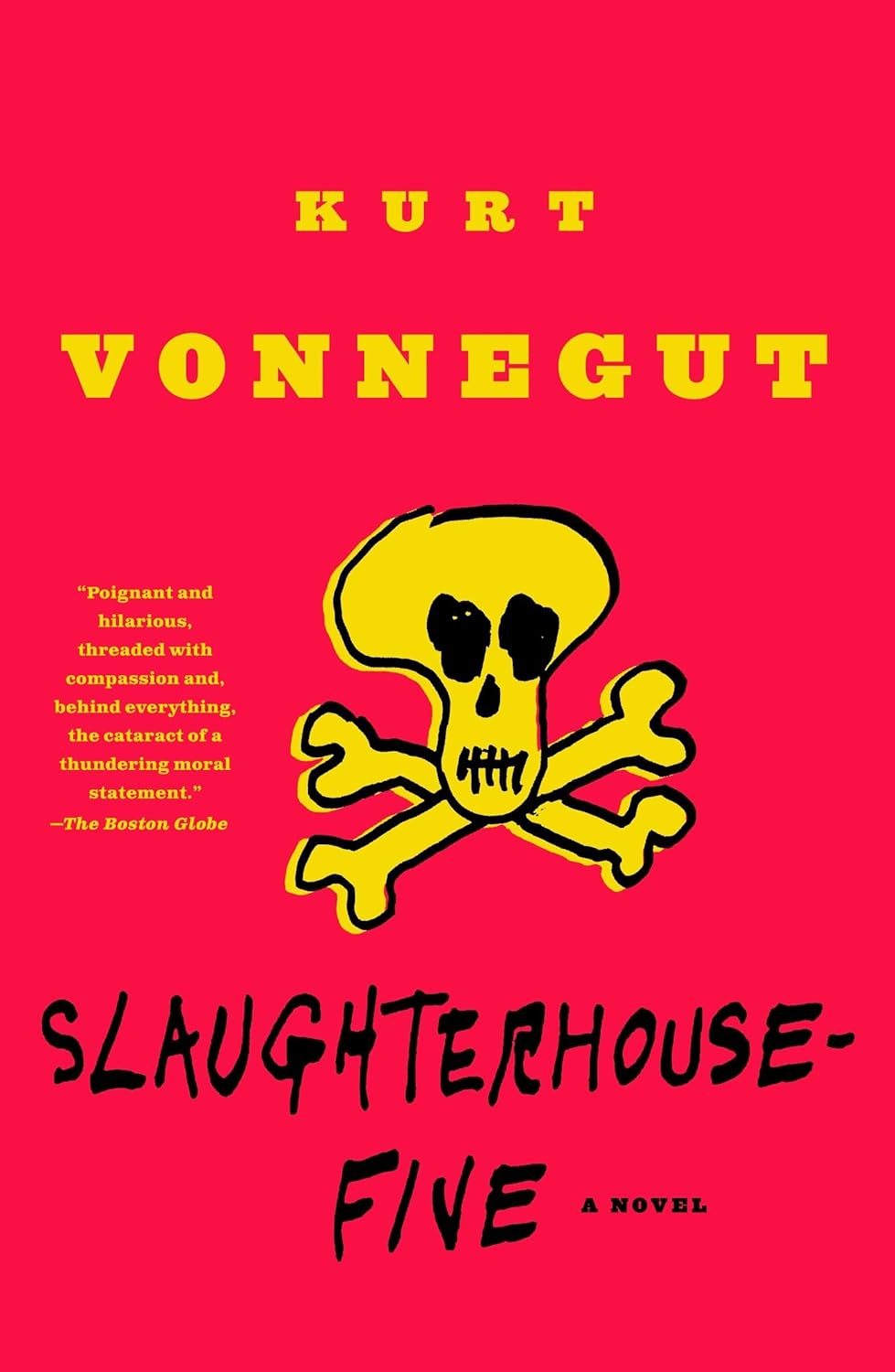
Slaughterhouse-Five, or The Children’s Crusade: A Duty-Dance with Death by Kurt Vonnegut is a novel about Billy Pilgrim, an American soldier who survives the Allied firebombing of Dresden as a prisoner of war in 1945, and who has become “unstuck in time” — experiencing moments of his life in non-chronological order, including repeated abduction by the alien Tralfamadorians. Published in 1969 at the height of the Vietnam War, it is a semi-autobiographical anti-war novel that refuses the conventions of the genre: it does not argue that war is terrible, it demonstrates it, and then moves on, because Vonnegut — who was there — concluded that there is nothing useful to say about the destruction of a city that can be said in the registers war literature typically uses. This complete guide covers Slaughterhouse-Five‘s reading level, recommended age, content considerations, characters, themes, and books similar to Slaughterhouse-Five, designed for parents, teachers, and students.
For Parents
A short, formally inventive anti-war novel combining World War II memoir, science fiction, and black comedy. Contains profanity, sexual content, and graphic descriptions of wartime death. Best for ages 14 and up. The dark humor is the point — Vonnegut uses it to say something war literature without it cannot.
For Teachers
A standard grades 9–12 text with rich material on narrative structure, satire, and the ethics of representing atrocity. The novel’s fractured time structure and metafictional first chapter reward discussion of form as argument. Pairs naturally with historical sources on the Dresden bombing and with the Vietnam War context in which it was written and received.
Slaughterhouse-Five at a Glance
Find on Amazon →| Author | Kurt Vonnegut |
| Published | 1969 (Delacorte Press) |
| Grade Level | 9–12 (our assessment) |
| Recommended Age | 14+ |
| ATOS Reading Level | 6.0 |
| Lexile | 850L |
| Word Count | 49,459 |
| Pages | ~275 (Delacorte paperback) |
| Chapters | 10 |
| Genre | Anti-war fiction / science fiction / satire |
| Setting | Dresden, Germany; Ilium, New York; Tralfamadore; 1944–1976 (non-linear) |
For official Lexile and AR levels, visit Lexile.com or AR BookFinder. ReadingVine provides independent editorial assessments.
What Reading Level Is Slaughterhouse-Five?
Slaughterhouse-Five has an ATOS reading level of 6.0 and a Lexile of 850L. These scores are closer to the actual reading experience than the Hemingway and Steinbeck scores in this catalog — Vonnegut writes in short, declarative sentences with minimal vocabulary complexity, but the sentences are stranger than Hemingway’s plain prose. They do unexpected things. They stop where you don’t expect them to stop. The famous phrase “So it goes” appears each time a death is mentioned — 106 times in the novel — and its effect changes from dark joke to incantation to something that begins to feel like a genuine philosophical position, though no formula can measure that transformation.
The novel’s fractured time structure is its primary reading challenge. Billy Pilgrim’s life is presented non-chronologically, and tracking which moment of his life is occurring at any given point requires attention. The metafictional first chapter — in which Vonnegut speaks as himself about his struggles to write this book — is both the novel’s introduction and its argument about what kind of book it is. Readers who miss the significance of that chapter often find the rest harder than it needs to be. At 49,459 words and approximately 275 pages, the novel reads in a single long sitting or two short ones; most classrooms complete it in one to two weeks. For official Lexile and AR scores, visit Lexile.com or AR BookFinder. ReadingVine’s assessments are independent editorial judgments.
What Age Is Slaughterhouse-Five Appropriate For?
We recommend Slaughterhouse-Five for readers ages 14 and up. The novel contains profanity throughout, several sexual scenes (including the Montana Wildhack sequences on Tralfamadore), graphic descriptions of dead bodies after the Dresden firebombing, and the general violence of wartime. The sexual content and language are the primary bases for the novel’s extensive challenge history.
The novel contains recurring profanity and multiple sexual scenes, including Billy’s relationship with Montana Wildhack on Tralfamadore, which is depicted directly. The war sequences include graphic descriptions of bodies in the aftermath of the Dresden firebombing — Vonnegut does not spare the horror, which is the point. Edgar Derby’s execution for looting a teapot is the novel’s most deliberately absurd act of wartime justice, and its emotional weight is cumulative rather than immediate. Parents of younger or more sensitive readers should be aware that Vonnegut uses dark comedy to carry material that is genuinely traumatic at its core.
What Is Slaughterhouse-Five About?
Chapter One is Vonnegut speaking as himself: a veteran who survived the Dresden firebombing as a prisoner of war, who has been trying for twenty years to write a book about it, who kept telling a war buddy’s wife that it would be an anti-war book, and who kept being told: “Why don’t you write an anti-war book, Mr. Vonnegut? As well tell it to be an anti-glacier book.” He could not find a way to write about Dresden. He went to Dresden to visit it again with his old friend Bernard O’Hare; he failed to write the book again. Then he wrote this one, which is not quite a novel and not quite a memoir and operates by the same logic as the massacre itself: it does not make sense, and sense is probably the wrong thing to look for.
Billy Pilgrim is the son of a barber from Ilium, New York. He becomes a chaplain’s assistant, is sent to Europe, is captured by Germans, and is kept alive in an underground slaughterhouse — Schlachthof-Fünf — in Dresden when the Allied firebombing of February 1945 kills approximately 135,000 people and destroys one of Europe’s most beautiful cities. After the war he becomes an optometrist, marries, has children, becomes mildly famous for describing his abduction by aliens from the planet Tralfamadore. He is also unstuck in time — he has no control over which moment of his life he is inhabiting at any given instant, drifting between Dresden and his optometrist’s office and Tralfamadore and the night of his daughter’s wedding without transition or warning.
The Tralfamadorians perceive all of time simultaneously rather than sequentially; they see every moment as equally present and cannot change any of them. Their philosophy — that when someone dies, they are simply in a bad condition at that moment but fine at all other moments, and that the appropriate response to death is “So it goes” — is the novel’s central borrowed idea. Vonnegut does not endorse it. He uses it as the only available response to something that has no adequate human response: the knowledge that 135,000 people were killed in a single night and the world mostly agreed it was necessary and moved on.
The novel moves between Billy’s experiences without chronological order — childhood, the war, postwar optometry practice, a plane crash, a hospital room, Tralfamadore, his daughter’s wedding — and each juxtaposition is a formal argument. The death of a dog followed by “So it goes.” The execution of Edgar Derby for stealing a teapot from the ruins of Dresden followed by “So it goes.” The bombing itself, which kills 135,000 people, reported in two short paragraphs. Vonnegut’s method is to give every death the same weight and no weight, because that is what it felt like to survive it.
Slaughterhouse-Five Characters
Is Slaughterhouse-Five Banned?
Slaughterhouse-Five has an extensive challenge and ban history. It was banned in a Drake, North Dakota school in 1973, where copies were burned — a school board member described the act as “civic service.” It was removed from school libraries in Strongsville, Ohio, in 1972, a case that eventually resulted in a federal court ruling restoring it. It has been challenged repeatedly across decades for profanity, sexual content, and its treatment of religion — Vonnegut’s God is not the God of any organized faith. The American Library Association lists it among the most challenged books in the United States.
Vonnegut himself was characteristically direct about the challenges. In 1973, responding to a school board in Levittown, New York, that had burned copies of the novel, he wrote: “If you are an educator, you might want to know that many books that were once thought dangerous are now considered perfectly harmless. Amongst these are the works of Charles Darwin and Karl Marx. However, you seem to think that ‘Slaughterhouse-Five’ is more dangerous than either of these. I disagree with you.” He signed it “Yours truly.”
Slaughterhouse-Five Themes and Lessons
Vonnegut’s argument about how to represent war begins in Chapter One, where he tries and fails to write a conventional war novel. He describes the problem: when you call someone up to ask what they remember about Dresden, they remember everything wrong; when you try to write it honestly, nothing you write is adequate to what happened; and when you write it through a traditional narrative lens — the heroism, the survival, the lessons learned — you have lied about what it was. His solution is to use science fiction as a distancing mechanism: by making Billy’s story formally impossible (the time travel, the Tralfamadorians), Vonnegut signals that this is not a direct representation of the truth but an attempt to circle around something that cannot be approached directly. The absurdity is the honesty.
“So it goes” is the novel’s most discussed formal device. It appears every time anyone or anything dies — people, animals, the city of Dresden — and it is borrowed from the Tralfamadorian philosophy that all moments of time exist simultaneously and that death is merely a bad condition at one moment rather than an ending. Vonnegut uses the phrase with increasing weight: it begins as dark comedy, accumulates through 106 repetitions into something closer to a prayer, and by the end functions as the only honest response available to a man who was there and cannot grieve adequately for everyone who was not. It is not the novel’s endorsement of passive acceptance. It is its acknowledgment that the alternative — genuine grief for 135,000 people — is humanly impossible, and that the attempt to perform that grief anyway is what literature is for.
The novel’s subtitle — “The Children’s Crusade” — is drawn from a real conversation Vonnegut has in Chapter One with Bernard O’Hare’s wife, who is angry about the book he is planning to write. She has understood, she tells him, that war is fought by children — that the men who are sent to fight are boys, not the heroic adults of war novels and movies — and she does not want him to write a book that makes the war seem glamorous and make it easier to send more children. The subtitle is his promise to her.
Discussion questions for classrooms and families: What does “So it goes” do the 106th time you read it that it did not do the first time — how does Vonnegut use repetition? Why does Vonnegut include himself as a character in Chapter One — what does this add to the novel that removing him would lose? Is Billy Pilgrim’s acceptance of the Tralfamadorian philosophy a healthy response to trauma or a capitulation to it? What is Vonnegut arguing when he describes his protagonist as “a man who was the son of a barber”? What does Mary O’Hare’s objection in Chapter One tell us about what Vonnegut is committed to doing differently?
How Many Pages and Chapters in Slaughterhouse-Five?
The Delacorte paperback is approximately 275 pages across 10 chapters. Word count is 49,459 — short for a novel, comparable to A Farewell to Arms in length but far shorter in feel because Vonnegut’s chapters are compressed and his transitions are sudden. Most readers finish it in a single long sitting or two; classrooms typically take one to two weeks. Chapter One is unusually long and unlike the rest of the novel; Vonnegut calls it a description of “what the book is going to be like” and delivers on this accurately: it is discursive, funny, full of digressions that turn out to matter, and honest about its own limitations.
Books Similar to Slaughterhouse-Five
About Kurt Vonnegut
Kurt Vonnegut was born in 1922 in Indianapolis, Indiana. He studied biochemistry at Cornell, was drafted into the Army in 1943, and was captured by German forces during the Battle of the Bulge in December 1944. He was imprisoned in Dresden as a prisoner of war, housed in a slaughterhouse — Schlachthof-Fünf — and survived the Allied firebombing of February 13–15, 1945, which killed approximately 135,000 people, by sheltering in the underground meat locker. After the war he was assigned to dig out bodies from the rubble. He did not discuss this experience publicly for more than twenty years.
Slaughterhouse-Five was published in 1969, when Vonnegut was forty-six, and became an immediate bestseller and counterculture touchstone — a book that spoke directly to a generation watching their contemporaries die in Vietnam and finding no adequate framework for what they were seeing. Its publication made Vonnegut a cult figure in American literature. He continued writing novels, essays, and plays until his death in 2007. His other major works include Cat’s Cradle (1963), Breakfast of Champions (1973), and Timequake (1997). He once described his work as “jokes that aren’t funny.”
Slaughterhouse-Five: Frequently Asked Questions
What reading level is Slaughterhouse-Five?
Slaughterhouse-Five has an ATOS reading level of 6.0 and a Lexile of 850L. The prose is accessible but the novel’s fractured structure and metafictional first chapter require genuine literary engagement. Our editorial assessment places it at grades 9–12 (ages 14+). For official Lexile and AR scores, visit Lexile.com or AR BookFinder.
What grade is Slaughterhouse-Five appropriate for?
We recommend grades 9–12, ages 14 and up. The novel contains profanity throughout, sexual content, and graphic wartime death. Most commonly assigned in grades 10–11. Its challenge history is extensive; the reasons for that history are better discussed than avoided.
How many pages are in Slaughterhouse-Five?
The Delacorte paperback is approximately 275 pages across 10 chapters. Word count is 49,459. Most readers finish it in one or two sittings; classrooms typically take one to two weeks.
What is Slaughterhouse-Five about?
Billy Pilgrim — an American POW who survived the Allied firebombing of Dresden in 1945 — has become unstuck in time, experiencing moments of his life in random order, including repeated abduction by aliens from the planet Tralfamadore. The novel is simultaneously a war memoir, a science fiction novel, and a sustained meditation on how to represent something so terrible that ordinary literary approaches fail it.
What does “So it goes” mean in Slaughterhouse-Five?
Vonnegut uses the phrase every time a death occurs — 106 times in the novel. It is borrowed from the Tralfamadorian philosophy that time is fixed and death is merely a bad condition at one moment, not an ending. By the novel’s end, through sheer repetition, it has accumulated from dark joke to something approaching a prayer — the only honest response available to a man who cannot grieve adequately for 135,000 people killed in a single night. Vonnegut does not endorse it as a philosophy; he uses it to enact the impossibility of adequate response.
Is Slaughterhouse-Five a banned book?
Yes — extensively. Copies were burned in Drake, North Dakota in 1973. It was removed from school libraries in Strongsville, Ohio in 1972 (a case restored by federal court ruling). It appears on the ALA’s most challenged books lists, primarily for profanity, sexual content, and treatment of religion. Vonnegut’s response to book burners was characteristically direct and funny.
Did the Dresden firebombing actually happen?
Yes. The Allied firebombing of Dresden occurred on February 13–15, 1945. The death toll has been debated; estimates range from approximately 22,700 (a 2010 German historical commission) to the 135,000 figure Vonnegut uses in the novel, which reflected estimates circulating at the time. The city was one of Europe’s most beautiful, and its destruction — late in the war, when German defeat was certain — was controversial. Vonnegut was there. The slaughterhouse where he sheltered is real.
Is there a Slaughterhouse-Five movie?
Yes — a 1972 film directed by George Roy Hill, adapted by Stephen Geller. It is rated R and is generally considered a capable, stylistically inventive adaptation that captures the novel’s non-linear structure more successfully than most readers expect a film could. Vonnegut reportedly approved of it, calling it “a flawless translation.”