
 = Partner Site
1984 Reading Level: A Complete Guide
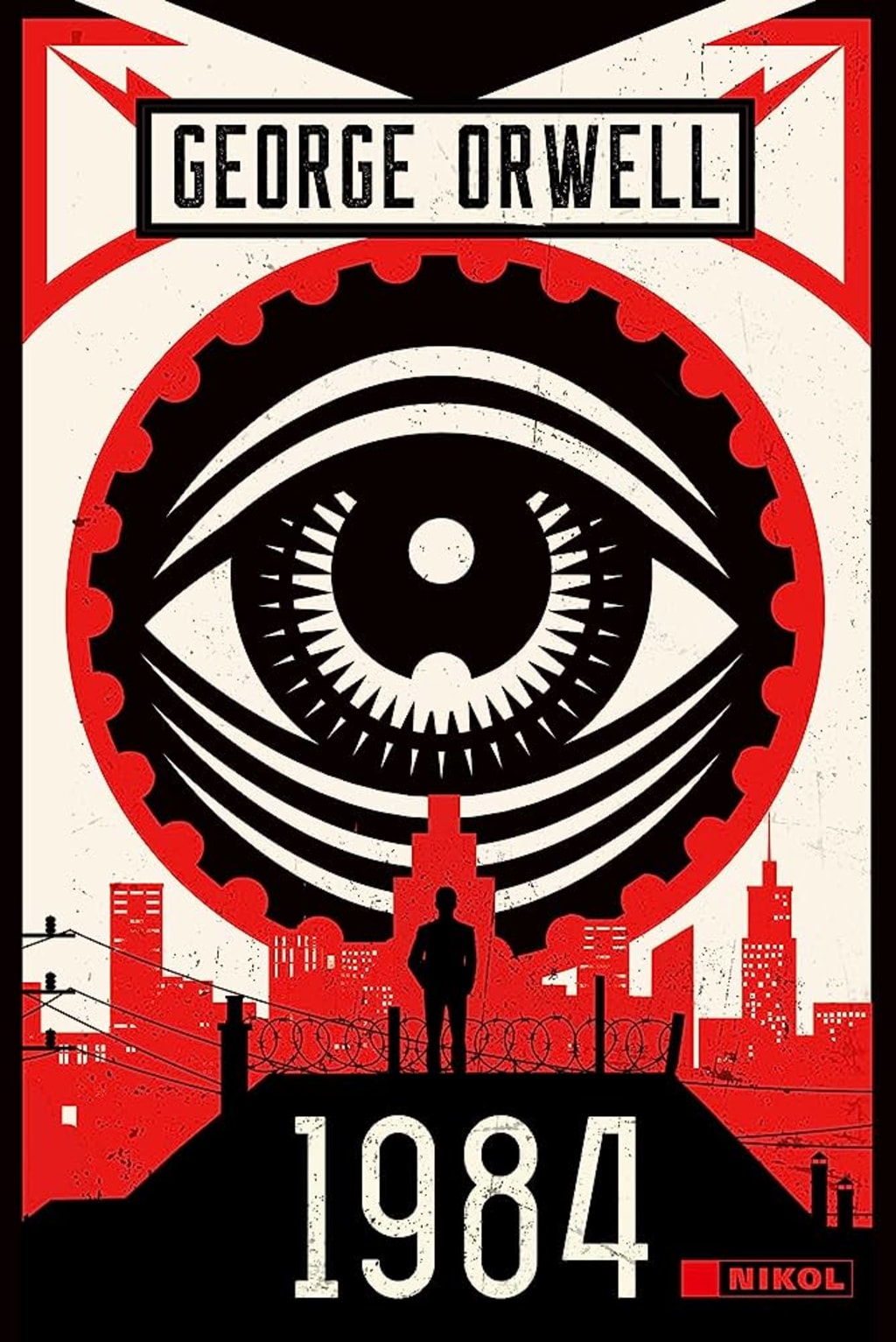
Nineteen Eighty-Four—published as 1984—is a 1949 dystopian novel by George Orwell, widely regarded as one of the most influential works of the twentieth century. Set in a future totalitarian superstate called Oceania, it follows Winston Smith, a low-ranking Party functionary who begins to question the all-encompassing control of the regime’s leader, Big Brother, and pays a devastating price for it. This guide covers the book’s reading level, age appropriateness, themes, characters, and teaching resources for high school students, parents, and educators.
For Parents
1984 is one of the most widely assigned novels in American high schools and one of the most culturally significant books of the past century. It contains a sexual relationship between the two main characters, scenes of torture and psychological breakdown, and sustained depictions of totalitarian violence and surveillance. The content is handled with literary seriousness rather than exploitation, but it is genuinely intense. It is best suited for readers ages 15 and older, typically assigned in grades 10–12.
For Teachers
Few novels provide richer material for classroom analysis than 1984. Orwell’s invention of concepts like doublethink, Newspeak, thoughtcrime, and the memory hole gives students a precise vocabulary for analyzing political language and propaganda—tools that transfer directly to media literacy and current events discussions. The novel pairs naturally with Animal Farm (often taught in sequence), with Aldous Huxley’s Brave New World, and with primary source material on twentieth-century totalitarianism. It is also a masterclass in the relationship between language and power that connects productively to Orwell’s 1946 essay “Politics and the English Language.”
1984 at a Glance
Find on Amazon →| Author | George Orwell |
| Published | 1949 |
| Grade Level | 9–12 (our assessment) |
| Recommended Age | 15–18 |
| Flesch-Kincaid Grade | 8.9 |
| Word Count | ~88,000 |
| Pages | ~328 (varies significantly by edition) |
| Chapters | 23 chapters across 3 parts |
| Genre | Dystopian fiction / political novel |
| Setting | London (Airstrip One), Oceania, circa 1984 |
| Awards | Prometheus Hall of Fame Award (1984); Modern Library 100 Best Novels, No. 13 (editors’ list), No. 6 (readers’ list); Time magazine 100 Best English-Language Novels, 1923–2005 |
For official Lexile and AR levels, visit Lexile.com or AR BookFinder. ReadingVine provides independent editorial assessments.
What Reading Level Is 1984?
ReadingVine places 1984 at a grade 9–12 reading level, with a Flesch-Kincaid score of approximately 8.9. This is notably higher than Orwell’s other widely taught work, Animal Farm, and reflects the difference in scope and complexity between the two books. Where Animal Farm uses a fable’s simplicity to deliver its political argument, 1984 builds a complete and immersive world—with its own bureaucratic structures, invented language (Newspeak), internal philosophical documents (The Theory and Practice of Oligarchical Collectivism), and a protagonist whose psychological unraveling is rendered in careful, sometimes harrowing detail.
The novel’s density is unevenly distributed. Parts One and Three move at a propulsive pace; Part Two, which includes the lengthy excerpts from Goldstein’s book and Emmanuel Goldstein’s manifesto, is more demanding and often where student attention falters. Strong readers in grade 9 can engage with the novel meaningfully, but it tends to reward the additional historical and political context that students accumulate in grades 10–12. It is most commonly assigned in grades 10–11, frequently in the same unit or year as Animal Farm.
For official Lexile and AR scores, visit Lexile.com or AR BookFinder.
What Age Is 1984 Appropriate For?
ReadingVine recommends 1984 for readers ages 15–18. The novel is significantly more mature in its content than Animal Farm and most other Orwell works assigned in school. The sexual relationship between Winston and Julia is depicted explicitly enough to require parental awareness, particularly for younger high school readers. The extended torture sequences in Part Three—specifically the Room 101 scenes and the psychological destruction of Winston—are among the most intense passages in canonical high school literature. These are not gratuitous: they are the philosophical and emotional core of what Orwell is arguing about the nature of totalitarian power. But they are genuinely disturbing.
1984 contains a sustained sexual relationship between the protagonist Winston Smith and Julia, depicted with moderate but clear explicitness—more so than most assigned high school texts. Part Three of the novel includes extended scenes of physical torture and psychological annihilation in the Ministry of Love, including the Room 101 sequence in which Winston is broken by being confronted with his deepest fear. Characters are starved, beaten, subjected to electric shocks, and systematically destroyed as individuals. The novel also contains themes of surveillance, propaganda, and state-enforced conformity that some younger or more sensitive readers may find disturbing beyond the explicit scenes. The content is calibrated to make the reader feel the horror of totalitarianism, not to shock for its own sake—but it is among the heaviest content in the standard high school curriculum.
What Is 1984 About?
Winston Smith is a thirty-nine-year-old outer Party member living in London—now called Airstrip One, a province of the totalitarian superstate Oceania. He works at the Ministry of Truth, where his job is to rewrite historical records so that the Party’s past statements always appear to have been correct. He lives under constant surveillance by the Thought Police through telescreens that monitor citizens at all times, in a society where even private thoughts against the Party constitute the crime of thoughtcrime. The Party’s leader, known only as Big Brother, is omnipresent—his face appearing on posters everywhere with the caption “Big Brother is Watching You.” Winston nurses a secret, dangerous hatred of the Party and a desperate longing for a past he can barely remember and cannot verify.
Winston begins a forbidden diary—an act of rebellion in itself—and becomes increasingly drawn to a dark-eyed woman named Julia, who works in the Fiction Department. When Julia passes him a note that simply reads “I love you,” they begin a clandestine affair, conducting their relationship in the few spaces they believe the telescreens cannot reach. Both are seeking not just physical connection but the experience of being fully human in a society that has systematically erased humanity. They are eventually contacted by O’Brien, a senior Inner Party member who Winston has long believed to be a secret rebel, and who invites them into what he claims is the Brotherhood—an underground resistance movement led by the legendary Emmanuel Goldstein, the Party’s public enemy number one.
The novel’s third and most devastating section reveals the full nature of the Party’s power. Winston and Julia are arrested. O’Brien, it turns out, has been watching Winston for years and has been a loyal Party operative throughout. In the Ministry of Love, Winston is tortured, broken, and finally brought to Room 101—where each prisoner is confronted with their deepest personal fear—until the last remnant of his independent self is destroyed. The novel ends with Winston sitting in the Chestnut Tree Café, drinking victory gin, and realizing with a sense of completion that he loves Big Brother. Orwell wrote the novel in 1948 while dying of tuberculosis on the remote Scottish island of Jura. He died in January 1950, seven months after its publication, never learning the extraordinary reach it would have.
1984 Characters
Is 1984 Banned?
1984 has one of the most ironic challenge histories in literary history: a novel explicitly about the dangers of censorship and thought control has itself been banned or challenged in numerous countries and school districts. In the United States, it has been challenged in schools over the years for its sexual content, its pro-communist or anti-capitalist themes (a frequent misreading—Orwell was a democratic socialist highly critical of Soviet communism), and its graphic torture sequences. It appeared on the American Library Association’s challenged books lists in the 1980s.
More significantly, 1984 has been banned in various forms in countries that recognized themselves in its pages. The Soviet Union suppressed it for decades. Several other authoritarian states have restricted it. In the United States, it remains one of the most assigned and most available novels in the high school curriculum, freely available in virtually all school and public libraries. Sales of the book reliably spike whenever political events prompt comparisons to Orwell’s vision—most recently in 2017, when it briefly became the best-selling book on Amazon following news of “alternative facts” entering political discourse.
1984 Themes and Lessons
The novel’s most original and disturbing argument is O’Brien’s explanation of why the Party seeks power—not for any practical goal, not even for the benefit of its members, but purely for the sake of power itself. Previous tyrannies, O’Brien explains, always claimed to serve some greater good. The Party makes no such claim. It seeks power as an end in itself, forever, and it has learned that the only reliable way to hold power is to destroy the capacity for independent thought in every individual subject. This is why doublethink—the ability to hold two contradictory beliefs simultaneously and believe both—is not a bug in the Party’s system but its central feature. A population that can be made to believe that two plus two equals five when the Party requires it can be made to believe anything.
Equally central is Orwell’s analysis of how language shapes thought. Newspeak—the Party’s systematically impoverished official language—is designed to make thoughtcrime literally impossible by eliminating the words in which dissident thoughts could be formed. This idea, that controlling language is the most fundamental form of political control, connects directly to Orwell’s nonfiction writing and remains one of his most enduring contributions to political philosophy. It is also the theme most immediately applicable to contemporary media literacy education. Discussion questions: How does the Party use language to control thought? What does the novel suggest about the relationship between privacy and freedom? What does O’Brien mean when he says the object of power is power?
How Many Pages and Chapters Are in 1984?
1984 is divided into three parts containing 23 chapters in total: Part One has 8 chapters, Part Two has 9, and Part Three has 6. Its word count of approximately 88,000 makes it one of the longer novels commonly assigned in high school—roughly comparable to To Kill a Mockingbird in length but significantly denser in philosophical content. Page counts vary considerably by edition: the standard Signet Classic paperback (the most commonly used in American schools) runs approximately 328 pages, while other editions range from 268 to over 400 pages. An average high school reader will complete it in 7–10 hours. Most teachers assign it over three to four weeks, with Part Two’s excerpts from Goldstein’s book often requiring additional classroom scaffolding.
Books Similar to 1984
About George Orwell
George Orwell was the pen name of Eric Arthur Blair (1903–1950). For a full biographical account, see our guide to Animal Farm, which covers his life in detail. In the context of 1984 specifically: Orwell wrote the novel in 1947–48 while gravely ill with tuberculosis, living in difficult conditions on the remote Scottish island of Jura. He completed it under enormous physical strain, convinced he was dying—which he was. He submitted the manuscript to his publisher in December 1948, and Nineteen Eighty-Four was published on 8 June 1949. Orwell died of a pulmonary hemorrhage in a London hospital on 21 January 1950, aged 46, never knowing that the book would become one of the most widely read novels of the twentieth century or that terms he invented—Big Brother, doublethink, thoughtcrime, Newspeak, the memory hole, Room 101—would pass permanently into the English language. He had married his second wife, Sonia Brownell, from his hospital bed four months before his death.
1984: Frequently Asked Questions
What is the reading level of 1984?
ReadingVine places 1984 at a grade 9–12 reading level, with a Flesch-Kincaid score of approximately 8.9. The prose is more demanding than Animal Farm and reflects the novel’s philosophical depth and structural complexity. It is most commonly assigned in grades 10–11, and is appropriate for strong readers in grade 9 with classroom support.
What awards did 1984 win?
1984 did not win major literary prizes upon publication—Orwell died in January 1950, just seven months after the book appeared, before formal recognition was possible. The novel has since received significant posthumous recognition: it won the Prometheus Hall of Fame Award in 1984, was ranked No. 13 on the Modern Library editors’ list (and No. 6 on the readers’ list) of the 100 Best Novels of the twentieth century, and was named one of Time magazine’s 100 Best English-Language Novels published from 1923 to 2005. It is widely considered one of the most influential novels ever written.
What does Big Brother mean in 1984?
Big Brother is the face of the Party—an omnipresent figure whose image appears on posters throughout Oceania with the caption “Big Brother is Watching You.” He is the focus of the Two Minutes Hate and the object of the population’s mandatory adulation. Whether Big Brother is a real individual or a symbolic construction invented by the Party is deliberately left unresolved—O’Brien’s answer to the question is itself a demonstration of the Party’s power to make certain questions unanswerable. “Big Brother” has since entered common usage as a phrase describing any entity that exercises pervasive, intrusive surveillance over individuals.
What is doublethink in 1984?
Doublethink is Orwell’s term for the ability to hold two contradictory beliefs simultaneously and to accept both as true. It is the cognitive foundation of Party control—the mental discipline required to believe the Party’s current position even when it contradicts what the Party said yesterday, and to forget that it ever said anything different. Orwell presents doublethink not as stupidity but as a sophisticated and deliberately cultivated skill, the mastery of which is required for Party membership. The concept has become one of the most widely used terms in political philosophy and media criticism.
What is Room 101 in 1984?
Room 101 is the final stage of the Ministry of Love’s re-education process. Each prisoner is confronted in Room 101 with the thing they fear most—whatever that particular individual cannot endure. For Winston, it is rats. When O’Brien threatens to release a cage of rats onto Winston’s face, Winston breaks completely and begs that Julia be subjected to it instead. This moment of betrayal is what the Party needs: Room 101 is not about physical torture but about forcing the prisoner to commit the ultimate act of emotional treachery against whoever they love, thereby destroying the last private human bond the Party has not yet reached. The term “Room 101” has since entered British English as a phrase for anything one finds unbearable.
What is Newspeak in 1984?
Newspeak is the official language of Oceania, designed by the Party to make thoughtcrime—dissident thought—literally impossible by systematically eliminating the words in which such thoughts could be expressed. The goal is to reduce language to a minimum of words with tightly controlled meanings, so that eventually no one will be able to conceive of rebellion because they will lack the linguistic tools to do so. Orwell’s appendix to the novel, written in the past tense as if from a future after the Party’s fall, describes Newspeak in scholarly detail. It remains one of the most cited examples of the relationship between language and political control in all of literature.
How does 1984 end?
Winston is broken by the torture of the Ministry of Love and the betrayal of Room 101. He is released back into society—not executed, because the Party wants not just his obedience but his genuine love—and is shown in the final scene sitting in the Chestnut Tree Café, drinking victory gin, gazing at a telescreen showing military news. He has been re-educated completely. When a news bulletin announces a great Party victory, Winston feels a surge of emotion. The final sentence—”He loved Big Brother”—is one of the most devastating endings in modern fiction, not because Winston dies but because he doesn’t: the Party has destroyed his inner life so completely that he no longer needs to.
Is 1984 based on a true story?
1984 is fiction, but it is grounded in Orwell’s direct experience of and research into totalitarian systems. He drew primarily on Stalinist Soviet Union—its show trials, its rewriting of history, its cult of personality, and its apparatus of terror—as well as on Nazi Germany and his observations of wartime propaganda in Britain. The bureaucratic structures of Oceania (the Ministry of Truth, Ministry of Love, Ministry of Peace, Ministry of Plenty) are satirical inversions of real government ministries. Orwell was also influenced by the work of James Burnham, Arthur Koestler’s Darkness at Noon, and Yevgeny Zamyatin’s dystopian novel We. The novel is a synthesis of everything Orwell had observed about how totalitarian states actually function.